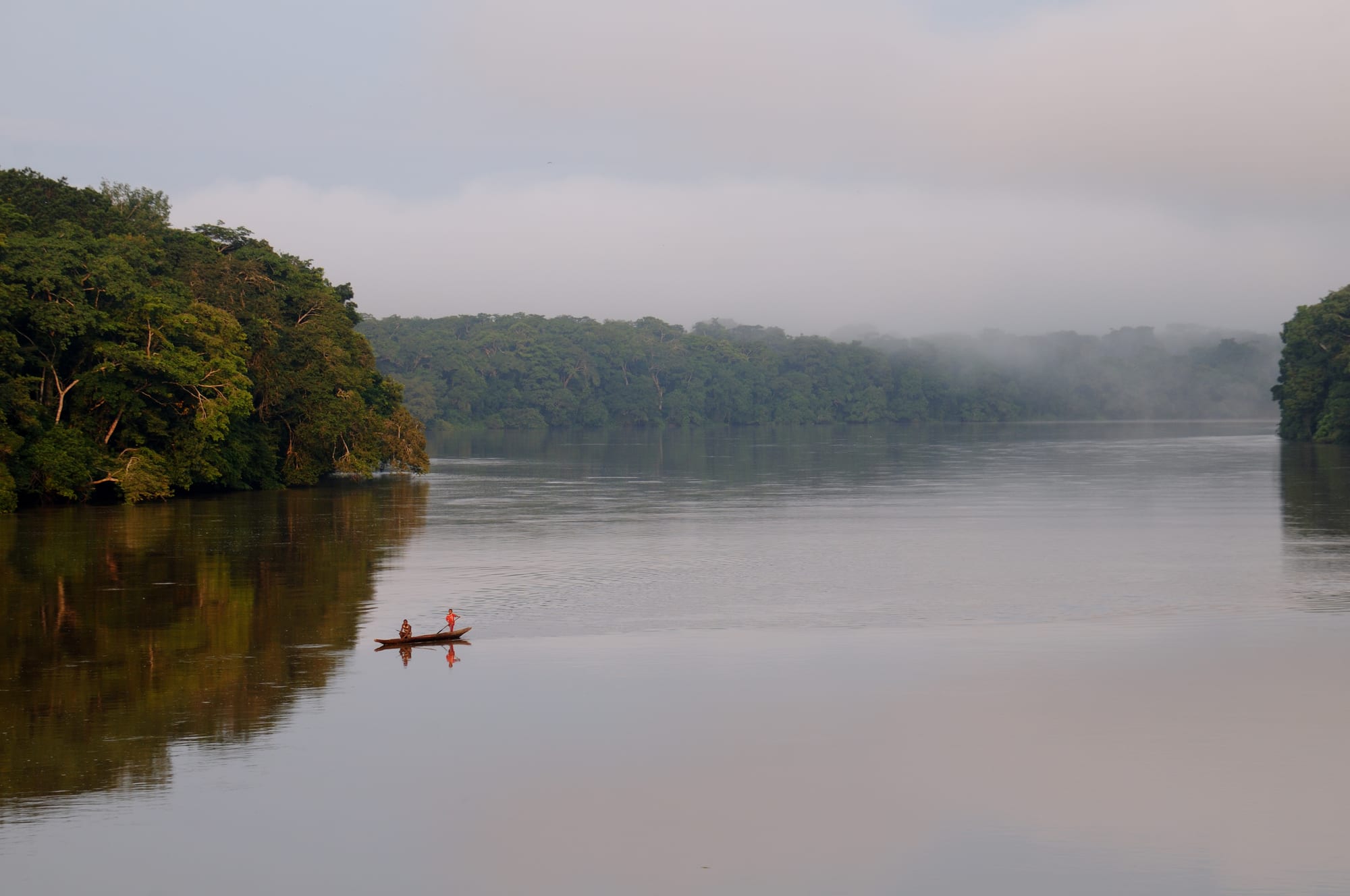
A lone dugout canoe with two paddlers crossing a broad, glassy river between walls of rainforest, with morning mist hanging over the far treeline

Central African Republic

Morning mist over the Sangha River near Bayanga, where a dugout canoe crosses between rainforest banks. (JosepMGracia / Wikimedia Commons · CC BY-SA 4.0)

A landlocked country at the heart of the continent — rich in diamonds, gold, and rainforest, among the poorest and least developed nations on Earth, and fractured by more than a decade of armed conflict.

Explore Central African Republic

History

The area between the Ubangi and Chari rivers was a crossroads for savanna and forest peoples and, in the eighteenth and nineteenth centuries, a hunting ground for slave raiders from the north and east that left it depopulated in places. France took control in the 1890s and ran it as the colony of Ubangi-Shari, notorious for the abuses of the rubber and cotton concession companies.

Independence came in 1960. The early leader Barthélemy Boganda died in a plane crash before it, and his successor David Dacko was overthrown by his cousin Jean-Bédel Bokassa, who ruled from 1966, crowned himself "Emperor" in a ruinously expensive 1977 ceremony, and was removed with French help in 1979 after the massacre of schoolchildren. Coups and short-lived governments followed.

In 2013 a mainly Muslim rebel coalition, Séléka, seized Bangui; a mostly Christian militia movement, the anti-balaka, formed in response, and the country collapsed into sectarian civil war. A 2016 election and a 2019 peace deal did not end the fighting. President Faustin-Archange Touadéra has leaned heavily on Russian paramilitary support to hold the capital and key mining areas, while armed groups still contest much of the interior.

  • Central African Republic: The Empty Quarter A landlocked, sparsely peopled country hollowed out by the slave trade, a French rubber colony run by concession companies, a self-crowned emperor, and decades of coups and rebellion

Culture & Customs

The population is a patchwork of peoples — the Gbaya, Banda, Mandjia, Sara, Mbum, Yakoma and Ngbandi along the rivers, and the Baka and Aka "forest people" of the southwestern rainforest, among the shortest-statured peoples in the world and holders of an extraordinary tradition of polyphonic yodelled song, recognised by UNESCO.

Most Central Africans are Christian, with a Muslim minority concentrated in the north and among traders, and traditional beliefs widely held alongside. The 2013–14 conflict deliberately pitted these communities against each other, and rebuilding trust between them is a central challenge.

Music, dance, and oral storytelling are strong, and the sanza thumb piano and water-drumming of the forest peoples are distinctive. Everyday social life, where it can function normally, runs on the extended family, the village, the church or mosque, and the market.

Daily Life

The Central African Republic consistently ranks near the bottom of global measures of income, health, and education. Most people live by subsistence farming — cassava, plantain, groundnuts, maize — supplemented by fishing on the rivers, hunting, and gathering forest products, with cotton, coffee, and above all diamonds and gold as the cash economy.

Years of conflict have displaced a large share of the population, inside the country and into Chad, Cameroon, and the DR Congo, and have left much of the interior without functioning schools, clinics, or administration. Aid agencies provide many basic services. Bangui, on the Ubangi River facing the DR Congo, is the one substantial city and the centre of what economy there is.

Food

Central African cooking is simple and starch-based. The staple is a stiff cassava or sometimes maize porridge — called gozo or foufou — eaten by hand with a sauce of greens, okra, or groundnut, and, when available, fish, bushmeat, or chicken. Cassava leaves pounded and stewed (ngoundja) are a common relish.

Fish from the Ubangi and other rivers, smoked or fresh, is important in the south, and grilled meat and brochettes are sold in Bangui. Palm oil, chilli, and djansang seeds season many dishes.

Palm wine and locally brewed millet or maize beer are the traditional drinks; strong sweet tea and, in Bangui, imported soft drinks and beer are common.

Attractions & Natural Wonders

In a country at peace, the Central African Republic's draw would be its wildlife. The Dzanga-Sangha reserve, in the southwestern rainforest where the country meets Cameroon and the Republic of the Congo, protects the Dzanga Bai — a large forest clearing where dozens of forest elephants, plus bongo, buffalo, and sitatunga, gather at the mineral-rich mud in full view of a viewing platform. Habituated western lowland gorillas can be tracked there with Aka guides.

In the north, the Manovo-Gounda St. Floris National Park was once one of the richest savanna reserves in Central Africa, with elephant, lion, and vast antelope herds, but decades of poaching by armed groups have devastated it, and it is a UNESCO World Heritage Site listed as "in danger."

Elsewhere, the Chutes de Boali, a wide waterfall on the Mbali river a few hours from Bangui, and the Ubangi River itself are the sights closest to the capital. For now, access to nearly all of this is limited by the security situation.

Planning basics

Budget

There is effectively no tourism economy. What little travel happens is expensive: charter flights or long escorted road transfers, security arrangements, and the specialist lodge at Dzanga-Sangha. Bangui has a handful of hotels priced for aid workers and diplomats. Cash only, in CFA francs and euros.

Source
Very limited data — verify everything against current advice before relying on it.
Daily Budget Midrange
USD 200–400+ per day for the few operating options, before flights
Daily Budget Shoestring
Not realistically applicable given the security situation

Any visit is arranged through a specialist operator with security and logistics built in.

Source: Very limited data — verify everything against current advice before relying on it.

Visa Requirements

A visa is required for all visitors and must be arranged in advance at a Central African embassy, usually with a letter of invitation. A yellow fever vaccination certificate is mandatory.

Typical Validity
30 to 90 days, single entry

Most governments advise against all travel, so consular support in an emergency is minimal to none.

Safety

This is the decisive fact about the Central African Republic. Since 2013 the country has been in armed conflict; armed groups control large areas, and violence against civilians, kidnapping, and banditry are widespread. A United Nations peacekeeping mission and Russian-linked paramilitary forces are both present. Most governments advise against all travel to the entire country.

Source
US Department of State, UK FCDO, and French diplomatic advisories — check for the latest wording.

Worldlore covers the Central African Republic so it can be understood, not to encourage travel there now. The one partial exception cited by some operators is the far southwestern Dzanga-Sangha area, reached by air; even that should only be attempted through a specialist with current knowledge.

Source: US Department of State, UK FCDO, and French diplomatic advisories — check for the latest wording.

Climate

Tropical. The south is equatorial and forested, hot and humid with rain much of the year. The centre and north are savanna with a marked wet season from about May to October and a dry season the rest of the year, including a dusty Harmattan haze in the north in winter.

North
wet May–October, dry and dusty November–April
South
hot, humid, wet most of the year

Transportation

Bangui M'Poko is the only international airport, with limited regional flights. There is no railway. Roads outside the capital are poor, often impassable in the rains, and many are controlled by armed groups or subject to banditry. Reaching Dzanga-Sangha usually means a charter flight to Bayanga.

Overland travel around the country is dangerous and, on most routes, not advised at all.

Best Time to Visit

In principle the drier months, December to March, offer the best road access and wildlife viewing at Dzanga-Sangha. In practice the security situation, not the season, determines whether and where travel is possible.

Currency

The currency is the Central African CFA franc (XAF), shared by six countries and pegged to the euro at a fixed rate.

Symbol
FCFA
Cash To Bring
Euros in cash
Currency Code
XAF — Central African CFA franc

Language

French is the official language of government and education, and Sango, a widely understood lingua franca that grew up along the Ubangi River, is the national language spoken by most of the population. Many other local languages are spoken by particular groups.

English
Very rarely spoken
National Language
Sango
Official Language
French