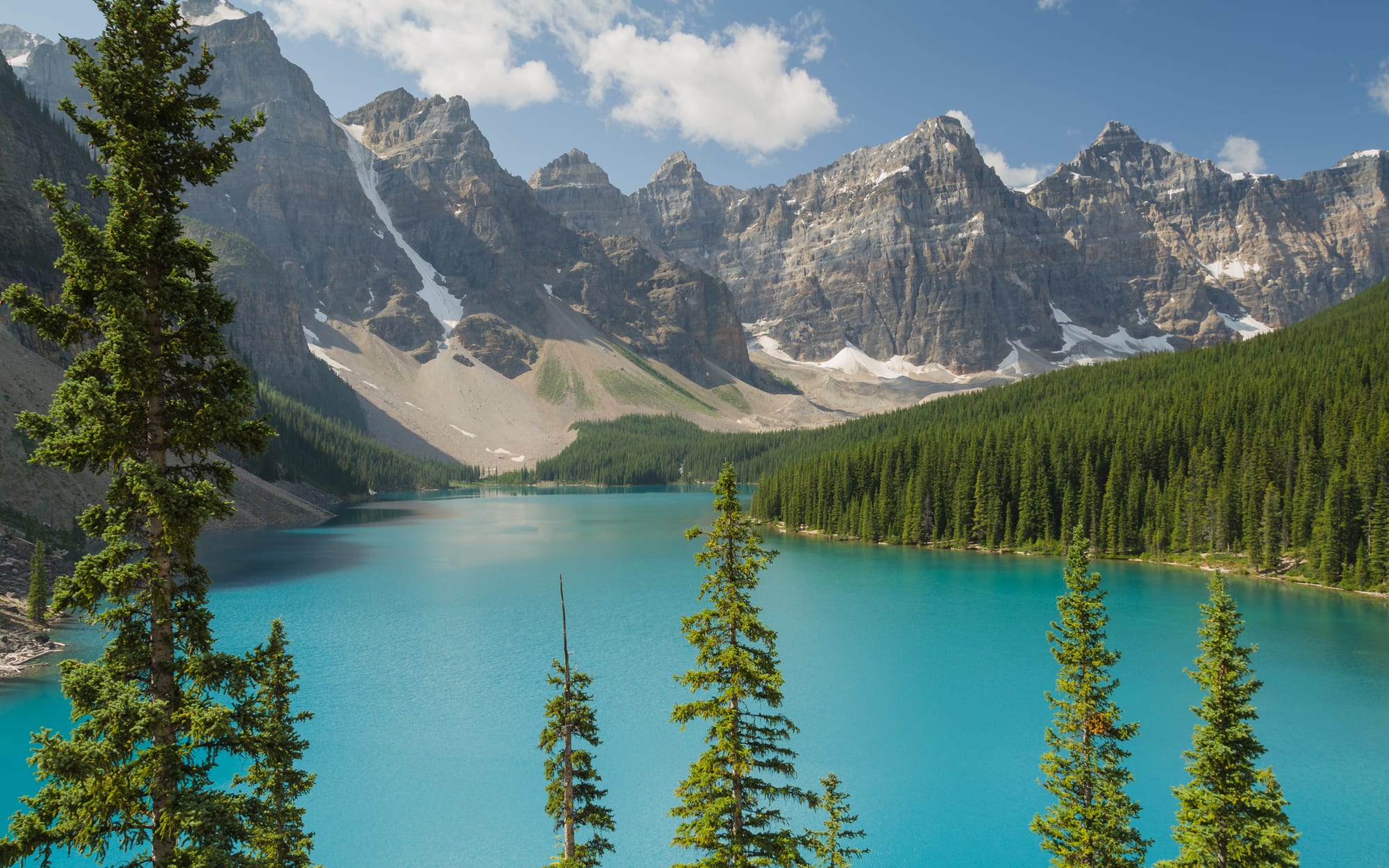
A vivid turquoise glacial lake ringed by dark pine forest and jagged snow-streaked mountain peaks under a clear sky

Canada

Moraine Lake in the Valley of the Ten Peaks, Banff National Park, Alberta, coloured by glacial rock flour. (Florian Fuchs / Wikimedia Commons · CC BY 3.0)

The second-largest country in the world by area, spanning six time zones from the Atlantic to the Pacific to the Arctic — a bilingual federation of forests, prairies, mountains, and a handful of large cities near the US border.

Explore Canada

History

Indigenous peoples — First Nations, Inuit, and later the Métis — have lived across what is now Canada for thousands of years, in nations as different as the coastal Haida, the Plains Cree, the Haudenosaunee of the eastern woodlands, and the Inuit of the Arctic. French settlers founded Québec in 1608 and Montréal in 1642; Britain took New France in 1763, leaving a large French-speaking, Catholic population under British rule.

The colonies of British North America federated in 1867 as the Dominion of Canada, expanding west and north over the following decades. The Canadian Pacific Railway bound the country together, immigration filled the Prairies, and Canadian troops fought as a distinct force in both world wars, a step toward full independence, formalised over the twentieth century and completed with the patriation of the constitution in 1982.

Alongside this runs a harder history: treaties often broken, the reserve system, and the residential schools that removed Indigenous children from their families for more than a century, an experience a Truth and Reconciliation Commission in 2015 called cultural genocide. The confirmation of unmarked graves at former school sites from 2021 brought a renewed national reckoning that continues.

Culture & Customs

Canada defines itself partly against the United States and partly through official multiculturalism, adopted as policy in the 1970s: about a quarter of residents were born abroad, and the big cities are among the most diverse in the world. Politeness, understatement, and a strong attachment to public healthcare are common self-descriptions.

The French–English duality runs deep, most of all in Québec, which has its own media, civil law tradition, language laws, and a lasting sovereignty movement. Indigenous art, film, and politics have moved from the margins toward the centre of national culture, and land acknowledgements now open public events.

Ice hockey is the national winter sport and a genuine cultural touchstone; canoeing, cottage weekends, Tim Hortons coffee, and a fondness for the outdoors in all seasons are others. Thanksgiving falls in October, and Canada Day is 1 July.

Daily Life

Most Canadians live within a couple of hundred kilometres of the US border, in a string of metropolitan areas — Toronto, Montréal, Vancouver, Calgary, Ottawa, Edmonton — separated by long distances. The far north, vast and resource-rich, is sparsely populated and largely Indigenous.

The economy combines natural resources — oil and gas in Alberta, minerals, forestry, farming on the Prairies, fisheries on both coasts — with finance, technology, and manufacturing in central Canada. Housing affordability in Toronto and Vancouver is a defining political issue, along with healthcare wait times and reconciliation.

Winter shapes daily life for much of the year: block heaters, snow tyres, indoor shopping concourses and skyways, and a national habit of decamping to a lake or the mountains when the weather turns.

Food

Canada has strong regional food traditions rather than one national cuisine. Québec contributes poutine — fries with cheese curds and gravy — along with tourtière meat pie, split-pea soup, and maple syrup, of which the province produces most of the world's supply. The Maritimes mean lobster, snow crab, mussels, and Digby scallops; the Prairies, beef, bison, and Ukrainian-influenced perogies and cabbage rolls.

Pacific salmon, spot prawns, and a strong Asian food culture define the West Coast, while Toronto and Montréal offer essentially every world cuisine. The "Canadian" staples that unite the country are more casual: butter tarts, Nanaimo bars, back bacon, ketchup chips, and coffee-and-doughnut culture.

Wine comes from the Okanagan Valley in British Columbia and the Niagara Peninsula in Ontario, the latter also known for icewine; craft beer and cider are widespread; and rye whisky is the traditional spirit.

  • Canada: Food and the National Dish A dish of fries, cheese curds and gravy that started as a Quebec diner order, a maple syrup industry serious enough to keep a strategic reserve, and a food culture built on immigration as much as geography

Attractions & Natural Wonders

The Canadian Rockies are the headline: Banff and Jasper national parks in Alberta, with turquoise glacial lakes such as Louise, Moraine, and Peyto, the Columbia Icefield, and the Icefields Parkway linking them. Across the border in British Columbia, Yoho and the Kootenays continue the range, and Vancouver sits between mountains and sea near Whistler.

In the east, Niagara Falls straddles the US border; Québec City has the only walled city north of Mexico, a UNESCO site; Montréal offers a distinctly French North American culture; and the Maritimes bring the Bay of Fundy's giant tides, Cape Breton's Cabot Trail, and Prince Edward Island's red cliffs. Newfoundland adds icebergs, seabird colonies, and the Viking site at L'Anse aux Meadows.

Farther afield are the polar-bear town of Churchill on Hudson Bay, the aurora over Yellowknife and Whitehorse, the Cabot and Bruce trails, the Bay of Islands, and the immense, little-visited national parks of the territories. Toronto's CN Tower and the country's big-city museums and festivals anchor an urban visit.

Planning basics

Budget

Canada is expensive, on a par with Western Europe or the United States. Accommodation, restaurants, alcohol, and mountain-town prices in Banff or Whistler are the big costs, and distances mean flights or long drives add up. Card and contactless payment is near-universal.

Daily Budget Midrange
CAD 250–450 (mid-range hotel, car rental, restaurants, park fees and activities)
Daily Budget Shoestring
CAD 120–180 (hostel, self-catering, intercity bus, transit)

Sales tax is added at the till, not shown on the shelf price, and tipping of 15–20% is expected in restaurants and taxis.

Visa Requirements

Visa-exempt travellers arriving by air — including citizens of the UK, the EU, Australia, and many others — need an Electronic Travel Authorisation (eTA), applied for online for a small fee. US citizens need neither a visa nor an eTA. Other nationalities need a visitor visa in advance.

Typical Stay
Usually up to 6 months on entry

Get the eTA before booking flights; approval is normally quick but can take days.

Safety

Canada is a safe country with low levels of violent crime. The main hazards are environmental: severe winter cold and storms, wildlife (bears, moose, and elk — keep your distance and carry bear spray on backcountry trails), wildfire smoke in summer, and long, empty stretches of highway.

Check park and avalanche bulletins, tell someone your hiking plans, carry water and warm layers, and give wildlife a very wide berth, especially females with young.

Climate

Mostly cold, with four distinct seasons and big regional differences. Winters are long and hard across most of the country; summers are warm to hot in the south and short in the north. The Pacific coast around Vancouver is mild and wet; the Prairies swing between temperature extremes.

Summer
20–30°C in the populated south, cooler and brief further north
Winter
well below freezing across most of the country; -20°C and colder inland

Transportation

Distances are continental, and flying (Air Canada, WestJet, and low-cost carriers) is how most people cross the country. Passenger rail (VIA Rail) is scenic but slow and limited; the Toronto–Montréal–Ottawa corridor is the exception. A rental car is the normal way to see the Rockies, the Maritimes, or any rural region. Big cities have good transit.

Driving
On the right; winter driving needs snow tyres and caution, and remote highways have long gaps between services

In the Rockies, book park-adjacent accommodation and popular shuttle spots such as Moraine Lake well ahead.

Best Time to Visit

June to September for warm weather, open hiking trails, and long days, and the busiest, priciest season in the Rockies and the national parks. September and early October add autumn colour, especially in the east. December to March is the ski season in Whistler, Banff, and Québec.

Events
Autumn foliage in Ontario and Québec (late September–October); the aurora, best in winter in the north

Currency

The currency is the Canadian dollar (CAD), divided into 100 cents. The one-cent coin is no longer minted and cash totals are rounded to the nearest five cents. Cards and phone payment work almost everywhere.

Cards
Accepted universally; cash rarely necessary
Symbol
$ (C$)
Currency Code
CAD — Canadian dollar

Language

English and French are both official at the federal level. English is the majority language nationwide; French is the majority language in Québec and widely spoken in parts of New Brunswick, Ontario, and Manitoba. Dozens of Indigenous languages are spoken, some being actively revitalised, and immigration has made cities highly multilingual.

Quebec
French is the official and everyday language; English is less widely spoken outside Montréal
Official Languages
English, French