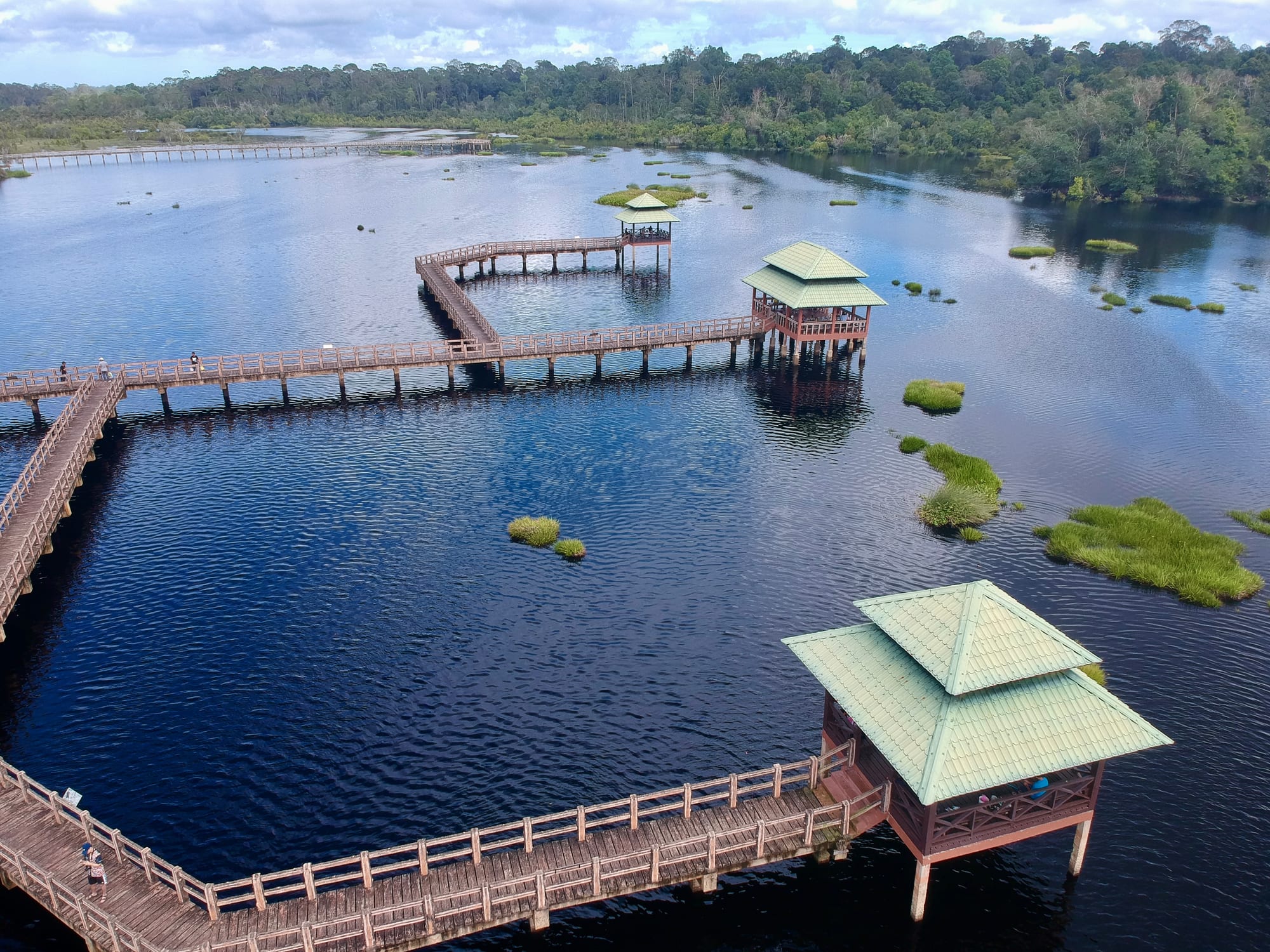
Aerial view of wooden boardwalks and green-roofed pavilions on stilts zigzagging across a dark blue lake dotted with grassy islets, ringed by dense rainforest

Brunei

Luagan Lalak Forest Recreation Park from the air, its boardwalks and stilted pavilions reaching out over Lalak Lake. (Pangalau / Wikimedia Commons · CC BY-SA 4.0)

A small, oil-rich sultanate on the north coast of Borneo — an absolute monarchy ruled under a national philosophy of Malay Islamic Monarchy, wrapped in some of Asia's best-preserved rainforest.

Explore Brunei

History

Brunei was once the seat of a powerful maritime sultanate that, at its height in the fifteenth and sixteenth centuries, controlled much of the coast of Borneo and parts of the present-day Philippines. Islam arrived with the trade routes and became the state religion. European contact, and then the rise of the British-backed Brooke "White Rajahs" in neighbouring Sarawak, steadily shrank the sultanate to its present two small enclaves.

Brunei became a British protectorate in 1888. The discovery of large offshore oil and gas fields in the twentieth century transformed a poor territory into a wealthy one. Unlike its neighbours, Brunei chose not to join the Malaysian federation in 1963, and a small armed rebellion that year was put down with British help.

Full independence came in 1984. The country is an absolute monarchy: the Sultan, Hassanal Bolkiah, has reigned since 1967 and is also prime minister and head of several ministries. The guiding state ideology is Melayu Islam Beraja — Malay Islamic Monarchy — and from 2014 the country began phasing in a sharia-based penal code alongside its common-law system.

  • Brunei: The Sultanate That Kept Its Oil Once the master of a great Borneo empire, then a British protectorate whittled down by rivals, and now a small, rich, absolute monarchy afloat on petroleum

Culture & Customs

Brunei is a conservative Muslim society, and Islam shapes public life: the call to prayer, Friday closures, modest dress, and a ban on the sale and public consumption of alcohol. Around a tenth of the population is ethnic Chinese, and smaller numbers are Indigenous Bornean peoples, some Christian or following older beliefs.

Respect for the Sultan and the royal family is woven through national life, from the scale of the mosques to the ceremony of the Sultan's birthday. Traditional Malay courtesy governs greetings and hospitality — using the right hand, removing shoes indoors, accepting refreshments when offered.

Oil wealth has funded free schooling and healthcare, subsidised housing and fuel, and no income tax, producing a comfortable, low-key society with little of the visible poverty or the frantic development of the region's boomtowns.

Daily Life

Most of the roughly 450,000 people live in and around the capital, Bandar Seri Begawan, and the oil town of Kuala Belait and Seria to the west. Life is quiet and car-centred, organised around family, the mosque, government employment, and the shopping mall; there is no bar or club scene.

The public sector is the largest employer, and the state provides generously, but the economy's near-total reliance on oil and gas is the central long-term worry, and efforts to diversify have been slow. Many young Bruneians study abroad, in Malaysia, the United Kingdom, or Australia.

Kampong Ayer, the water village of stilt houses and boardwalks on the Brunei River, has been inhabited for centuries and still houses thousands of people within sight of the modern capital — a living link to the sultanate's riverine past.

Food

Bruneian food closely resembles Malay cooking, with Indonesian and Chinese influence. Rice is the staple, eaten with grilled or curried fish and chicken, sambal chilli pastes, and vegetables. The national dish is ambuyat, a sticky, near-flavourless starch extracted from the sago palm, twirled onto a two-pronged bamboo fork and dipped in a tart sauce.

Everyday meals lean on nasi katok (a cheap plate of rice, fried chicken, and sambal), noodle soups, satay, and kelupis and lamban (rice cakes steamed in leaves). Night markets and the Gadong food market are the places to graze.

There is no alcohol, so meals are paired with sweet iced drinks, fresh juices, and tea. Malay cakes (kuih) in bright colours are sold everywhere, especially in the run-up to the evening meal during Ramadan.

  • Brunei: Food and the National Dish A sago starch eaten by twirling it onto a bamboo fork, cheap rice parcels sold from a window you literally knock on, and a country where no restaurant serves alcohol at all

Attractions & Natural Wonders

Bandar Seri Begawan is compact and centres on two grand mosques: the older Sultan Omar Ali Saifuddien Mosque, with its golden dome and lagoon, and the larger Jame'Asr Hassanil Bolkiah Mosque with its 29 domes. The Royal Regalia Museum displays the coronation and jubilee treasures, and a water-taxi ride crosses to Kampong Ayer.

The real draw is the rainforest. Ulu Temburong National Park, in the eastern enclave, protects primary forest reached by longboat up shallow rivers, with a canopy walkway high above the trees and proboscis monkeys along the banks. It is part of the "Heart of Borneo" conservation zone.

Elsewhere, the Empire hotel complex on the coast is a monument to 1990s oil money, and the Tasek Merimbun lake and the forests of Belait district offer quieter wildlife walks. Brunei's appeal is calm and green rather than lively.

  • Brunei: Nine Attractions and Natural Wonders A gold-domed mosque reflected in its own lagoon, a water village of 30,000 people on stilts, the largest residential palace on Earth, and untouched rainforest across the bay

Planning basics

Budget

Brunei is not cheap, but it is quieter and less expensive than nearby Singapore. Fuel and government services are heavily subsidised; hotels and imported goods are the main costs. There is no tourist nightlife economy — alcohol is banned — which keeps evening spending low. Cards are widely accepted.

Daily Budget Midrange
USD 90–180 (hotel, restaurants, a Temburong day tour, car hire)
Daily Budget Shoestring
USD 45–70 (guesthouse, food-court meals, local buses)

Most visitors see the country in one or two days; a hired car or tour is needed for the rainforest.

Visa Requirements

Citizens of the EU, the UK, the US, Australia, Canada, New Zealand, Malaysia, and several other countries enter visa-free for stays that range from 14 to 90 days depending on nationality. Others need a visa in advance.

Typical Stay
14 to 90 days visa-free depending on passport

Import of alcohol is limited and must be declared; it cannot be bought or sold in the country.

Safety

Brunei is a very safe country for visitors, with very low crime. The points to be aware of are legal and social rather than physical: this is a strict Islamic state that has adopted elements of sharia penal law, alcohol is banned, and public behaviour, dress, and any conduct seen as offending Islam or the monarchy are taken seriously.

Lgbt Travellers
Same-sex relations are criminalised; discretion is essential.

Dress modestly, do not eat or drink in public during daylight in Ramadan, and avoid criticism of the Sultan.

Climate

Equatorial: hot, humid, and wet all year, with no real dry season. Rainfall is heaviest from about October to January during the northeast monsoon, but downpours can come at any time. Temperatures barely move from day to day.

Wettest
roughly October to January
Temperature
27–33°C year-round, high humidity

Transportation

Brunei International Airport near Bandar Seri Begawan is the gateway, served mainly by Royal Brunei Airlines. Public buses are limited and stop early; most visitors use taxis, ride-hailing, a rental car, or an organised tour. Water taxis cross to the Kampong Ayer stilt village, and boats run up the rivers.

Driving
On the left; roads are good and quiet, and fuel is very cheap

Reaching Temburong district now uses the long Sultan Haji Omar Ali Saifuddien Bridge rather than a boat.

Best Time to Visit

The drier stretch from February to August has more reliable sunshine for the rainforest and river trips, though rain is possible in any month. Ramadan changes daytime hours, with many restaurants closed until dusk.

Events
The Sultan's birthday celebrations in mid-July, including a public gathering at the palace

Currency

The currency is the Brunei dollar (BND), pegged one-to-one with the Singapore dollar, which also circulates freely and is accepted everywhere.

Cards
Accepted in hotels, malls, and restaurants; carry cash for markets and buses
Symbol
$ (B$)
Currency Code
BND — Brunei dollar (1:1 with the Singapore dollar)

Language

Malay is the official language, in a local Bruneian form. English is very widely spoken, used in business and much of education, and Chinese (Hokkien and Mandarin) is common among the Chinese minority. Several Indigenous Bornean languages are also spoken.

English
Very widely spoken
Official Language
Malay