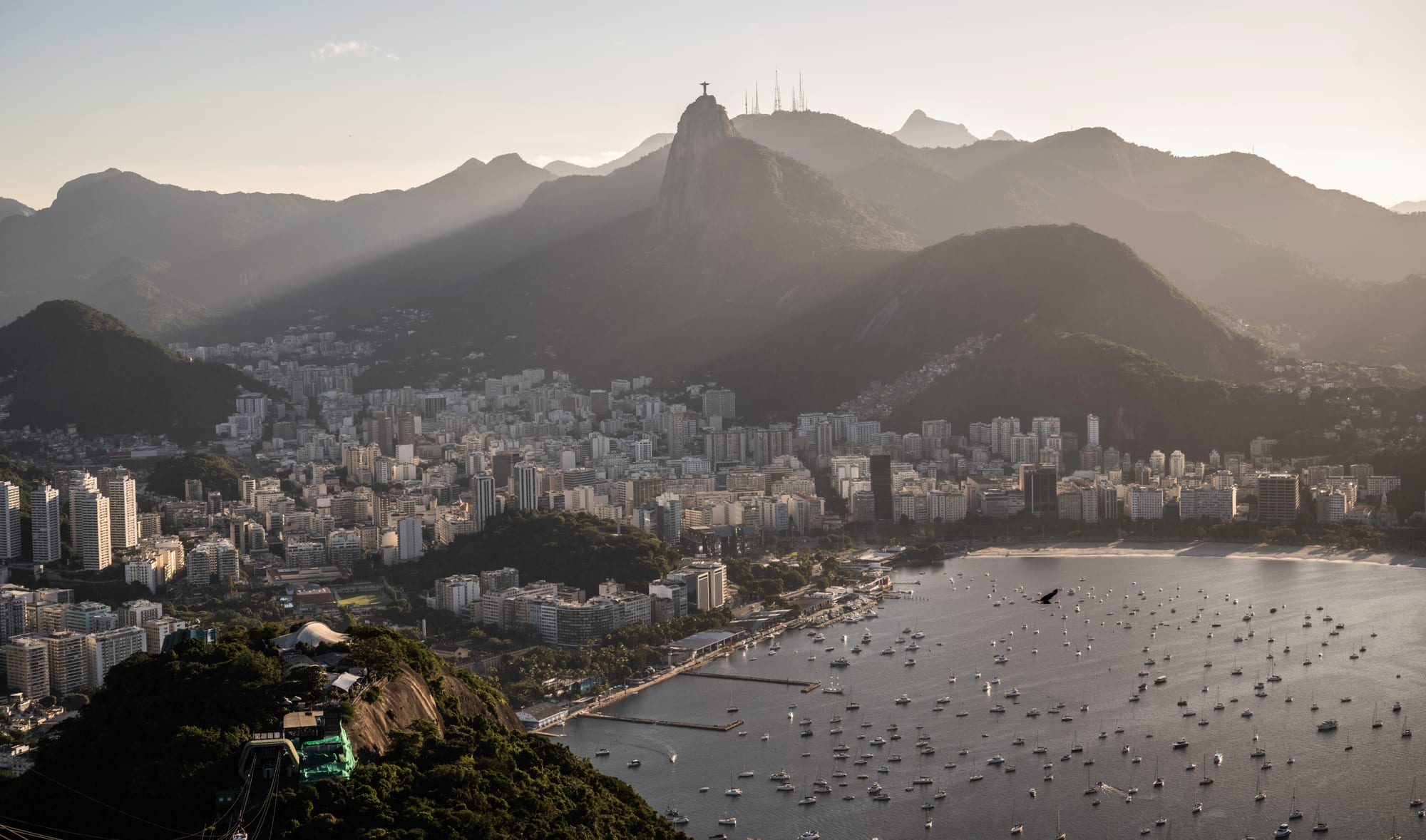
A wide view over Rio de Janeiro from Sugarloaf — Botafogo Bay, the city curving between forested peaks, and Christ the Redeemer on the ridge

Brazil

Rio de Janeiro from Sugarloaf Mountain, with Botafogo Bay below and Christ the Redeemer on the Corcovado ridge. (Wilfredor / Wikimedia Commons · CC0 (public domain dedication))

The giant of South America — half the continent, the world's largest rainforest, a Portuguese-speaking nation of some 212 million, and a culture built from Indigenous, African, and European roots.

Explore Brazil

History

Brazil was home to millions of Indigenous people — Tupi, Guarani, Gê, and hundreds of others, with around 250 groups and some 150 languages surviving today, mostly in Amazonia. Claimed for Portugal in 1500, it developed through cycles of extraction: brazilwood, which gave the country its name, then sugar in the northeast, a gold rush in Minas Gerais, rubber in Amazonia, and coffee in the southeast.

Brazil imported far more enslaved Africans than anywhere else in the Americas — an estimated four to five million — and was the last country in the Western world to abolish slavery, in 1888. Independence came almost bloodlessly in 1822 as a monarchy under a son of the Portuguese king; a republican coup followed in 1889.

The twentieth century brought the populist Vargas era, rapid industrialisation, the building of Brasília, and a military dictatorship from 1964 to 1985. Since the return to democracy, hyperinflation was tamed by the 1994 Real Plan, tens of millions were lifted out of poverty during the commodity boom, and politics has grown sharply polarised — the leftist Lula returned to the presidency in 2023 after beating the incumbent Jair Bolsonaro, whose supporters then stormed government buildings in Brasília.

Culture & Customs

Brazil sees itself as a mixed society — Indigenous, African, Portuguese, and later Italian, German, Japanese, Lebanese, and more — though race and inequality remain deep, unresolved themes. Football is close to a national religion, with a record five World Cups and a pantheon from Pelé to Neymar.

Music is a vast inheritance: samba, born in Rio's Afro-Brazilian communities; bossa nova; the Bahian axé and Afro-blocos; forró in the northeast; and today's dominant sertanejo and funk carioca. Carnival, in the days before Lent, is celebrated nationwide — the Rio Sambadrome parade, the street blocos of Rio and São Paulo, and Salvador's sound-truck parties are the best known.

Afro-Brazilian religions such as Candomblé, especially in Bahia, coexist with a fast-growing evangelical movement that is reshaping society and politics. Capoeira, the martial-art-dance developed by enslaved Africans, and a strong literary and film tradition round out the picture, along with an easy physical warmth and the "jeitinho," the knack of finding a way around obstacles.

Daily Life

About a third of Brazilians live in the southeast, in and around São Paulo — the economic engine and one of the world's largest metros — and Rio de Janeiro, the former capital and the country's tourist face. The modernist capital, Brasília, was carved out of the central plateau and inaugurated in 1960 to pull development inland.

Beyond the cities are the Amazon and Pantanal, the drought-prone sertão of the northeast, the agribusiness frontier of the centre-west, and a long Atlantic coastline where beach life is its own social world. Inequality is stark and visible, with gated apartment blocks beside self-built favelas in the same neighbourhoods.

Card payment and the instant Pix transfer system have made much of daily life nearly cashless. Life runs late, especially around Carnival and in the northeast, and football, church, and the extended family anchor the week.

Food

Brazilian cooking is regional. The national dish is feijoada, a rich black-bean stew with cuts of pork, served with rice, collard greens, toasted cassava flour, and orange — traditionally a weekend lunch. Everyday meals pair rice and beans with a grilled or stewed protein. The southern churrasco, skewered salt-crusted meats carved at the table, became the global "rodízio" steakhouse.

Bahia's Afro-Brazilian kitchen uses palm oil, coconut milk, and dried shrimp in moqueca fish stew and acarajé fritters. Minas Gerais is known for pão de queijo cheese bread and pork dishes; the Amazon for freshwater fish, the tongue-numbing jambu herb, and savoury açaí eaten cold as a staple.

Fruit is spectacular and often unfamiliar — cupuaçu, graviola, jabuticaba, cajá. The national cocktail is the caipirinha, made with cane spirit, lime, and sugar, and small strong sweet coffees punctuate the day.

  • Brazil: Food and the National Dish A black bean and pork stew big enough to define a nation, a coastal cuisine built on African cooking brought by force, and a country too large to have just one food identity

Attractions & Natural Wonders

Rio de Janeiro is the classic introduction: Christ the Redeemer atop Corcovado, the cable car up Sugarloaf over Guanabara Bay, the beaches of Copacabana and Ipanema, the Selarón Steps, and the bohemian nightlife of Lapa and Santa Teresa, all wrapped in the replanted Tijuca Forest. Iguaçu Falls, on the Argentine border, is a 2.7-kilometre arc of cascades, with the Brazilian side giving the panorama.

The Amazon is usually seen from Manaus — the "Meeting of the Waters," jungle lodges, and a Belle Époque opera house — or from Belém at the river's mouth. The Pantanal, in the west, is the best place in South America to see wildlife, including wild jaguars along its rivers, plus caiman, capybara, giant otters, and hyacinth macaws.

Salvador da Bahia has the colourful Pelourinho old town and the heart of Afro-Brazilian culture; Ouro Preto and the Minas Gerais gold towns have Baroque churches and the sculpture of Aleijadinho. The northeast adds the dunes and lagoons of the Lençóis Maranhenses and the protected archipelago of Fernando de Noronha, and Brasília offers Niemeyer's architecture on a monumental scale.

Planning basics

Budget

Brazil ranges from cheap to costly depending on region and season. Set-menu lunches, buses, and hostels keep costs low; domestic flights, Amazon and Pantanal lodges, and Rio in high season push them up. Card payment, including the instant Pix transfer system, is accepted almost everywhere.

Source
Traveller reports and price observation, 2024 — verify against a current source.
Pantanal Jaguar Trip
Several hundred USD per day for a river-based lodge and guide near Porto Jofre
Daily Budget Midrange
USD 90–180 (hotel, some domestic flights, restaurants, tours)
Daily Budget Shoestring
USD 40–70 (hostel, set lunches, buses, self-catering)

Carry modest cash for small towns and beaches; withdraw by day inside banks or malls, as many ATMs limit foreign cards.

Source: Traveller reports and price observation, 2024 — verify against a current source.

Visa Requirements

Many nationalities — the EU/Schengen countries, the UK, and others — need no visa for tourist stays of up to 90 days, extendable to 180 per year. Brazil has reintroduced a visa requirement, handled as an e-visa, for citizens of the United States, Canada, and Australia; it took effect in 2025, so apply in advance and check the current status.

Typical Stay
90 days, extendable to 180 per year

A yellow fever certificate is not required to enter Brazil itself but is strongly recommended for the Amazon, the Pantanal, and Iguaçu, and required by some onward countries — get it at least 10 days ahead.

Safety

Brazil has high rates of crime, including violent crime, and it is the main practical concern for visitors — though very unevenly distributed. Millions travel safely each year by following local habits: don't display phones, jewellery, or cash; carry only what you need; be alert in crowds, at ATMs, and on beaches; and if robbed, hand everything over without resistance.

Source
US Department of State and UK FCDO travel advisories — check for the latest wording.
Favelas
Do not enter informal neighbourhoods casually; police operations can flare with little warning.

Use app-based rides rather than street taxis at night, avoid deserted areas and empty beaches after dark, heed shark and rip-current warnings on some northeastern beaches, and use repellent against dengue.

Source: US Department of State and UK FCDO travel advisories — check for the latest wording.

Climate

Mostly tropical, with a wetter and a drier season rather than four temperate ones over most of the country; the south is subtropical with a mild winter. Seasons are southern-hemisphere — summer is December to February. Humidity, not just heat, defines much of the year.

Amazon
27–33°C year-round; wetter roughly December–May, drier June–November
Pantanal
marked dry winter (May–September) is the prime wildlife season; wet summer floods it
Rio And Southeast
hot and sticky in summer with heavy storms; mild and drier in winter (20–26°C)

Transportation

Brazil is huge, and flying is how you cover it — a well-developed domestic network links every region from São Paulo, Rio, and Brasília. Long-distance buses are comfortable and extensive but journeys can run 40 hours or more. There is almost no intercity passenger rail. In the Amazon, boats are the roads.

Cities
São Paulo and Rio have metros, safe in central zones; app taxis (Uber, 99) are cheap and widely used

Renting a car suits regional touring, not the big cities; avoid driving rural highways at night.

Best Time to Visit

It depends on the region. April–June and August–October are good shoulder windows nationally. Rio and the southeast beaches peak December–March (and Carnival, which moves with Easter, falls in February or early March). The Pantanal is best July–October; the northeast coast is reliably sunny September–February.

Crowds
Prices spike around Carnival, Easter, the July school holidays, and New Year on Copacabana

Currency

The currency is the Brazilian real (BRL; plural "reais," symbol R$). Card and phone payment, including Pix, is near-universal in cities and tourist areas. The real floats and can be volatile, so check the rate near your travel dates.

Symbol
R$
Tipping
A 10% service charge is usually added to restaurant bills
Currency Code
BRL — Brazilian real

Language

Portuguese is the official language and is spoken by essentially the whole population — Brazilian Portuguese, distinct from the European form in accent and vocabulary. English is not widely spoken outside upscale hotels, tour operators, and younger people in big cities and prime tourist spots, so basic Portuguese and a translation app help a lot.

English
Limited; less common than European visitors expect
Also Present
About 150–170 Indigenous languages; German and Italian dialects in the south; Japanese in São Paulo
Official Language
Portuguese (Brazilian)