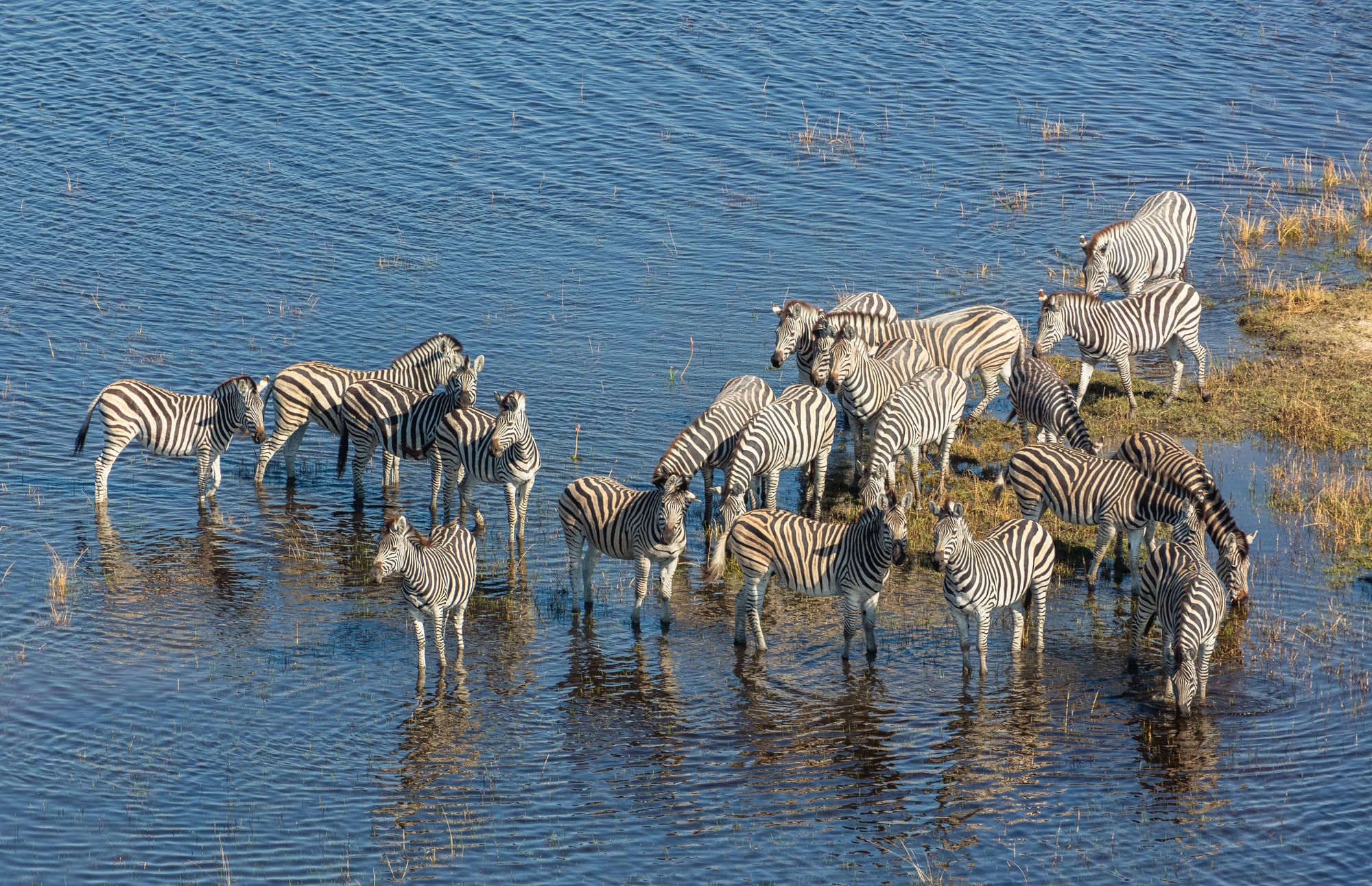
An aerial view of the Okavango Delta — winding channels and green islands threading a golden floodplain, with zebra below

Botswana

The Okavango Delta from the air, where a river from the Angolan highlands fans out and evaporates into the Kalahari. (Diego Delso / Wikimedia Commons · CC BY-SA 4.0)

A sparsely populated, mostly Kalahari country in Southern Africa that turned diamond wealth into stable democracy, and whose Okavango Delta and elephant herds draw a deliberately small, high-end safari trade.

Explore Botswana

History

The area was one of the poorest countries on Earth when it became independent from Britain in 1966, as the former Bechuanaland Protectorate. The discovery of diamonds soon after — at Orapa, then the vast Jwaneng mine — transformed it. Unusually, the wealth was managed carefully through a fifty-fifty partnership with De Beers, funding roads, schools, and clinics.

That gave Botswana decades of among the fastest growth rates in the world and a rare reputation for stable multiparty democracy and low corruption. The founding party governed from independence until 2024, when it lost an election for the first time and an opposition coalition took over peacefully.

The country still depends heavily on diamonds, and a recent slump in prices has strained the budget. Its other defining modern experience was the HIV/AIDS epidemic, devastating in the 1990s and 2000s and now largely controlled through a pioneering free treatment programme.

  • Botswana: The Kalahari Success Story San hunters and Tswana chiefdoms, a British protectorate almost by accident, and the diamond-rich democracy that became Africa's development model

Culture & Customs

The majority are Tswana, organised historically into eight principal chiefdoms whose kgotla — a community assembly and court held under a tree, where decisions are talked through to consensus — is woven into local governance and the wider political culture. Minorities include the Kalanga, the Herero, whose women wear distinctive long dresses and horn-shaped headdresses, and the San, the region's first people and among the oldest continuous cultures on Earth, now largely settled and marginalised.

Society is fairly conservative and Christian-majority, with traditional beliefs alongside. Family cattle ownership carries deep cultural weight, and the seasonal harvest of mophane caterpillars is a genuine event.

Choral singing, the setapa dance, and a strong oral tradition anchor cultural life. Outside images of the country have been shaped by the writer Bessie Head and by the fictional Gaborone of the "No. 1 Ladies' Detective Agency."

Daily Life

Around 2.6 million people live in a country the size of France, most of them in the wetter eastern strip near South Africa, in and around Gaborone, Francistown, and the larger villages. The Kalahari covers most of the rest, thinly grazed by cattle and goats.

The economy is built on diamonds, government, cattle, and tourism, and unemployment and inequality remain high despite the national wealth. Life in the villages turns on the kgotla, the church, the cattle post, and the farming year; Gaborone is a functional, fast-growing capital rather than a tourist city.

Maun and Kasane, on the edges of the great wildlife areas, live largely off safari tourism, with a transient population of guides, pilots, and lodge staff.

Food

Everyday cooking is simple: bogobe or pap, a porridge of sorghum or maize, eaten with a relish of beef, goat, chicken, or wild greens (morogo). Seswaa — beef or goat boiled with little more than salt and pounded soft — is the celebratory national dish, served at weddings, funerals, and kgotla gatherings.

Other staples are dikgobe (samp and beans), madila (fermented milk), biltong, and mophane worms, dried or fried with onion and tomato as a protein-rich delicacy. Braai, the barbecue shared with South Africa, is the social meal.

In the safari camps, the food is international lodge fare. Chibuku, a commercial sorghum beer, and home-brewed bojalwa are the traditional drinks, alongside bottled lagers.

  • Botswana: Food and the National Dish Beef cooked for hours until it falls apart and gets pounded by hand, sorghum porridge as the everyday starch, and a dried caterpillar with its own seasonal economy

Attractions & Natural Wonders

The Okavango Delta is the centrepiece: game drives on its islands and the classic mokoro glide through reed channels poled by a local guide, past red lechwe, elephant, and hippo, with lion, leopard, and wild dog in the surrounding Moremi Game Reserve. Scenic flights reveal the full maze of water and herds.

Chobe National Park in the north has some of the highest elephant densities in Africa, best seen from a boat on the Chobe River at sunset, and pairs easily with Victoria Falls across the border. The Makgadikgadi and Nxai salt pans offer a completely different landscape — quad-biking and walking on the cracked flats, habituated meerkats, giant baobabs, and, after the rains, flamingos and one of Africa's last big zebra migrations.

The Central Kalahari Game Reserve, one of the largest protected areas on Earth, holds desert-adapted wildlife and black-maned lions, spectacular after the rains. In the northwest, the Tsodilo Hills carry thousands of San rock paintings and are a place of deep spiritual significance.

Planning basics

Budget

Botswana runs its tourism as "low volume, high value," with few beds, large private concessions, and high prices — fly-in Okavango and Chobe lodges are among the most expensive safari experiences in Africa. A self-drive camping trip is far cheaper but is a serious expedition. Lodges bill in US dollars.

Source
Operator pricing, 2023–2024 — verify against current rates.
Fly In Luxury
USD 800–2,000+ per person per night at premium Delta camps, all-inclusive
Daily Budget Midrange
USD 250–600+ (mid-range lodges and mobile safaris)
Daily Budget Shoestring
USD 80–150 (self-drive camping with a 4x4, park fees, supplies)

Book Okavango and Chobe camps and park campsites months ahead; capacity is capped.

Source: Operator pricing, 2023–2024 — verify against current rates.

Visa Requirements

Many nationalities — the EU, UK, US, Canada, Australia, and most Commonwealth and Southern African countries — enter visa-free for up to 90 days, often issued as 30 and extendable at an immigration office. An online travel authorisation applies to some travellers, and a tourism levy is payable on arrival or online.

Typical Stay
Up to 90 days, visa-free, for most Western passports

Check whether the eVisa or travel authorisation applies to your passport before flying.

Safety

Botswana is one of the safer countries in Africa for visitors, with a stable government and low levels of violent crime; towns have ordinary urban theft that sensible precautions handle. The greater risks are environmental: dangerous wildlife, malaria in the north, heat, and long distances from help.

Wildlife
Never walk in unfenced camps at night without an escort, keep well back from elephants, and follow your guide's instructions exactly on foot or in a mokoro.

Take malaria prophylaxis for the Okavango, Chobe, and Kasane, especially in and after the rains, and carry medical-evacuation insurance.

Climate

Semi-arid. A hot rainy season runs roughly November to April, with afternoon thunderstorms, lush growth, and scattered game; the dry season, May to October, thins the bush and concentrates animals at water for the best viewing. Winter nights (June–August) can be near freezing in the Kalahari.

Dry Season
warm clear days, cold early mornings; prime game viewing
Wet Season
30–38°C and humid in the north; green, with newborn animals and migratory birds
Okavango Flood
The Delta's floodwaters arrive from Angola in the dry season and peak around June–August

Transportation

Gaborone is the main international airport, but Maun (for the Delta) and Kasane (for Chobe and Victoria Falls) are the practical hubs, reached by regional flights. Access to the Okavango and remote reserves is by light aircraft or 4x4 transfer. Sealed roads connect the eastern towns, served by cheap minibuses, but these do not reach the parks.

Self Drive
A fully equipped 4x4, sand-driving skill, recovery gear, extra fuel and water, and pre-booked campsites

Avoid driving between towns at night — elephants, cattle, and antelope on the roads are a real danger.

Best Time to Visit

May to October for classic safari — sparse vegetation, animals massed at water, lower malaria risk — with the Okavango flood at its fullest from June to August. September and October offer the best wildlife but fierce heat. The green season (November–March) is cheaper and superb for birds and the Makgadikgadi zebra migration.

Currency

The currency is the Botswana pula (BWP) — the name means "rain." It is one of Africa's more stable currencies. Cards are widely accepted in towns, hotels, and supermarkets; carry pula cash for markets, fuel in small towns, and tips.

Lodges
Most safari lodges quote and settle in US dollars
Symbol
P
Currency Code
BWP — Botswana pula

Language

English is the official language — government, courts, higher education, most signage — and is widely spoken in towns and throughout the tourism industry, so visitors get by easily. Setswana is the national language and the everyday lingua franca for the large majority. Minority languages include Kalanga, Herero, and several San languages.

English
Widely spoken; easy for English-speaking visitors
National Language
Setswana
Official Language
English