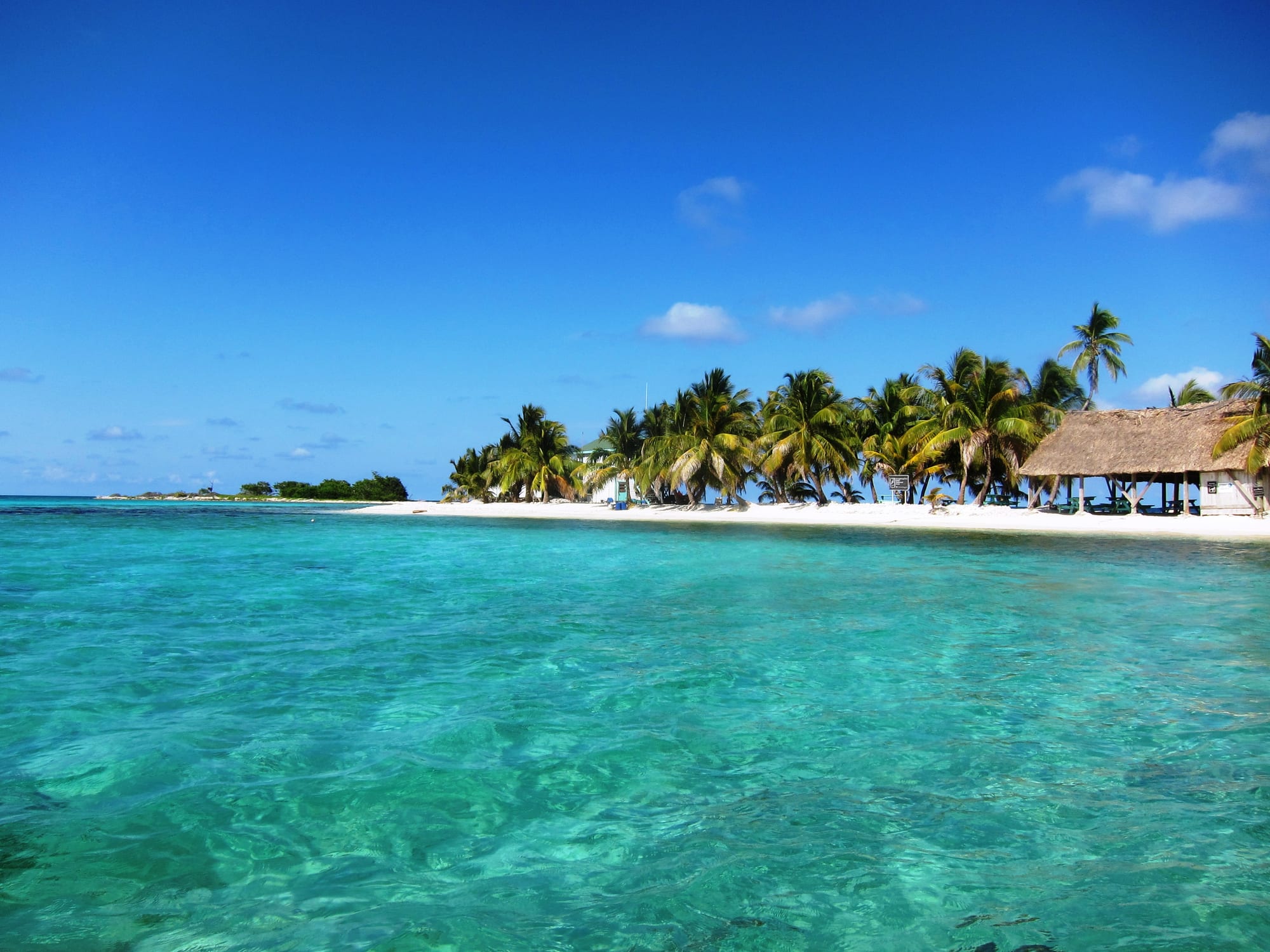
Clear emerald-green shallows in front of a small island of white sand, leaning coconut palms and a thatched shelter under a deep blue sky

Belize

Laughing Bird Caye, a small palm-covered island of white sand off the coast of Belize, seen from the water. (satanoid / Wikimedia Commons · CC BY 2.0)

A small, thinly populated country on the Caribbean coast of Central America — English-speaking, culturally mixed, and fronted by the longest barrier reef in the northern hemisphere.

Explore Belize

History

The land was a heartland of the ancient Maya. Cities such as Caracol, Lamanai, Xunantunich, and Altun Ha flourished for centuries, and Caracol at its height held more people than live in Belize City today. The Spanish never effectively settled the swampy, reef-guarded coast, leaving a gap that English and Scottish buccaneers and logwood cutters — the "Baymen" — filled from the 1600s, working enslaved Africans in the forest.

The territory became the colony of British Honduras in 1862. In 1798 a Spanish fleet was beaten off at the Battle of St. George's Caye, still marked as a national holiday. A labour movement and constitutional reform led to internal self-government in 1964 under George Price, the founding leader, and to independence — with a change of name to Belize — in 1981.

Guatemala has long claimed all or part of the country, and British troops remained until 1994 as a deterrent; the dispute is now before the International Court of Justice, with both countries having voted to send it there. Tourism, along with agriculture and offshore services, has become the mainstay of a small economy.

  • Belize: The Maya Coast and the Baymen A Maya heartland, a logwood-cutters' foothold that Spain never dislodged, the last British colony on the American mainland, and a nation Guatemala still claims

Culture & Customs

Belize is unusually diverse for its size. The Creole population, of Afro-European descent, gave the country its widely spoken Kriol language; Mestizos, many descended from refugees of the nineteenth-century Caste War of Yucatán, are now the largest group and keep Spanish and the food of the region alive. Three Maya peoples — Yucatec, Mopan, and Q'eqchi' — farm the west and south.

The Garifuna, descendants of Carib and African people exiled from St. Vincent in 1797, arrived in 1802 and settled the southern coast at Dangriga, Hopkins, and Punta Gorda. Their language, drumming, and ceremonies are recognised by UNESCO, and Garifuna Settlement Day on 19 November is one of the country's biggest celebrations. German-speaking Mennonite colonies, established from the 1950s, supply much of the country's dairy and poultry.

The national mood is famously unhurried — Caye Caulker's motto is "Go Slow" — and Christian, with Catholic and evangelical churches side by side. Punta and punta rock, both Garifuna-derived, are the home-grown music.

Daily Life

With around 410,000 people, Belize has the smallest population in Central America and one of the lowest densities. Belize City, on the coast, is the largest town and commercial hub; the capital, Belmopan, was built inland after Hurricane Hattie levelled Belize City in 1961. Most people live in a scatter of towns and villages along the highways and rivers.

The economy runs on tourism, sugar, citrus, bananas, and increasingly on services, with a large slice of activity informal or cross-border. Many families have relatives in the United States, and remittances matter. English-language schooling and a British-style legal and political system set Belize apart from its Spanish-speaking neighbours.

Coastal life is shaped by fishing, the reef, and the weather; inland, by farming, the forest, and the tourist lodges of the Cayo district. Hurricane season, June to November, is watched every year.

Food

The everyday staple is "rice and beans" — cooked together with coconut milk — or "beans and rice" served separately, alongside stewed chicken, fried plantain, and potato salad. "Boil up," a Creole one-pot of ground provisions, fish or pig tail, and egg, is a weekend dish.

Each community adds its own table. The Garifuna make hudut, fish in a coconut broth with mashed plantain, and ereba, cassava bread; Mestizo cooks turn out garnaches, salbutes, escabeche, and tamales; the Maya keep to caldo and hand-made corn tortillas. The reef supplies conch, lobster (in season from mid-June), and snapper.

Marie Sharp's habanero sauce, made in the Stann Creek valley, is a national emblem and on every table. Belikin is the national beer, One Barrel the local rum, and a seaweed shake the traditional pick-me-up.

  • Belize: Food and the National Dish Rice and beans cooked together in coconut milk for Sunday lunch, a Garifuna dish of mashed plantain and fish, and a food culture split between more communities than almost anywhere else its size

Attractions & Natural Wonders

The reef and the cayes are the main draw. Hol Chan Marine Reserve and Shark Ray Alley off Ambergris Caye offer easy snorkelling; the Great Blue Hole and the offshore atolls — Turneffe, Lighthouse, Glover's — are classic dives; and whale sharks gather seasonally off Gladden Spit. Caye Caulker is the budget base, Ambergris the busier one.

Inland, the Maya sites reward the effort: Caracol, deep in the Chiquibul forest; Xunantunich, reached by a hand-cranked ferry, with its tall "El Castillo" pyramid; Lamanai, approached by boat up the New River; and Altun Ha, the closest to Belize City. The Actun Tunichil Muknal cave — a wet trek past Maya offerings to a calcified skeleton called the "Crystal Maiden" — is often rated among the best cave experiences anywhere.

The Cockscomb Basin Wildlife Sanctuary was the world's first jaguar preserve, and Mountain Pine Ridge has waterfalls, swimming holes, and the Rio Frio cave. Placencia and Hopkins have the mainland's best beaches, and the Belize Zoo, home to rescued native animals, is a genuine attraction in its own right.

Planning basics

Budget

Belize is more expensive than its Central American neighbours, partly because so much is imported and partly because tourism is concentrated in a few pricey spots. The cayes and dive trips cost the most; inland Cayo and the bus network are cheaper. Cards work at hotels and dive shops; cash is needed for buses and small vendors.

Source
Traveller reports and price observation, 2023–2024 — verify against a current source.
Dive The Blue Hole
Roughly USD 250–350 for the day trip from Ambergris Caye
Daily Budget Midrange
USD 120–250 (hotel or lodge, some flights, tours and diving)
Daily Budget Shoestring
USD 50–80 (guesthouse, local food, buses, one caye)

A domestic flight to the cayes or Placencia costs far more than the water taxi but saves a half-day each way.

Source: Traveller reports and price observation, 2023–2024 — verify against a current source.

Visa Requirements

Citizens of the US, Canada, the EU, the UK, and most Caribbean and Commonwealth countries enter visa-free, usually for 30 days, extendable month by month at an immigration office for a fee. An onward ticket and proof of funds may be requested.

Exit Fees
A departure tax and conservation fee apply when leaving; often bundled into airfares
Typical Stay
30 days on entry, visa-free, for most Western passports

Safety

Belize has a high overall homicide rate, but the violence is almost entirely gang-related and concentrated in specific parts of Belize City that visitors have no reason to enter. The tourist areas — the cayes, Cayo, Placencia, Hopkins — are comparatively safe, with the usual petty theft and occasional robberies.

Source
US Department of State and UK FCDO travel advisories — check for the latest wording.

Don't walk in Belize City after dark, use licensed taxis, keep valuables out of sight, and be cautious with drugs, which are widely offered on the cayes and carry real penalties.

Source: US Department of State and UK FCDO travel advisories — check for the latest wording.

Climate

Subtropical and humid. The drier season runs roughly late November to May and is the tourist high season; the wet season, June to November, brings afternoon downpours and overlaps the Atlantic hurricane season. A short dry spell often breaks the rains in August.

Diving
Underwater visibility is usually best from April to June
Dry Season
warm, breezy, around 24–30°C on the coast
Wet Season
hotter and more humid, heavy short rain, storm risk

Transportation

Philip Goldson International Airport near Belize City is the gateway. Tropic Air and Maya Island Air run frequent small-plane hops to the cayes, Placencia, and the south. "Chicken buses" cover the main highways cheaply; water taxis run from Belize City to Caye Caulker and San Pedro. A rental car — ideally a 4x4 — helps for the Maya sites and Mountain Pine Ridge.

Driving
On the right; four main highways are paved, many minor roads are not

Water taxis to the cayes take under 90 minutes and cost a fraction of the flight.

Best Time to Visit

Late November to April for the driest, sunniest weather, with December to April the peak for price and crowds. May can be warm, quiet, and good value before the rains. Lobster season opens in mid-June.

Avoid
September and October carry the highest hurricane risk.

Currency

The Belize dollar (BZD) has been pegged to the US dollar at 2 to 1 since 1978. US dollars are accepted everywhere, often with change given in Belize dollars. ATMs are in the towns but not on the smaller cayes.

Cards
Hotels, dive operators, and better restaurants; carry cash elsewhere
Symbol
$ (BZ$)
Currency Code
BZD — Belize dollar (2:1 with USD)

Language

English is the official language and the medium of government and schooling — the only such country in Central America. Belizean Kriol is the everyday lingua franca. Spanish is very widely spoken, and there are three Maya languages, Garifuna, and the Low German of the Mennonite communities.

Also Common
Spanish, spoken at home by a large share of the population
Lingua Franca
Belizean Kriol
Official Language
English