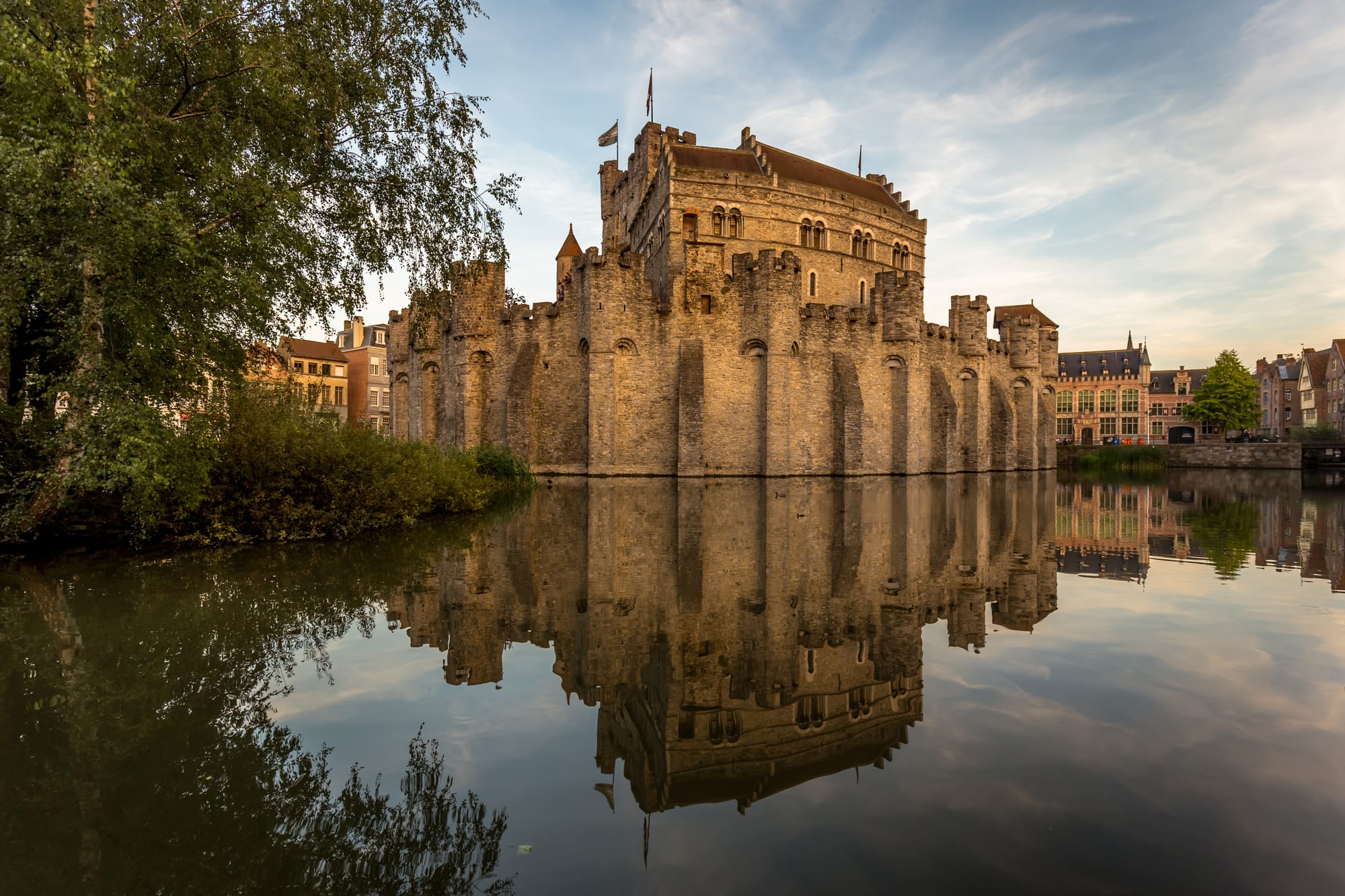
A grey stone medieval castle with battlements and turrets glowing gold in low evening sun, mirrored in the still water of its moat beneath a streaked blue sky

Belgium

The Gravensteen castle in Ghent at sunset, mirrored in the water and seen from Sint-Widostraat. (Davidh820 / Wikimedia Commons · CC BY-SA 4.0)

A small, densely populated country at the crossroads of Western Europe, split between Dutch-speaking Flanders and French-speaking Wallonia, and home to the institutions of the European Union.

Explore Belgium

History

This has long been the crossroads and cockpit of Western Europe. In the Middle Ages the County of Flanders and the Duchy of Brabant grew rich on the cloth trade, and cities such as Bruges, Ghent, and Ypres were among the largest and wealthiest north of the Alps. Under the Burgundians and then the Habsburgs the "Low Countries" flourished; the Dutch Revolt split them, the Protestant north becoming the Dutch Republic while the Catholic south stayed under Habsburg rule, Spanish then Austrian.

After a spell under revolutionary and Napoleonic France — Waterloo was fought just south of Brussels in 1815 — the southern provinces were handed to the Netherlands, rebelled, and won independence as the neutral Kingdom of Belgium in 1830. That neutrality was violated by Germany in 1914, and Belgium was largely occupied in both world wars, with the Western Front's worst killing grounds in Flanders around Ypres.

King Leopold II, meanwhile, ran the Congo Free State from 1885 as a personal possession, a regime of forced labour and atrocity that killed millions before the Belgian state took it over in 1908; reckoning with that history is a live public debate. Post-war Belgium industrialised and then deindustrialised in the Walloon coal-and-steel belt while Flanders rose, feeding the regional tensions that produced today's federal state of three regions and three language communities.

  • Belgium: The Crossroads of Europe Rich medieval cloth towns, a nation invented in 1830, a brutal empire in the Congo, and a small state still pulled between its two languages

Culture & Customs

Belgium holds two majority-language cultures under one flag, each oriented as much toward Paris or Amsterdam as toward the other, plus the cosmopolitan churn of Brussels. Government formation is famously slow — the country once went well over a year without an elected government — yet it keeps functioning, a standing national joke.

Shared touchstones exist. There is a deep painting tradition, from the Flemish Primitives through Bruegel and Rubens to the Surrealist Magritte. Comics are a national art form — Tintin, the Smurfs, Lucky Luke — with murals across Brussels and a dedicated museum. Art Nouveau was substantially invented in 1890s Brussels by Victor Horta. And there is a self-deprecating, surreal streak in the humour, epitomised by the small, irreverent Manneken-Pis.

Folkloric carnivals — Binche with its Gilles, Aalst, the Ommegang in Brussels — are UNESCO-recognised, and cycling is close to a religion, especially in Flanders, where the spring Tour of Flanders over cobbled climbs is a national event.

Daily Life

Belgium is one of the most urbanised countries in Europe, with around 11.7 million people in a small area and a nearly continuous belt of towns across the centre. Brussels is both the national capital and, in effect, the capital of the European Union, hosting the Commission, the Council, much of the Parliament, and the headquarters of NATO.

The language border is a real administrative line that runs through schooling, broadcasting, and politics, and moving between Flanders and Wallonia can feel like crossing between two countries that happen to share a train network. Living standards are high, the social safety net is generous, and shops keep shorter hours than in some neighbouring countries.

Daily life is comfortable and low-drama: excellent trains, good food close at hand, a strong café and market culture, and weekends given to family meals, cycling, football, and — in season — the carnivals and city festivals.

Food

Belgium eats and drinks very well and knows it. Beer is the headline: a Trappist and abbey brewing tradition (Westvleteren, Chimay, Orval, Rochefort, Westmalle), the sour lambics and gueuze of the Brussels area, strong golden ales, and wheat beers, each with its own branded glass — Belgian beer culture is on the UNESCO list.

Then there are frites, twice-fried and served from a friterie in a cone with mayonnaise or a dozen other sauces; the country half-seriously claims to have invented them. Mussels with frites is the unofficial national dish, alongside carbonade flamande (beef braised in brown ale), waterzooi (a creamy Ghent stew), stoemp (mashed potato and vegetables), and the tiny grey North Sea shrimp.

Chocolate is a serious craft — the filled praline was invented in Brussels — and the country is dense with chocolatiers. Waffles come in two distinct forms: the lighter rectangular Brussels waffle and the denser, caramelised Liège waffle. Speculoos biscuits round out the sweet repertoire.

  • Belgium: Food and the National Dish A pot of mussels and a mountain of fries, a country that claims to have invented the fry itself, and more styles of beer than anywhere else on earth

Attractions & Natural Wonders

Bruges is the headline town — an almost implausibly preserved medieval core of canals, the Markt and its belfry, and the Beguinage; touristy but genuinely lovely, and quiet in the evenings. Ghent has a similar townscape with a younger, livelier feel and, in St. Bavo's Cathedral, the Van Eyck brothers' "Ghent Altarpiece."

Brussels centres on the Grand-Place, one of the great squares in Europe, with its guildhalls and biennial flower carpet, plus the Art Nouveau quarters and Horta houses, the Royal Museums of Fine Arts and the Magritte Museum, the Atomium from Expo 58, and the comic-strip route. Antwerp is Rubens's city, a global diamond centre with a monumental railway station and a strong fashion scene.

The Flanders Fields battlefields around Ypres — the rebuilt Cloth Hall, the Menin Gate and its nightly Last Post, and the war cemeteries — are a major place of remembrance. Wallonia offers a greener side: the forested hills, caves, and rivers of the Ardennes, Dinant on the Meuse, the spa town of Spa that gave the word to the world, and the Waterloo battlefield with its Lion's Mound.

Planning basics

Budget

Belgium sits in the mid-to-upper range for Western Europe. Brussels and the tourist cities are the priciest; a beer and a plate of frites remain cheap. Card and contactless payment is near-universal and often preferred, though some bakeries, markets, and small cafés still want cash.

Glass Of Beer
EUR 3–5 in a café
Daily Budget Midrange
EUR 150–260 (mid-range hotel, restaurant meals, museums, day trips)
Daily Budget Shoestring
EUR 75–120 (hostel or budget hotel, frites and bakery food, trains)

The rail network is dense and cheap enough that you can base yourself in one city and day-trip the rest.

Visa Requirements

Belgium is in the Schengen Area. Citizens of the EU, the US, the UK, Canada, Australia, and many other countries need no visa for stays of up to 90 days in any 180-day period. The EU's ETIAS pre-travel authorisation for visa-exempt visitors is being phased in.

Typical Stay
90 days in any 180-day period, visa-free, for most Western passports

High-speed trains link Brussels directly to London, Paris, Amsterdam, and Cologne.

Safety

Belgium is generally safe, with low levels of violent crime against visitors. The main nuisance is pickpocketing and bag-snatching in Brussels — around the Grand-Place, the main stations, and on the metro — and occasional theft from parked cars.

Keep bags closed and in sight on transport and in tourist crowds, take extra care around Bruxelles-Midi station at night, and watch the priority-from-the-right rule if you drive.

Climate

Temperate maritime — cool, cloudy, and often damp, with rain possible in any season and few extremes. Summers are mild to warm; winters are chilly and grey, with some frost and occasional snow, more in the higher Ardennes.

Summer
June–August, generally 18–23°C with warmer spells
Winter
December–February, around 3–7°C; colder in the Ardennes

Pack a rain jacket whatever the season.

Transportation

Compact and easy. Brussels is a rail hub, and the national network (SNCB/NMBS) puts almost every town within an easy day trip — Brussels to Bruges, Ghent, Antwerp, or Leuven takes well under an hour. Trams, metros, and buses serve the cities, and the coastal tram runs the length of the North Sea shore.

Cycling
A genuine mode of transport, especially in flat Flanders, with segregated lanes and bike-share schemes

A car is optional for most visits; Brussels and Antwerp traffic and parking are painful, and several cities have low-emission zones.

Best Time to Visit

May, June, and September offer the best balance of milder, brighter weather and manageable crowds; April brings blossom and the Flemish cycling classics. July–August is warmest and busiest. December is for the Christmas markets and lights in Bruges, Brussels, and Ghent.

Events
Binche and Aalst carnivals (February–March); Ghent Festivities (July); the Bruges and Brussels Christmas markets

Currency

Belgium uses the euro. Card and phone payment work almost everywhere and are often the default; carry a little cash for small purchases and markets. Restaurant service is included, so tipping is modest.

Symbol
Tipping
Rounding up, or about 5–10% for good restaurant service, is plenty
Currency Code
EUR — euro

Language

Three official languages: Dutch (spoken by about 60%, in Flanders), French (about 40%, in Wallonia and the majority language in Brussels), and German (a small community in the east). Brussels is officially bilingual. English is very widely spoken in Brussels, Flanders, and tourist areas, less so in rural Wallonia.

Brussels
Officially bilingual Dutch/French; English widely understood
Official Languages
Dutch, French, German

It is courteous to ask which language someone prefers rather than assuming.