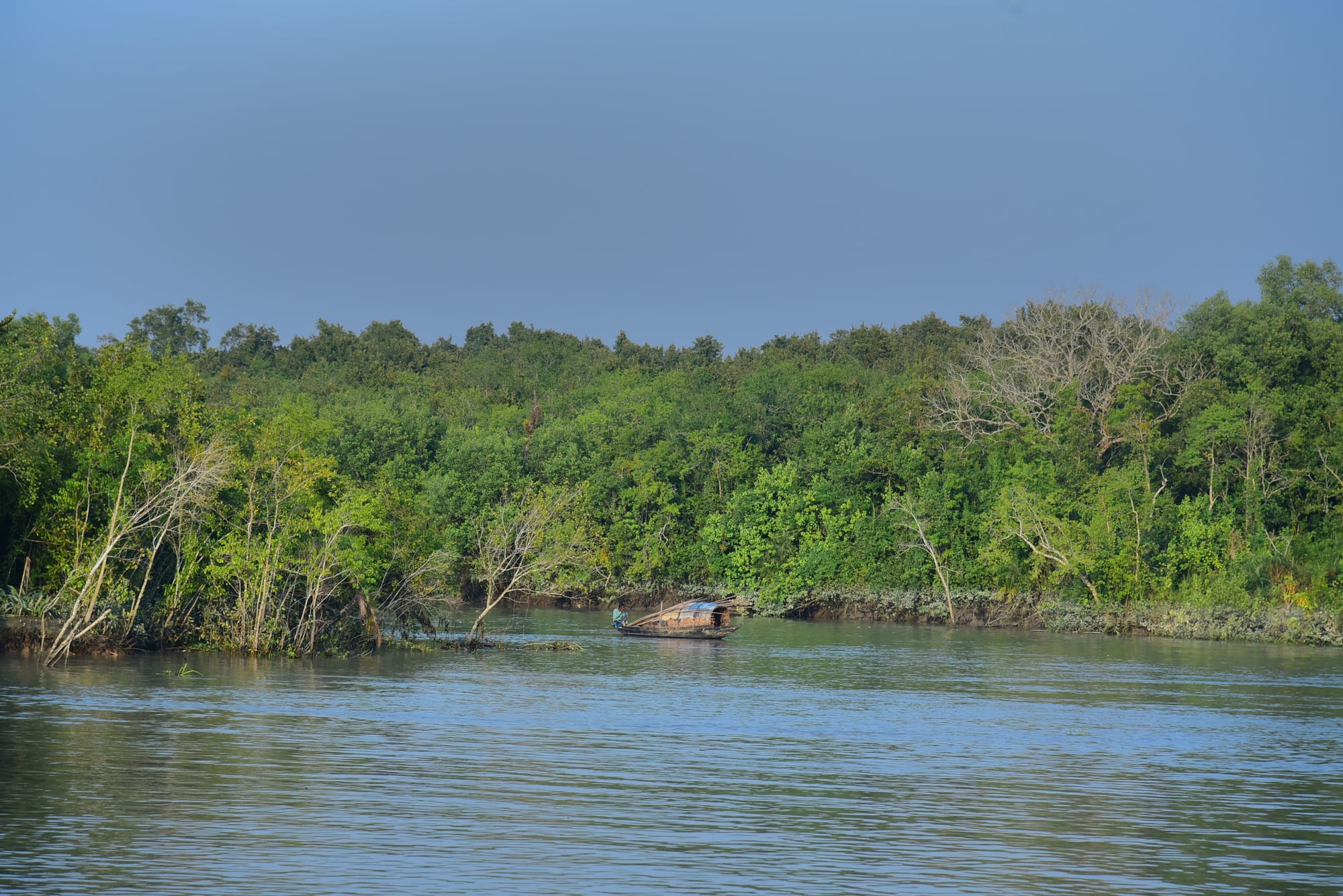
A small wooden boat on a still tidal channel curving between dense green mangrove banks under a soft sky

Bangladesh

A tidal channel in the Sundarbans, the world's largest mangrove forest and the last stronghold of the Bengal tiger — a UNESCO World Heritage Site shared with India. (Emonjnu / Wikimedia Commons · CC BY-SA 4.0)

A vast river delta of some 170 million people — one of the most densely populated countries on Earth — built around Bengali language and culture, and shaped by water, monsoon, and rapid change.

Explore Bangladesh

History

Bengal was long one of the richest parts of the Indian subcontinent, a centre of rice, trade, and the famous fine muslin cloth, ruled in turn by the Buddhist Palas, the Sena, the Bengal Sultanate, and the Mughals, whose provincial capital was Dhaka. British rule began after the Battle of Plassey in 1757 and brought catastrophic famines, including that of 1943.

The 1947 Partition of India made this Muslim-majority region "East Pakistan," governed from West Pakistan a thousand miles away. Resentment at political and economic domination, and at the suppression of the Bengali language, built into a movement for autonomy. When the Awami League's 1970 election victory was ignored, the Pakistan army launched a crackdown in March 1971; the nine-month Liberation War that followed, with Indian intervention at its end, was hugely destructive and ended in independence in December 1971.

The founding leader Sheikh Mujibur Rahman was assassinated with most of his family in 1975, and military rule followed until 1991. Politics since has been a bitter rivalry between two dynastic parties, the Awami League and the BNP. Sheikh Hasina governed from 2009 until a student-led uprising forced her out in August 2024, after which an interim government under the Nobel laureate Muhammad Yunus took over.

  • Bangladesh: The Delta Nation The world's largest river delta — Buddhist and Hindu kingdoms, the wealth of Mughal Bengal, Partition, and a war of independence in 1971

Culture & Customs

Bangladesh is one of the few nations built around a single language, and Bengali culture is intensely literary and musical. This is the land of Rabindranath Tagore, whose songs and words — including the national anthem — are everywhere, and of the "rebel poet" Kazi Nazrul Islam; of the wandering Baul mystic singers, recognised by UNESCO; and of adda, the long, rambling conversation treated as a social institution.

The population is majority Sunni Muslim, with a significant Hindu minority and smaller Christian, Buddhist, and Indigenous communities. The two Eids are the largest holidays; Durga Puja is a major event for Hindus and widely enjoyed. Pahela Baishakh, the Bengali New Year in mid-April, fills the streets with the Mangal Shobhajatra procession, another UNESCO listing.

Hospitality is warm and centred on feeding guests generously. Dress is modest, more so for women and outside Dhaka. Cricket is a national passion, and weddings are multi-day affairs with their own ceremonies and foods.

Daily Life

Bangladesh packs around 170 million people into an area the size of a small US state, making it the most densely populated large country in the world. Dhaka, the capital, is a sprawling mega-city of relentless traffic, construction, and rickshaws; Chattogram is the main port; and most of the country is intensely farmed delta, cultivated to the water's edge.

It is also a development surprise. Once a byword for poverty and disaster, the country has had decades of strong growth and sharp gains in health and girls' education, driven by the world's second-largest garment industry — employing millions, mostly women, and scarred by the 2013 Rana Plaza collapse — by remittances from workers in the Gulf and Malaysia, by microcredit, and by enormous domestic NGOs.

Water shapes everything: the monsoon flood, riverbank erosion that erases villages, cyclones off the Bay of Bengal, and creeping salinity in coastal farmland. Bangladesh also hosts around a million Rohingya refugees from Myanmar, mostly in camps near Cox's Bazar.

Food

The saying goes that "a Bengali is made of fish and rice." The signature fish is hilsa (ilish), oily and bony, cooked with mustard or steamed in banana leaf; freshwater fish, prawns, and dried fish also feature. Rich, slow-cooked meat dishes include Dhaka's kacchi biryani of goat and fragrant rice, a wedding staple, and haleem in Ramadan.

Every meal has rice, lentils (dal), and vegetables, often as bhorta — mashes of potato, eggplant, or dried fish with mustard oil, onion, and green chilli. Street food is a world of its own: fuchka, chotpoti, jhalmuri, singara, and piyaju.

Bengal is famous across South Asia for milk sweets — roshogolla, mishti doi (sweet set yoghurt), sandesh, chomchom — and for winter treats made with fragrant date-palm jaggery. Tea, milky and sweet, is drunk constantly from roadside stalls.

  • Bangladesh: Food and the National Dish A river-delta nation raised on the saying "fish and rice make a Bengali," a New Year's plate built from yesterday's leftovers, and biryani serious enough to start arguments

Attractions & Natural Wonders

The Sundarbans, the largest mangrove forest in the world and a UNESCO site shared with India, is explored by boat through tidal channels and is the last stronghold of the Bengal tiger, along with spotted deer, crocodiles, and vast birdlife. The historic mosque city of Bagerhat, another UNESCO site, is a fifteenth-century planned city in the delta whose centrepiece is the austere, many-domed Sixty Dome Mosque.

At Paharpur, the ruins of Somapura Mahavihara — one of the largest Buddhist monasteries south of the Himalayas — are a third World Heritage Site. Old Dhaka holds the Lalbagh Fort, the pink Ahsan Manzil palace, the Star Mosque, and the crush of Sadarghat, the river port on the Buriganga. Nearby Sonargaon, a former capital, has the decaying mansions of Panam Nagar.

The Sylhet division in the northeast is green with tea gardens and rainforest — Srimangal, Lawachara, and the flooded Ratargul swamp forest. Cox's Bazar claims one of the world's longest natural beaches, though it is busy and built up, and St. Martin's is the country's only coral island. River travel itself — on ferries and the old paddle-steamers — is the classic Bangladeshi journey.

Planning basics

Budget

Bangladesh is inexpensive for travellers. Local food, trains, and simple hotels cost very little; the main expenses are mid-range city hotels, a hired car with driver, and permits or boat charters for the Sundarbans. Cash dominates outside Dhaka and Chattogram.

Source
Traveller reports and price observation, 2023–2024 — verify against a current source.
Sundarbans Boat Trip
Multi-day live-aboard tours from roughly USD 100–200 per day
Daily Budget Midrange
USD 50–100 (comfortable hotel, car with driver, guided trips)
Daily Budget Shoestring
USD 20–35 (basic hotel, local restaurants, trains and buses)

Carry small notes; changing large bills for street food and rickshaws is a daily nuisance.

Source: Traveller reports and price observation, 2023–2024 — verify against a current source.

Visa Requirements

Most Western nationalities need a visa. Bangladesh offers visa on arrival at Dhaka airport for tourists of many countries (typically 30 days, with a fee and conditions) and is expanding an e-visa system. Policies change, so confirm with a Bangladeshi mission before travelling.

Typical Validity
30 days for tourism; visa on arrival or e-visa for many passports

Have hotel bookings and a return ticket ready; keep a printed copy of any e-visa approval.

Safety

Violent crime against visitors is uncommon, and foreigners are generally met with curiosity and hospitality. The realistic concerns are chaotic and dangerous road traffic, petty theft in crowds, and the risk of being caught up in political demonstrations and strikes, which can turn violent and shut down transport.

Source
US Department of State and UK FCDO travel advisories — check for the latest wording.
Women Travellers
Expect a lot of staring and some harassment; take extra care after dark and on public transport.

Avoid rallies and crowds, monitor local news during political tension, and note that the Chittagong Hill Tracts require permits and have low-level insurgency.

Source: US Department of State and UK FCDO travel advisories — check for the latest wording.

Climate

Tropical monsoon. A hot, humid pre-monsoon (March–May) with violent thunderstorms; the main monsoon (June–October) delivers most of the rain and routine flooding; and a cool, dry, pleasant winter (November–February) with morning fog.

Winter
Dhaka around 20–28°C by day, cooler at night
Hazards
Cyclones spin up the Bay of Bengal, mainly April–May and October–November
Monsoon
heavy rain; in a bad year a third or more of the country floods

Transportation

Hazrat Shahjalal International Airport in Dhaka is the main gateway. Domestic flights link Dhaka with Cox's Bazar, Chattogram, Sylhet, and others. The railway is cheap and useful between major cities (book ahead for air-conditioned classes). Roads are slow and crowded; launches and ferries remain central to delta life.

Dhaka Traffic
Legendary congestion; the new elevated metro, cycle-rickshaws, and auto-rickshaws (CNGs) move the city

Hire a car with driver for intercity road trips; self-driving is not advisable.

Best Time to Visit

November to February — dry, sunny, and comfortable, and the season for the Sundarbans and river travel. October and March are warm shoulders. Avoid the monsoon for flooding and transport disruption, and the pre-monsoon heat of April–May.

Festivals
Pahela Baishakh, the Bengali New Year, in mid-April; the two Eids; Durga Puja in autumn

Currency

The currency is the Bangladeshi taka (BDT). It has been under pressure and is not easily obtained abroad. ATMs are common in cities; mobile payment services such as bKash and Nagad are used everywhere locally.

Cards
Hotels, malls, and better restaurants in cities; cash elsewhere
Symbol
Currency Code
BDT — Bangladeshi taka

Language

Bengali (Bangla), written in its own script, is the sole official language and the core of national identity — the 1952 killing of students demanding its recognition is commemorated worldwide as International Mother Language Day. English is used in business, higher education, and government, and spoken by educated urban Bangladeshis.

English
Common in cities and the tourist trade; limited in rural areas
Regional
Sylheti and Chittagonian differ markedly; the Hill Tracts have their own languages
Official Language
Bengali (Bangla)