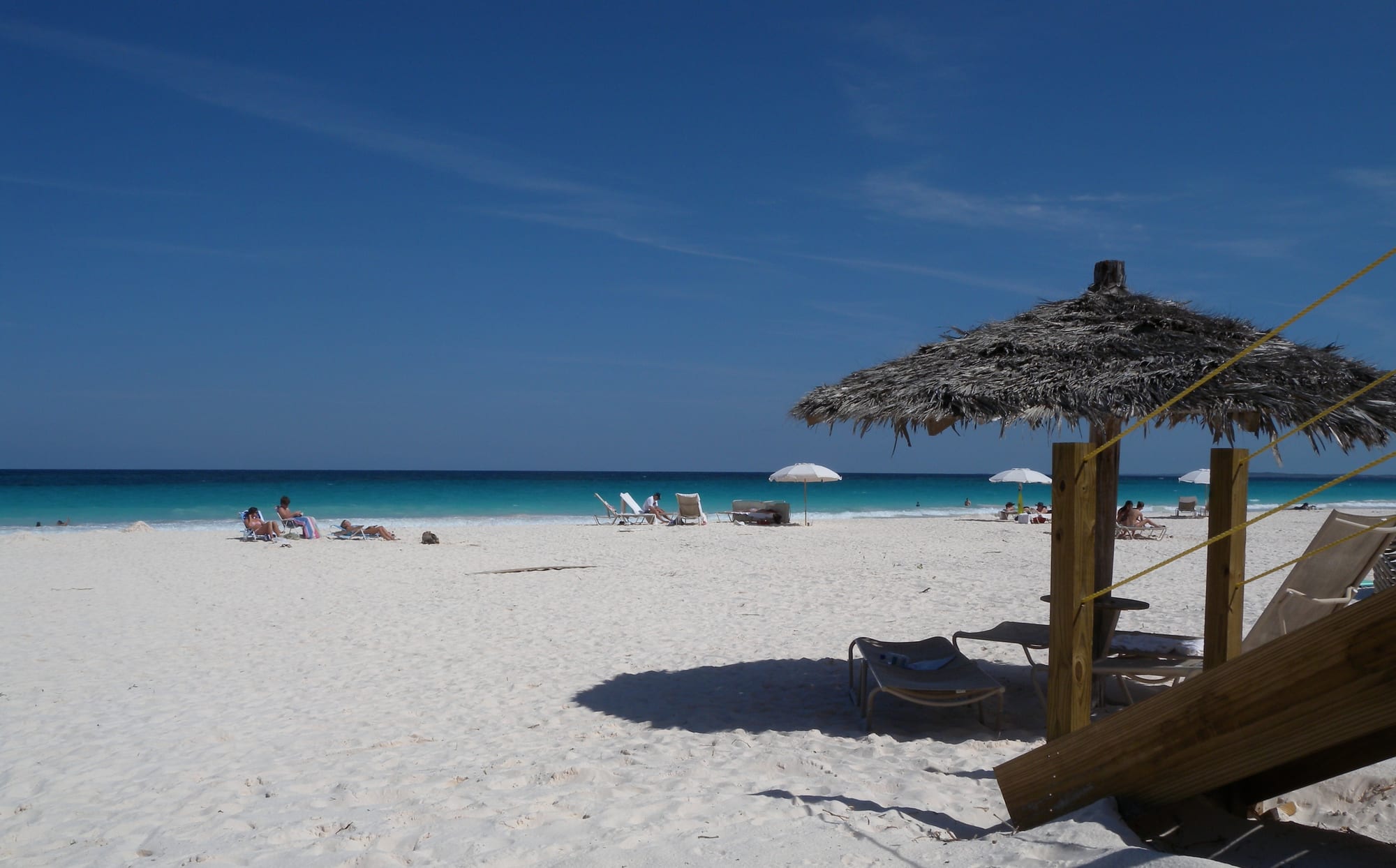
A long empty beach of pale pink-tinged sand meeting calm turquoise water under a bright sky

The Bahamas

The pink-sand beach of Harbour Island, off Eleuthera, coloured by crushed red foraminifera shells in the sand. (Oscar Flowers / Wikimedia Commons · CC BY-SA 3.0)

An archipelago of some 700 low coral islands and cays scattered across clear Atlantic shallows off Florida, with a single busy capital and a scattering of quiet Family Islands.

Explore The Bahamas

History

The islands were home to the Lucayans, a Taíno people, when Columbus made his first landfall in the Americas here in 1492 — on an island in the Bahamas whose exact identity is still debated. Within a few decades the Spanish had enslaved and removed the entire Lucayan population to work elsewhere, and the islands were left empty.

English Puritans settled Eleuthera in 1648. Nassau became a pirate base in the early 1700s — the "Republic of Pirates," Blackbeard among them — until the crown reimposed control. Loyalist planters fleeing the American Revolution arrived in the 1780s with enslaved Africans and tried cotton, which failed; the population became overwhelmingly of African descent. Wrecking, blockade-running for the Confederacy, sponging, and Prohibition-era rum-running were successive island economies.

Majority rule came in 1967 under Lynden Pindling, and independence from Britain in 1973. The Bahamas is a Commonwealth realm with King Charles III as head of state and a stable two-party parliamentary democracy. Tourism and offshore finance now dominate the economy, and hurricanes — most recently Dorian in 2019 — are a recurring catastrophe.

Culture & Customs

Bahamian culture is Afro-Caribbean, English-speaking, and strongly Christian, with Baptist congregations especially numerous. The signature cultural event is Junkanoo, a masquerade street parade with towering crepe-paper costumes, cowbells, goatskin goombay drums, whistles, and brass, staged in the small hours of Boxing Day and New Year's Day with fierce competition between organised groups.

Music runs from Junkanoo rhythms to rake-and-scrape, played on a saw, accordion, and goombay drum. Sloop sailing is a point of pride, with island regattas — above all the Family Island Regatta at George Town — as major social occasions. Straw-plaiting is the traditional craft, sold at the markets in Nassau.

For a small country, the Bahamas has an outsized record in track and field, with Olympic sprint and relay medals, and Bahamian athletes are national heroes. Family, church, and the weekend gathering are the anchors of social life, especially on the quieter islands.

Daily Life

About seven in ten Bahamians live on New Providence, in and around Nassau, where cruise tourism — millions of passengers a year — stopover visitors, banking, and government drive the economy. Traffic, the high cost of imported goods, and unreliable, expensive electricity are constant complaints.

The Family Islands are a different world: small, close-knit communities living on fishing, boatbuilding, farming, and modest tourism, with populations that have lost people to Nassau and abroad. Many settlements have a few hundred residents, a church, a couple of shops, and a mail-boat dock.

A large Haitian migrant community, often in a precarious legal position, does much of the low-wage work in construction, gardening, and domestic service. Hurricane season, June to November, is watched closely every year; a single storm can undo decades of development on an island.

Food

Conch — pronounced "conk" — is the national ingredient: cracked conch (battered and fried), conch fritters, and conch salad, a ceviche of raw conch "cooked" in lime and citrus with onion, sweet pepper, and tomato, made to order at a waterside shack. Rock lobster (called crawfish here), grouper fried whole, and stew fish are the other mainstays.

The standard sides are peas 'n' rice with pigeon peas, baked macaroni "pie", potato salad, and coleslaw. Souse, a light lime-and-pepper broth with chicken or pig's feet, is a weekend breakfast, often with "switcha" (limeade) and johnnycake. Guava duff, a rolled and boiled dessert with rum-butter sauce, is the classic pudding.

Kalik and Sands are the local beers, and Bahamian rum is in everything from a simple rum-and-Coke to the sweet Goombay Smash. The Friday-night fish fry — at Arawak Cay in Nassau, or village fish fries elsewhere — is a national ritual of grilled and fried seafood, sides, and music.

  • The Bahamas: Food and the National Dish A giant sea snail turned into everything from raw salad to fried fritters, pigeon peas and rice on every plate, and a rolled guava pastry unlike any other Caribbean dessert

Attractions & Natural Wonders

Nassau has the colonial core — Parliament Square, the Queen's Staircase, the old forts — the Straw Market, and, across the bridge, Paradise Island with the vast Atlantis resort and its water park and marine habitats. It is the easiest base but the least representative of the country.

The Exumas, a 120-mile chain of cays, hold the most famous scenery: the swimming pigs at Big Major Cay, the rock iguanas of Allen's Cay, Thunderball Grotto, and Exuma Cays Land and Sea Park, one of the oldest marine protected areas in the world. Harbour Island, off Eleuthera, is known for its three-mile pink-sand beach.

Andros, the largest and least developed island, sits on the edge of the Tongue of the Ocean and is riddled with blue holes and fringed by a vast barrier reef, famous for bonefishing and diving. Long Island's Dean's Blue Hole is one of the deepest ocean blue holes and a freediving centre, and San Salvador draws divers for its walls and the Columbus monuments.

Planning basics

Budget

The Bahamas is expensive. Almost everything is imported, resort taxes and service charges add up, and inter-island flights are costly. Nassau and Paradise Island are dearest; the Family Islands can be cheaper if you use guesthouses and cook, but options are limited.

Conch Salad
USD 10–15 from a shack
Daily Budget Midrange
USD 300–600 (hotel or small resort, restaurants, a boat trip, car hire)
Daily Budget Shoestring
USD 130–200 (guesthouse, self-catering, jitney buses, one island only)

Pick one or two islands per trip — every island hop is a flight or a mail boat, and both cost time and money.

Visa Requirements

Citizens of the United States, Canada, the United Kingdom, the EU, and most Commonwealth countries do not need a visa for stays of up to three months (longer for some). Proof of onward travel and accommodation may be requested. US-bound travellers clear US immigration preclearance at Nassau and Freeport before departure.

Typical Stay
Up to 3 months on entry, visa-free, for most Western passports

Keep your return or onward ticket accessible at immigration.

Safety

The Family Islands are very safe and quiet. Nassau needs more care: there is significant gun and gang violence, but it is concentrated in specific residential districts away from the tourist areas, and armed robberies and thefts targeting visitors do occur.

Natural Hazards
Hurricanes are the defining seasonal threat; Dorian devastated Abaco and Grand Bahama in 2019. Heed evacuation advice.

Avoid isolated beaches after dark, don't walk back to a hotel late through unlit areas, and use licensed taxis at night. In the water, watch boat traffic and currents.

Climate

Subtropical, warm all year and steadied by the trade winds. The drier, slightly cooler season runs December to April; May to November is hotter, more humid, and wetter, and overlaps the Atlantic hurricane season.

Summer
hot and humid, frequent afternoon showers
Winter
highs around 25–28°C, low rainfall, some cool northerly spells
Hurricane Season
1 June to 30 November, greatest risk August–October

Transportation

Nassau's Lynden Pindling International Airport is the main gateway, with Freeport second. Between islands you fly on small domestic carriers, take a slow subsidised mail boat from Nassau, or use the faster Bahamas Ferries. On New Providence, shared "jitney" minibuses run fixed routes by day; taxis have government rates.

Driving
On the left; on the Family Islands you rent a car, golf cart, or bicycle

Domestic flight schedules are thin and change; build in buffer time around connections.

Best Time to Visit

Mid-December to mid-April brings the most reliable weather, along with the highest prices and biggest crowds. May and early June are an excellent-value shoulder. Late summer and autumn carry real storm risk.

Events
Junkanoo parades on Boxing Day (26 December) and New Year's Day; the National Family Island Regatta at George Town in spring

Currency

The Bahamian dollar (BSD) is pegged one-to-one to the US dollar, and US dollars circulate freely — you may get change in a mix of both. Cards are fine in Nassau, Freeport, and resorts; carry cash on the Family Islands.

Cards
Widely accepted in tourist areas; ATMs scarce on smaller islands
Symbol
$ (B$)
Currency Code
BSD — Bahamian dollar (1:1 with USD)

Language

English is the official language and universally spoken. Everyday speech is Bahamian dialect, an English-based creole with its own rhythm and vocabulary. Haitian Creole is widely spoken within the large Haitian community.

English
Universal
Everyday Speech
Bahamian dialect (creole)
Official Language
English