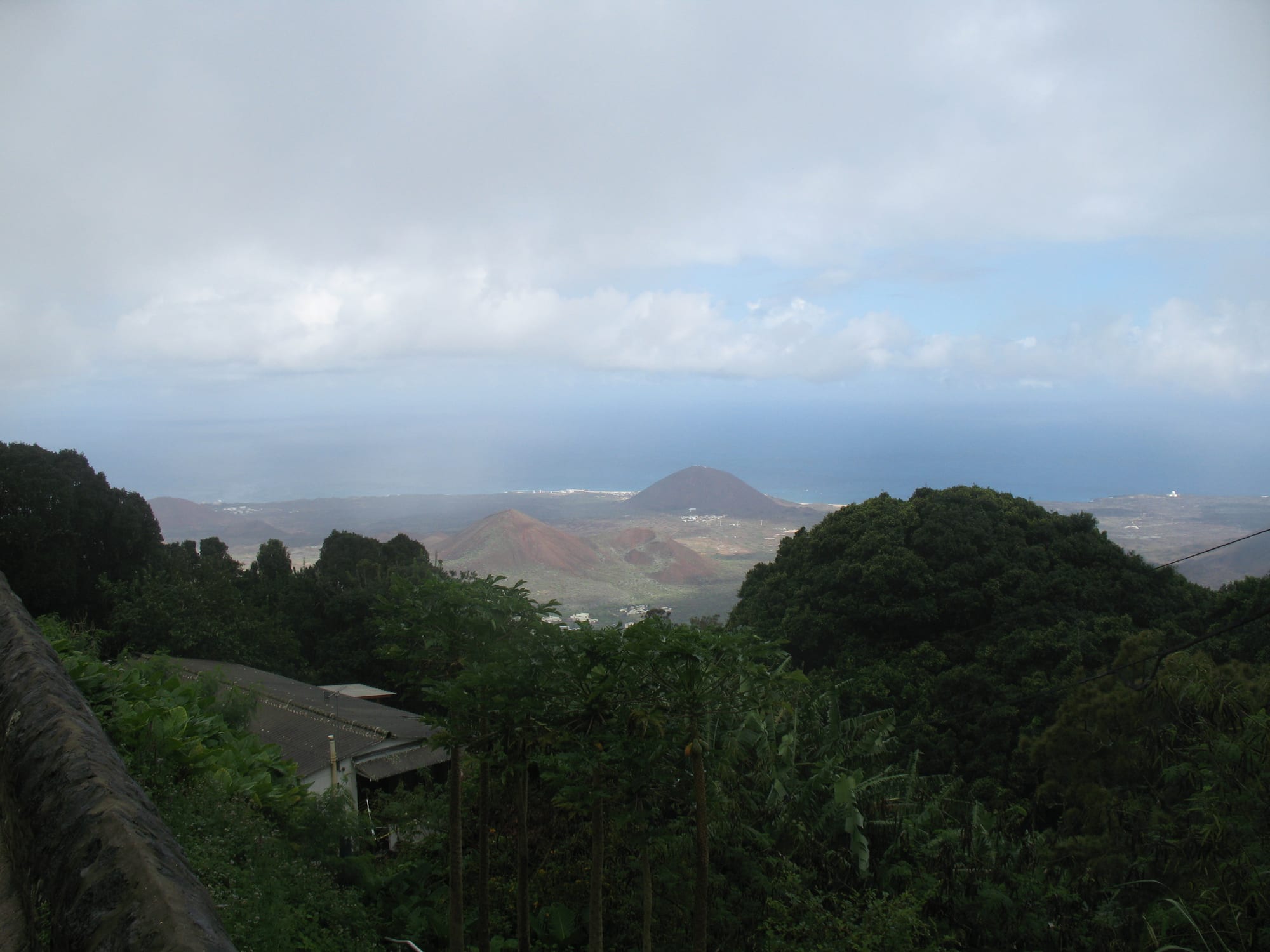
A small settlement of low buildings on a bare, reddish-brown volcanic plain running down to the sea, cinder cones on the skyline

Ascension Island

Georgetown, the main settlement, on the arid lava plain of Ascension Island's leeward coast. (Ben Tullis / Wikimedia Commons · CC BY 2.0)

A barren volcanic island in the equatorial South Atlantic, part of the British Overseas Territory of Saint Helena, Ascension and Tristan da Cunha — never a settled colony but a working base for the military, satellite trackers, seabirds, and turtles, with no right of abode and a population that comes and goes with the jobs.

Explore Ascension Island

History

Ascension was an uninhabited, waterless rock when the Portuguese sighted it in 1501 on Ascension Day. For three centuries ships used it only for turtles and the odd marooned sailor. The Royal Navy garrisoned it in 1815 to help guard Napoleon on Saint Helena and stayed, running the island as a stone frigate, HMS Ascension, until 1922. Charles Darwin called in 1836, and the botanist Joseph Hooker later devised a scheme to "green" the barren summit by planting hundreds of species from around the world, creating the unique man-made cloud forest of Green Mountain.

A Cable & Wireless relay station opened in 1899. In 1942 the United States built Wideawake airfield, which was used again as a staging post for the 1982 Falklands War and remains active. The BBC World Service ran an Atlantic relay station here from 1966 until 2025, and a European Space Agency Ariane tracking station and a signals-intelligence site were added. The island is administered from Saint Helena. There is no permanent population and no right of abode — everyone is present on a contract for the airfield, the American facilities, the government, or the communications operators.

Culture & Customs

About 800 people live on Ascension, most of them Saint Helenians on work contracts, alongside British and American service and civilian staff. English is the only language. Life revolves around the employers, the two small settlements of Georgetown and Two Boats, the social club, fishing, and the beach. There is no indigenous culture, and nobody is "from" Ascension.

A strong conservation ethos has grown up around the turtles and seabirds, and the turtle-nesting season and the club's sports-and-social calendar shape the year. Contracts end and families move on, so the community turns over steadily.

Daily Life

The population rises and falls with the contracts. Georgetown, the tiny capital, sits by the pierhead; Two Boats village lies halfway up Green Mountain. The economy is entirely the bases and government services, plus income from fishing licences in Ascension's waters. Housing, power, and water are provided by the employers. There is a school, a hospital, a shop, and little else, and the American and RAF airfields dominate the flat lava plain. Broadband is limited and costly.

Food

Food is whatever comes in on the ship or the plane. There is a shop, a couple of small eateries, and the club bars. Fresh fish is the local bounty — the yellowfin tuna and wahoo fishing off Ascension is exceptional — and Saint Helenian home cooking (plo, fishcakes, curry) is common in that community. Otherwise the diet is largely self-catered from imported and frozen goods.

Attractions & Natural Wonders

Green Mountain National Park is the surprise: an artificially created cloud forest with a farm, bamboo tunnels, a dew pond near the 859-metre summit, and the walk around "Elliot's Pass". The green turtles that nest on Long Beach and other sands from December to May — one of the largest colonies in the Atlantic — are watched on guided night walks.

Boatswain Bird Island offshore holds a vast seabird colony, and since feral cats were eradicated from the mainland the endemic Ascension frigatebird and the boobies have returned to breed on the main island. The Letterbox peninsula and the lava fields, Comfortless Cove and English Bay for a swim, Cross Hill and the old Marine barracks above Georgetown, and the world-class shore and boat fishing round out a short but distinctive list. The wartime and space-tracking installations are visible landmarks, though the sites themselves are closed.

Planning basics

Budget

Ascension is not a leisure destination. Visitor accommodation is very limited — a small guesthouse or hotel and some self-catering units — and you generally need a confirmed reason and a local sponsor to travel there. Costs are high and set by the flight.

Daily Budget Note
High and inflexible; dominated by the airfare and the scarce accommodation

Arrange your Entry Permit, accommodation, and transport well in advance; casual, unplanned visits are effectively not possible.

Visa Requirements

An Entry Permit must be obtained in advance from the Ascension Island Government, supported by proof of accommodation, onward travel, sufficient funds, and full medical insurance. There is no visa on arrival and no tourism-on-spec. Stays are time-limited.

Typical Stay
As specified on the Entry Permit (short, and tied to your onward transport)

Apply for the Entry Permit early and have a confirmed way off the island before you arrive.

Safety

Very safe, with negligible crime. The hazards are environmental — powerful Atlantic swell and undertow (swim only where advised, and beware the "rollers"), sharp lava, heat and strong sun on the exposed plain, and long distances between help. The military and communications areas are off-limits and must not be photographed. Medical care is a small hospital; serious cases are evacuated.

Health
No tropical disease risk; the concern is access to advanced care and the sea conditions

Respect all restricted-area signage and photography bans, swim only at supervised or advised spots, and carry water and sun protection on the open lava.

Climate

Tropical, warm, and dry at sea level all year at around 24–31°C, tempered by the southeast trade winds. Green Mountain, the high point, is cooler, wetter, and often in cloud. There is little seasonal variation and no cyclone risk.

Lowland
Warm and dry, 24–31°C
Green Mountain
Cooler, wetter, often clouded

Transportation

The RAF "airbridge" from RAF Brize Norton, en route to the Falklands, carries a small number of civilian passengers when seats allow, and there are occasional Airlink connections via Saint Helena. There is no scheduled commercial service and no ferry. On the island a hire car is essential — driving is on the left — as the settlements are far apart across the lava, and roads are rough.

Confirm your seat on the airbridge or the Saint Helena connection before committing, and arrange a vehicle on arrival.

Best Time to Visit

Green turtle nesting runs roughly December to May, with hatchlings from February to June, and guided night walks to see it are a highlight. The fishing is good all year. Otherwise the season barely matters, and access depends on the flight and the permit.

Events
Turtle-nesting season (December–May); the sports-and-social-club calendar that structures island life

Currency

The Saint Helena pound and pound sterling circulate at par. It is a cash economy, with only a small branch of the Bank of St Helena and no international ATMs — bring sterling.

Symbol
£
Currency Code
SHP / GBP — Saint Helena pound and sterling, at par

Language

English is the language of the island. There is no indigenous population and no local language; residents are on work contracts, most of them Saint Helenians, along with British and American staff.

Language
English