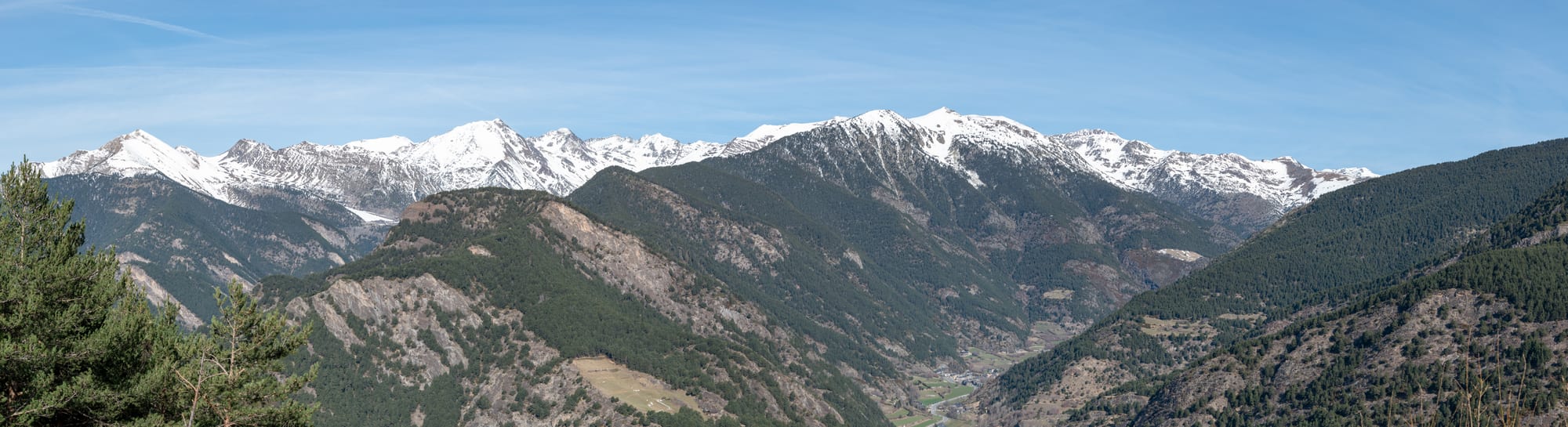
A wide panorama of green Pyrenean valleys and bare grey peaks under scattered cloud in Andorra

Andorra

The high Pyrenees of Andorra, where the whole country sits above roughly 900 metres and peaks approach 3,000. (Krzysztof Golik / Wikimedia Commons · CC BY-SA 4.0)

A tiny Pyrenean co-principality between France and Spain, ruled jointly for seven centuries and now living on skiing, hiking, and tax-free shopping.

Explore Andorra

History

Andorra's origin story reaches back to Charlemagne, credited by tradition with granting the valley a charter for helping fight the Moors — the national anthem still calls the country "the daughter of Charlemagne." The arrangement that actually endured dates from 1278, when a dispute between a French count and the Catalan Bishop of Urgell was settled by a paréage: the two would rule Andorra jointly.

That shared sovereignty survived, almost untouched, for more than seven hundred years. The count's rights passed down through French history to the President of the French Republic, so that today Andorra's two heads of state are a French president and a Spanish bishop — the world's only such co-principality. For most of that time Andorra was a poor, isolated place of shepherds, tobacco growers, and smugglers.

The twentieth century transformed it. Roads, then hydroelectric power, then mass tourism and duty-free retail turned the valley into a prosperous micro-economy. In 1993 Andorrans voted for their first written constitution, becoming a parliamentary democracy and joining the United Nations while keeping the two co-princes as ceremonial heads of state. Under international pressure, the country introduced income tax only in 2015.

Culture & Customs

Andorra is culturally Catalan, closely tied to the neighbouring Spanish comarca of the Alt Urgell, and shares its language, cuisine, and festival calendar. It is traditionally Roman Catholic — one of the two co-princes is a bishop — and the patron saint is Our Lady of Meritxell, whose feast on 8 September is the national day.

Folk tradition centres on the contrapàs and marratxa, formal circle dances performed at village festivals, and on the Escudella community meals. Because roughly half the population holds a foreign passport — Spanish, Portuguese, and French above all — day-to-day culture is a blend, and genuine Andorran citizenship is hard to obtain, requiring long residence.

Mountain life shapes attitudes: a strong sense of community in small parishes, a practical relationship with weather and terrain, and pride in having stayed independent and neutral while empires came and went around the valley.

Daily Life

Almost everyone lives in the string of towns along the two main valleys — Andorra la Vella, the capital and the highest in Europe, runs straight into Escaldes-Engordany, and the road continues through Encamp, La Massana, Ordino, and Sant Julià de Lòria. The economy is built on winter sports, summer hiking, shopping tourism, and banking, and the working year swings hard with the ski season.

The capital's main street is essentially one long shopping district, busy with day-trippers from Spain and France stocking up on tax-free goods. Away from it, the upper parishes such as Ordino stay quiet and village-like, with stone churches and terraced fields.

Public services are good and taxes are low; there is universal healthcare and schooling is offered in three parallel systems — Andorran, French, and Spanish. The main daily frustrations are traffic and parking in the narrow valley floor, and, in bad winters, roads closed by snow.

Food

Andorran cooking is hearty Catalan mountain food. The signature dish is trinxat, a pan-fried cake of boiled cabbage and potato studded with bacon or pork belly — a cold-weather staple of the high Pyrenees. Escudella, a thick meat-and-vegetable stew with a large meatball, is the winter comfort meal.

Meat dominates: cunillo (rabbit) cooked with tomato, lamb and pork grilled over wood, game in season, and river trout from the mountain streams, often served "a la llosa," seared on a hot stone at the table. Cured embotits — botifarra, bull, and mountain hams — and the soft fresh cheese mató with honey are typical starts and finishes.

Meals come with robust red wine from Catalonia and, increasingly, from Andorra's own tiny high-altitude vineyards, some of the highest in Europe. The French and Spanish influences meet here: a café might offer both pa amb tomàquet and a proper croque.

  • Andorra: Food and the National Dish Mashed cabbage and potato fried with cured pork, a Christmas stew shared across the Catalan Pyrenees, mountain trout, and a pantry stocked from both sides of the border

Attractions & Natural Wonders

Skiing is the main event. Grandvalira, on the eastern side, is the largest linked ski area in the Pyrenees, and Pal Arinsal and Ordino Arcalís cover the west; the season and the snowmaking are reliable, and lift passes cost less than in the Alps.

The country's natural showpiece is the Madriu-Perafita-Claror Valley, a UNESCO cultural landscape that takes up nearly a tenth of Andorra's territory and has no road into it — a glacial valley of pasture, birch and pine, stone huts, and old iron-working sites, reached only on foot. In summer the GR11 and GRP trails and a network of staffed refuges open up the peaks and glacial lakes such as Estany de l'Illa and the Tristaina lakes.

For a rainy day, Caldea in Escaldes-Engordany is a large thermal spa fed by hot springs, and the Romanesque churches scattered through the parishes — Sant Joan de Caselles, Santa Coloma with its round bell tower, Sant Miquel d'Engolasters — are small, austere, and centuries old. The Casa de la Vall in the capital served as Andorra's parliament house from 1702 until 2011.

Planning basics

Budget

Andorra uses the euro and prices are broadly European, but the absence of value-added tax (a low 4.5% general rate applies instead) makes alcohol, tobacco, fuel, electronics, and cosmetics noticeably cheaper than in France or Spain — which is why the shops are full. Cards are accepted everywhere.

Ski Pass
Roughly EUR 50–60 per day at Grandvalira, less for multi-day
Daily Budget Midrange
EUR 110–190 (hotel, restaurants, ski pass or activities)
Daily Budget Shoestring
EUR 60–95 (limited budget lodging, self-catering, local bus)

Budget beds are scarce; most lodging is mid-range hotels and apartments aimed at skiers.

Visa Requirements

Andorra issues no visas of its own and has no airport. You can only reach it overland from France or Spain, both in the Schengen Area, so in practice Schengen entry rules apply. There are, however, customs checks on the way out because of the duty-free limits.

Typical Stay
Governed by Schengen rules via France or Spain — 90 days in any 180 for most Western passports

Keep your passport handy: French and Spanish customs stop cars leaving Andorra.

Safety

Andorra is one of the safest countries in the world, with very little crime. The genuine risks are environmental: mountain weather that changes fast, avalanche danger for off-piste skiers, and driving on steep roads in snow and ice.

Check avalanche bulletins, tell someone your hiking route, and do not underestimate winter driving.

Climate

A high-mountain climate. Winters are cold with heavy, reliable snow that feeds the ski season from roughly December to April. Summers are mild, sunny, and much cooler than the Spanish plains, ideal for walking.

Summer
pleasant, around 18–25°C in the valleys, cool at altitude
Winter
cold; valley temperatures often around -2 to 6°C, colder and snowy up high
Sunshine
high; the Pyrenees here are relatively dry and bright

Transportation

No airport and no railway. Most visitors arrive by bus or car from Barcelona or Toulouse airports (about three hours), or from the French rail stations at L'Hospitalet-près-l'Andorre and Latour-de-Carol. A national bus network links the valley towns; a car is useful but not essential.

Nearest Rail
L'Hospitalet-près-l'Andorre and Latour-de-Carol, in France
Nearest Airports
Barcelona and Toulouse (about 3 hours each by road)

In winter, carry snow chains or winter tyres; the mountain passes and the road up from France can close.

Best Time to Visit

December to March for snow — Andorra has the largest ski area in the Pyrenees — and June to September for hiking, when the high trails and mountain refuges are open. April–May and October are quiet shoulder months with some facilities closed.

Events
Sant Jordi (23 April) and the Meritxell national holiday (8 September)

Currency

Andorra uses the euro under a monetary agreement with the EU, despite being neither an EU nor a eurozone member. It mints a small number of its own euro coins.

Cards
Accepted universally; ATMs common in the towns
Symbol
Currency Code
EUR — euro

Language

Catalan is the only official language and the one used in government and schools, which makes Andorra the only country where Catalan is the sole official tongue. Because most residents were born abroad, Spanish, French, and Portuguese are all widely spoken day to day.

English
Understood in hotels, ski resorts, and larger shops
Also Spoken
Spanish, French, Portuguese
Official Language
Catalan