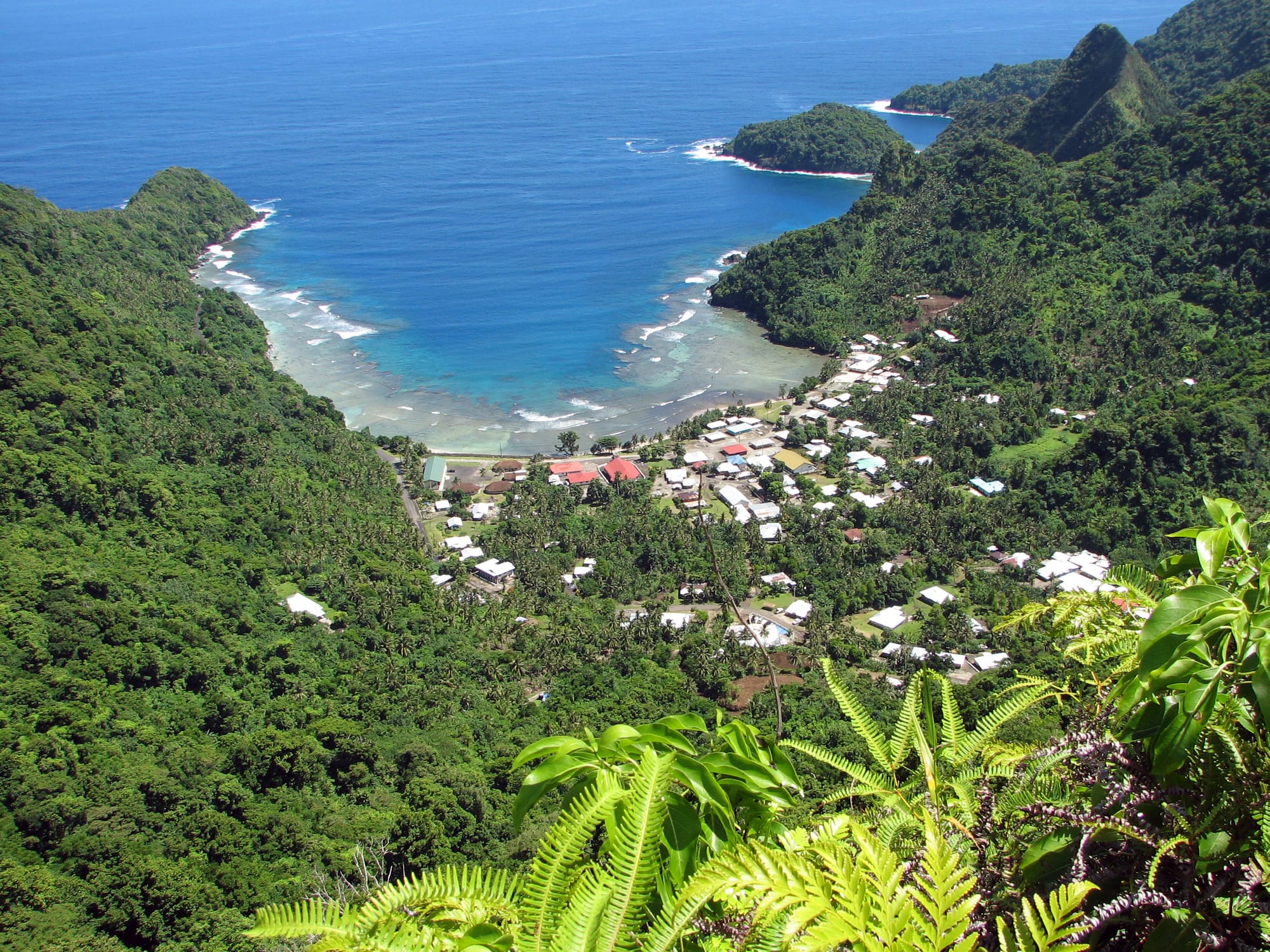
Looking down from a fern-fringed ridge onto a small village of white-roofed houses among palms, set on a curved bay of bright blue water and reef between steep rainforest slopes

American Samoa

The village of Afono on the edge of Afono Bay on Tutuila island, seen from the forested ridge above. (Tavita Togia, National Park Service / Wikimedia Commons · Public domain)

The eastern Samoan islands, an unincorporated US territory in the South Pacific and the only US soil south of the equator — a place where land is communally held under the chiefly matai system, life follows fa'a Samoa, and people are US nationals but not citizens by birth.

Explore American Samoa

History

The Samoan islands were settled around three thousand years ago and are a cultural heartland of western Polynesia. Samoans resisted European encroachment into the nineteenth century, when rivalry between Germany, Britain, and the United States over the islands culminated in the 1899 Tripartite Convention: Germany took the western islands (now independent Samoa), the United States took the eastern ones, and Britain was compensated elsewhere.

The high chiefs of Tutuila and Aunu'u formally ceded their islands to the United States in 1900, and those of the Manu'a group in 1904 — the Deeds of Cession that remain the legal foundation of the territory. The US Navy administered American Samoa until 1951, when it passed to the Department of the Interior, and the territory adopted its own constitution and, from 1977, began electing its governor. It sends a non-voting delegate to Congress.

American Samoa's status is distinctive. People born there are US nationals but not US citizens by birth — a matter now being litigated — though they can serve in the US military, which they do at the highest rate of any US state or territory. Land is roughly 90 per cent communally owned under the matai (chief) title system and is protected: outsiders essentially cannot buy it. These protections, and the wish to keep them, are a main reason American Samoa has not sought a closer constitutional relationship with the US. The economy has long depended on tuna canning, and emigration to Hawaii, California, Washington, and Utah has left far more American Samoans living stateside than in the islands.

Culture & Customs

Life is governed by fa'a Samoa, "the Samoan way": the aiga (extended family), the matai who holds the family's chiefly title and represents it in the village council (fono), and a dense web of obligation, respect, and ceremonial exchange. The matai system is not folklore — it is the working structure of land, dispute resolution, and local governance.

Christianity is central; the territory is overwhelmingly church-going, mostly Congregationalist, Catholic, Methodist, and Latter-day Saint. Most villages observe sa, a short evening curfew for family prayer, during which visitors passing through should stop and wait quietly. Sunday is for church and rest, and little is open.

Formal occasions involve the 'ava (kava) ceremony, oratory, and the presentation of fine mats ('ie toga), and events such as Flag Day feature fautasi longboat races and siva dancing. Modesty in dress, removing shoes before entering a fale (house), and deference to elders and matai are expected.

Daily Life

About 50,000 people live in American Samoa, the great majority on Tutuila, mostly around Pago Pago Harbor and the villages strung along the coast road; the Manu'a Islands hold only a few hundred people. The population has been declining as young people leave for the US.

The economy rests heavily on the StarKist tuna cannery at Pago Pago — by far the largest private employer, so that the territory's fortunes track the cannery's — along with US federal funding and the government payroll. A special lower federal minimum wage, phased upward over time, is meant to keep the canneries viable and is a long-running point of debate.

Daily life is village-centred, church-centred, and communal, organised around the aiga, the plantation plot, the sea, and the fortnightly or monthly rhythm of remittances and visits between the islands and the mainland diaspora.

Food

American Samoan food is Samoan food: taro, breadfruit, green banana, and yam as the starches, with palusami or lu'au — young taro leaves baked in coconut cream, sometimes with corned beef (pisupo) — as the classic dish. The Sunday to'ona'i, cooked in an umu (above-ground earth oven) after church, is the week's main feast.

Oka (raw fish marinated in coconut cream, lime, onion, and chilli), sapasui (a Samoan chop suey), fa'apapa (a dense coconut bread), and koko alaisa (cocoa rice) are everyday favourites. Tinned corned beef, Spam, turkey tails, and mutton flaps — cheap imported meats — feature heavily, a diet linked to high rates of diet-related illness.

Kava ('ava) is drunk ceremonially rather than socially, and koko Samoa (a thick local cocoa drink), coconut water, and imported soft drinks are the everyday beverages. Almost everything not grown locally is shipped in.

Attractions & Natural Wonders

Pago Pago Harbor, a flooded volcanic crater ringed by steep green peaks, is one of the best natural harbours in the Pacific and the scenic heart of Tutuila. Rainmaker Mountain (Mount Pioa) looms over it, snagging the clouds that make the harbour so wet, and a trail climbs Mount Alava on the opposite ridge, past the rusting towers of a long-closed cable car.

The National Park of American Samoa — the only US national park south of the equator — is spread across three islands. On Tutuila it protects the rainforest, flying-fox colonies, and coast of the Amalau valley and the dramatic Pola Island sea cliffs at Vatia. On Ofu, in the Manu'a group, it takes in a reef-fringed white beach beneath jagged peaks, one of the most beautiful and least-visited in the Pacific. On Ta'u it climbs to Lata Mountain, the territory's highest point.

Other sights include the little island of Aunu'u off Tutuila's east end, with its red-taro swamp, quicksand, and crater lake; the "flowerpot" sea stacks of Fatu ma Futi near the airport; Two Dollar Beach; and the Jean P. Haydon Museum in Fagatogo, in a former Navy commissary. Rose Atoll, far to the east, is a marine national monument closed to visitors.

Planning basics

Budget

American Samoa has very little tourism infrastructure — a handful of hotels and guesthouses on Tutuila, and simple lodging in the Manu'a Islands. Prices for imported goods and lodging are relatively high, but there is little to spend money on beyond food, a rental car, and the flight to Manu'a. It is a place for travellers seeking authenticity, not amenities.

Daily Budget Midrange
USD 130–260 (Tutuila hotel, restaurants, rental car, the flight to Ofu or Ta'u)
Daily Budget Shoestring
USD 60–110 (guesthouse, store and roadside food, shared rental car)

Base in the Pago Pago area, rent a car, and treat a trip to the Manu'a Islands as a separate mini-expedition dependent on the small-plane schedule.

Visa Requirements

American Samoa runs its own immigration, separate from the rest of the United States. Most visitors, including US citizens, need an entry permit or must meet entry conditions arranged in advance or on arrival, typically with an onward ticket and proof of funds and accommodation. It is not a visa-free "just show up" destination even for Americans.

Typical Stay
Entry permits are commonly issued for 30 days, extendable

Check the American Samoa immigration requirements well before travel — even US citizens must satisfy entry conditions — and carry an onward ticket.

Safety

American Samoa is safe, with low crime and strong village social control. The main hazards are natural and infrastructural: cyclones, a serious tsunami risk (a 2009 earthquake and tsunami killed dozens here), strong ocean currents outside the reef, and limited medical care, with serious cases flown to Hawaii. Village sa (evening prayer curfew) should be respected.

Health
Dengue, chikungunya, and other mosquito-borne illnesses occur; tap water quality varies by village — treat or use bottled; the hospital on Tutuila handles basics, with evacuation to Honolulu for anything serious

Learn tsunami evacuation routes, swim inside the reef and heed currents, stop and wait quietly if you are in a village during evening sa, and carry insurance covering evacuation to Hawaii.

Climate

Tropical, hot, and humid year-round, around 28–31°C, with high rainfall — Pago Pago Harbor is one of the rainiest spots in the Pacific, thanks to cloud caught on Rainmaker Mountain. The wetter season runs roughly November to April and carries the cyclone risk; May to October is a little drier.

Wet Season
November–April (cyclone risk)
Drier Season
May–October

Transportation

Pago Pago International Airport on Tutuila has flights from Honolulu and from Apia in independent Samoa, plus small-plane services to the Manu'a Islands (Ofu and Ta'u). Tutuila has a network of privately run "aiga" buses — brightly painted wooden buses that run without a fixed timetable — and a rental car is the practical option for visitors.

Rent a car on Tutuila, use the aiga buses for a local experience, and book the Manu'a flights early, as they are small and weather-dependent.

Best Time to Visit

May to October is the drier, less humid stretch and the safer window for cyclones, with better conditions for hiking and boat travel. Humpback whales pass between about August and November. Rain is possible at any time of year.

Events
Flag Day (17 April), the territory's biggest celebration, with fautasi (longboat) races, dancing, and speeches; White Sunday (Lotu Tamaiti) in October, honouring children; village and church festivals year-round

Currency

The currency is the US dollar. Cash is used for most everyday purchases; cards work at the larger stores and hotels on Tutuila but rarely in the villages or the Manu'a Islands. ATMs are on Tutuila only.

Symbol
$
Currency Code
USD — United States dollar

Language

Samoan, a Polynesian language shared with independent Samoa, is the everyday language of almost everyone. English is co-official and used in government, business, and schooling, and is widely understood.

Languages
Samoan and English (both official)