💰 Budget
Algeria runs largely on cash. Foreign cards are rarely accepted and ATMs that take them are scarce, so travellers bring euros or US dollars to change. There is a wide gap between the official exchange rate and the unofficial street rate, which strongly affects what a trip costs.
- Source
- Traveller reports and exchange-rate observation, 2023–2024 — verify against a current source.
- Sahara Tours
- Add USD 100–200 per day for a licensed guided desert expedition with 4x4 and permits
- Daily Budget Midrange
- USD 70–130 (mid-range hotel, some domestic flights, restaurant meals)
- Daily Budget Shoestring
- USD 30–55 (basic hotel, café food, shared transport)
Changing money on the parallel market is common but technically illegal; hotels and banks give the weaker official rate. Bring clean euro notes.
Source: Traveller reports and exchange-rate observation, 2023–2024 — verify against a current source.
✈️ Visa Requirements
A visa is required for almost all nationalities and must usually be arranged in advance through an Algerian embassy, with a hotel booking or a letter of invitation. A visa-on-arrival scheme exists for organised tours flying into the southern Saharan airports of Djanet and Tamanrasset.
- Typical Validity
- 30 days, single or double entry; processing can be slow
Independent travel in the Sahara is restricted: many desert areas require a licensed agency, a permit, and sometimes a police escort. Arrange this before you arrive.
🛡️ Safety
Northern Algeria and the main cities are far calmer than during the civil conflict of the 1990s and are generally safe for visitors, with the usual urban petty crime. Most governments advise against all travel to the border regions with Mali, Niger, Libya, and Mauritania, and to parts of the Saharan interior, citing terrorism and kidnapping risk.
- Source
- US Department of State, UK FCDO, and French diplomatic advisories — check for the latest wording.
- Photography
- Avoid photographing military sites, police, government buildings, and infrastructure.
Read your government's travel advisory closely — the safe and off-limits areas are specific — and use a licensed operator for any desert travel.
Source: US Department of State, UK FCDO, and French diplomatic advisories — check for the latest wording.
🌦️ Climate
Three bands. The Mediterranean north has mild, wet winters and hot, dry summers. The high plateaus behind the coast are semi-arid with cold winters. The Sahara, covering most of the country, is scorching by day in summer, cool to cold at night, and best visited in winter.
- Sahara
- winter days 20–25°C and cold nights; summer daytime highs above 45°C
- Algiers Summer
- hot and humid, around 30–34°C
- Algiers Winter
- mild, 10–16°C, with rain
🚆 Transportation
A railway runs along the north, linking Algiers with Oran, Constantine, and Annaba. Beyond that, travel is by louage (shared long-distance taxi), intercity coach, or — for the vast distances to the south — domestic flights on Air Algérie. Algiers has a modern metro and tram.
- Roads
- Good in the north, including the East–West Highway; long and remote in the south
- Main Hub
- Houari Boumediene Airport, Algiers
Flying is the practical way to reach Tamanrasset, Djanet, or Timimoun; the overland routes are enormous.
📅 Best Time to Visit
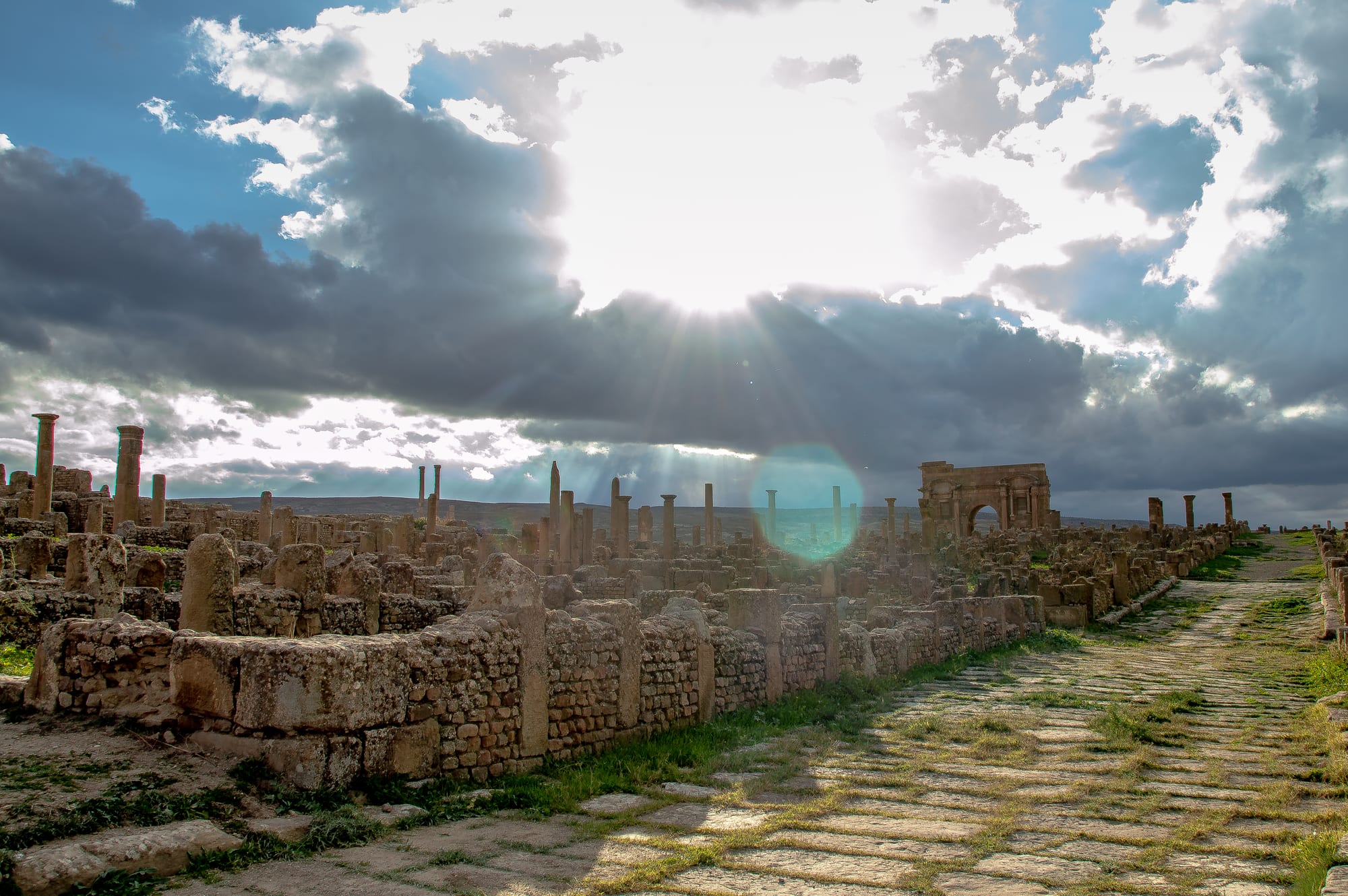
Spring (March–May) and autumn (October–November) suit the coast and the Roman sites. The Sahara — the Hoggar, Tassili, and the oasis towns — is only comfortable from roughly November to February.
- Avoid
- The desert in summer; the coast is fine but very hot in August.
- Ramadan Note
- During Ramadan, daytime cafés and restaurants largely close and the pace of everything slows.
💱 Currency
The currency is the Algerian dinar (DZD). It cannot be obtained or exchanged easily outside the country, and export of dinars is prohibited.
- Symbol
- د.ج / DA
- Cash To Bring
- Euros (most useful) or US dollars
- Currency Code
- DZD — Algerian dinar
💬 Language
Arabic and Tamazight (Berber) are both official. Everyday speech is Algerian Arabic (Darja), heavily mixed with French and Berber. French remains widely used in business, higher education, and the media despite having no official status. English is taught but less commonly spoken.
- English
- Limited; more common among younger people in cities
- Working Language
- French, very widely understood
- Official Languages
- Arabic, Tamazight (Berber)