History · Algeria
Algeria: Empires on a Narrow Shore
Berbers, Romans, Ottomans and 132 years of France — the many conquests of Africa's largest country, and the war that made it a nation
By Worldlore Editorial · 10 September 2026
A country that is mostly desert
Algeria is the largest country in Africa — about 2.4 million square kilometres, four times the size of France — and roughly four-fifths of it is Sahara. Almost everyone lives on the Tell, a strip of mountains, valleys and coast a few dozen kilometres deep along the Mediterranean. That imbalance shapes the whole history. For three thousand years, the powers that mattered here — Carthaginian, Roman, Arab, Ottoman, French — held the fertile shore and the port cities, drew their wealth from grain, olives and trade, and only ever partly controlled the mountains and the desert behind them. The people of those highlands, the Amazigh or Berbers, are the one constant: they were here before all the conquerors and they outlasted every one.
Three thousand years, in brief
The dates below compress a great deal; the sections that follow fill them in.
- from c. 1200 BCE
Phoenicians and Berbers
Phoenician traders found coastal posts; inland, Amazigh (Berber) kingdoms take shape.
- 202 BCE
Rome and Numidia
The Numidian king Massinissa backs Rome against Carthage and unites a kingdom across northern Algeria.
- 1st–5th c. CE
Roman Africa
Timgad, Djémila and Tipasa flourish as grain and oil cities; Christianity takes deep root.
- 7th–8th c.
The Arab conquest
Muslim armies from the east bring Islam; Berber resistance under leaders such as Kusayla and the Kahina is eventually overcome.
- 8th–13th c.
Berber dynasties
Rustamid, Zirid, Hammadid, Almoravid and Almohad states rule from centres across the Maghreb.
- 1516
The Regency of Algiers
The Barbarossa brothers place Algiers under Ottoman protection; it becomes a corsair state.
- 1830
The French invasion
France seizes Algiers; conquest of the interior takes decades and is resisted by Emir Abdelkader.
- 1848
Algeria becomes France
The coast is organised into French départements and opened to European settlement.
- 8 May 1945
Sétif and Guelma
French forces kill thousands of Algerians after nationalist marches.
- 1 November 1954
The war begins
The FLN launches the war of independence.
- 5 July 1962
Independence
After the Évian Accords, Algeria is free; some 800,000 European settlers leave.
- 1992–2002
The Black Decade
A civil war between the army and armed Islamist groups kills well over 100,000 people.
- 2019
The Hirak
Mass peaceful protests end President Bouteflika's 20-year rule.
The Amazigh homeland
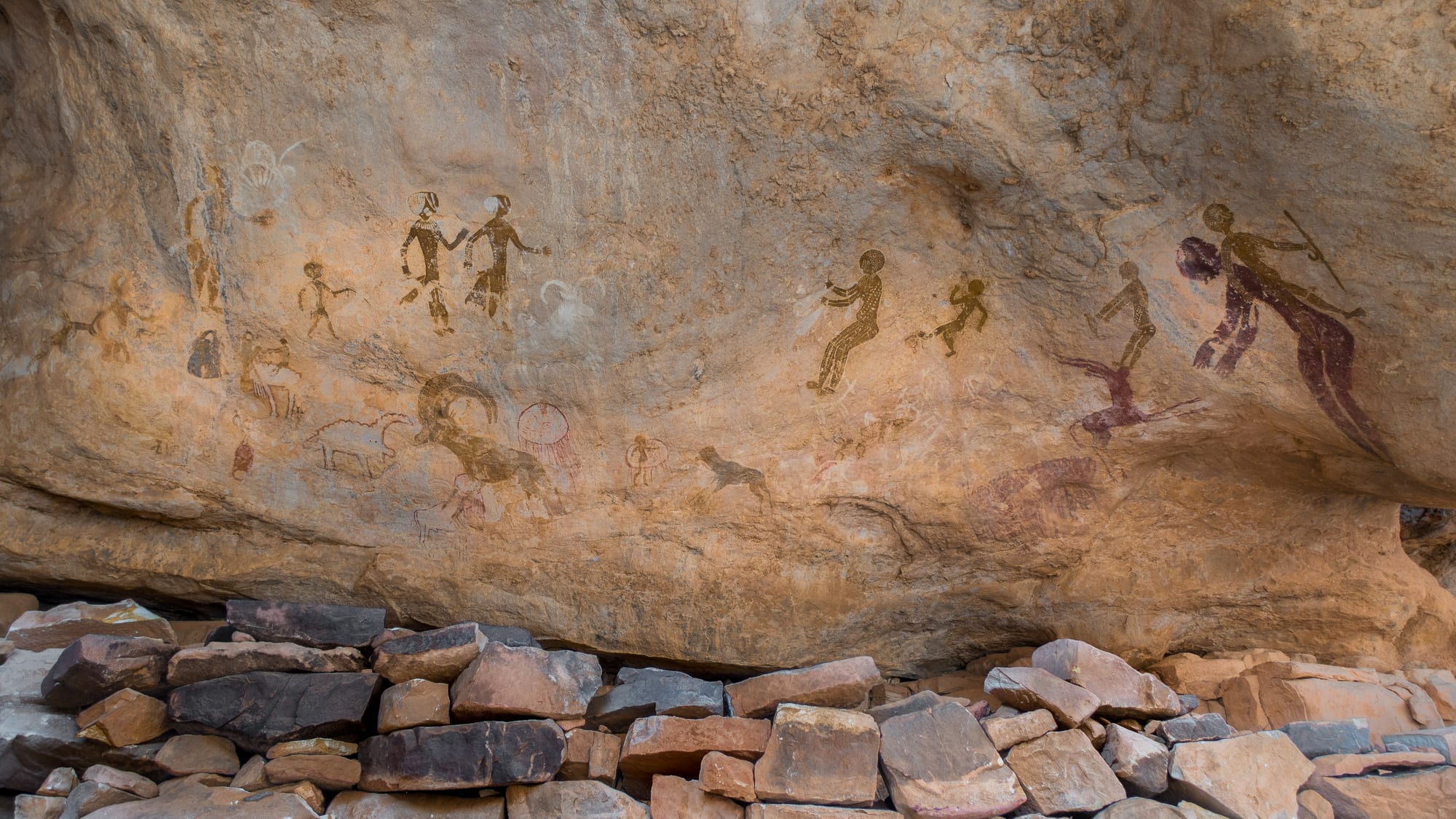
The Sahara was not always desert. When it was still grassland, between roughly 10,000 and 4,000 years ago, the people of the central massifs left thousands of paintings and engravings on the rock — herds of cattle, hunters, dancers, chariots — that record a green Africa slowly drying out. As the desert spread, its population concentrated on the northern coast and in the mountains, and it is there that classical writers found the Amazigh, the people they called Libyans or Numidians, speaking early forms of the Berber languages still used in Algeria today.
From about the 12th century BCE, Phoenician merchants from the eastern Mediterranean planted trading stations along the shore, and one of them, Carthage, grew into a power in its own right. The Berber kingdoms of the interior — Numidia in the east, Mauretania in the west — traded with Carthage, supplied it with famous light cavalry, and sometimes fought it.
Numidia and Rome
Numidia's moment came during the wars between Rome and Carthage. Its king Massinissa switched his cavalry to the Roman side at the decisive battle of Zama in 202 BCE, and was rewarded with a unified kingdom stretching across most of northern Algeria. His descendants ruled it for a century, until a grandson, Jugurtha, fought a long and humiliating war against Rome that ended with Numidia absorbed into the empire.
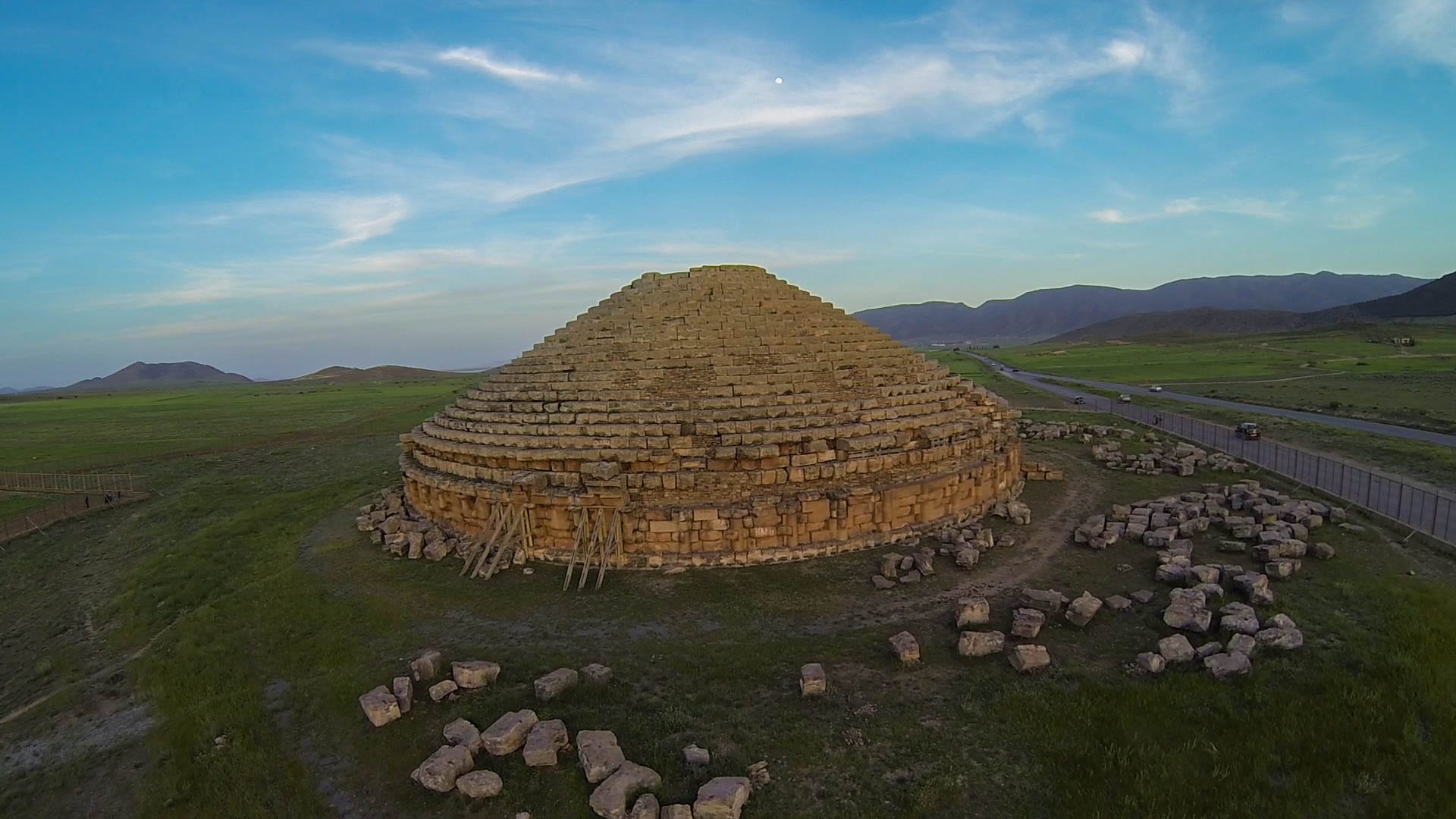
The Medracen is the oldest surviving monument of the Berber kingdoms: a stepped stone drum more than 18 metres high, built for a Numidian king around the 3rd century BCE, mixing a Greek colonnade and an Egyptian cornice with a local tradition of royal burial mounds. It stands on the plain east of Batna, not far from the later Roman veterans' town of Timgad.
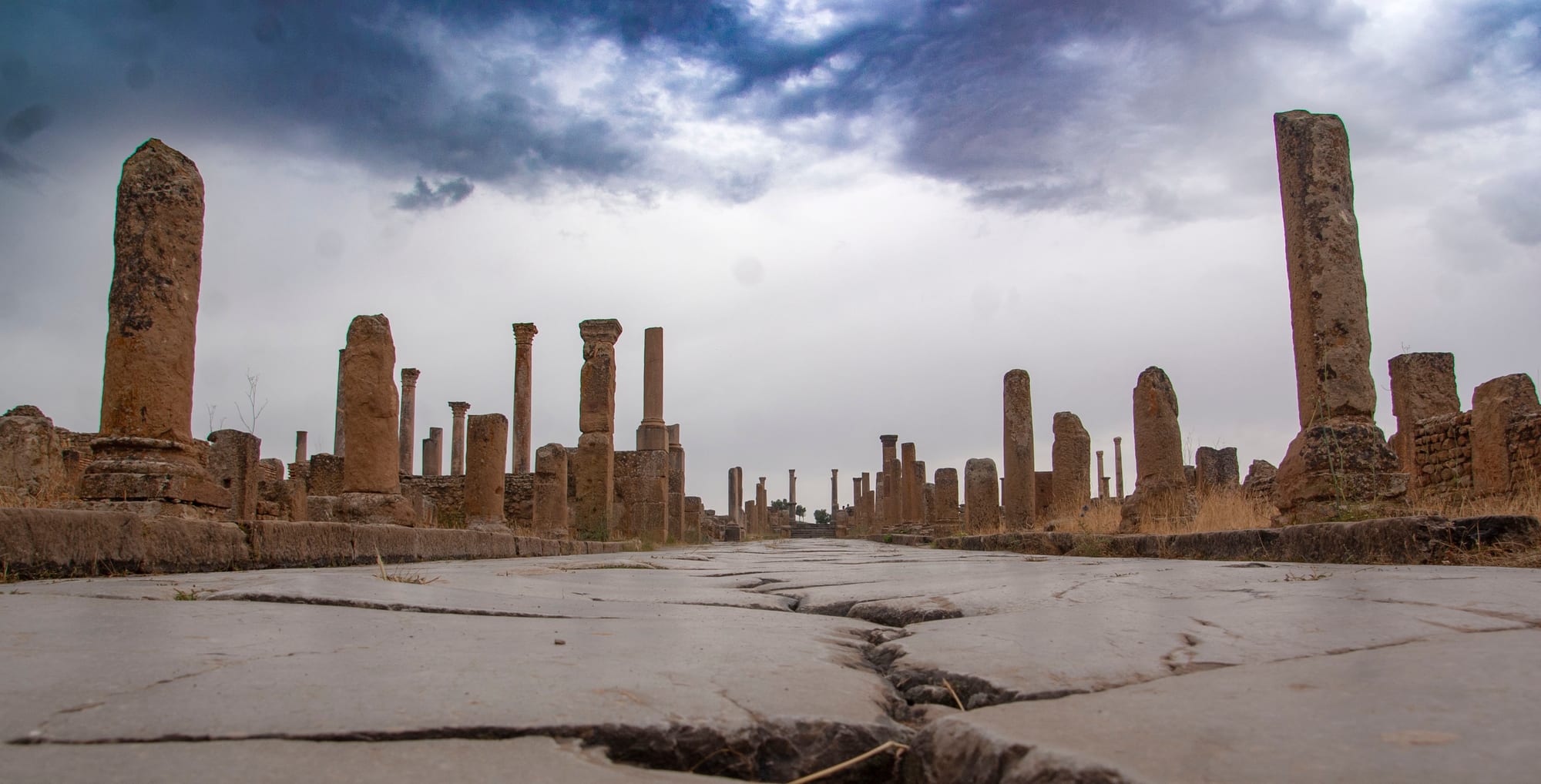
Roman North Africa became one of the richest parts of the Mediterranean world — the granary that fed the city of Rome, and a land of olive oil, wine and cities. Timgad was laid out on a perfect grid for army veterans around 100 CE; Djémila climbed a ridge with its forum, temples and arches; Tipasa and Caesarea sat on the coast. Christianity took hold here early and deep: this was the church of Tertullian and Cyprian, and of Augustine, bishop of the port city of Hippo, whose writings shaped Western Christianity and who died in 430 while a Vandal army besieged his town. The Vandals, a Germanic people, crossed from Spain and ruled the coast for a century; the Eastern Roman Empire took it back in 533; and then, within a hundred years, a new power arrived from the opposite direction.
Islam and the Berber dynasties
Arab armies carrying Islam reached the Maghreb in the mid-7th century, using Kairouan in modern Tunisia as their base. Berber resistance was fierce — the war-leader Kusayla and, after him, a woman remembered as the Kahina held out for years — but by around 700 the conquest was complete, and over the following centuries most Berbers became Muslim. They did not simply submit to Arab rule, though. In the 740s much of the Maghreb rose in a Berber revolt under the banner of Kharijite Islam, and out of it came the first durable local states, including the Rustamid imamate at Tahert, in central Algeria, which lasted from the 8th century to the 10th.
What followed was five centuries of Berber-led dynasties. The Fatimids began here before moving their caliphate to Egypt; the Zirids and Hammadids ruled after them; and in the 11th and 12th centuries two vast empires, the Almoravids and the Almohads, were built by Berber movements from the western Maghreb and briefly united North Africa with Muslim Spain. When the Almohads broke apart in the 13th century, the territory of modern Algeria was split between the Zayyanid kingdom of Tlemcen in the centre-west and the Hafsids of Tunis in the east. In the same period the arrival of Arab pastoral tribes, the Banu Hilal, spread the Arabic language across the plains and steppe.
The Regency of Algiers
In the early 16th century, with Spain seizing ports along the coast, the city of Algiers turned for help to two corsair captains, the brothers Aruj and Hayreddin, known in Europe as Barbarossa. Hayreddin placed the city under the protection of the Ottoman sultan, who sent troops, and Algiers became the seat of an Ottoman regency that would last until 1830. Real power passed over time from governors sent by Istanbul to the local garrison and its elected rulers, the deys.
The Regency lived substantially off the sea. Its fleets preyed on Christian shipping across the western Mediterranean and raided coastal Europe for captives who were held for ransom or sold — over the centuries, hundreds of thousands of them. European navies bombarded Algiers again and again to stop it, and the young United States fought two wars, in 1801–05 and 1815, against the Barbary states over the same demands. It was a pretext of exactly this kind that France would use to justify invasion.
132 years of France
In 1827, in a dispute over an unpaid grain debt, the dey of Algiers struck the French consul with a fly-whisk. France declared the insult intolerable, blockaded the coast, and in 1830 landed an army that took Algiers within three weeks. What began as a punitive expedition became a 40-year war of conquest. The most serious resistance came from Emir Abdelkader, who from 1832 built a functioning state across the western interior, fought the French to repeated treaties, and only surrendered in 1847. Kabylia held out until 1857, and a last great revolt swept the mountains in 1871.
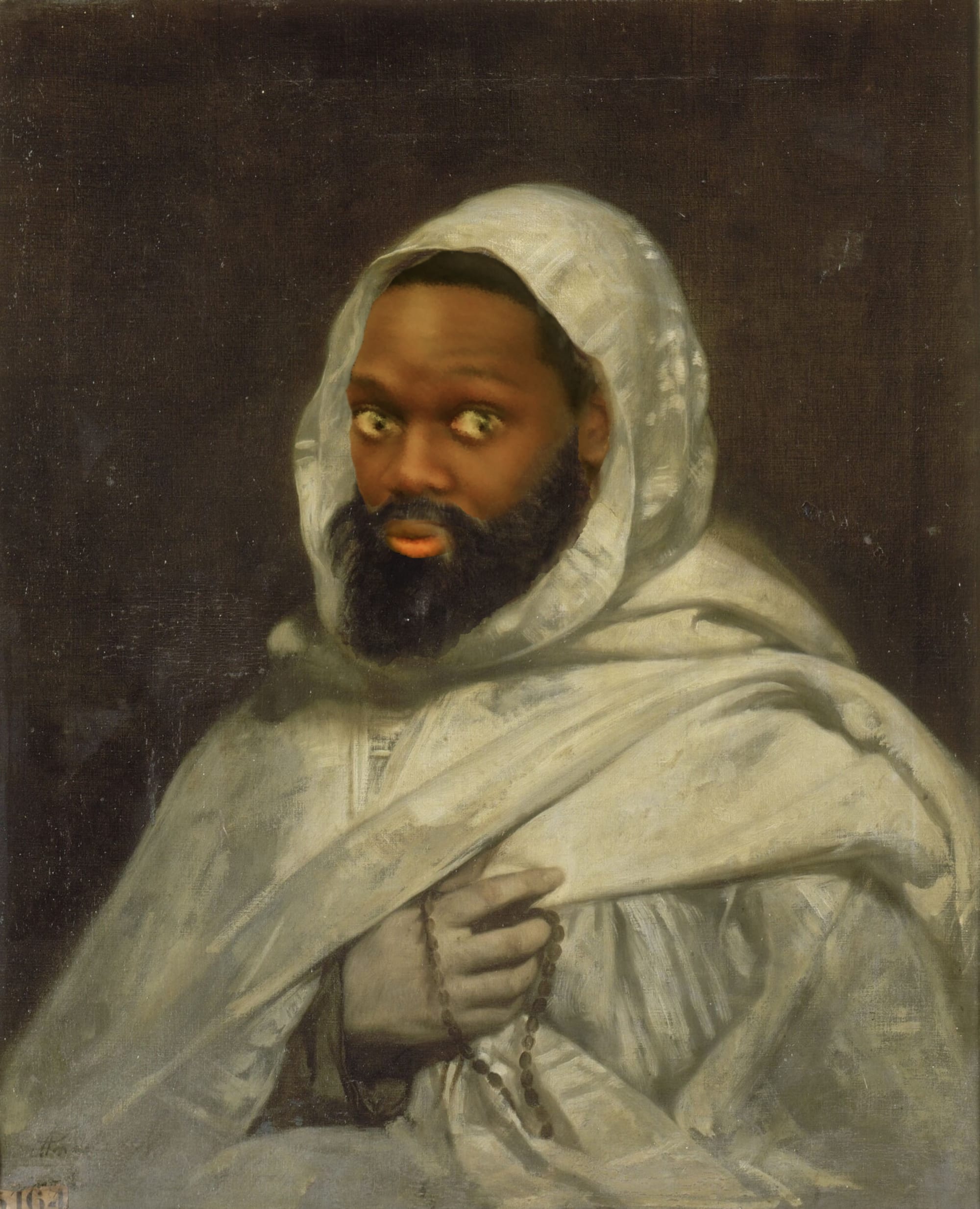
France did something in Algeria it did nowhere else in its empire: in 1848 it declared the settled north an integral part of France, organised into départements and governed from Paris. Land was taken from Algerian owners on a huge scale and sold to European colonists — French, but also Spanish, Italian and Maltese — who by the 1950s numbered around a million against nine million Muslim Algerians. Those Algerians were French subjects but not citizens; they paid special taxes, fell under a separate legal code, and could not vote on equal terms. When crowds marched in the eastern towns of Sétif and Guelma on the day the Second World War ended in Europe, 8 May 1945, French forces and settler militias killed thousands in the reprisals that followed. Many later dated the war of independence from that day.
The war, 1954–1962
On 1 November 1954 a new organisation, the National Liberation Front (FLN), launched coordinated attacks across the country and issued a call for an independent Algerian state. The war that followed was one of the 20th century's most brutal decolonisation conflicts. In 1957 the French army broke the FLN network in the capital during the Battle of Algiers, using systematic torture that was later widely documented; in the countryside, more than two million villagers were moved into controlled camps. The crisis brought down the French Fourth Republic in 1958 and returned Charles de Gaulle to power.
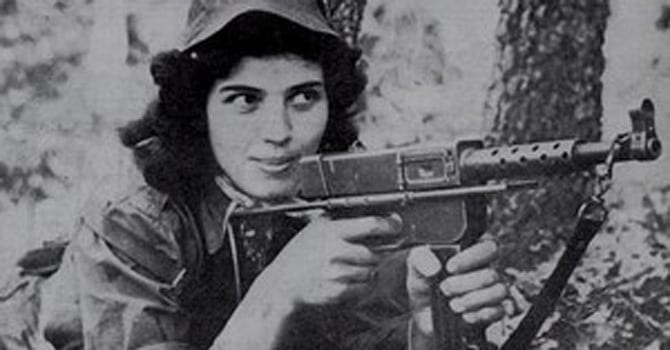
De Gaulle gradually concluded that Algeria could not be held, and moved toward negotiation. Settlers and army officers who felt betrayed staged a failed coup in 1961 and formed the OAS, a group that waged a terror campaign against Algerians and against de Gaulle's government. The Évian Accords of March 1962 ended the fighting; a referendum followed; and Algeria became independent on 5 July 1962, 132 years to the day after the fall of Algiers. Algeria counts around 1.5 million dead; most outside historians put the figure lower but still in the hundreds of thousands. Within months, some 800,000 of the million Europeans left for France, along with a smaller number of Algerian auxiliaries, the harkis; many harkis who stayed were killed.
The republic since 1962
Independent Algeria was a one-party socialist state built around the FLN and the army. Its first president, Ahmed Ben Bella, was overthrown in 1965 by his defence minister, Houari Boumédiène, who nationalised the oil and gas industry in 1971 and used the revenue to fund rapid industrialisation. The system delivered schools, health care and jobs while the money lasted, but by the late 1980s low oil prices, debt and unemployment brought it to a crisis. Riots in October 1988 were put down with hundreds of deaths, and forced the government to legalise opposition parties.
The opening ended in catastrophe. The Islamic Salvation Front (FIS) swept local elections in 1990 and the first round of a parliamentary vote in December 1991. In January 1992 the army cancelled the second round, forced the president out, and banned the FIS. Armed Islamist groups took to the mountains, and for a decade Algeria endured a civil war — the "Black Decade" — marked by village massacres, disappearances and assassinations, in which well over 100,000 people died. President Abdelaziz Bouteflika, elected in 1999, offered the fighters an amnesty that gradually wound the violence down.
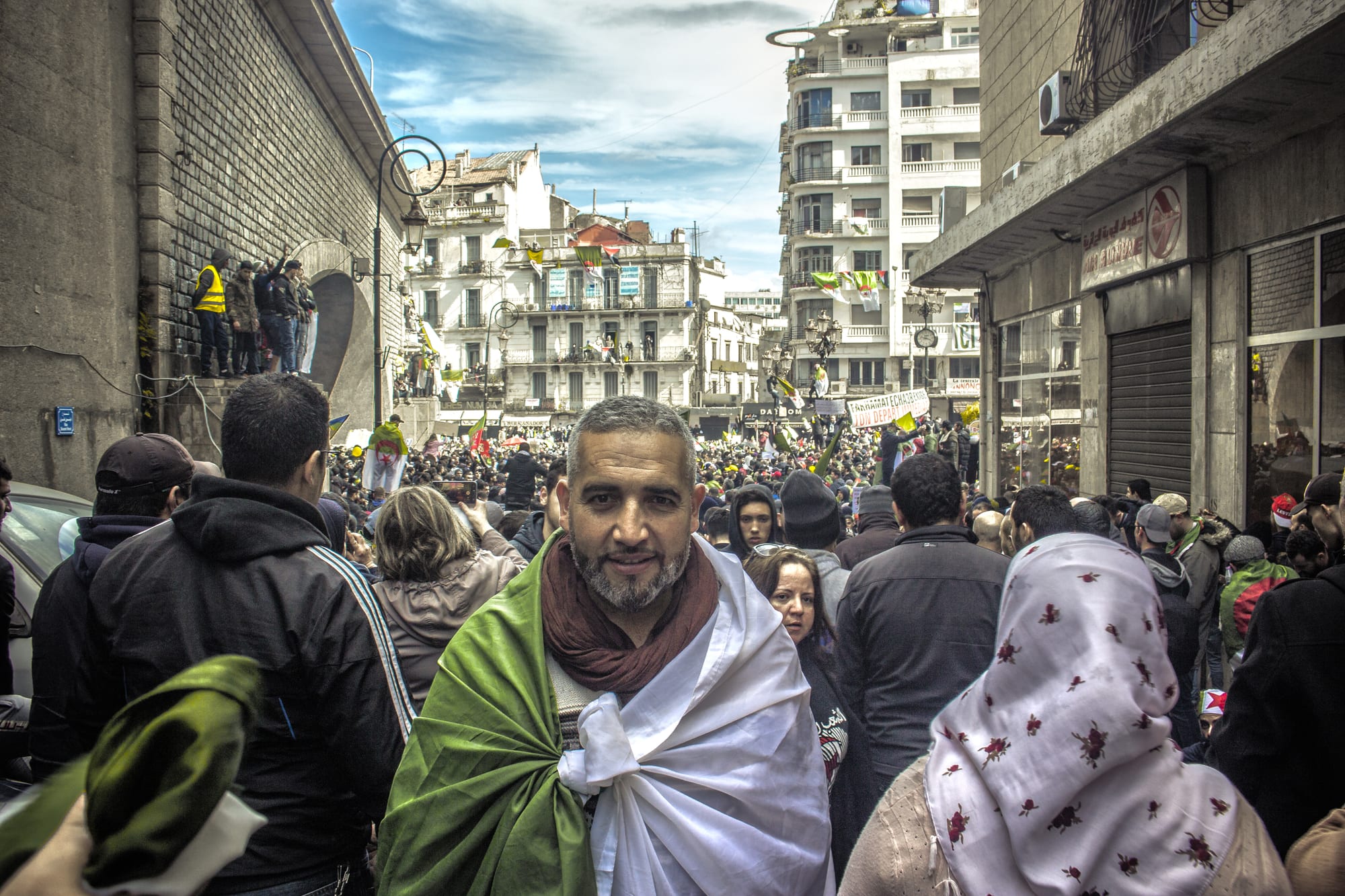
Bouteflika stayed for four terms, propped up by high gas prices in the 2000s. When his circle put him forward for a fifth term in February 2019, despite his being visibly incapacitated by a stroke, millions took to the streets every Friday in a movement called the Hirak. The army withdrew its support, and Bouteflika resigned in April. A new president, Abdelmadjid Tebboune, was elected at the end of 2019 on a low turnout; the protests continued into 2021 before being suppressed.
What holds Algeria together
Every conqueror who held the Algerian coast eventually left, and the same thing was true underneath each of them: the Amazigh language and identity, driven into the mountains and the desert but never erased, and now recognised again as an official language of the state. Modern Algeria rests on two other pillars — the oil and gas that pay for almost everything, and the war of independence, which remains the founding story of the nation and the source of the ruling establishment's legitimacy. The Roman cities still stand on the plains, almost perfectly preserved by the sand, as a reminder of how many times this shore has changed hands.