Daily Life · Syria
Syria: Waiting for Ordinary to Return
A currency stripped of two zeros, checkpoints coming down after decades of fear, and millions of displaced families still weighing whether it is safe to come home since the Assad government fell in December 2024
By Worldlore Editorial · 30 September 2026

An ordinary day in Syria is currently being redefined in real time. Since the Assad government fell in December 2024, the internal checkpoints that once controlled movement between cities have largely come down, a new currency with two zeros deleted from every note began replacing the old one in January 2026, and more than a million refugees have returned home. Syria has stayed out of the war between Israel, the United States and Iran that began in February 2026, though it has spilled over the country's borders and pushed food and fuel prices up again. None of this has erased the underlying hardship: subsidised bread is still queued for, electricity still comes and goes, and millions of families remain scattered abroad or displaced within the country's own borders. Daily life now sits somewhere between the relief at the end of the Assad era, with clashes continuing in several parts of the country, and the slow, uneven work of making that peace feel ordinary.
Family and home life
Family is the central institution in Syrian life, extending well beyond the household to grandparents, aunts, uncles and cousins who function as a real system of emotional and financial support. Where possible, several generations still share one roof, and authority in the household traditionally rests with the father or eldest male, who is expected to provide for the family in turn. Years of war have made this pattern harder to generalise: many Syrian households have been fragmented by conflict, with members scattered between different parts of the country, refugee camps abroad and cities as far off as Berlin or Istanbul. The roughly 1.3 million refugees who returned to Syria in 2025 are only beginning to knit some of those households back together; UNHCR put the number of Syrians still refugees abroad at 4.9 million at the end of 2025, with around seven million more still displaced inside the country.

Work, school and the rhythm of the day
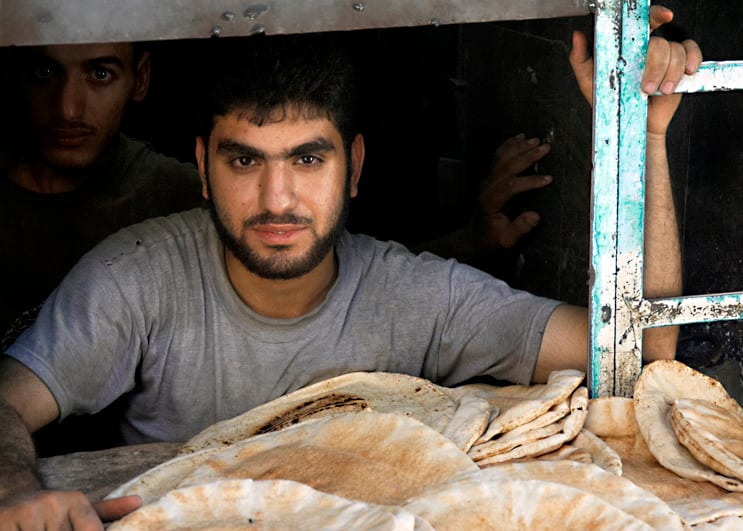
Friday, the Muslim holy day, is the fixed day off nationwide, and many workplaces and government offices also close on Saturday. Beyond that, the working day is shaped less by a schedule than by what services are actually available: state electricity, which in many areas ran for only a couple of hours a day under the old government, has been supplied for longer hours since 2025, though a new tiered tariff introduced in late 2025 pushed household electricity bills sharply higher. Subsidised bread remains a fixture of the daily routine for most families, sold from government bakeries, though its price and the rules for buying it have changed repeatedly. Schools reopened after the areas around them stopped being front lines, but the school system as a whole is still recovering from years of damaged buildings, interrupted terms and teachers who left the country.
Community life and public spaces
Covered souqs like Damascus's Souq al-Hamidiyah remain the real public square in Syrian cities, thick with stalls selling textiles, spices, sweets and dried fruit, and busy with the kind of everyday crowd that a market draws rather than a formal civic space. Mosques and churches anchor neighbourhood life for their respective communities, in a country where Sunni Arabs share cities and, often, city quarters with Alawites, Christians of several churches, Druze, Ismailis, Twelver Shia, and ethnic Kurds, Armenians, Assyrians and Circassians. The most significant recent change to public life is one of absence rather than addition: the network of regime checkpoints that fragmented the country for over a decade, and that were widely associated with arbitrary arrest, has largely been removed from many cities since December 2024, and Syrians can now move between cities such as Damascus, Aleppo and Homs far more freely than at any point in the war.
Free time and weekends
With Friday as the shared day off, weekends centre on extended family visits, a pattern reinforced by how many households have members returning from years abroad or from other parts of the country. Football is followed closely and watched communally, in homes and cafés alike, and weddings and other family celebrations, curtailed for years by war and displacement, are becoming more visible again in cities where the fighting has stopped. For families able to afford it, a trip to see relatives in another city is now a realistic weekend plan in a way it was not before the checkpoints came down.
A visitor's ordinary day
Syria remains a largely cash-based economy in transition: the new, redenominated Syrian pound began circulating in January 2026 and the exchange of the old notes was completed by the end of July 2026, and both banking access and card acceptance are still very limited, so carrying cash, historically US dollars, remains the practical approach. Electricity is unreliable across the country, and shops, restaurants and offices work around power cuts rather than fixed hours. Public transport between cities is by shared taxi and bus rather than rail, and while the fixed checkpoints that once slowed every journey have mostly disappeared from cities, checks still occur on some intercity roads. Visa procedures, like much else in the transitional period, are being reorganised and should be confirmed immediately before any trip rather than assumed from older information.
What to take away
What defines an ordinary day in Syria right now is less any single routine than the sense of a country testing, family by family and city by city, whether the changes since December 2024 are the start of something lasting or just a pause between one hardship and the next.