Culture & Customs · South Sudan
South Sudan: Cattle, Kin and Respect
Some sixty peoples, as many languages and a shared set of courtesies — a firm handshake, a lowered gaze for elders, and an offer of water that should never be refused — in a country where cattle carry wealth, law and poetry
By Worldlore Editorial · 30 September 2026
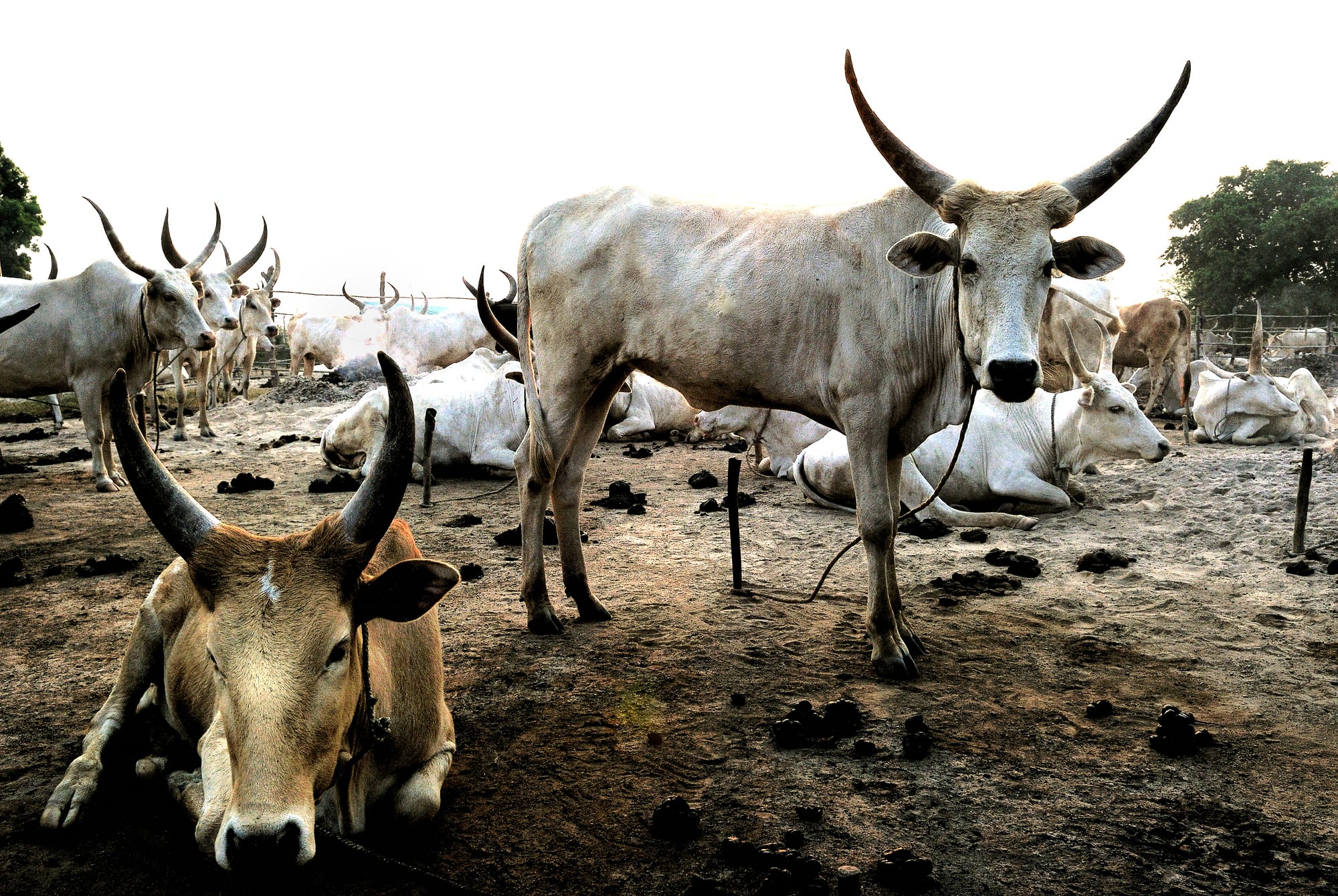
Dusk falls over a cattle camp. The herds have come in from the pastures, smoke rises from smouldering fires, and at the edge of the camp a young man begins to sing. His song, which he composed himself, praises a favourite ox — the curve of its horns, the pattern of its hide — and through the ox it praises the singer and his family. He sings without accompaniment, fast and high, and others listen and judge. Among the cattle-keeping peoples of South Sudan, such songs are part of how young men make their names, and the animals at their centre are far more than livestock: they are wealth, the currency of marriage and of customary law, and a thread that links a person to kin, past and future.
Faith, identity and values
South Sudan is home to more than sixty ethnic groups, often grouped into broad families such as the Nilotic, Bari-speaking, Zande and Central Sudanic peoples. The Dinka are the largest group, with estimates ranging from a quarter to two fifths of the population, followed by the Nuer; the Shilluk, Bari, Azande, Anuak and many others add to the mix, and larger groups are themselves divided into subgroups with distinct dialects and customs. English is the official language and Juba Arabic is widely used in towns, but more than sixty indigenous languages are spoken, and many people speak two or three.
For semi-nomadic, cattle-keeping peoples such as the Dinka and Nuer, cattle sit at the centre of this world. Beyond their value as property, they serve as a currency in customary law: compensation for wrongs and the bride wealth paid at marriage are negotiated in livestock. Farming peoples such as the Zande and Anyuak exchange tools, labour and other goods instead. In some Dinka communities, young unmarried men have traditionally spent the wettest months in cattle camps, growing strong on plentiful milk and composing songs about love, rivalry and the cattle they hope to gather for marriage.
The country became independent in 2011 after decades of civil war with the government in Khartoum. A new conflict broke out in 2013, and a 2018 peace agreement has been implemented only slowly and in part, and fighting intensified again in several states in 2025; large numbers of people remain displaced within the country or live as refugees abroad. These experiences have shaped values that the Cultural Atlas describes as central — resilience, self-reliance, discipline and a strong sense of mutual dependence within the community. For many people, loyalty to their ethnic group, clan and family runs deeper than loyalty to the state, and family matters are kept private to protect a family's good name.
Age brings authority. Elders take part in the highest community meetings, make decisions and lead cultural practices, and to be called old is a compliment rather than a slight. Chiefs and elders also play a central role in resolving disputes under customary law, which varies from one community to another.
Christianity is the majority faith, mainly through the Catholic and Anglican churches, and religion is discussed openly and often. Many people attend church several times a week, and services are full of singing and dancing in local languages. Christian practice is frequently interwoven with older beliefs: traditional religion includes the veneration of ancestors and spirits and, among some peoples, a creator known by a particular name, such as Nhialic among the Dinka and Kuoth among the Nuer. A small Muslim minority lives mostly in towns and generally follows a less conservative interpretation of Islam than is common in Sudan to the north; because of the country's history, religious proselytising, particularly for Islam, can be a sensitive matter. Attitudes to alcohol vary: beer and local brews are drunk in some places, while in many communities drinking is frowned upon, particularly for women.
Greetings and meeting people
A handshake is the standard greeting, and withholding a hand can be taken as a sign of disrespect. A pat on the shoulder may come first, close friends and relatives often embrace, and women who know each other well may exchange kisses on alternating cheeks. When greeting an elder or someone of higher standing, it is respectful to bend or even kneel, and to lower the eyes. Direct eye contact with elders and superiors can be read as rude; short, occasional glances are more appropriate.
First names are generally acceptable, but elders, teachers and religious leaders are addressed with more formality, and superiors with a title and surname. Because so many families have links to the armed forces, "comrade" is also heard as a form of address. Greetings in local languages vary from people to people, and each community has its own formulas for asking after a person's health and family.
Communication varies with the relationship. With strangers, people tend to be indirect and guard their privacy; among friends and family, speech becomes more straightforward. Humour is usually built on stories and shared situations rather than sarcasm, which may be taken literally, and jokes are kept out of serious discussions. Two gestures differ from what many visitors expect: pointing at someone with a single finger is impolite and can suggest hostility, so a closed fist or even the tongue may be used instead, and a nod downwards means yes while a movement of the head upwards means no.
Hospitality and being a guest
Visiting is one of the main ways relationships are built and repaired. Friends and relatives may call without warning, although longer stays are arranged in advance, and a small gift is a thoughtful gesture. Shoes are removed at the door, and the male head of the household is greeted first.
A guest is offered water on arrival, followed quickly by tea or coffee, and turning these down is considered rude. The same goes for food: guests are served first, and declining what a host offers can cause real offence. In many households the father eats before the rest of the family, and in some communities men and women eat separately, while children may eat apart or earlier. Eating alone is discouraged, and chewing is done quietly. A distinguished visitor may be honoured with goat, sheep or chicken, and for a guest of very high standing a bull may be slaughtered. The left hand alone is not used for passing things or gesturing; the right hand, or both, is correct.
Festivals and life's big moments
The public calendar mixes faith and recent history. Christmas and Easter are the main Christian festivals, and Eid al-Fitr and Eid al-Adha are public holidays for the Muslim minority. Independence Day on 9 July marks the birth of the state in 2011, Martyrs' Day on 30 July marks the death of the SPLA leader John Garang in 2005 and remembers those who died in the struggle, and 16 May marks the founding of the Sudan People's Liberation Army in 1983.
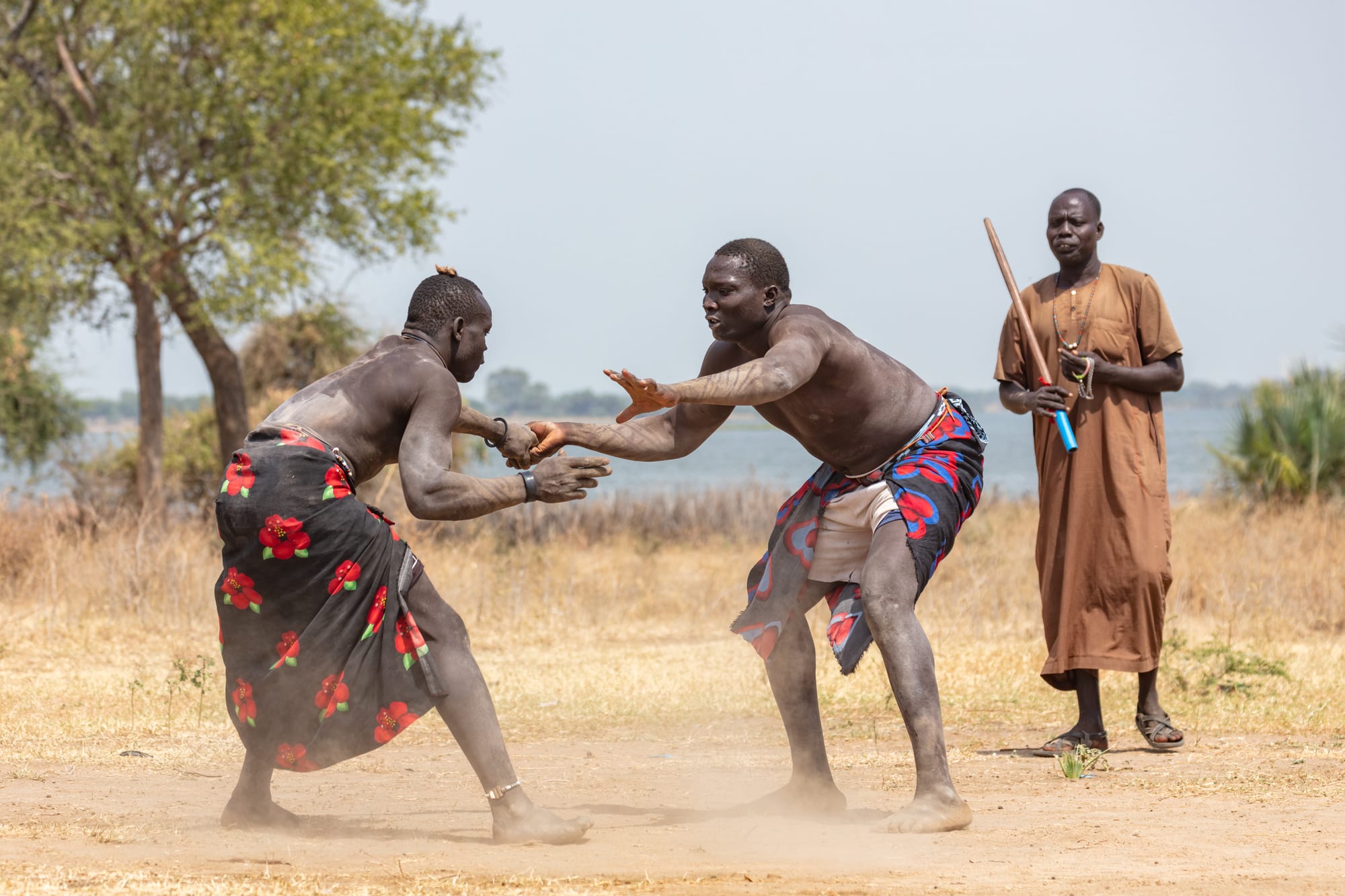
Some of the largest gatherings are sporting ones. Traditional wrestling is popular among several peoples, including the Dinka and Mundari, and in the dry season matches between villages or sections draw big, vocal crowds. Wrestlers may appear with ash on their bodies and faces. The sport has also been used to bring rival communities together: in 2016, a week-long "Wrestling for Peace" tournament at Juba Stadium matched teams from different ethnic groups, including the Mundari and Bor Dinka, whose communities had a history of conflict over cattle and pasture.
Marriage joins two families rather than two individuals, and it requires the approval of both sets of parents. Among cattle-keeping peoples, the groom's family pays bride wealth to the bride's family, traditionally in cattle; the number can run to around a hundred cows, while in farming communities it may take other forms, including labour. Because bride wealth involves so many relatives on both sides, divorce is rare and complicated. Polygyny is practised, and after marriage a wife usually joins her husband's household.
The extended family is the foundation of society. Younger generations are expected to care for older relatives as they age, orphaned or widowed relatives are taken into the household, and the discipline of children is a shared responsibility. Society is strongly patriarchal, with men traditionally the decision-makers and women responsible for the home and the crops, although the many women widowed by conflict have taken on wider roles.
Death is surrounded by obligations to both the dead and the living. Across many communities, relatives gather around a person who is dying, the body is washed, and burial takes place close to the family homestead, sometimes after several days. Carrying out the proper rites is regarded as essential: a burial done badly is believed to bring misfortune on those left behind. Customs then vary widely from one people to another. Scarification, once common as a mark of initiation or group identity, remains culturally significant but has been declining.
Arts, crafts and music
Much of South Sudan's artistic life is oral and performed. Among the Dinka, young men compose songs in praise of their oxen, drawing on a rich vocabulary of terms for the colours and patterns of cattle hides, and men may take the colour name of a favourite ox as their own. Most songs are forgotten after a season, but the work of celebrated composers can travel far across the floodplains, and singers are admired for their voices as much as for their verses. Songs are also composed about courtship, rivalry and disputes between clans.
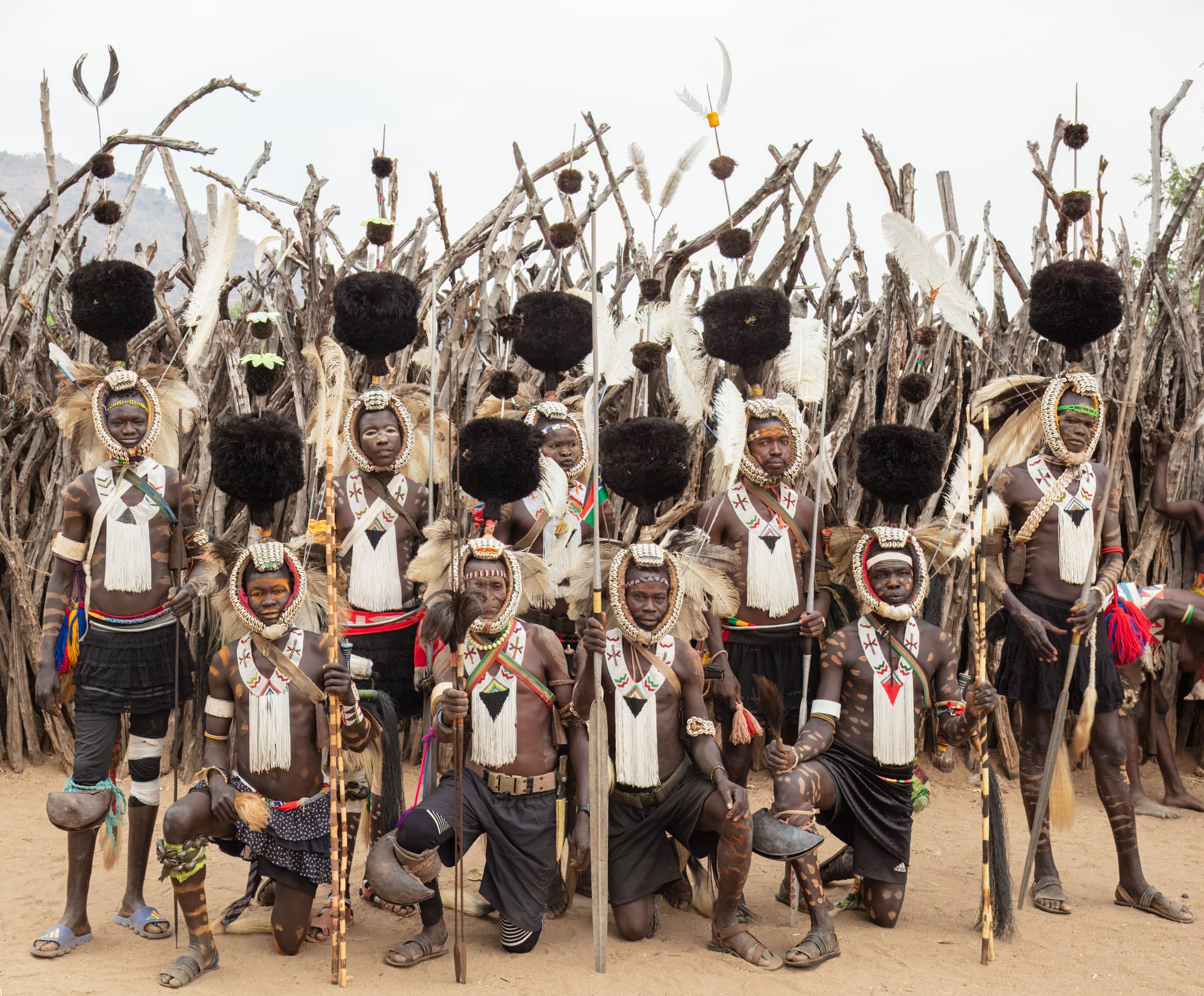
Dance and dress are strong markers of community identity. At cattle camps, young men decorate themselves with ash and ochre, and after wrestling matches opponents may dance and eat together. Church music, sung and danced in local languages, is another living tradition, heard at services several times a week. South Sudan ratified UNESCO's convention on intangible cultural heritage in 2016 and has begun inventorying its traditions and preparing nominations.
Dos and don'ts for visitors
- Do check the latest government travel advice before any trip; most governments advise against all travel to South Sudan because of armed conflict, inter-communal violence, crime and the risk of kidnapping.
- Do shake hands with everyone when greeting, and bend slightly and lower the eyes when greeting elders.
- Do accept the water, tea or food a host offers, since refusing is considered rude.
- Do remove shoes when entering a home and greet the head of the household first.
- Do use the right hand, or both hands, to pass and receive things.
- Don't point at people with a single finger, and remember that a downward nod means yes and an upward one means no.
- Don't drink alcohol openly in company where it may cause offence, as many communities frown on drinking.
- Don't photograph people without asking their permission first.
What to take away
South Sudan's many peoples differ in language, faith and custom, but most share a code of courtesy built on respect for elders, loyalty to kin and generosity to guests — a code that has endured through long years of hardship.