Culture & Customs · São Tomé and Príncipe
São Tomé and Príncipe: Charlemagne on Trial
A Catholic country that still pours palm wine for its ancestors, a greeting that always asks after the family, and a centuries-old European tragedy staged in the open air until an emperor's son is found guilty
By Worldlore Editorial · 30 September 2026
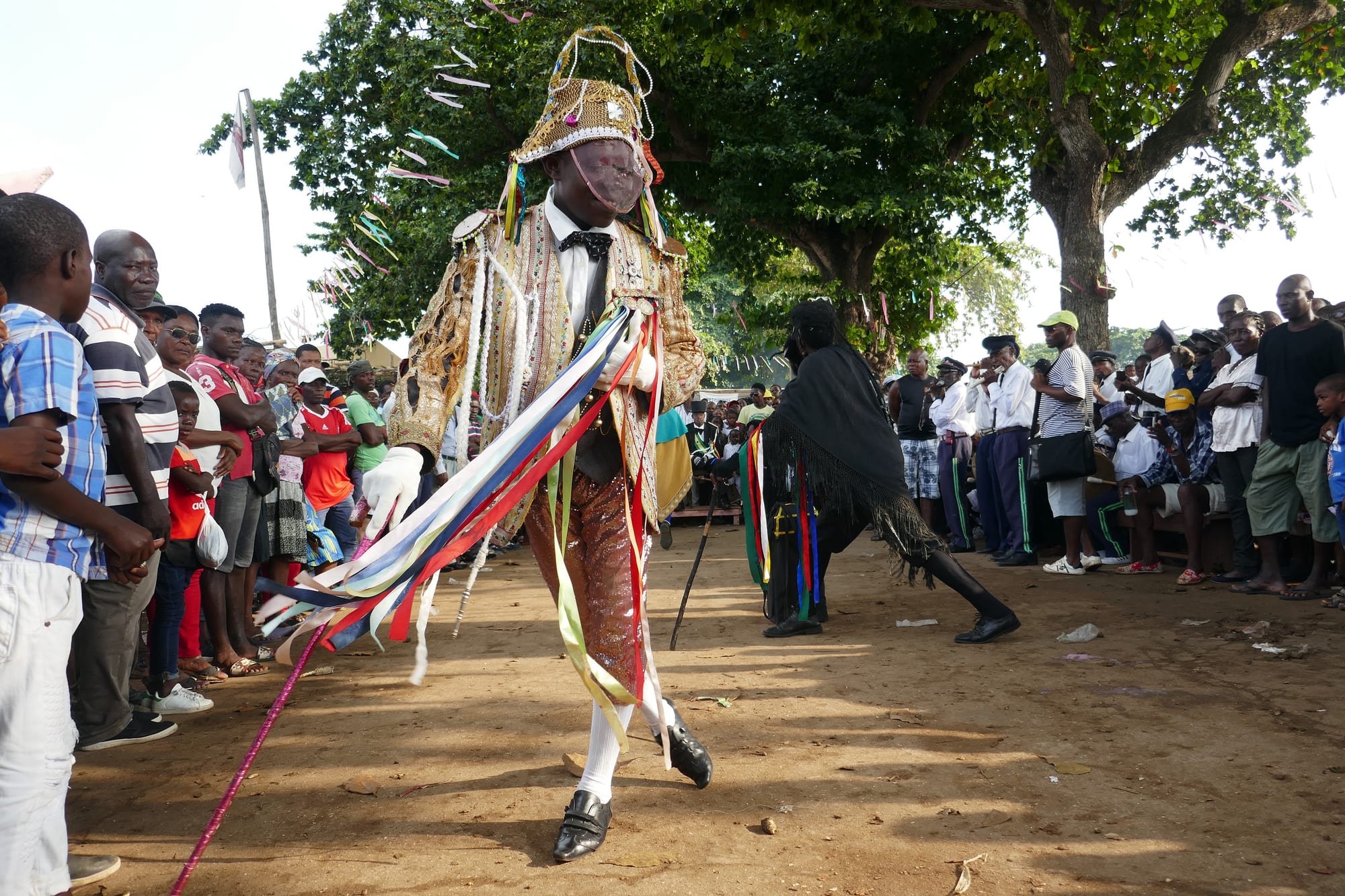
On a patch of bare, sandy ground, a crowd has been gathering since early afternoon. Some stand with their arms folded, others sit on the earth. Flutes and drums strike up, and figures step into the open space in black frock coats hung with ribbons, their faces hidden behind small painted masks of white netting. An old emperor with a cotton-wool beard sits on a makeshift throne. Over the next several hours a murder will be investigated, argued over and judged, and the emperor's own son will be found guilty. The play is a European tale of the court of Charlemagne, centuries old, but nothing about the afternoon feels borrowed. The audience comments, laughs and draws its own parallels with the news of the day, and the story of justice owed even by the powerful has long since become São Tomé and Príncipe's own.
Faith, identity and values
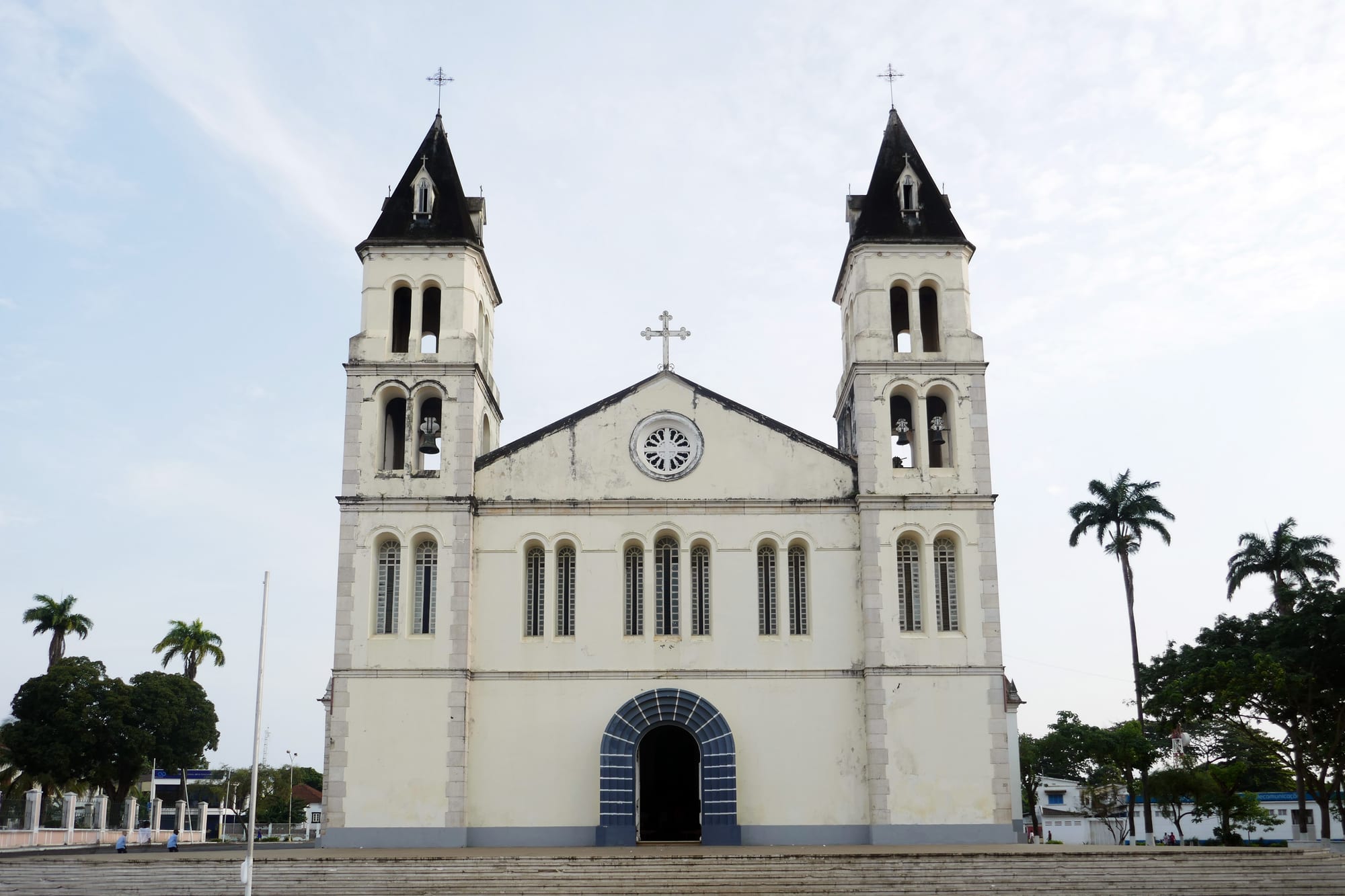
The islands were empty when Portuguese ships arrived in the fifteenth century, and the society that grew up there was formed by settlers and, above all, by Africans brought from the mainland to work the plantations. Catholicism has been present from the start. The Catholic bishop's office has recently put the Catholic share of the population at around 54 per cent, down from earlier estimates as high as 85 per cent, with Protestant churches, among them Seventh-day Adventists and Methodists, forming the next largest group and Muslims a small minority. The country has a single Catholic diocese, and lay religious brotherhoods and sisterhoods play a large part in parish life, organising the feasts of the patron saints.
Alongside the church runs a deeply held set of beliefs derived from the religions of the African coast, and many Christians hold to aspects of both without contradiction. The spirits of the dead are understood never to be fully cut off from the living, who have a duty to remember them and keep them content; misfortune in a family is often put down to a spirit that has been forgotten or neglected. The djambi is the best known expression of this world: a healing ceremony at which a whole neighbourhood or village gathers through the night to drum and dance, and at which healers enter a trance before treating the sick. People may also consult a ritual specialist for protection, for health or for luck in love, and traditional herbal healers and masseurs are still consulted for illness.
Society is Creole and proud of it. The Forros, descendants of the free African population of the colonial era, have long been seen as the core of national identity; the Angolares form a distinct community with their own creole; and descendants of the contract labourers brought from Angola, Mozambique and Cape Verde make up much of the rest. Some of the labels used between these groups have carried a disparaging edge. Over all of this sits leve-leve, "easy-easy", the phrase often described as the national motto: a carefree, unhurried approach to life.
Greetings and meeting people
Manners matter. Greeting a person properly and asking after their health and their family is regarded as an essential part of any encounter, and going straight to the point without it can seem abrupt. The Portuguese greetings of the time of day, bom dia in the morning, boa tarde in the afternoon and boa noite in the evening, open most conversations, and Portuguese is understood almost everywhere; at home many people also speak a Portuguese-based creole, Forro being the most widely used. A few words of Portuguese go a long way.
Age commands respect. Older men and women are treated with particular deference, all the more so if they have many children and grandchildren, and it is the elders who are regarded as the keepers of tradition: the stories, the dance steps and the knowledge of the rituals are still passed on largely by word of mouth, from the older generation to the younger.
Hospitality and being a guest
The big occasions of family life are marked with food, and plenty of it. At weddings, baptisms and funerals the host family lays a generous table in the Portuguese manner, with a large array of dishes set out together, and those who can afford it serve roast goat, chicken or beef. The spread is a statement of respect for the occasion and for the guests, and it is the gathering around it, as much as the meal, that counts.
Palm wine is the everyday local drink, but it is also an offering. Before a tchiloli performance, one of the actors and his family prepare food and palm wine, and at religious festivals these are carried to the chapel. There the leader of the group pours palm wine before the statue of the saint, around the chapel and in the lanes and yards nearby, calling the ancestors by name and making the sign of the cross as he goes. It is a small ceremony that sums up much about the islands: a Catholic saint and the family's own dead honoured in the same act, with the same drink that is shared among the living.
Festivals and life's big moments
Independence Day, on 12 July, is the biggest celebration of the year, marking the end of Portuguese rule in 1975. On 3 February, Martyrs' Day remembers the victims of the 1953 Batepá massacre, and Labour Day falls on 1 May. The Catholic calendar supplies the rest, above all the feasts of patron saints, organised by the brotherhoods and often the occasion for a tchiloli or a danço-congo, most of all during the gravana, the cooler dry season in the middle of the year.
Príncipe has its own great festival. In mid-August, around the feast of São Lourenço, the island stages the Auto de Floripes, a street play in which a large part of the community takes part, and the story unfolds through the streets of the island's small capital: Charlemagne and his twelve peers of France at war with the Moorish admiral Balan, combat between the knight Oliver and Balan's son Fierabras, and at last Floripes, Balan's daughter, who falls in love, becomes a Christian and saves the knights.
Family milestones follow the Catholic rites. Baptism and the wake, followed by a funeral mass, are the most important of them. Christian marriage carries the most prestige, but customary unions, in which a couple live together without a church wedding, are far more common. After the death of an adult, the family keeps the nozado, a week of mourning in which relatives and friends gather at the house every night to eat, drink and keep one another company. Elders tell traditional stories, riddles are traded and cards are played, and the nozado has long been one of the main settings in which the islands' oral tales are handed down. When a family believes that a dead relative lies behind some misfortune, it may also hold a puíta in that person's honour, a dance with its own music that is meant to reach the spirits.
Arts, crafts and music
The tchiloli remains the defining art of São Tomé. Each company, known as a tragédia, has around thirty members drawn from a particular locality, and the main roles are handed down within families. Performances typically open with a ritual, and then unfold in the round on open ground over several hours, marked out by flutes, drums and sucalos, basket rattles filled with seeds. The costumes are made by the performers' own families, who rework ribbons, upholstery fabric, mirrors and glasses into the finery of a European court, and the masks, smaller than the face, are cut from mosquito netting painted white, with eyes and a mouth added. At the heart of the play is a public trial in which the emperor's son is judged and convicted despite his rank, and UNESCO describes it as a living expression of social justice and equality before the law. The skills are taught in schools as well as within families and companies.
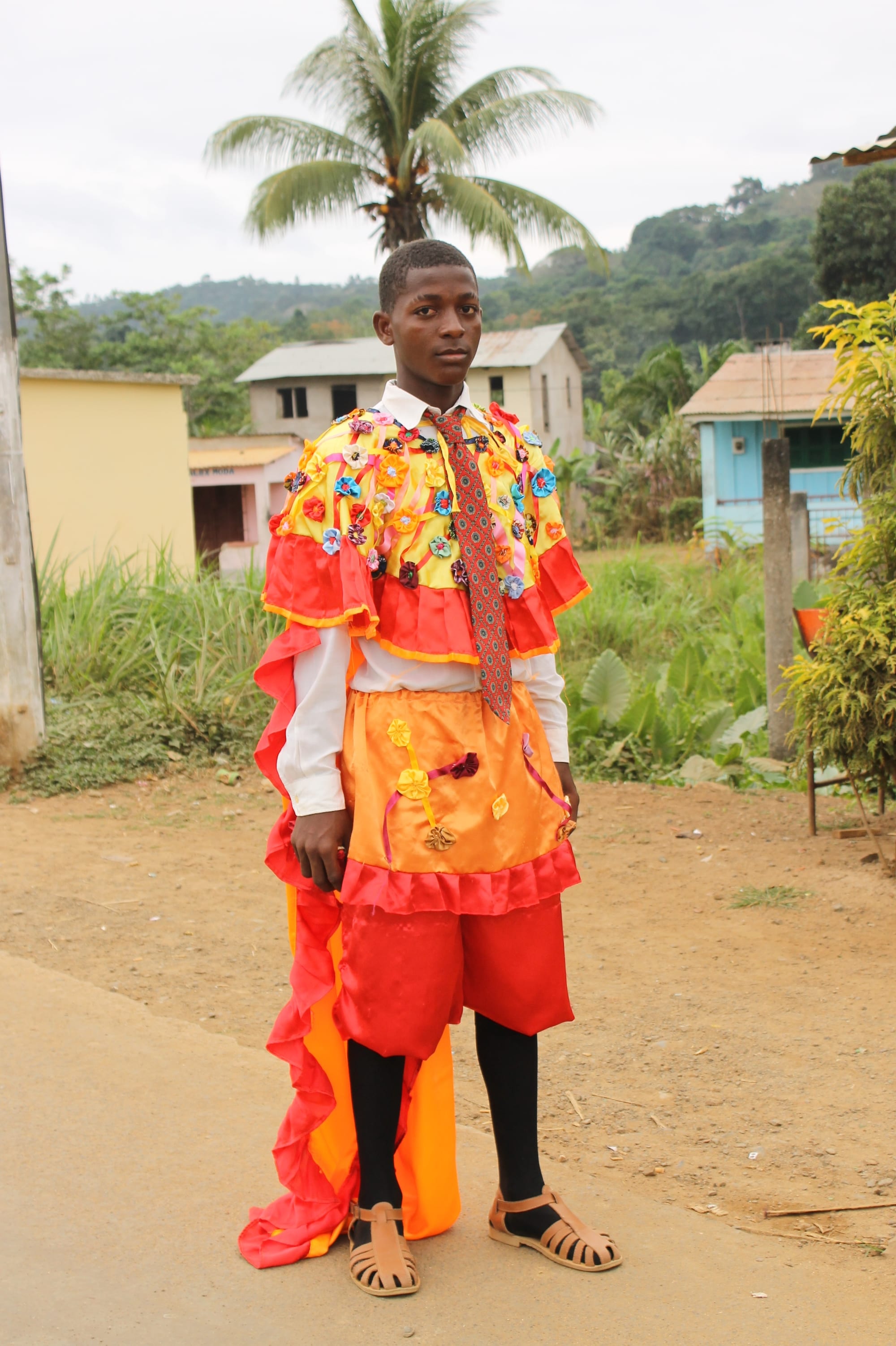
Other performance traditions draw more directly on the African inheritance. The danço-congo, a folk pageant of drumming and dance, is performed at festivals and, like the puíta, is also understood as a way of making contact with the spirits. The ússua is a dance and musical style that took shape in the early twentieth century, played by an orchestra mixing European accordions with African drums; the men dance in straw hats with an embroidered towel over one arm, and the women in skirts with a shawl. The socopé, whose name is usually explained as "só com o pé", "only with the foot", is of uncertain origin, and the puíta, also known as semba, is among the most popular rhythms of all.
In the decades either side of independence, dance bands such as Africa Negra and Os Leonenses, led for more than half a century by Pedro Lima, built a vibrant live scene on these island rhythms, with a lead singer answered by a small chorus of harmonising voices. In literature, poetry has been the strongest form, and poets such as Francisco José Tenreiro and Alda do Espírito Santo gave the islands a voice in Portuguese.
Dos and don'ts for visitors
- Do greet people with the right time of day and ask after their health and family before anything else.
- Do show particular respect to older people, who are regarded as the keepers of tradition.
- Do learn a few words of Portuguese; it is understood almost everywhere and the effort is appreciated.
- Do settle in if a tchiloli or danço-congo is being staged: performances run for hours, with the audience standing or sitting around the open ground.
- Do treat a djambi, a nozado or a puíta held for the dead as a religious or family occasion rather than a spectacle.
- Don't use ethnic labels for people; some have carried a disparaging edge.
- Don't expect things to run to a tight schedule; the leve-leve pace is best met with patience.
What to take away
São Tomé and Príncipe weaves a Catholic calendar, a lasting bond with the ancestors and a medieval European tragedy into something entirely its own, and visitors who take the time to greet people properly and to watch the islands' long, unhurried performances will find themselves warmly received.