Culture & Customs · Saint Barthélemy
Saint Barthélemy: Kiss-Me-Not Bonnets and Candlelit Graves
A small, Catholic and thoroughly French island whose old families still speak a patois carried from western France, keep their saints' days by the harbour, remember a Swedish century and light candles for their dead each November
By Worldlore Editorial · 30 September 2026
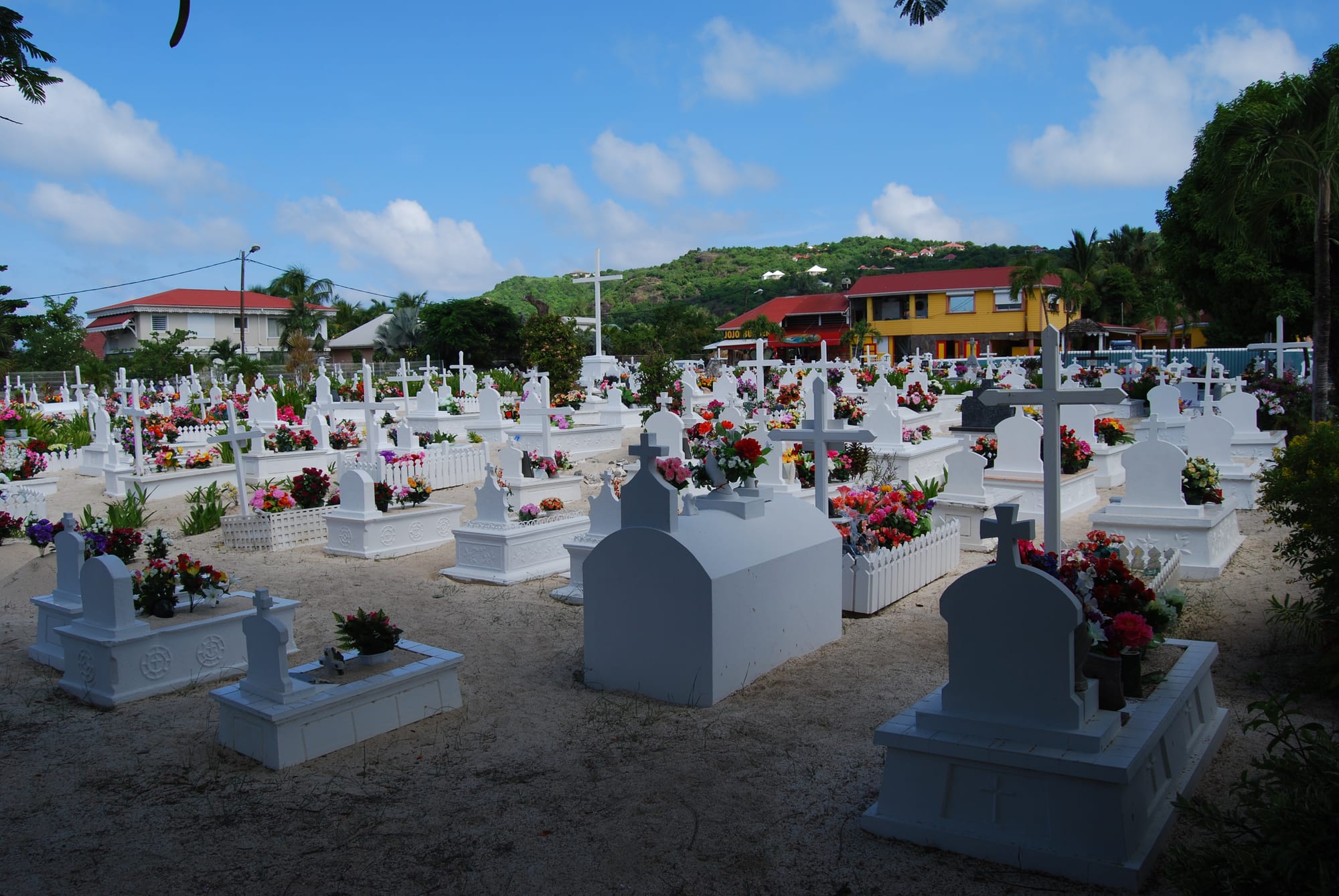
On the evening of 1 November, the island's cemeteries fill with people. Families of every age move between the white tombs and crosses, pulling weeds, washing the stone, arranging fresh flowers and setting out candles before the light goes. As darkness falls, small red and white flames light up the graves. A mother steadies a candle while her young daughter places it at the foot of a large white cross; nearby, quiet prayer gives way to conversation, as relatives swap news and memories in the flickering light. All Saints' Day on Saint Barthélemy captures the character of its old island families: Catholic, close-knit, loyal to the dead, and holding on to customs that many visitors find they have lost at home.
Faith, identity and values
Saint Barthélemy is Catholic by tradition and French in its institutions, language and schooling. The families whose roots go back furthest on the island descend from settlers of Breton, Norman, Poitevin, Saintongeais and Angevin origin who arrived from the seventeenth century, and many of their customs, words and religious habits can be traced back to the villages of western France.
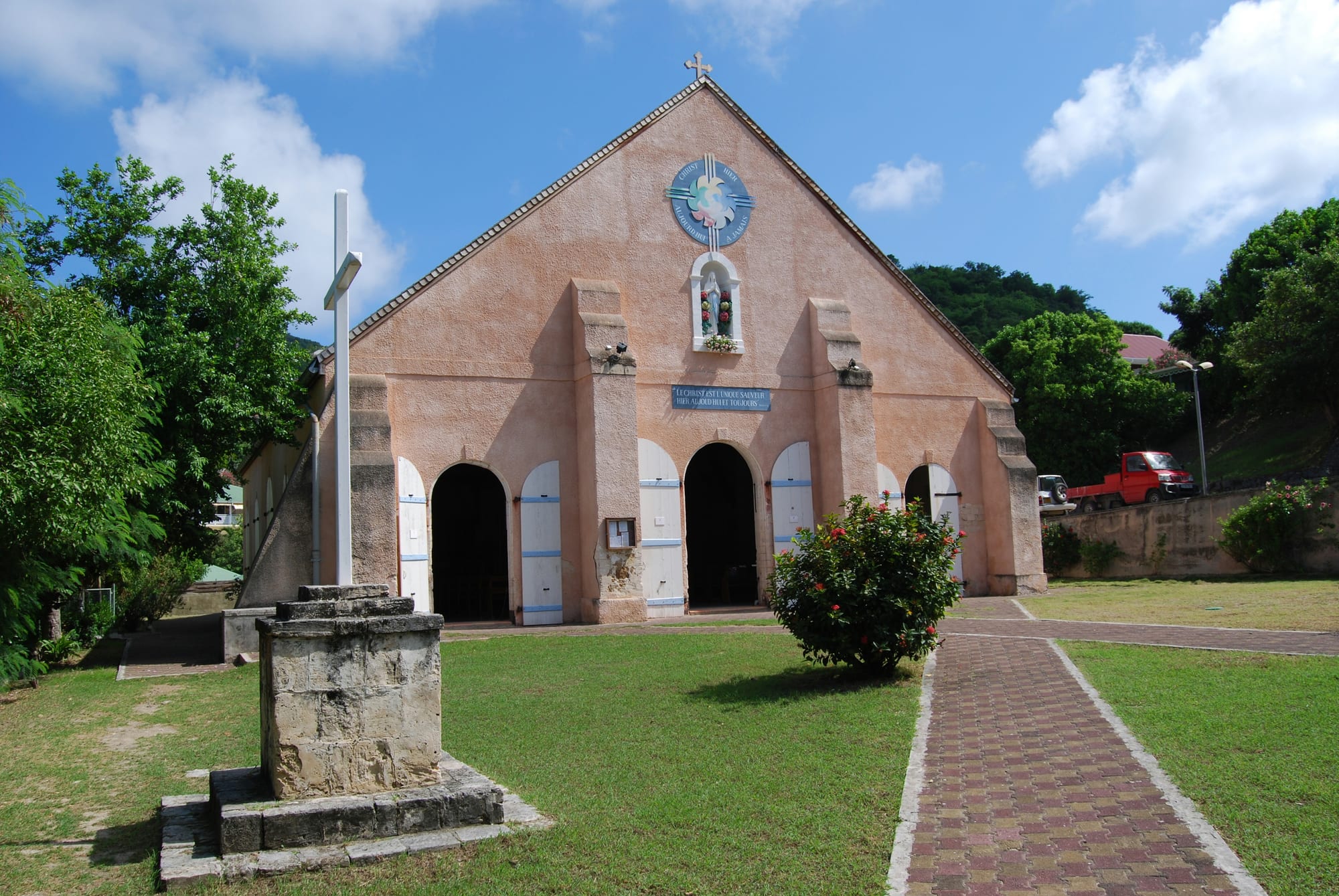
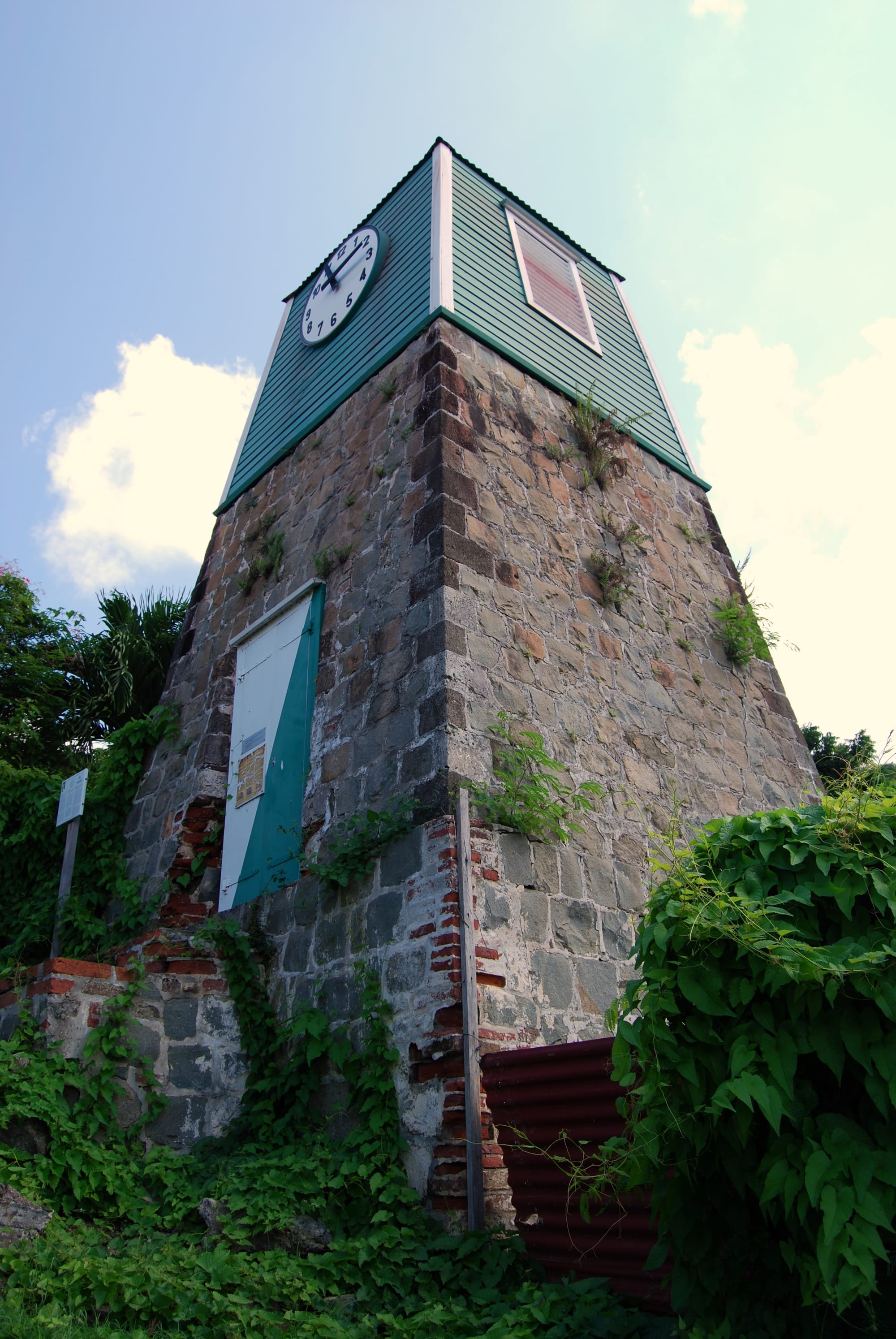
The island's churches tell its unusual story. The Catholic church of Lorient was built around 1850, during the Swedish period, and French heritage records describe it as a rare witness to that era; its bell was cast in Nantes in 1860, and its bell tower, standing close to the sea, served as a landmark for sailors. The Swedes themselves left a stone bell tower in the capital, built in 1799 to replace the old tower of the Lutheran church of Sophia Magdalena. According to the heritage plaque beside it, that wooden church, inaugurated in 1787, was open to Lutherans, Anglicans, Catholics and Methodists alike before a hurricane ruined it. The bell called the faithful to services, and older residents still remember it ringing at six in the morning and eight at night.
The Swedish century, from 1784 to 1878, is still marked in public life. Since the late 1970s the island has been twinned with the Swedish town of Piteå, and the link is celebrated every year.
Language is at the heart of local identity. The linguist Julianne Maher has described four distinct vernaculars on an island of barely 10,000 people: a French patois on the leeward side, a Creole on the windward side, a variety known as Saline French in the centre, and an English spoken in the capital since the Swedish era. Standard French has steadily gained ground, Saline French may already be gone, and the others are in decline as families mix and young people grow up speaking the French of school. Yet interest remains strong: plays performed in patois and Creole by the local troupe Raconte-moi Saint-Barth draw overflowing audiences, and a cultural association has sought volunteers to teach the rudiments of both to children and adults.
Greetings and meeting people
Everyday courtesy follows French norms. A "bonjour" is expected when approaching a counter or speaking to anyone providing a service, and it is considered rude not to greet everyone on arriving and again on leaving. Among friends and relatives, the usual greeting is la bise, touching cheeks and making a light kiss on each side, and it is polite to take off sunglasses or a hat to do it. With acquaintances and in business, a handshake is the norm, offered to everyone present.
Respect is shown through forms of address. Women are addressed as "Madame" whatever their marital status and men as "Monsieur", and elders and people met in formal settings are addressed by title and surname until they suggest moving to first names. French is the language of daily life, though English is widely spoken wherever visitors are received, and a few words of French are always welcomed.
Hospitality and being a guest
Invitations to a private home come with French expectations. Guests usually arrive a little after the stated time for dinner, rather than early, and bring a small gift of good quality for the host, most often a bottle of wine. They are expected to dress well. Arriving unannounced is considered disrespectful, so visits are arranged in advance.
At the table, the meal begins with "bon appétit", and wine is treated with respect rather than simply drunk. It is polite not to talk with food in one's mouth and generally frowned upon to leave food on the plate, particularly in someone's home.
Festivals and life's big moments
Carnival opens the festive year. On the eve of Mardi Gras, a pyjama parade winds through the streets at night, and on Mardi Gras itself floats set out through the capital, each carrying an island association whose members have spent months on their feathers, costumes and choreography, stopping to dance at points along the route. On Ash Wednesday the season ends with the burning of Vaval, the carnival king, whose effigy is carried to the beach to the sound of drums and set alight.
Late August belongs to the island's saints. The feast of Saint Barthélemy on 24 August begins with a mass for the island's sailors and a procession, followed by a ceremony at the war memorial; the afternoon brings children's games and dominoes on the quayside, and the evening a public dance and fireworks. The next day, a fishing village keeps the feast of its own patron, Saint Louis, with an early fishing contest, a morning mass, card games and table football, a shared lunch and a firework display to end the day. Traditional bonnets are still sometimes worn on festive occasions.
November brings Piteå Day, the feast of the Swedish twinning, which the island has celebrated every year since the twinning was agreed in 1977–78. Races are part of the festivities, among them the Gustavialoppet road race into the capital, and in 2011 the mayor of Piteå presented the island with a sundial made for the occasion. January, meanwhile, belongs to the St Barth Music Festival, one of the island's major cultural events, which brings orchestral musicians, singers and conductors from around the world to perform in its churches and runs workshops for young local musicians.
The great moments of family life follow French and Catholic custom. Marriages are legally made at the town hall, as everywhere in France, and baptisms and funerals take place in the island's churches. Mourning once had its own dress: the island's traditional bonnets were made in black for mourning and in black patterned with white for half-mourning. Remembrance of the dead reaches its peak on All Saints' Day, when families gather at the graves.
Arts, crafts and music
The traditional bonnet is the island's emblem. Its later form, the calèche, came in two main types: the calèche à platine, wide and made of braided strips of fabric sewn in vertical lines, and the calèche à bâtons, a cotton bonnet stiffened with thin strips of card or wooden rods. In time, many women exchanged the calèche for hats woven from the leaves of the latanier palm, and weaving straw hats and baskets became a craft in its own right. Other hat styles followed and became popular in several of the island's districts.
Music runs from church choirs and carnival drums to the classical concerts of the January festival, which has become a fixture of island life over several decades. The patois and Creole theatre of Raconte-moi Saint-Barth shows that the island's old languages can still fill a hall.
Dos and don'ts for visitors
- Do say "bonjour" before asking for anything, and greet everyone when arriving and leaving.
- Do address people as "Madame" or "Monsieur", and use surnames until invited to do otherwise.
- Do take off sunglasses or a hat when greeting friends with la bise.
- Do bring a small gift of good quality, such as a bottle of wine, if invited to a home, and arrive a little after the stated time.
- Don't call on anyone unannounced; visits are arranged in advance.
- Do behave quietly and respectfully in cemeteries, especially around All Saints' Day, when families tend their graves.
- Don't carry or use illegal drugs; French law applies and penalties are severe.
What to take away
Behind its glamorous reputation, Saint Barthélemy is a small community of old families, saints' days and remembered languages, and visitors who greet people properly and respect its quieter traditions will find a warm and distinctive island culture beneath the surface.