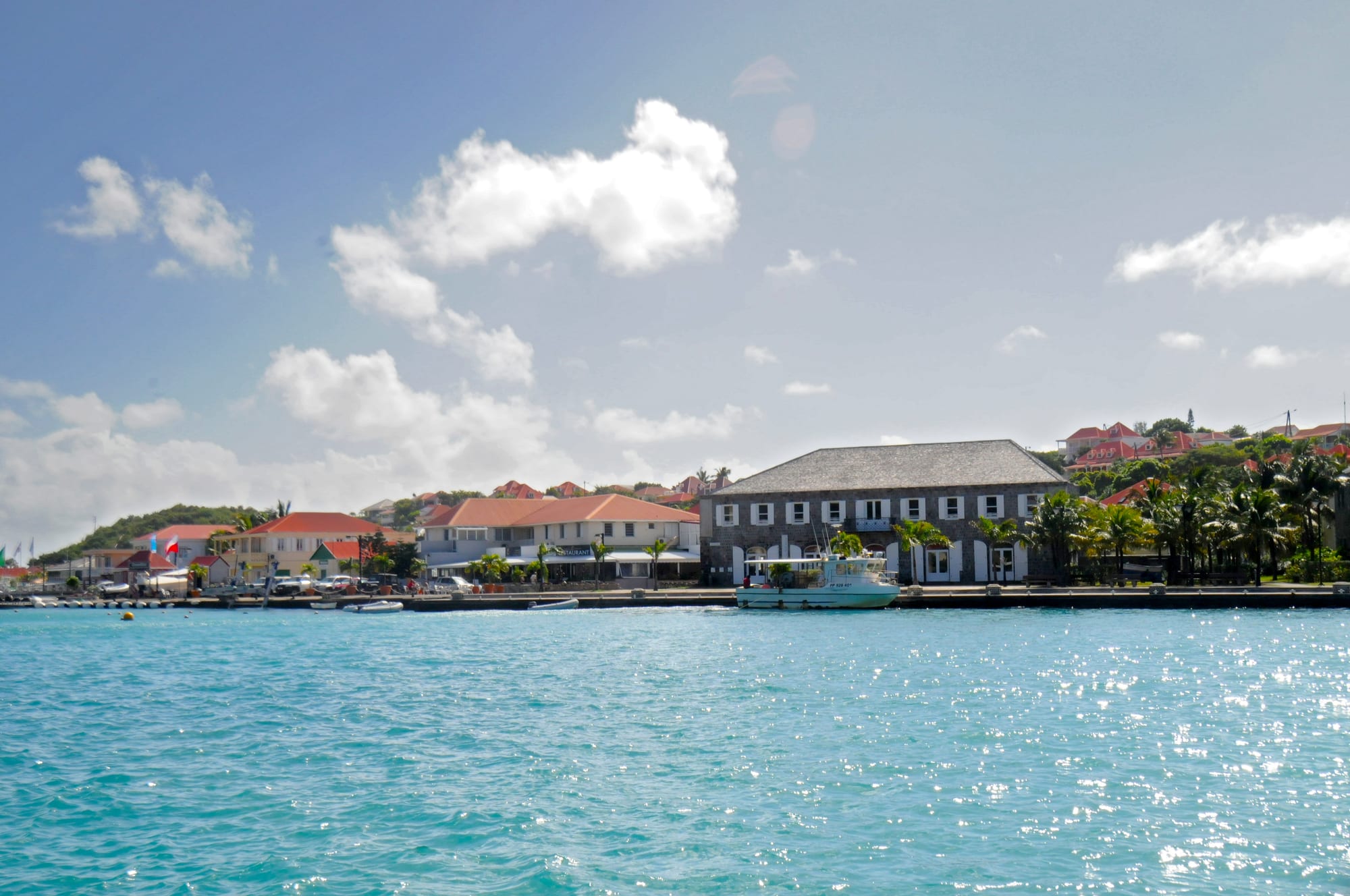
A narrow harbour full of yachts, ringed by red-roofed white buildings climbing green hills, seen from the water

Saint Barthélemy

Gustavia, the harbour town and capital, named for a Swedish king and still laid out on its 18th-century plan. (David Broad / Wikimedia Commons · CC BY 3.0)

A small, dry, hilly island in the northern Leeward Islands, an overseas collectivity of France — once Swedish, now a byword for discreet luxury, with a yacht-filled harbour at Gustavia and a scatter of fine beaches.

Explore Saint Barthélemy

History

Columbus named the island in 1493 for his brother Bartolomeo. Too dry and rocky for plantations, it was settled from the 1650s by poor French families from Normandy and Brittany who lived by fishing, salt, and subsistence farming. Because there was little plantation agriculture, slavery played only a minor role, and the island retained a large population of white, French-descended smallholders with their own customs and dress.

In 1784 France ceded Saint Barthélemy to Sweden in exchange for trading rights in Gothenburg. Sweden made Gustavia — named for King Gustav III — a free port and ran the island for nearly a century before selling it back to France in 1878. It was then administered as a dependency of Guadeloupe.

American visitors, beginning with the Rockefeller family in the 1950s, and later a wider jet-set crowd, discovered the island and shaped a deliberately low-density, high-spending tourism model — no large hotels, no big cruise ships, no casinos. In 2007 residents voted to separate from Guadeloupe, and Saint Barthélemy became its own French overseas collectivity with fiscal autonomy. In 2012 it moved from EU outermost-region status to that of an EU overseas country and territory. Hurricane Irma battered the island in September 2017, and it rebuilt quickly and upmarket.

  • Saint Barthélemy: The Island Sweden Owned A dry, sugar-poor speck in the northern Antilles — settled by Norman and Breton fishermen, given by France to Sweden for a warehouse in a French port, run as a free port for a century, sold back, and now a French tax-light playground for the very rich

Culture & Customs

French is the language of administration and daily life, and the island is Catholic and culturally very French. The small permanent population — around 10,000 — includes old "Saint-Barth" families, some of whose older women still wear the quichenotte sunbonnet and among whom a Norman-rooted patois lingers, alongside metropolitan French residents and a Portuguese and West Indian workforce.

Sailing and fishing are the heritage, and the calendar turns on the harbour and the regattas — the Bucket, Les Voiles de Saint-Barth — as well as Carnival, the music festival, and Pitea Day, which keeps up the link with the Swedish town. The culture of the visitor economy is understated wealth: beach clubs, villas, and long lunches rather than nightlife spectacle.

Daily Life

About 10,000 people live on the island, with tiny Gustavia as the capital and port. The economy is luxury tourism — villas and small hotels — the duty-free harbour, and construction. There is no French income tax for qualifying residents, and property prices are among the highest in the Caribbean.

Almost everything is imported, much of it transhipped through Sint Maarten, and fresh water comes from a desalination plant and household cisterns. Getting around means a small car or scooter on steep, narrow roads. Crime is close to nonexistent, and life outside the high season is quiet and village-like.

Food

French bistro and fine dining set the tone, with excellent seafood — spiny lobster, mahi-mahi, snapper — and imported French produce, cheese, and wine. Creole cooking appears in accras, boudin, and colombo curry. The beach clubs range from the see-and-be-seen to the more natural settings at Saline and Gouverneur.

Fresh baguettes and pastries are a daily fixture, rosé is drunk by the case in season, and the ti-punch — rum, cane syrup, and lime — is the standard aperitif.

Attractions & Natural Wonders

Gustavia is a compact, red-roofed harbour town with Swedish-era street names, the three surviving hilltop forts (Karl, Oscar, and Gustav), the Wall House museum, and the boutiques along the quay. The beaches, small but choice, are the other draw: wild, undeveloped Anse du Gouverneur and Anse de Grande Saline, with no buildings or facilities; lively St Jean, split by the airport approach, where aircraft skim the ridge just above the sand; calm Flamands; and Colombier, reached only by trail or boat.

The short, steep landing at Gustaf III Airport is a spectacle in its own right. The old fishing village of Corossol keeps some traditional life, the island's nature reserve protects turtle-nesting beaches and the Grand Cul-de-Sac lagoon for snorkelling, and the spring regattas fill the harbour with classic and racing yachts.

Planning basics

Budget

Saint Barthélemy is one of the most expensive destinations in the Caribbean, and among the most expensive anywhere. Villas run into the thousands per night in season and restaurants are Paris-priced. There is no real budget option beyond a couple of small guesthouses or day-tripping from Sint Maarten.

Daily Budget Note
No realistic shoestring; plan on USD 500+ per day, far more in the December–April high season

Come in the May–June or November shoulder, or visit for the day by ferry from Sint Maarten, where accommodation is a fraction of the price.

Visa Requirements

Saint Barthélemy is part of France but sits outside the EU's VAT and customs area as an "overseas country and territory", and outside the Schengen Area. EU citizens enter freely; citizens of the UK, US, Canada, Australia, and many others are visa-free for up to 90 days. Those who need a visa require a specific French overseas visa, not a Schengen one.

Typical Stay
Up to 90 days visa-free for most Western passports

A Schengen visa does not cover Saint Barthélemy; check the French overseas-territory rules for your nationality.

Safety

Very safe, with very little crime. The real hazards are the roads — steep, narrow, with blind bends and frequent scooter accidents — along with strong surf and currents on the Atlantic-facing beaches, the sun, and hurricanes. Medical care is limited and serious cases go to Sint Maarten, Guadeloupe, or the United States.

Health
Water is largely desalinated or from cisterns and is safe; there is no malaria, but dengue and other mosquito-borne illnesses occur

Drive slowly on the hill roads, take extra care on a scooter, swim on the leeward beaches when the Atlantic side is rough, and carry good insurance.

Climate

Tropical and dry, warm year-round at around 27–31°C. A slightly hotter, wetter stretch runs from August to November within the Atlantic hurricane season; December to April is drier and breezier. Hurricane Irma struck in September 2017.

Wetter
August–November (hurricane season)
Dry Season
December–April

Transportation

Gustaf III Airport at St Jean takes only small aircraft, on short hops from Sint Maarten (about 10 minutes), San Juan, Antigua, and Guadeloupe; the steep approach over a hilltop road is famous among pilots. A ferry or private boat from Sint Maarten (about 30–45 minutes) is the alternative. On the island, hire a small car or a scooter; the roads are steep, narrow, and winding, and driving is on the right.

Book the light-aircraft transfer from Sint Maarten well ahead, or take the ferry; reserve a small car, as parking in Gustavia and St Jean is very limited.

Best Time to Visit

December to April is the (very expensive) high season with the best weather; May–June and November are quieter and cheaper. The island largely empties and many businesses close from September to mid-October.

Events
The Saint-Barth Music Festival (January); the Bucket Regatta and Les Voiles de Saint-Barth (spring); Carnival before Lent; Pitea Day (August), marking the Swedish twin town

Currency

The euro is the currency. US dollars are accepted in many places at a variable rate. Cards are standard everywhere.

Symbol
Currency Code
EUR — euro

Language

French is the official language, used in government and schools. English is widely spoken in the tourism industry. An old French patois of Norman origin survives among some older residents.

Also Spoken
English in tourism
Official Language
French