Culture & Customs · Myanmar
Myanmar: A Life of Making Merit
A Theravada Buddhist majority alongside more than a hundred ethnic groups and several faiths, a code of manners built on deference to elders and consideration for others, and a calendar of full moons, water and light
By Worldlore Editorial · 30 September 2026
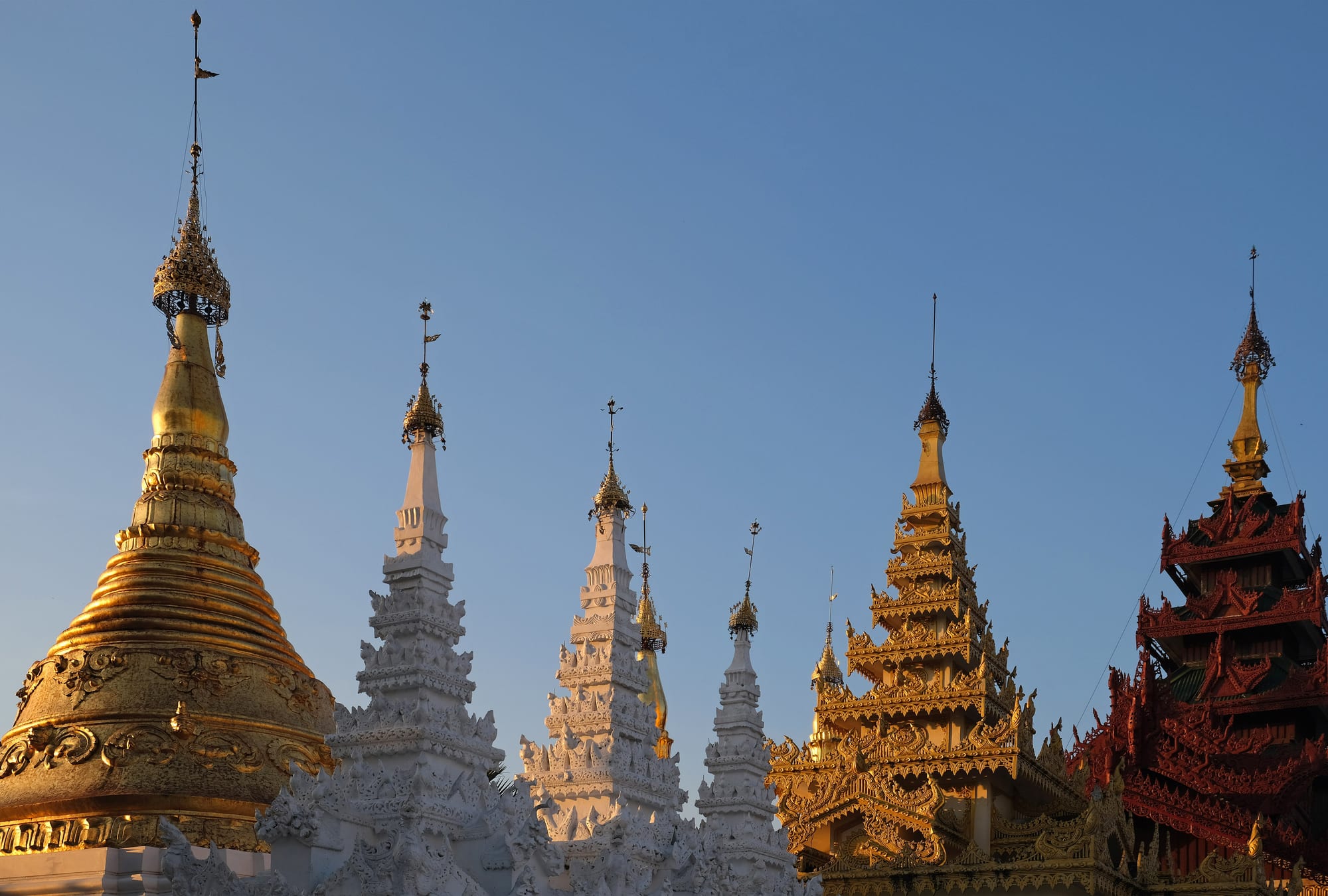
A visitor arrives at a family home in Myanmar. Shoes stay at the door. The guest is offered a chair, and within moments there is green tea and a plate of snacks. When the grandmother comes in, the younger members of the family lower themselves a little as they pass her, and anything handed to her is offered with both hands. At the meal, the first food goes to the eldest; if she is not there, a spoonful of rice is set aside for her before anyone else begins. In Myanmar, respect is shown less in words than in posture — in how low a head is held, how an object is passed, and how carefully others are spared discomfort.
Faith, identity and values
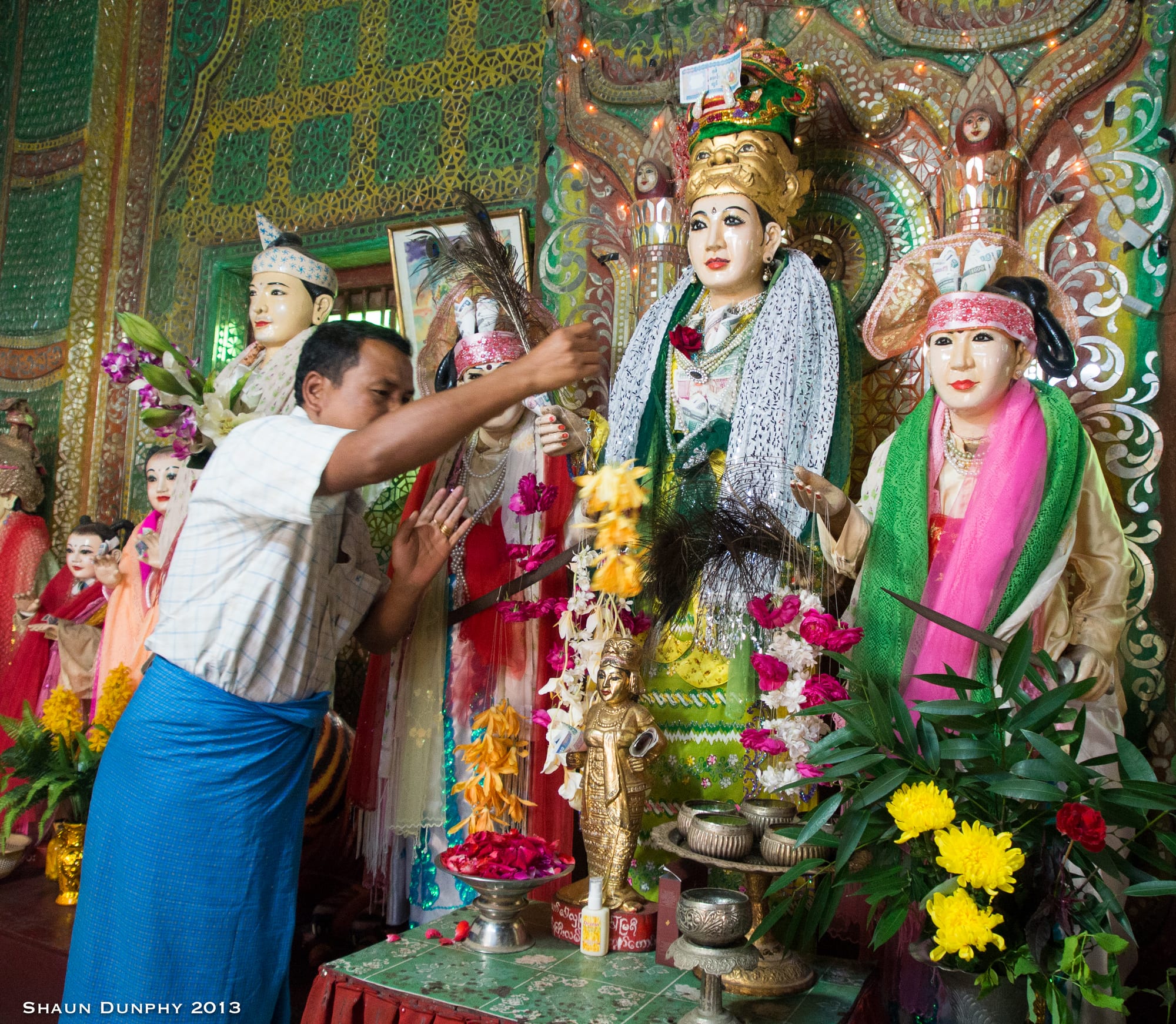
Theravada Buddhism is the faith of the great majority. At the 2014 census around 88 per cent of the population was recorded as Buddhist, and the monastic community, the sangha, holds a place of great respect. Buddhists take refuge in what is known as the Triple Gem — the Buddha, revered as a teacher rather than a god; his teaching, the dhamma; and the community of monks and nuns. Daily religious life is shaped by merit-making: offering food to monks, giving to the monastery, keeping precepts and supporting pagodas are all ways of earning merit, and misfortune is often explained in terms of karma. Alongside Buddhism runs an older belief in nats, spirits thought to inhabit natural places and objects, and nat shrines across the country receive offerings for protection and success.
Myanmar is also one of the most diverse countries in Asia, with 135 officially recognised ethnic groups and sub-groups, each with its own language or dialect and customs. The Bamar are the largest group, and seven major minorities — the Chin, Kachin, Karen, Karenni, Mon, Rakhine and Shan — give their names to states in the hills and borderlands. Religion and ethnicity are closely linked. Christians, around 6 per cent of the population, are the majority among the Kachin, Chin and Naga and are numerous among the Karen and Kayah. Muslims, a few per cent, include people of South Asian descent, the Kaman and the Rohingya of Rakhine State. The Rohingya were excluded from the 2014 census and are denied citizenship; after military operations in 2016 and 2017 that UN investigators described as ethnic cleansing, most now live as refugees in Bangladesh. Identity is sensitive ground: "Bamar" refers to the majority ethnic group, while "Burmese" can mean the language or citizenship, and many people from minority communities prefer to be identified by their own group's name. Even the country's name carries weight, since "Myanmar" was adopted by the military government in 1989 and some still prefer "Burma".
Since the military seized power in February 2021, the country has been in a state of armed conflict, and daily and public life has been disrupted across much of it. Age and status shape almost every interaction, and it is considered inappropriate to argue with or answer back to someone older or more senior. Ah-nar-de, a reluctance to impose on others or cause them embarrassment, leads people to say what they think others would like to hear rather than contradict them. Face — reputation and dignity — matters, so criticism is given gently and in private. Patience, modesty and composure are admired; speaking softly is the norm, and losing one's temper is taken as a sign of poor upbringing. A common phrase, roughly "let it be", captures a stoical acceptance of what cannot be changed.
Greetings and meeting people
The everyday greeting is "mingalaba", a word of blessing used as "hello". The traditional gesture is a small bow; younger people bow to their elders, who usually reply with a nod. Some people, especially in towns and among non-Buddhists, shake hands, often supporting the right elbow with the left hand as a sign of respect. Monks are greeted with the palms pressed together at face level and a deep bow, and the fullest gesture of reverence, known as kadaw, involves kneeling and touching the palms and forehead to the floor three times.
Most people in Myanmar have no family name: every part of a name belongs to the individual. People are addressed with an honorific before their name that reflects age and relationship rather than kinship — U, "uncle", for an older man; Daw, "aunt", for an older woman; Ko, "older brother", and Maung, "younger brother", for younger men; and Ma, "sister", for younger women. Questions about where someone is going or whether they have eaten are simply friendly greetings.
Body language matters. The head is regarded as the most sacred part of the body and should not be touched, while the feet are regarded as the lowest and least clean, so they should never be pointed at anyone or used to move things. Pointing at people with a single finger is rude; the polite way to beckon is with the palm facing down. Direct eye contact is fine in moderation, but lowering the eyes is a sign of respect to elders and superiors.
Hospitality and being a guest
Shoes come off on entering a home, and bedrooms and kitchens are private unless a guest is invited in. Hosts will usually offer refreshments — green tea, coffee or snacks — and a guest is expected to thank them warmly on leaving. It is polite to decline a second helping once or twice before accepting.
At the table, elders are served first. Eating with the hand is acceptable, using only the right hand to scoop up food; the left hand may support the right, but is never used alone to pass or receive things. Singing, humming or playing music during a meal is considered inappropriate. Many Buddhists do not drink alcohol, since abstaining is one of the precepts, and it is widely regarded as unsuitable for women to drink. Food left out as an offering to spirits should never be eaten.
Gifts are presented and received with both hands and are not usually opened straight away. Modest gifts are best, since something expensive may cause embarrassment, and gifts are a natural way to show respect to teachers, monks and seniors. Monks may not have physical contact with women, so a woman who needs to hand something to a monk may pass it through a man or place it on a cloth rather than into his hands.
Most people, men and women alike, wear the longyi, a long wrapped skirt, and many wear thanaka, a pale paste ground from bark and applied to the cheeks both for beauty and for protection from the sun.
Festivals and life's big moments
The year follows a lunar calendar of twelve months, each with its own festival, and many of the most important days fall at the full moon. The greatest celebration is Thingyan, the traditional New Year, a four- or five-day festival in mid-April that UNESCO added to its list of intangible cultural heritage in 2024. People pour water over one another, an act of symbolic cleansing believed to bring good fortune for the year ahead. It is also a time of merit-making — donating food, giving to charity, joining meditation retreats — and of paying homage to elders, with younger relatives washing their hair or feet. Flowers and leaves representing the seven days of the week are arranged in an earthenware pot and placed at the front of the house, and communities stage songs and dances.
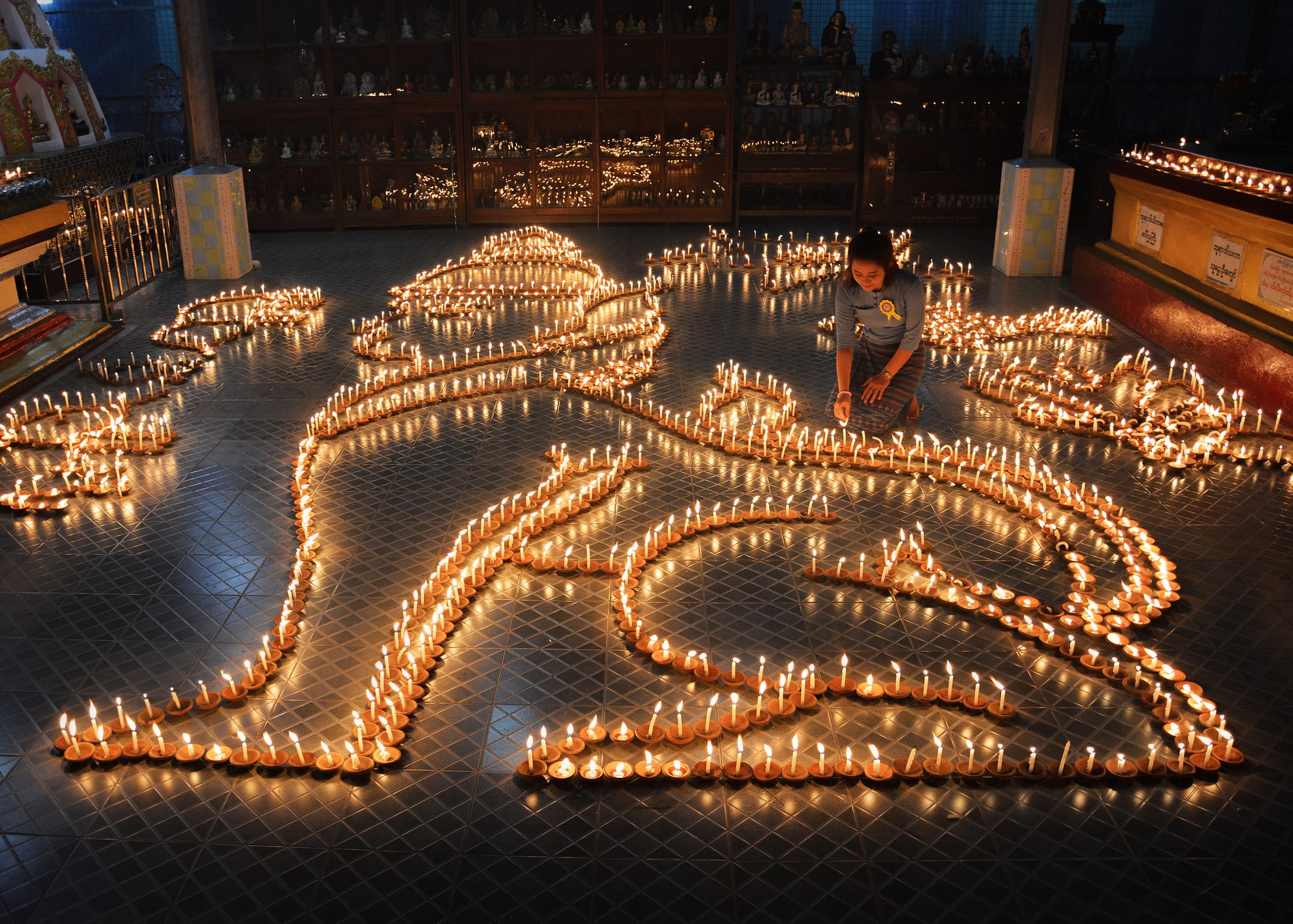
The Buddhist rains retreat, running roughly from July to October, is a quieter season, and Buddhist couples generally avoid marrying during it. Its end, at the full moon of Thadingyut, is marked by a festival of lights, with lamps and candles set out in their hundreds. Other full-moon days mark the Buddha's birthday, Sangha Day in honour of the monastic community, and the festival of Tazaungdaing. Christian communities celebrate Christmas, and the Karen New Year is a public holiday.
For Buddhist families, one of the proudest occasions is the shinbyu, the novitiation of a boy into the monastery. Before the ceremony, boys are dressed as princes in the manner of the young Siddhartha before he renounced his royal life, and are carried or ride in procession with family and friends to the monastery, where they take on robes and live as novices for a time. Many men enter the monastery more than once, as a boy and again as a young adult.
Weddings are mainly social rather than religious events, with many guests, and monks do not officiate, since marriage is regarded as a worldly affair. Arranged marriage is not the general custom, though some families consult an astrologer to choose an auspicious date.
Funerals are shaped by the idea of sharing merit with the dead. When someone dies, monks are invited to the home and offered food so that the merit of the gift can pass to the deceased. The burial or cremation often takes place on the third day, and relatives and friends call to offer condolences, bringing money or food. On the seventh day after death comes the most important rite: monks are invited and fed, requisites such as robes are donated to them, and the family formally shares the merit with the departed by calling out their name, a ceremony believed to help them towards a better rebirth.
Arts, crafts and music
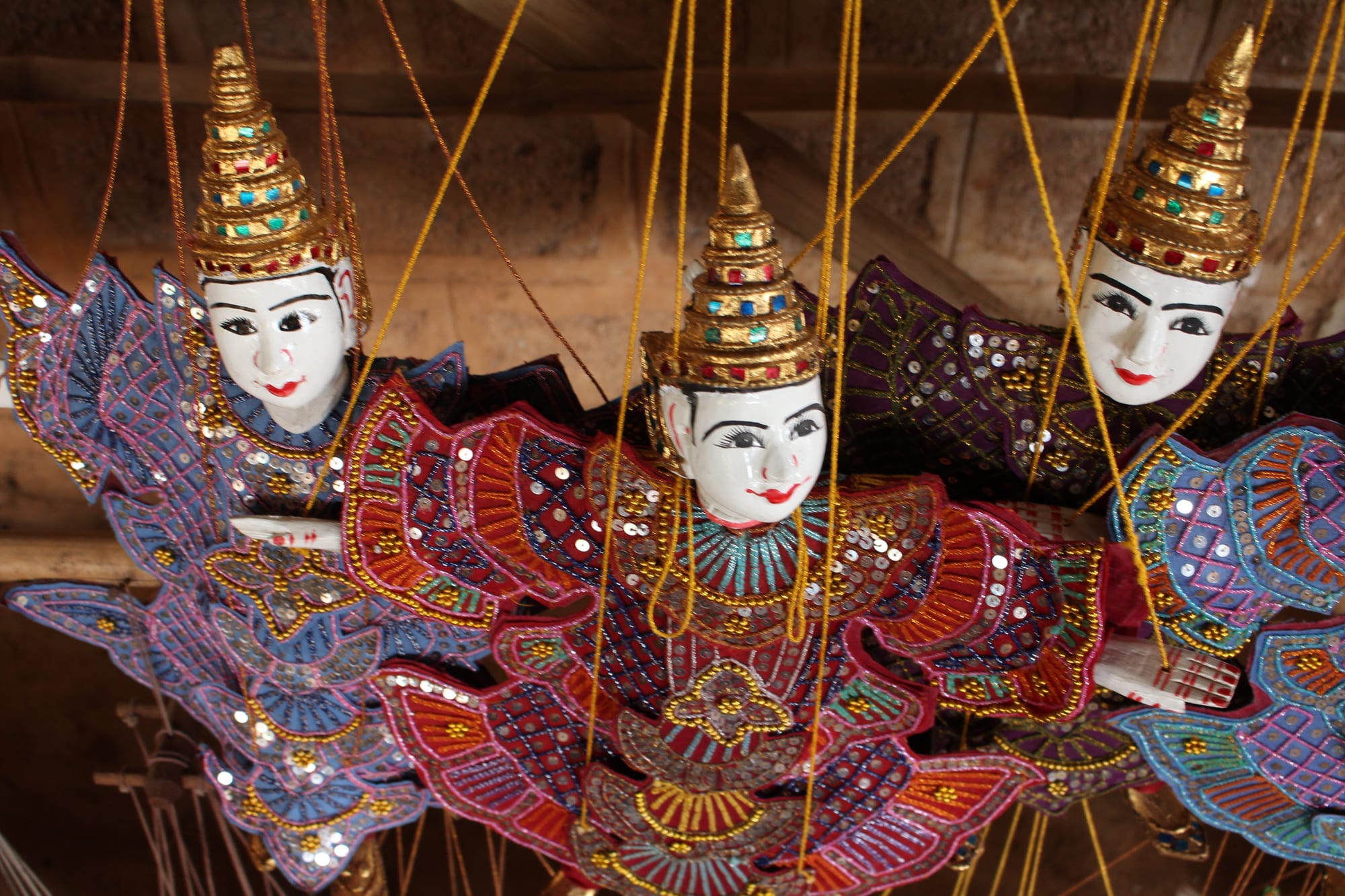
Myanmar's classical performing arts grew up around the royal courts and the pagoda festival. Marionette theatre, known as yoke thé or yokhte pwe, is generally dated to around 1780, when it was introduced at the royal court and flourished under royal patronage. Performances drew on the Jataka tales of the Buddha's past lives and on the Ramayana, with the most elaborate puppets controlled by many strings. The art declined after the fall of the monarchy and has since seen a modest revival, often in shorter performances staged for visitors. Classical music centres on instruments such as the saung, an elegant arched harp, which accompanies song.
Lacquerware is the best-known craft. It is made with thitsi, the black sap of the lacquer tree, applied over a base of coiled or woven bamboo, or bamboo and horsehair for the finest pieces. The lacquer is built up in many layers, each left to dry. The decorative stage, known as yun, involves engraving patterns into the surface and filling them with colour, commonly red, green and yellow. A small vessel can take three or four months and a large piece more than a year. Bagan, where the craft has been established for about two centuries, remains its main centre.
Dos and don'ts for visitors
- Do check the latest government travel advice before any trip; most governments advise against all or all-but-essential travel to Myanmar because of the armed conflict that followed the 2021 coup.
- Do remove shoes and socks before entering a pagoda or monastery, and dress modestly, avoiding shorts, short skirts and sleeveless tops.
- Do pass and receive things with both hands, or with the right hand supported by the left.
- Don't touch anyone's head, point at people with a finger, or point the soles of the feet at anyone.
- Don't treat Buddha images disrespectfully; insulting religion is a prosecutable offence, and this can include Buddha tattoos.
- Don't, as a woman, touch a monk or hand anything directly to one, and never eat food left out as an offering.
- Don't photograph soldiers, police, military sites or demonstrations, and don't press people to talk about politics.
- Don't shout, lose one's temper or criticise anyone in front of others.
What to take away
Myanmar's manners rest on deference, patience and a quiet generosity rooted in merit-making, and visitors who move gently, give with both hands and keep their feet and voices low will be met with the same consideration in return.