Culture & Customs · Mali
Mali: A Name That Carries a History
Greetings that honour a family name, cousins licensed to trade insults, griots who keep the genealogies, and a web of kinship that has held a country of many peoples together for centuries
By Worldlore Editorial · 30 September 2026
Two neighbours meet in the early morning. One says "i ni sɔgɔma" — literally "you and the morning" — and the other answers with "nba" if he is a man or "nse" if she is a woman, before returning the greeting. Questions follow about the household, the children, the night's rest. Then a family name is spoken, and if the two families happen to stand in a joking relationship, the tone changes at once: a mock insult, a retort, and laughter from everyone within earshot. Nothing in the exchange is idle. In Mali a greeting is a small act of respect, a surname is a thread back through generations, and teasing between the right families is not rudeness but one of the oldest ways the country has of keeping the peace.
Faith, identity and values
Islam is the faith of the great majority. At the 2022 census about 96 per cent of Malians were Muslim, around 2 per cent Christian and under 1 per cent followed traditional African beliefs. The country is home to more than 20 major ethnic groups, each with its own language and social structure. Roughly half the population belongs to the Mande family of peoples, among them the Bambara, Malinké and Sarakolé, alongside the Peul (Fulani), Songhai, Tuareg, Moors and others, and Bambara is the most widely spoken language.
Islam here sits alongside older ways of understanding the world. Among the Bambara, Bozo, Marka and Somono communities of Markala, young men are still initiated into adulthood in a sacred wood beside the Niger, and the instruction closes with libations and offerings to protective spirits before they are permitted to wear the masks and dance. Mali's Kôrêdugaw, a secret society associated with a rite of wisdom, is on UNESCO's list of heritage in need of urgent safeguarding.
Beneath both faith and ethnicity runs a deep attachment to kinship and social ties. The Peace Corps describes Mali as rich in social capital, and nowhere is that clearer than in the system of joking cousins, known in the Mande languages as senankuya. Particular families, clans and peoples are bound to one another by a licence to tease: they may trade mock insults about each other's family or people, and no offence is taken. The custom works as a pressure valve, easing tension between groups and smoothing the way to settling disputes, and it gives strangers an instant, good-humoured connection the moment their surnames are known. Respect for age is the other great organising principle. Elders are honoured, their opinions carry weight, and younger people defer to them in speech and manner.
Greetings and meeting people
A greeting comes before any business, question or request, and in Mali it is rarely rushed. In Bambara the greeting changes with the time of day: "i ni sɔgɔma" in the morning, "i ni tile" around midday, "i ni wula" in the afternoon and "i ni su" at night. When the time is uncertain, "i ni ce" serves for every occasion, and it doubles as "thank you". The reply depends on the speaker: men answer "nba" and women "nse", and the greeting is then returned, so that each person acknowledges the other in turn. Fulfulde, Songhai, Tamasheq and Mali's other languages have their own formulas, but the principle of a full, unhurried exchange is shared across them.
Once the opening words are over, the conversation moves through the health of the family and the household before anything else is raised. Family names matter, because a surname places a person within a lineage and, often, within a web of joking relationships. Discovering that a new acquaintance is a joking cousin is usually greeted with delight and an immediate round of affectionate insults, delivered with a straight face and received with a laugh.
Respect for seniority shapes body language too. It is polite to avoid holding the gaze of an elder when speaking to them; lowered eyes signal deference rather than evasion.
Hospitality and being a guest
Hospitality is regarded as an obligation, and meals are shared from a communal dish. Diners gather around the bowl in groups, and in many homes the older men share one bowl, the women another and the children a third. Food is eaten with the right hand, and each person takes only from the part of the bowl directly in front of them rather than reaching across into someone else's section.
Appearance is taken seriously. Malians put a high value on being neatly and properly dressed, and wearing dirty, crumpled or torn clothing is seen as disrespectful. Shorts are not worn in public by men or women, skirts and dresses fall below the knee, and tops that are tight, low-cut or sleeveless are avoided; some communities expect arms, legs and hair to be covered as well. Tailors are everywhere, and having clothes made from local fabric is a common way for newcomers to fit in.
Much of Mali's social life happens over tea in the grin, an informal circle of friends who meet regularly, often daily, to brew tea and talk. A study of grins in Bamako published in the American Political Science Review found that members were mostly young men, that the groups cut across ethnic lines, and that most gave members financial help at moments such as weddings and funerals. The Malian press traces the custom to older forms of solidarity among the Peul and the Bambara. Joining a grin for a round of small glasses of tea is one of the simplest ways to be welcomed.
Kola nuts are the traditional gift for important moments. They are offered to mark major events, and they have long accompanied a request for a woman's hand in marriage.
Festivals and life's big moments
Tabaski, as Eid al-Adha is known in Mali, is widely described as the most important holiday of the year, ranking above the festival that ends Ramadan. Heads of household who can afford it sacrifice a sheep, and families save for months to buy the animal as well as new clothes and shoes for the household. Beyond its religious meaning, Tabaski is one of the few moments when relatives scattered by work return home and gather together.
Other festivals follow the land and the river. In the inner Niger delta, the Yaaral and Degal mark the crossing of the Niger by the Peul herds on their seasonal migration. Held on dates set each year by the state of the pastures and the level of the river, they bring contests for the most beautifully decorated herd, pastoral poetry recited by the herders and songs of praise from young women in their finest clothes. At Markala, the coming forth of the masks and puppets at the end of the dry season heralds the fishing season, and the gathering doubles as a moment to settle quarrels between families and communities. In the Manden region, the Kamablon, a sacred round house in the village of Kangaba, is re-roofed every seven years. Over several days, young men of the village take down the old thatch and lay a new roof under the guidance of elders, while members of the Keita clan and griots of the Diabaté family recount the history of the Manden. All three are on UNESCO's list of intangible cultural heritage.
Weddings are elaborate, multi-day affairs. A marriage proposal has traditionally been carried by a griot, who brings kola nuts to the future bride's family, and at the wedding itself griottes sing the praises of the two families and deliver the blessings the bride's parents wish to pass on. Given the Muslim majority, a religious ceremony is central, and music, singing and dancing follow in the days of celebration that come after it.
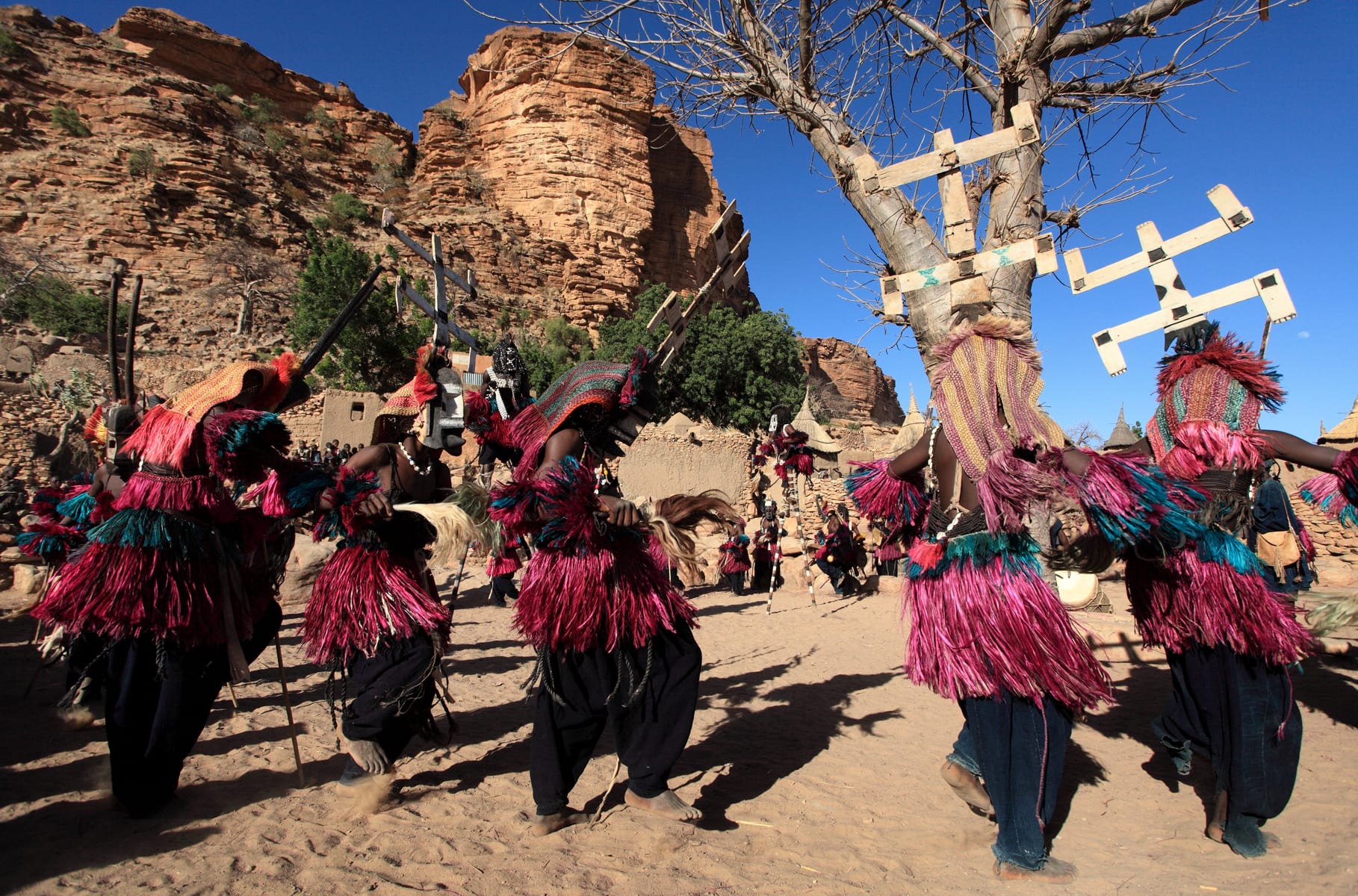
For the Muslim majority, funerals follow Islamic rites. Among the Dogon, the dead are also honoured through the dama, a collective funerary rite that may take place months or even years after a death, often for several people at once. Organised by the Awa, the men's society of masks, it lasts several days and ends the period of mourning, escorting the souls of the dead out of the village and into the world of the ancestors. Dancers in kanaga masks leap and sweep the mask down to touch the ground; the mask's shape is often read as the arms and legs of Amma, the Dogon creator god.
Arts, crafts and music
Mali's music is famous far beyond its borders, and at its heart stand the griots, or jeli: hereditary families of musicians, praise-singers, genealogists and keepers of history. Their art, called jeliya, carries the epics and lineages of the Mande world, and griots are expected at almost every significant family occasion. The kora, a harp-lute of 21 strings built from a gourd, cow-skin and, in modern instruments, fishing line, is their most celebrated instrument. The musicologist Lucy Durán has described how griots once travelled great distances on foot in search of patrons, carrying stories and tunes with them, and how griot families bound together the whole of the pre-colonial Mande region.
The kora is only one voice among many. The balafon, a wooden xylophone, is on UNESCO's list in a joint 2024 inscription, alongside Indonesia's kolintang, shared with Burkina Faso, Côte d'Ivoire and Indonesia. The m'bolon, a percussive stringed instrument, is on the list of heritage in need of urgent safeguarding, and the imzad, the one-stringed fiddle played by Tuareg women, is inscribed jointly with Algeria and Niger.
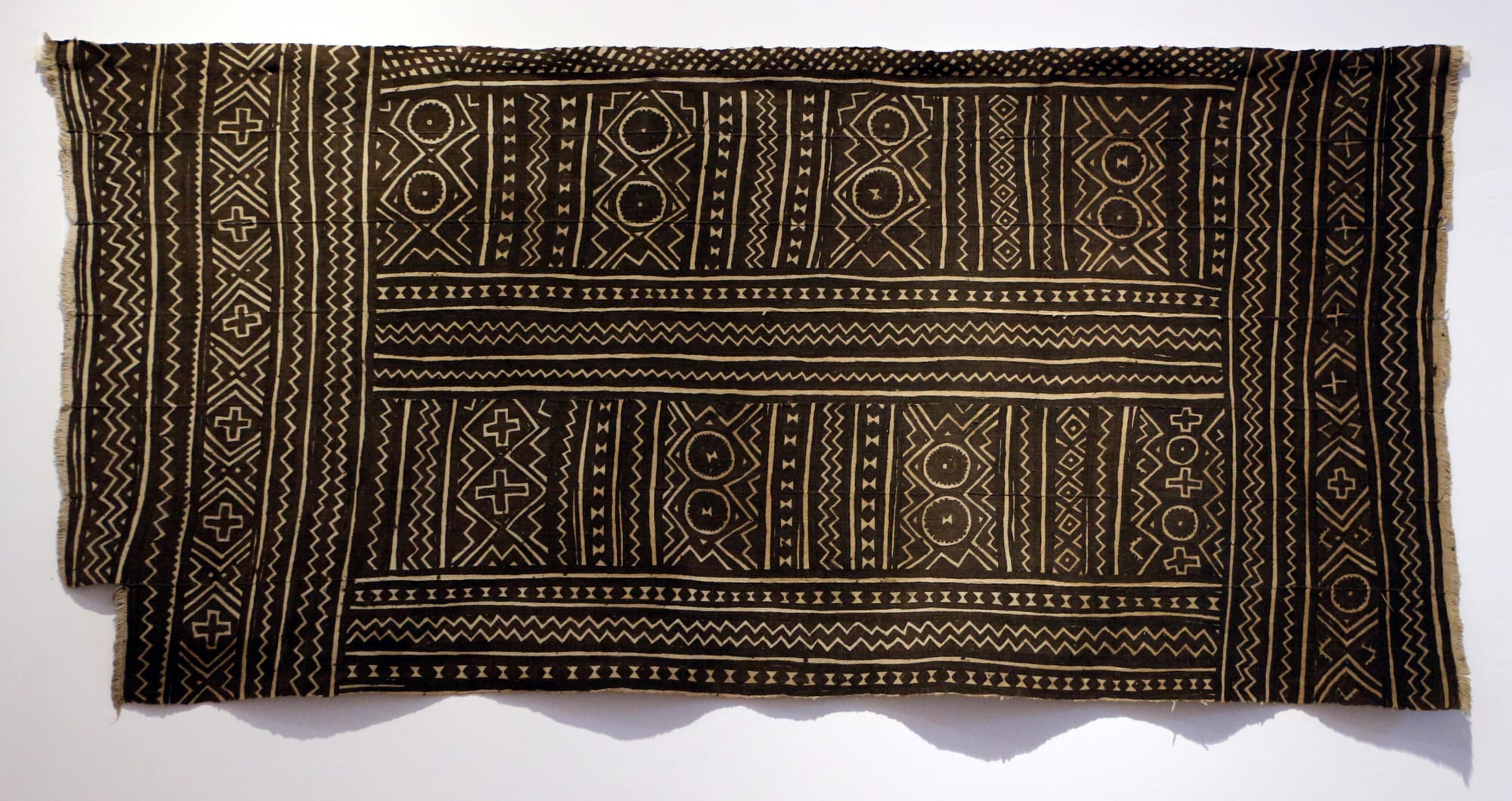
Among the crafts, none is more closely identified with Mali than bogolan, or bogolanfini, the Bambara "mud cloth". The name joins the words for mud and cloth. Cotton is woven by men into narrow strips, which are sewn together; the cloth is then soaked in a dye made from leaves, and women paint on the designs using iron-rich river mud that has been left to ferment, the chemistry turning the patterned areas deep brown or black. Once worn by hunters as camouflage, bogolan was carried into international fashion by the Malian designer Chris Seydou and is now a symbol of national pride, even as artisans work to keep the hand-painted, natural-dye method alive against cheaper printed imitations.
Dos and don'ts for visitors
- Do check the latest government travel advice before any trip; most governments advise against all travel to Mali.
- Do greet people fully before asking for anything, using the time-of-day greeting or the all-purpose "i ni ce".
- Do take joking-cousin teasing in good humour; it is a sign of friendship, not an insult.
- Do show respect to elders, including lowering the eyes when speaking to them.
- Do eat with the right hand and take food only from the part of a shared bowl in front of you.
- Don't wear shorts in public, and keep knees and shoulders covered with clean, neat clothing.
What to take away
In Mali a greeting, a surname and a well-aimed joke all do the same quiet work — binding people to one another across families and peoples — and visitors who take the time to greet properly and laugh along will find that work extended to them.