Culture & Customs · Luxembourg
Luxembourg: A Step to the Left, a Step to the Right
A small, multilingual grand duchy with Catholic roots, where pilgrims hop through a medieval town, bonfire crosses chase away winter, and a pretzel on a Sunday in Lent can still settle a romance
By Worldlore Editorial · 30 September 2026
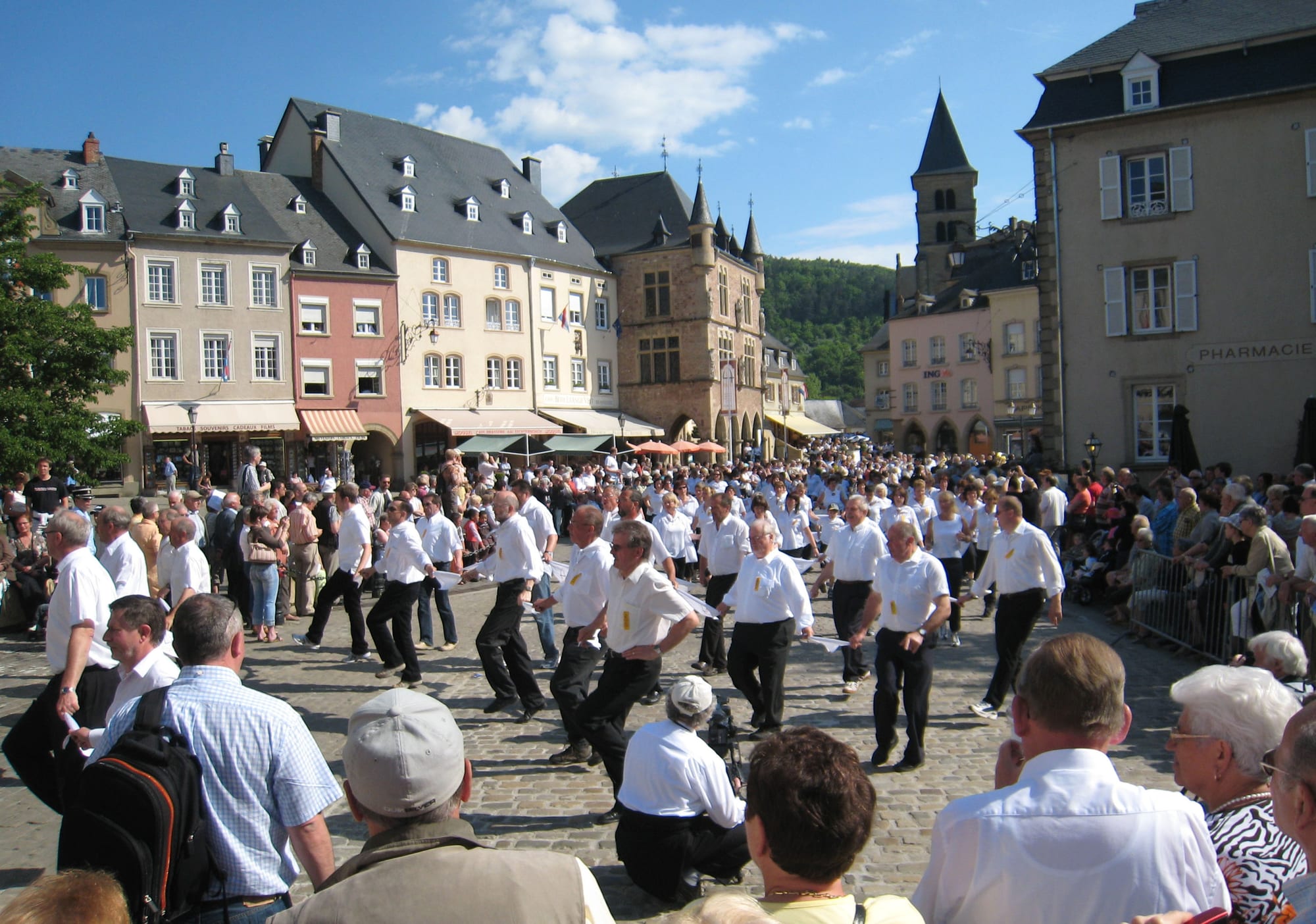
On the Tuesday after Pentecost, the streets of Echternach, the oldest town in the country, fill with thousands of pilgrims dressed mostly in white and black. They stand in rows, each person holding a white handkerchief whose ends are held by the neighbours on either side, and when the brass bands strike up the old procession melody the rows begin to move: a hop to the left, a hop to the right, forward through the medieval streets while singers recite litanies. The procession honours Saint Willibrord, the monk who founded the town's abbey in the seventh century and was revered for curing the sick, and it ends as the pilgrims file past his tomb. In 2010 it was inscribed on UNESCO's Representative List of the Intangible Cultural Heritage of Humanity as the Hopping procession of Echternach. For the people taking part, the hopping is a prayer made with the whole body. It is also a very Luxembourgish sight: devout and good-humoured at once, shared with visitors from all the neighbouring countries, and kept going generation after generation with quiet determination.
Faith, identity and values
Luxembourg's calendar and many of its customs are Catholic in origin. Since 1979 the state has not been allowed to collect statistics on religious belief, so there are no official figures; recent estimates put Catholics at around half of the population. In 2015 the state signed new agreements with the main religious communities, among them the Catholic Church, the Orthodox and Anglican churches and the Protestant community, and for the first time the Muslim community also received official recognition and support.
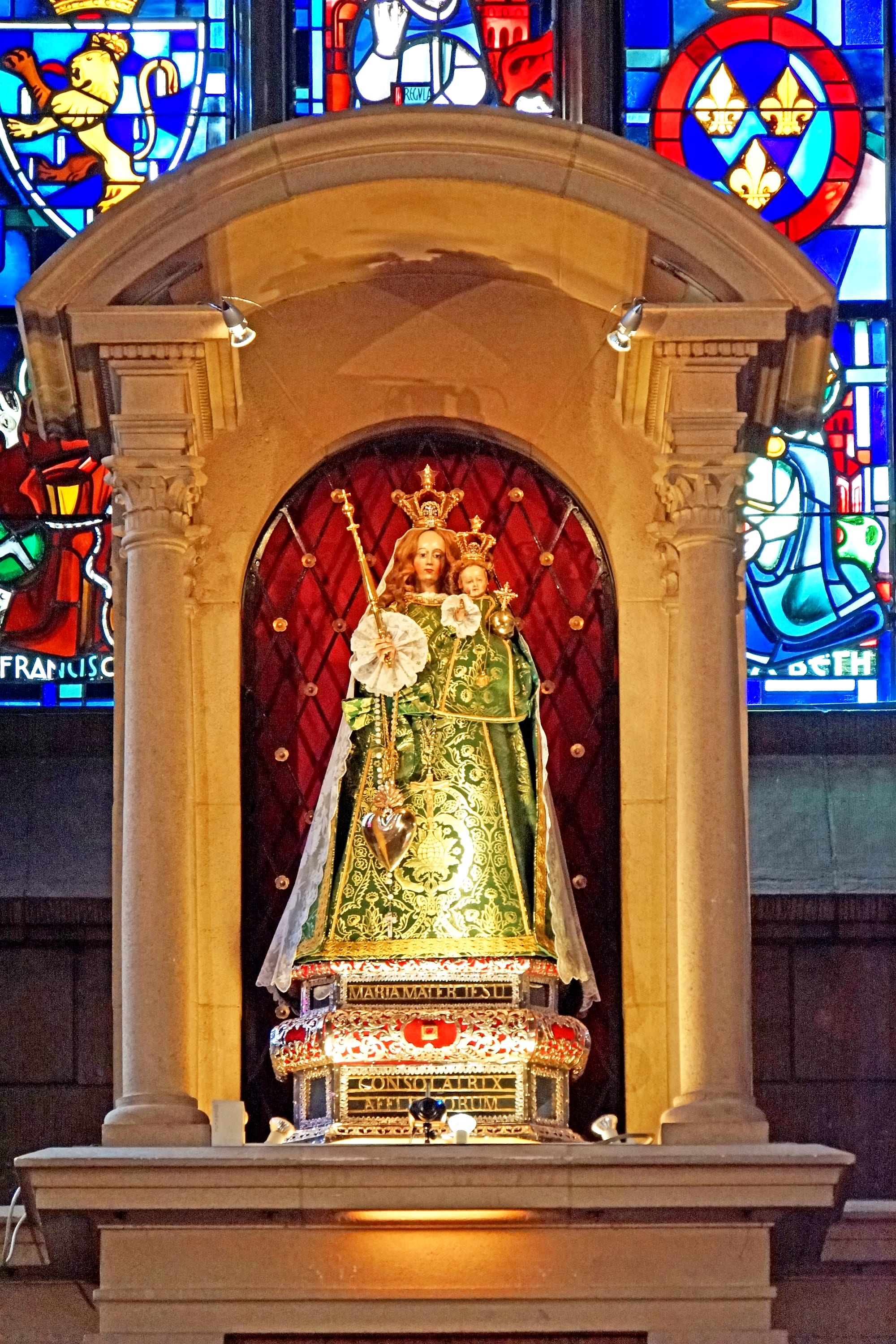
The country's spiritual focus is a statue of the Virgin Mary in Notre-Dame Cathedral in the capital. Devotion to Mary, Comforter of the Afflicted, began in 1624, in years of plague and war; she was chosen as patron of the city in 1666 and of the duchy in 1678. Her feast, the Octave, still draws thousands of pilgrims each spring.
Identity rests heavily on language. A law of 1984 made Luxembourgish the national language, while Luxembourgish, French and German all serve as administrative languages, and citizens may address the authorities in any of the three. Everyday life moves easily between them: French is the main language of commerce and hospitality, Luxembourgish dominates radio and television, German has long led the written press, and English is the common language of the large international workforce. According to a 2018 government study, 98 per cent of residents speak French, 80 per cent English, 78 per cent German and 77 per cent Luxembourgish, and it is rare for two people not to find a language in common.
The national anthem, "Ons Hémecht" ("Our Homeland"), is telling: rather than a martial song, it is an appeal for peace. Social manners tend to be reserved and controlled. Disagreement can be stated plainly but is expressed in a calm tone, logic persuades more than emotion, and privacy is respected, so personal questions are best left until people know each other well.
Greetings and meeting people
A first meeting, whether social or professional, begins with a handshake, firm but neither limp nor crushing. Kissing on the cheek comes later, once people have met socially a few times. The usual number is three, starting with the right cheek, and the gesture is a light brush of cheek against cheek with an almost silent kiss rather than a loud one. It is generally exchanged when a woman is involved; men usually shake hands with one another. With a large group, a few nods are enough rather than greeting everyone individually.
The everyday Luxembourgish greeting is "Moien", and using it shows an awareness of the country's own identity, even when the rest of the conversation continues in French, German or English. In formal settings people are addressed by their title and surname, with "Monsieur" and "Madame" where French is being spoken, until they suggest otherwise.
Hospitality and being a guest
Punctuality matters. Appointments are arranged in advance and confirmed, and arriving late is read as a lack of respect, so a quick call is expected if a delay is unavoidable. The same applies to invitations to a home.
A guest usually brings flowers or good chocolates. Flowers are best given in odd numbers, and chrysanthemums, associated with funerals and with the graves of All Saints' Day, are avoided. Once at the table, the host begins the meal and normally proposes the first toast, and guests follow the host's lead on the customs of the house. It is polite to try to finish what has been served, and to keep hands visible on the table. A social evening is not the place to press business matters.
Festivals and life's big moments
The year begins its customs early. On 2 February, Liichtmëssdag, children go from door to door with brightly coloured lanterns, singing a traditional song that begins "Léiwer Härgottsblieschen" and asks, quite literally, for bacon and peas; today they are given sweets and coins, which they share out among themselves afterwards. Around the same time comes Fuesend, the carnival season, with masked balls, parades and cavalcades for children and adults.
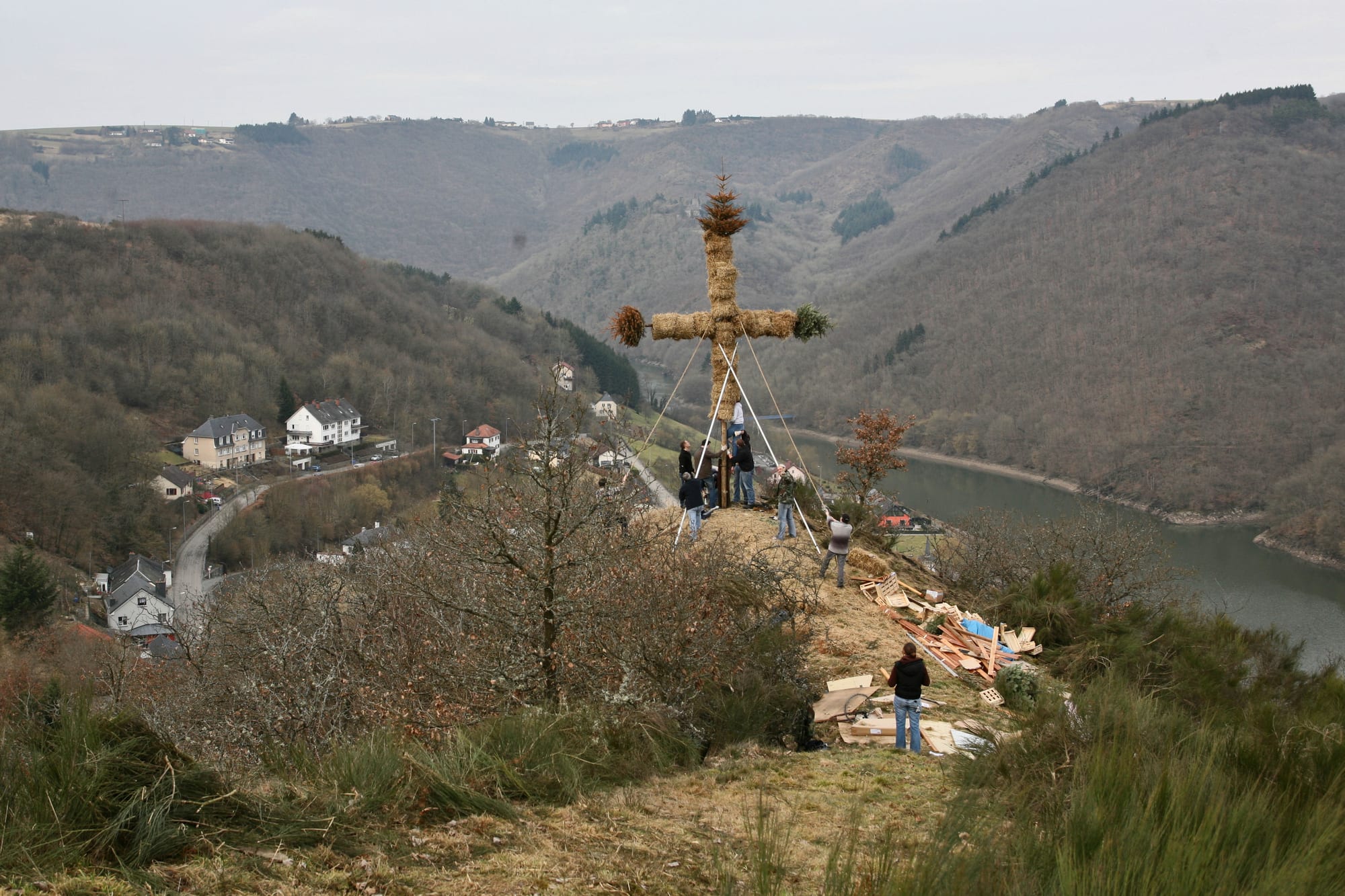
The first Sunday of Lent, just after carnival, brings Buergbrennen. In villages across the country, local youth associations build a great pyre of straw, brushwood, logs and old Christmas trees, usually with a cross at its centre, and light it after dark following a torchlight procession. The fire stands for the end of winter and the victory of light over darkness, and the crowd stays long after it has burned down, warmed by mulled wine and pea soup.
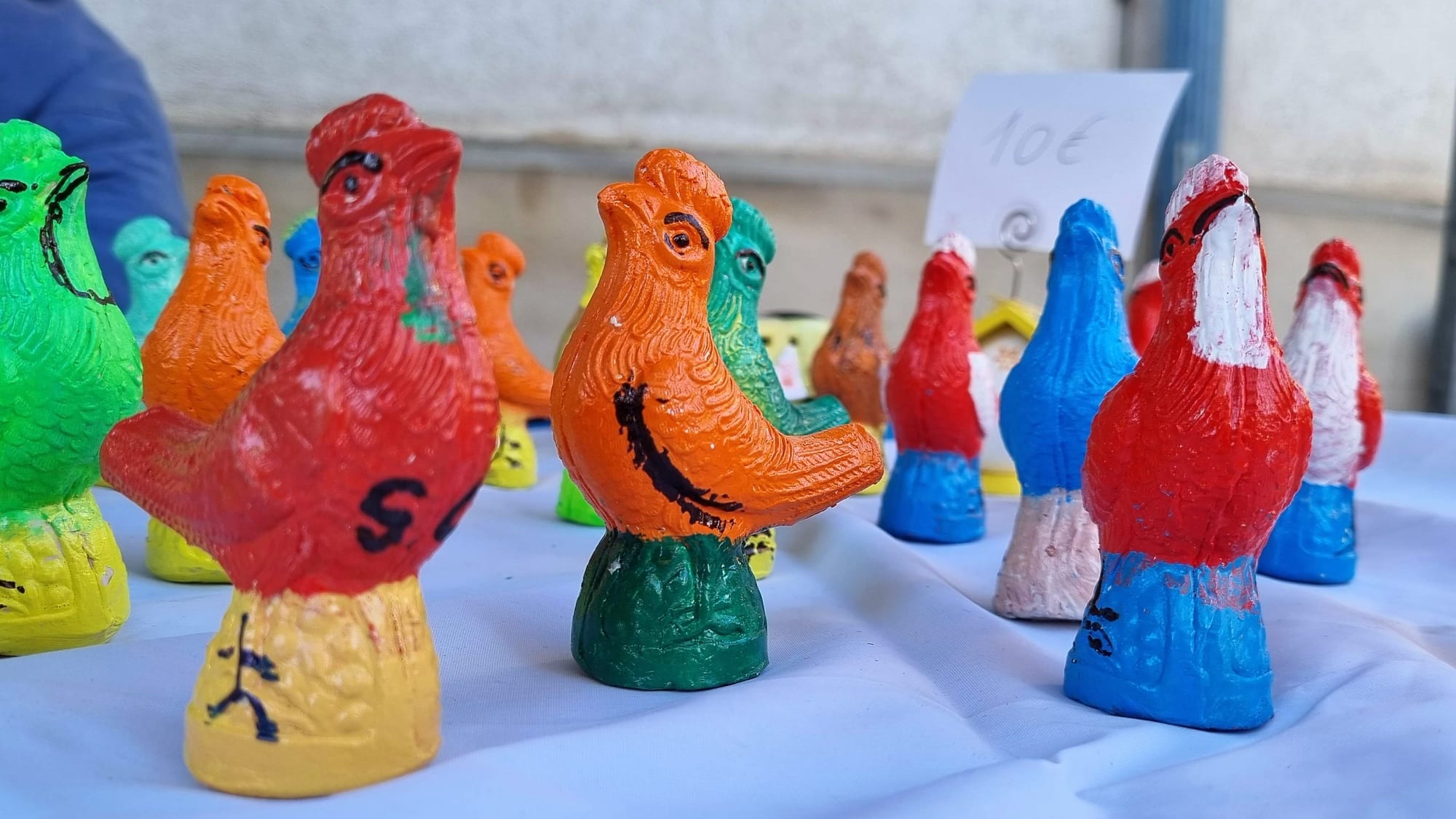
Easter has customs of its own. Because the church bells are said to fly to Rome before Easter, young people go round with wooden rattles, klibbers, to call people to prayer in their place, and are rewarded with eggs and money. Children knock painted eggs together in a contest called técken, and the winner keeps the egg that survives. On Easter Monday comes the Éimaischen, a craft market famous for its péckvillercher.
From the third Sunday after Easter, the Octave fills two weeks with pilgrimages. Parishes from across the country and beyond walk in procession to Notre-Dame Cathedral, where masses are said throughout the day, and afterwards pilgrims stop at a small market for refreshments and souvenirs. It closes with a solemn procession carrying the statue of the Virgin through the capital, attended by representatives of the government and the Grand Ducal Family.
National Day, on 23 June, marks the Grand Duke's official birthday, fixed on that date by a decree of 1961 whatever the sovereign's real birthday. On the evening before, a torchlight procession and a great fireworks display fill the capital, and on the day itself come an official ceremony, a military parade and a Te Deum in the cathedral. Fairs, too, began as feasts of a parish's patron saint, and musicians still march through the streets playing the Hämmelsmarsch to invite people to them, above all before the capital's great Schueberfouer.
The dark months have their own rituals. On 1 November families visit cemeteries to lay flowers, candles and wreaths on graves, often with a blessing of the graves, and 2 November is kept for the souls of the dead. On 6 December, a school holiday, St Nicholas, known as Kleeschen, arrives in a bishop's mitre with his dark companion, the Houseker, who hands out twigs to children who have misbehaved. Children leave their slippers outside their bedroom doors in the weeks beforehand, and find toys and sweets there on the morning of the feast. Two days earlier, on 4 December, the feast of Saint Barbara honours the country's miners.
Weddings follow a strict legal order: only a civil marriage before a registrar has legal effect, and a religious ceremony may take place only after it. The hunting-horn players known as the Haupeschbléiser are among the musicians regularly asked to play at weddings and celebrations.
Arts, crafts and music
Much of Luxembourg's living heritage is musical. The Haupeschbléiser, founded in 1973, play the French hunting horn, a triple-coiled instrument some four and a half metres long when unrolled, with no valves at all, so every note depends on breath and control. They perform at St Hubert masses, concerts and family celebrations, and their art, shared with France, Belgium and Italy, is on UNESCO's list of intangible heritage. The melody of the Hämmelsmarsch, the fair march, was given words in the nineteenth century by the national poet Michel Lentz. Traditional folk dances are also recorded as part of the country's intangible heritage.
The best-loved folk craft is the péckvillchen, a small terracotta bird whistle. They are sold at the Éimaischen each Easter Monday, in the old town of the capital, where the market was revived in 1937, and in the potters' village of Nospelt, where a new design has been made each year since 1957.
Several country crafts have been recognised by UNESCO too, in joint listings with neighbouring countries: dry stone walling, in which stones are fitted together without mortar; the old technique of irrigating meadows through networks of ditches; and the seasonal droving of sheep between pastures. Midwifery, with its care for parents before, during and after a birth, is on the same list.
Dos and don'ts for visitors
- Do greet people with a firm handshake at a first meeting; the three kisses, starting on the right cheek, come later among friends.
- Do say "Moien"; a word of Luxembourgish is appreciated even when the conversation continues in another language.
- Do arrive on time for appointments and invitations, and call ahead if running late.
- Do bring an odd number of flowers or good chocolates when invited to a home, and avoid chrysanthemums.
- Do wait for the host to start the meal and propose the first toast.
- Don't ask personal questions of new acquaintances; privacy is valued and disagreement is expressed calmly.
What to take away
Luxembourg's customs belong to a small country that has learned to live between larger neighbours and several languages without losing its own rituals, and visitors who arrive punctually, greet with a "Moien" and respect a certain reserve will find the welcome warmer than it first appears.