Daily Life · Kiribati
Kiribati: A Day Measured in Tides
A ribbon of coral atoll where the tide, not the clock, sets the timing of a day, the maneaba meeting house still runs village decisions by consensus, and a small nation with almost no room to spare is crowding onto one narrow strip of it
By Worldlore Editorial · 30 September 2026
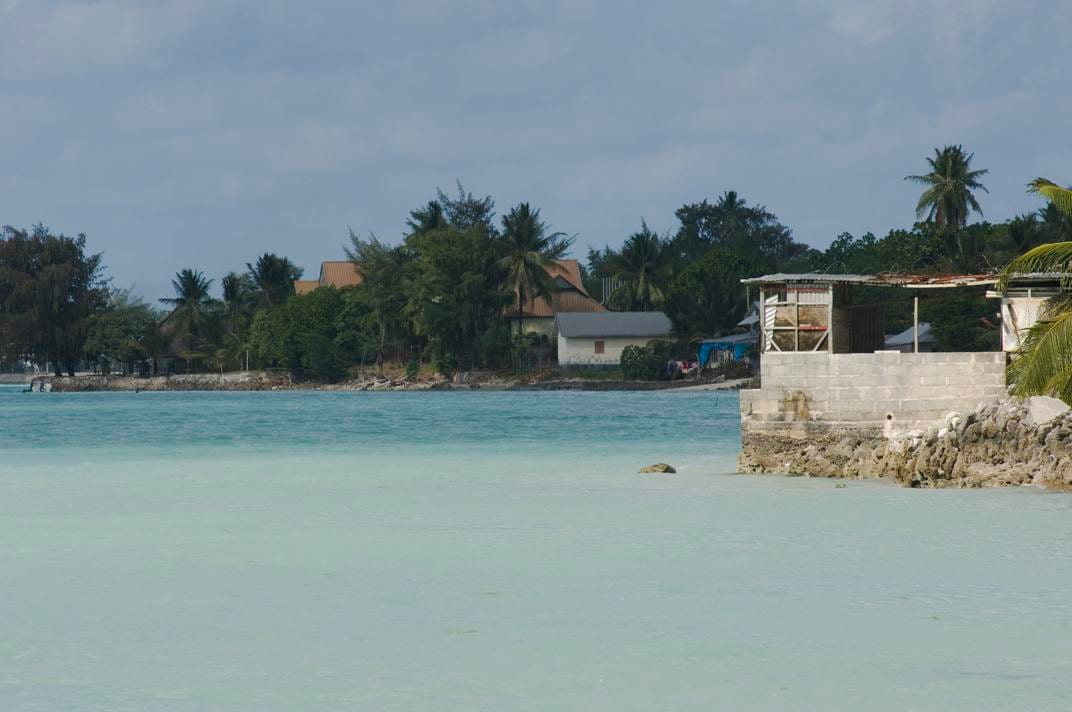
In Kiribati, the working day is set less by the clock than by the sea. Along the outer islands of the Gilbert group, when the tide is out and the reef flats are exposed, that is fishing time, whatever the hour; when it is in, boats and travel wait. On crowded South Tarawa, where more than half the country's people now live on a strip of coral only a few hundred metres wide, that older rhythm runs up against something closer to city life: minibuses, a cash economy, and a struggle for space, water, and land that the outer islands simply do not have to face. Both versions of the day still run, in the end, through the same institution — the maneaba, the open-sided meeting house that has organised I-Kiribati village life for generations and remains the place where real decisions get made.
Family and home life
The extended family is the basic unit of I-Kiribati life, and land, a scarce and precious resource on a coral atoll, is inherited and held collectively rather than treated as an individual's alone. Respect for elders runs through daily interaction, and it is normal for several generations of one family, along with more distant relatives, to share a household and its responsibilities. On the outer islands, where a large share of families still live substantially outside the cash economy, fishing, coconuts, and garden pits of swamp taro, known as babai, still supply much of what a household eats, even as imported food spreads. On South Tarawa, where land is desperately short and housing dense, extended families are more often compressed into smaller plots, and the pressure that crowding puts on water and sanitation is one of the country's most serious everyday problems.
Work, school and the rhythm of the day
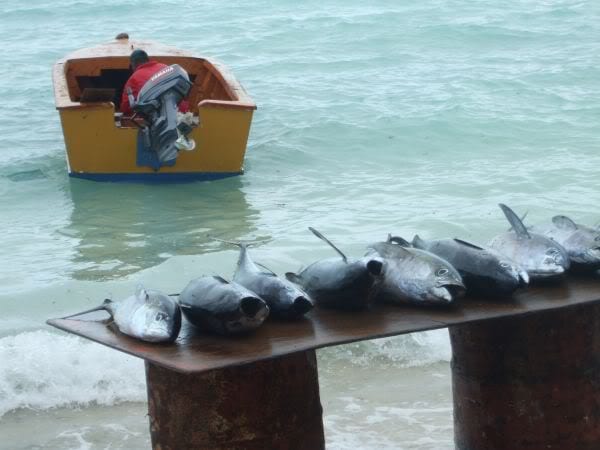
Away from the small formal economy of government jobs, banks, and shops concentrated on South Tarawa, work follows the tide and the season rather than an office clock: reef and lagoon fishing by canoe or on foot at low water, tending garden pits dug for swamp taro, and tapping coconut palms for their sap, climbed and cut early in the day and again in the evening to collect a sweet liquid that is drunk fresh or left to ferment into toddy. Formal employment is limited and concentrated in South Tarawa and, to a lesser extent, Kiritimati (Christmas Island) far to the east; for many households elsewhere, money arriving from relatives working abroad, many of them seafarers on foreign ships, is an important part of the household budget.
Community life and public spaces
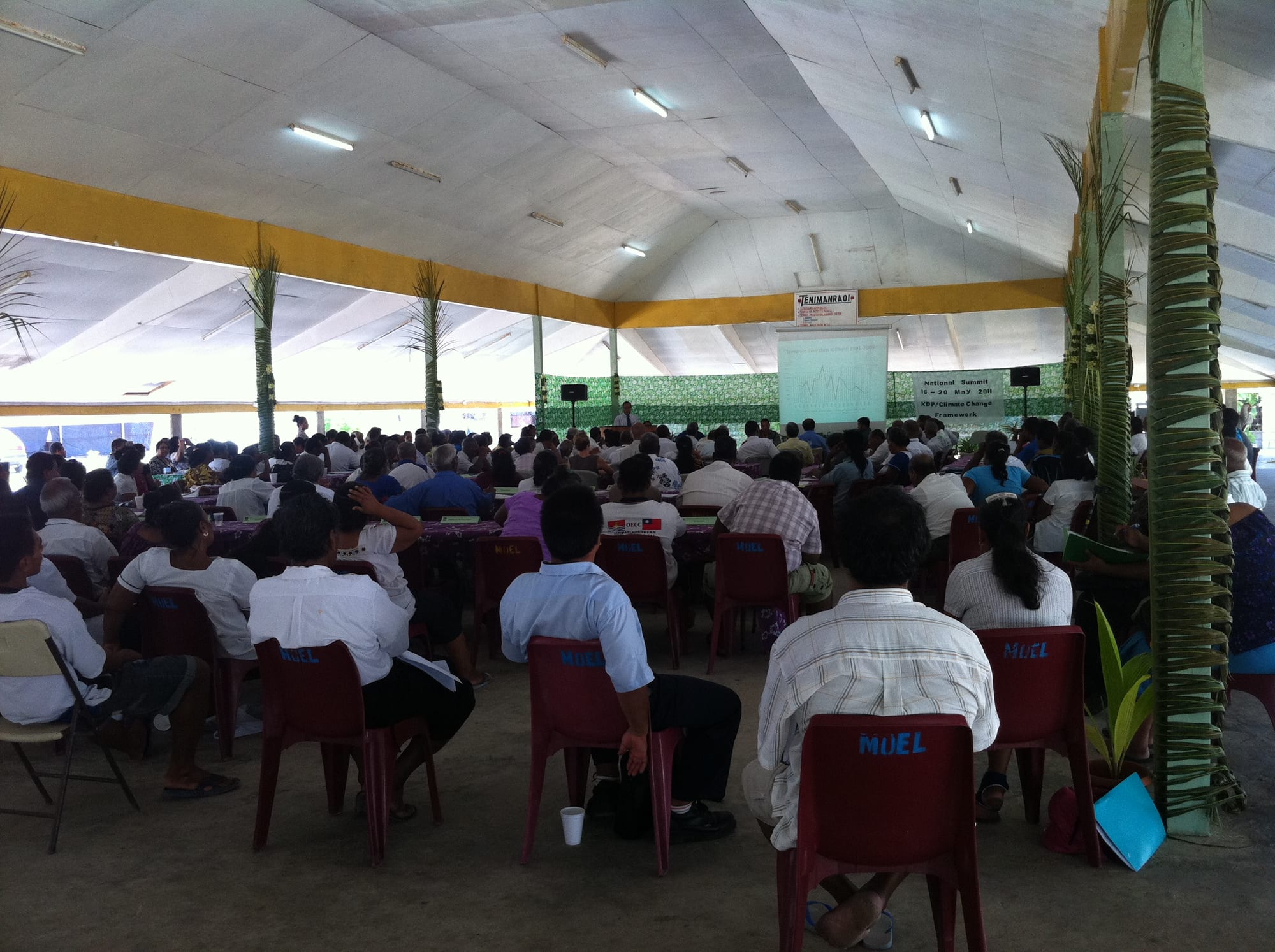
The maneaba is the true centre of public life, island by island: a large, open-sided meeting house with a steep thatched or corrugated roof, where each family or clan has its own recognised seating place, or boti, around the perimeter, and where community matters are discussed at length until a consensus is reached rather than settled by a simple vote. Churches, in a country where about 96 per cent of people are Christian, are frequently the largest and most prominent buildings in a village after the maneaba itself. On South Tarawa, the causeways linking the islets carry a livelier, more urban public life — shared minibuses, small shops, and a produce and fish market — that the outer islands, reached only by small plane or slow boat, do not have.
Free time and weekends
Church services and the events built around them structure much of the week, and Sunday in particular is treated as a day set apart for worship and family time rather than work. Canoe building and canoe racing are a genuine pastime as well as a practical skill. Dancing is the other major recreational and ceremonial art form: the hip dance, te buki, and the standing dance, te kaimatoa, performed to chanted song with sharp, controlled arm and head movements, are taught from childhood and performed at community feasts, known as botaki, which double as one of the main forms of shared weekend entertainment.
A visitor's ordinary day
Kiribati uses the Australian dollar, and cash matters: cards are accepted in relatively few places, and on the outer islands cash is usually the only way to pay. On South Tarawa, shared minibuses run the length of the atoll along the single main road and are the practical way to get around; elsewhere, travel is on foot, by bicycle, or by boat, and inter-island transport depends on a thin schedule of small planes and government or copra boats prone to delay. Shops and the produce market on South Tarawa keep fairly regular daytime hours, but there is no fixed tourist infrastructure of restaurants or transport timetables to rely on outside the capital, so plans generally need to flex around whatever boat, plane, or tide is actually running that day.
What to take away
What defines an ordinary day in Kiribati is not a single custom but a scale problem in both directions: island life still measured by the tide and the maneaba on one hand, and, on the crowded strip of South Tarawa, just how little room a rising sea is leaving for either.