Culture & Customs · Ghana
Ghana: Greet Everyone, Right Hand First
A handshake that ends in a snap, a name chosen by the day of the week, chiefs who speak through a linguist, and funerals that fill a Saturday with drumming — the customs of a country where courtesy begins with a greeting
By Worldlore Editorial · 30 September 2026
A visitor steps into a courtyard where a family is gathered. Before any business, before sitting down, before anything else, there is a round of greetings. Moving from right to left, the visitor offers a right hand to each person in turn, the eldest included, and each handshake ends as the two middle fingers slide apart with a crisp snap. Health, family and work are asked after. Only then is a seat offered and the reason for the visit explained. In Ghana, skipping a greeting is one of the few truly serious breaches of manners. Taking time over it is the first sign of the respect for people, elders and community that runs through the rest of the country's customs.
Faith, identity and values
Ghana is a deeply religious country. At the 2021 census, 71.3 per cent of Ghanaians identified as Christian, with Pentecostal and Charismatic churches now the largest single group, and 19.9 per cent as Muslim, while 3.2 per cent followed traditional religions. Many people bring elements of older beliefs into their Christian or Muslim lives, above all a sense that the ancestors remain present and must be honoured. Ghana is a secular state that takes pride in the peaceful coexistence of its faiths, and dismissive remarks about any religion, political party or ethnic group cause real offence.
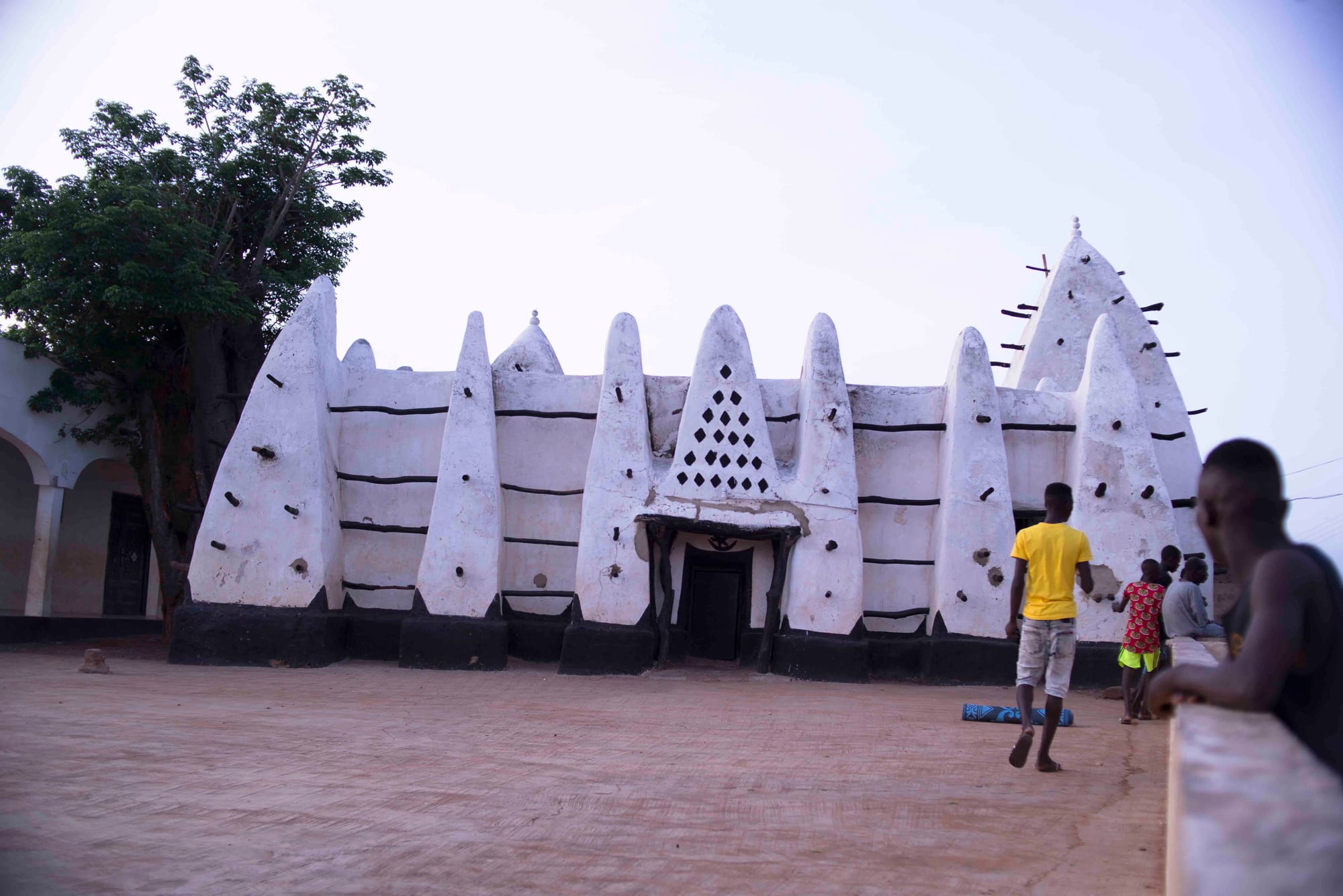
Beside the churches and mosques stands a second, older pillar of public life: chieftaincy. Traditional rulers still carry great authority in their communities and stand at the centre of their festivals. Among the Akan, Ghana's largest group, a chief does not speak directly to the public in formal settings. Words pass through the okyeame, or linguist, the chief's principal counsellor and spokesman, who carries a staff of office often topped with a carved figure that illustrates a proverb. In rural areas, anyone arriving on business is expected to call on the local chief first. Visitors in a chief's presence remove their hats, keep their hands out of their pockets, avoid crossing their legs, and bring a small gift, a bottle of schnapps being the traditional choice.
Respect for elders runs through everyday life. Older people are greeted first, served first and listened to with deference, and behaviour that might seem harmless elsewhere can look disrespectful when an elder is present. Sharing is a basic social expectation, as is care not to waste food or anything else of value. Communication tends to be polite and indirect, particularly where disagreement or bad news could embarrass someone, and plain bluntness is often taken as rudeness.
Greetings and meeting people
Greetings matter more in Ghana than almost anywhere, and they should never feel rushed. On entering a room or joining a group, the custom is to greet everyone individually, working from right to left, although a chief is greeted first on formal occasions. The handshake is the standard greeting, given with a smile and eye contact. Among Ghanaians it often ends with the finger snap, a flick of the middle fingers as the hands part; a loud snap is best, and a missed one is simply tried again. Visitors are not expected to master it, but a good-humoured attempt is usually appreciated.
The right hand is essential. The left hand is associated with personal hygiene and considered unclean, so using it alone to greet, eat, give or receive anything is disrespectful. If it cannot be avoided, a brief apology smooths things over. Academic, professional or honorific titles are used with surnames until first names are invited, and senior people are greeted before junior ones. Some practising Muslims prefer not to shake hands with members of the opposite sex, and it is best to wait for the other person to offer a hand.
Names themselves carry meaning. Among the Akan, every child receives a day name according to the day of the week on which they were born: a boy born on a Friday may be Kofi and a girl Afua, while Saturday gives Kwame and Ama, and Sunday Kwesi and Akosua. Each day carries its own associations, and the name stays with a person for life. The name is traditionally given at the child's outdooring, described below.
Hospitality and being a guest
A guest invited into a Ghanaian home should dress neatly, greet the head of the household and any elders first, and then wait to be shown where to sit. Where food is served from a communal bowl, each person eats from the section in front of them, using the right hand only, and a bowl of water may be brought for washing hands before the meal. It is polite to wait for the eldest or most senior person to begin eating first. A guest who would rather use cutlery can ask for it without embarrassment.
Time is treated flexibly at social events, which rarely begin exactly when planned, but visitors are still expected to keep appointments and to show patience rather than irritation when things run late. Small talk about family and health is the courteous way into any conversation, business included, and rushing straight to the point can seem abrupt.
Festivals and life's big moments
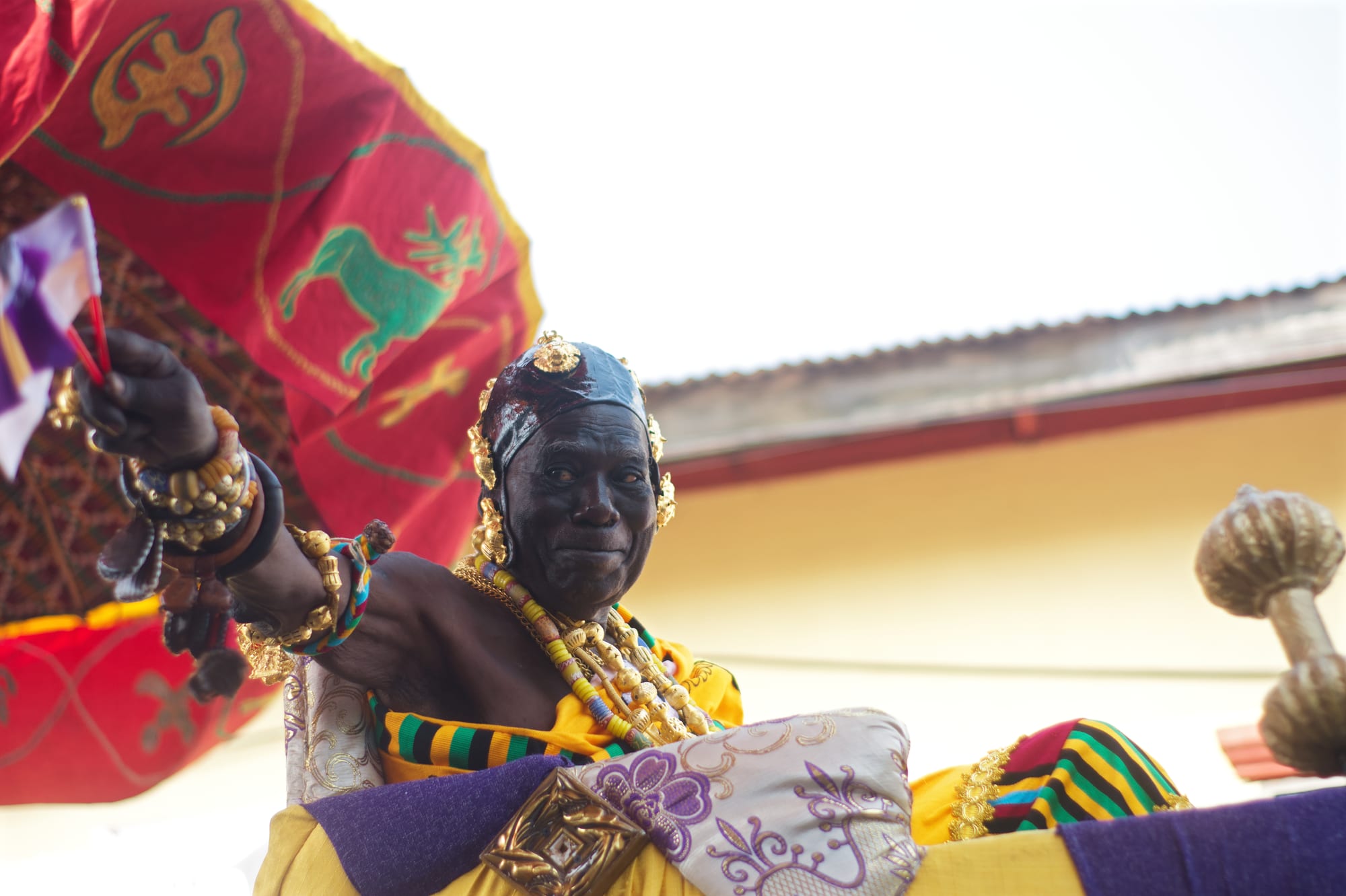
Ghana's calendar is crowded with festivals, most belonging to a particular people and many tied to the harvest, the sea or the history of a community. The Ga celebrate Homowo, whose name means "mocking hunger", around the fish and grain harvest in August and September. The Ewe mark Hogbetsotso, remembering their ancestors' escape from a tyrannical ruler. The people of Winneba hold Aboakyir, a hunting festival in which two companies of men compete to catch a live bushbuck, a small antelope, with their bare hands. Among the Asante, the Akwasidae ceremony comes round roughly every six weeks, when the Asantehene holds court amid drumming and the blare of horns. At many festivals, chiefs process in full traditional regalia, some carried shoulder-high in palanquins beneath great umbrellas, amid drumming and dancing. Christmas, Easter and the two Eids are also national celebrations.
Life begins with the outdooring. Among the Akan, a baby is formally presented to family and community on the eighth day after birth and given its name, a choice traditionally made by the father. An elder touches the child's tongue with a drop of water and a drop of spirits, telling the baby to call water water and gin gin — a first lesson in telling truth from falsehood. Gifts follow, along with food and drink for the guests.
Marriage is an alliance between two families as much as two people. It begins with the "knocking", in which the groom, his father and family elders call at the bride's home to ask formally for her hand, bringing drinks for prayers. Once the families agree, the groom's side receives a list of customary gifts — cloth, jewellery, drinks and money for the bride's parents, with a sum for her brothers — and presents them at the traditional marriage ceremony. No customary marriage is considered complete without the drinks, a sign of how central the formal meeting of the two families is.
Funerals are among the largest social events in Ghanaian life, and the dead are honoured with great ceremony. Families often take weeks or months to prepare, gathering relatives and meeting the considerable costs, and Saturdays in the cities are filled with funerals, drumming and music. Mourners dress in funeral colours: cloth in brown, blue-black and red has traditionally marked mourning among the Akan, while white is worn to celebrate a long life or a happy occasion. Many people view death as a passage to the ancestors, so a funeral can feel as much a celebration as a time of grief.

Arts, crafts and music
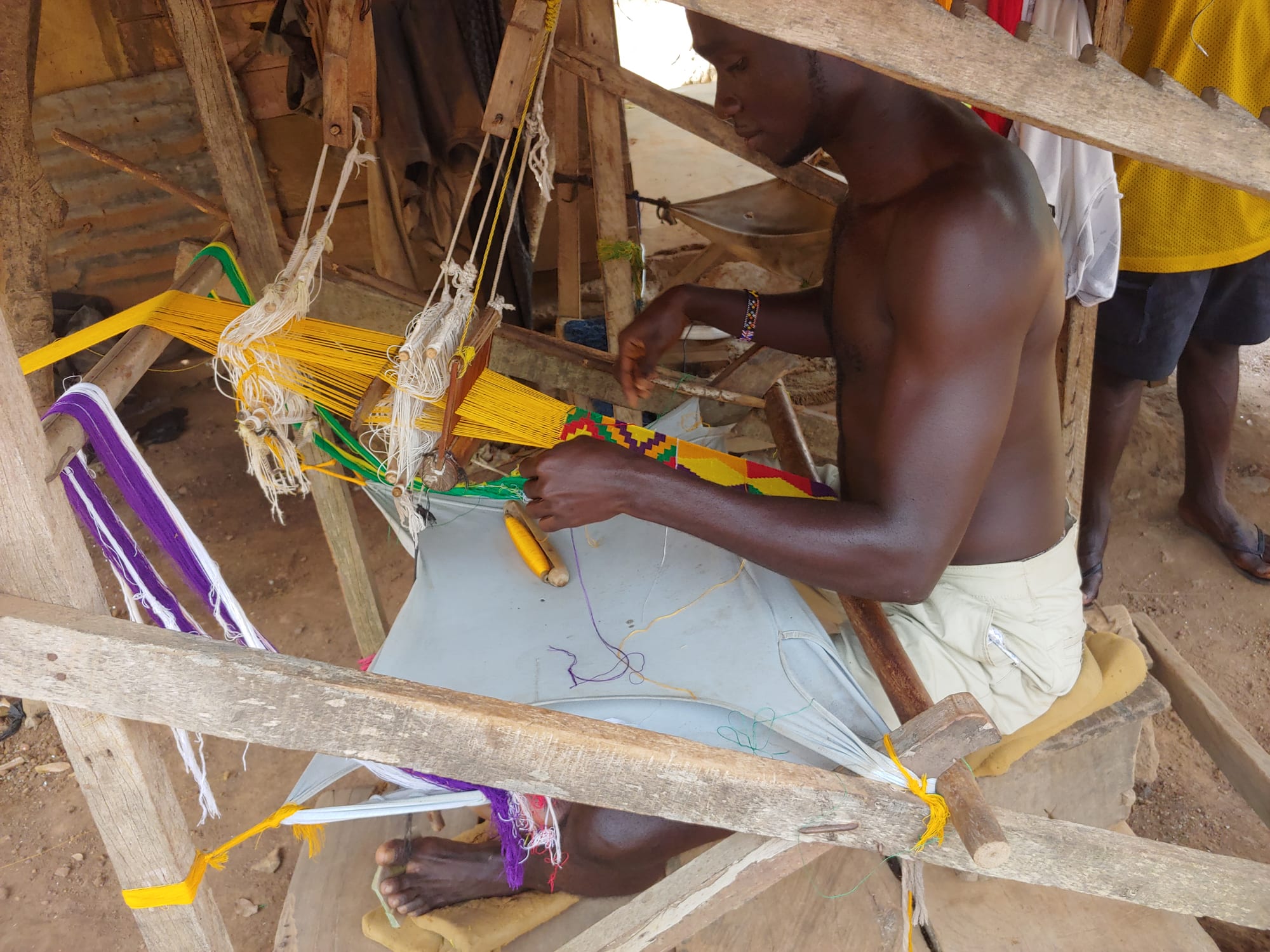
Kente is Ghana's best-known textile and one of its proudest symbols. On UNESCO's list of intangible heritage, it is woven in narrow strips of silk and cotton on horizontal looms and then sewn together into cloth. Each design carries a name drawn from a proverb, saying or social situation, and the age, status and gender of the wearer guide the choice of colour and pattern. The craft passes through families and apprenticeships to master weavers, and each weaving community is overseen by a chief weaver who upholds standards and settles disputes.
Adinkra cloth speaks a different language. Its name means "goodbye" in Twi, and it was traditionally worn at funerals. Craftspeople carve symbols into pieces of calabash gourd, dip them in a thick dye made by boiling the bark and roots of the badie tree, and stamp them onto cloth in a grid, one at a time. Each symbol stands for an idea: concentric circles for leadership and ram's horns for humility and strength. Once reserved for royalty, adinkra is now worn by many peoples, for births and marriages as well as funerals, and its symbols are reproduced in screen prints and factory-made fabrics.
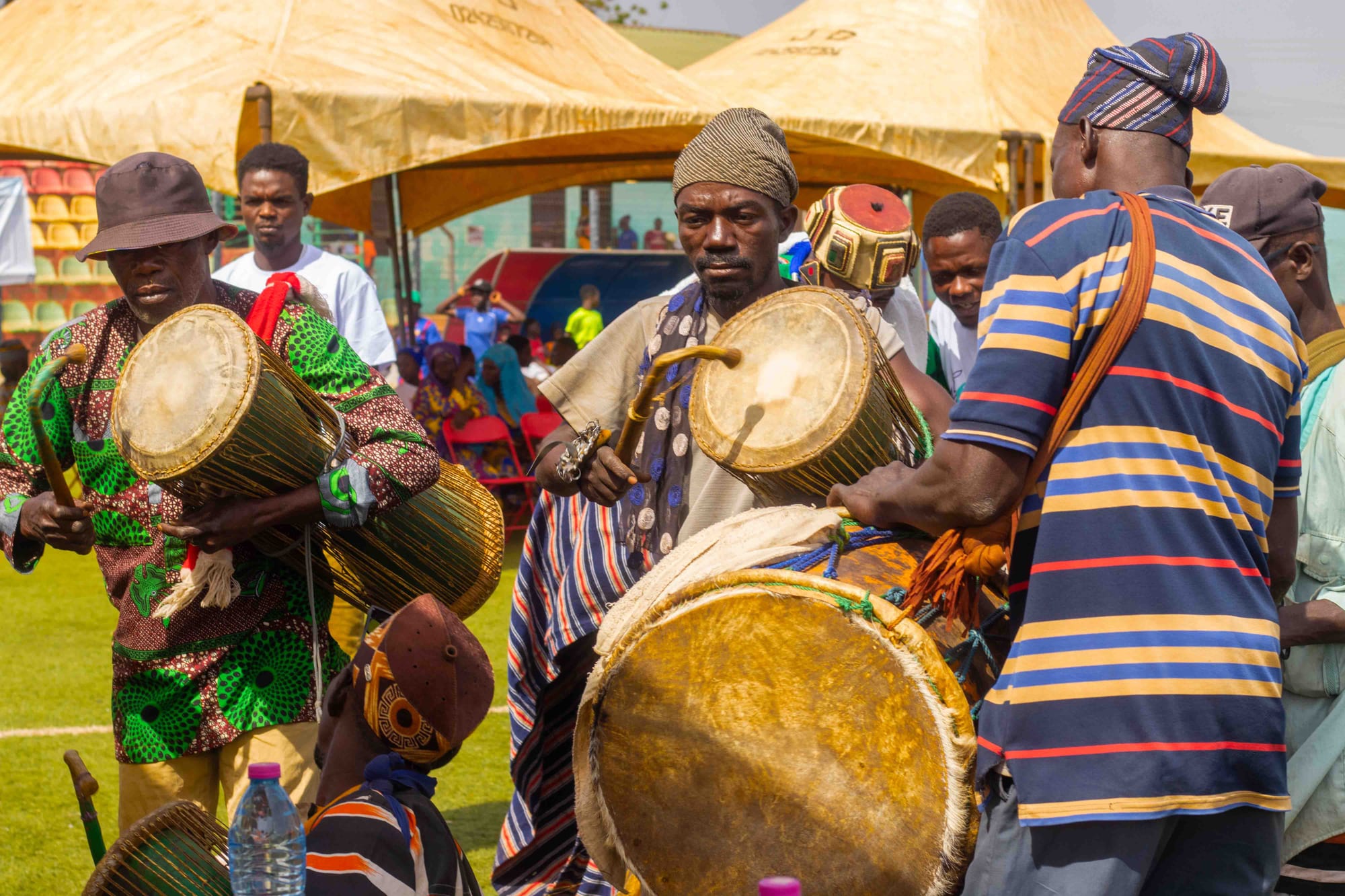
Music and dance bind all of this together. Drumming accompanies festivals, funerals and the courts of chiefs. Ghana's great popular music, highlife, grew up along the coast in the late nineteenth and early twentieth centuries, blending Akan rhythms and palm-wine guitar with brass bands and jazz. Musicians such as E. T. Mensah, Ebo Taylor and C. K. Mann made it Ghana's most enduring popular music, and it was added to UNESCO's list of intangible heritage in 2025, following kente a year earlier.
Dos and don'ts for visitors
- Do greet everyone individually, from right to left, before getting down to business.
- Do use the right hand to greet, eat, give and receive; if the left must be used, apologise.
- Do greet elders first and use titles until invited to use first names.
- Do call on the local chief first when visiting a village on business, and bring a small gift such as schnapps.
- Do wait for the eldest person to start eating, and eat only from the section directly in front at a shared bowl.
- Don't cross the legs, keep hands in pockets or wear a hat in the presence of a chief.
- Don't be too blunt or criticise anyone in public, and never make disparaging remarks about any religion, political party or ethnic group.
- Don't forget the law on sexuality: sex between men is a criminal offence, and parliament has passed a bill, in 2024 and again in May 2026, to criminalise LGBTQ identity and advocacy as well; public affection between same-sex couples carries real risk, so check the latest official travel advice.
What to take away
Ghanaian courtesy is built on attention to other people — the greeting that is never skipped, the elder served first, the ancestors honoured — and visitors who take the time to greet properly will find that warmth returned many times over.