Culture & Customs · Faroe Islands
Faroe Islands: Hand in Hand in the Chain Dance
A devout Lutheran society with a strong egalitarian streak, a medieval ballad dance that survived nowhere else, a national day of rowing and midnight song, and a communal whale hunt that divides opinion far beyond the islands
By Worldlore Editorial · 30 September 2026
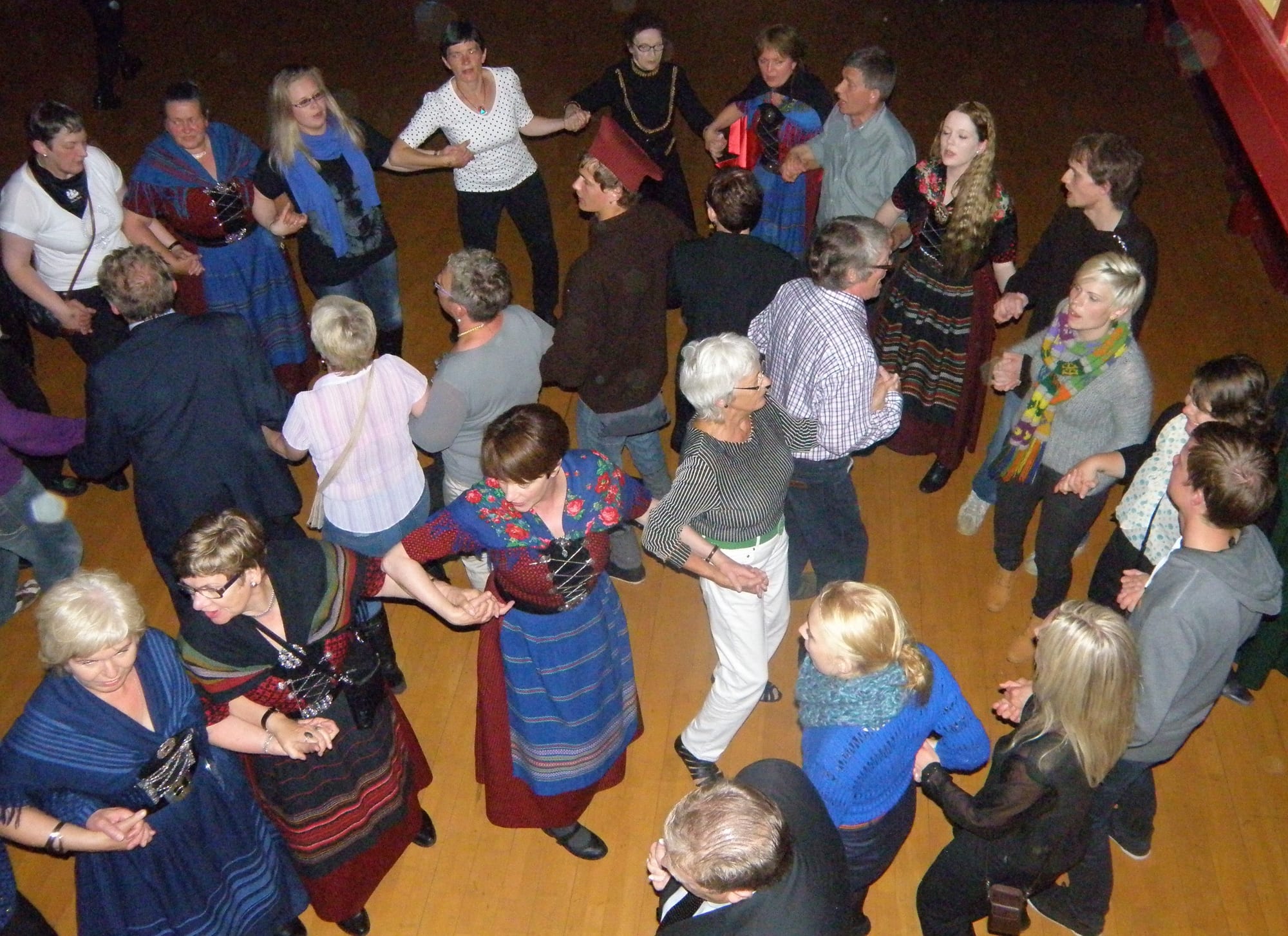
It is close to midnight on 29 July, the last night of the national festival, and the square in the capital is packed. Someone begins a verse of an old ballad, hands are joined, and a line of people starts to move: two steps to the left, one step back, over and over, the line folding round on itself until it fills the square. There are no instruments. The only music is the voices of the dancers, following a leader who calls out each verse while everyone else takes up the refrain. Old and young, officials and fishermen, people in their finest national dress and people in rain jackets, all hold hands in the same slow circle. It is a fair picture of Faroese culture: communal, rooted in the Middle Ages, and entirely unfussed by rank.
Faith, identity and values
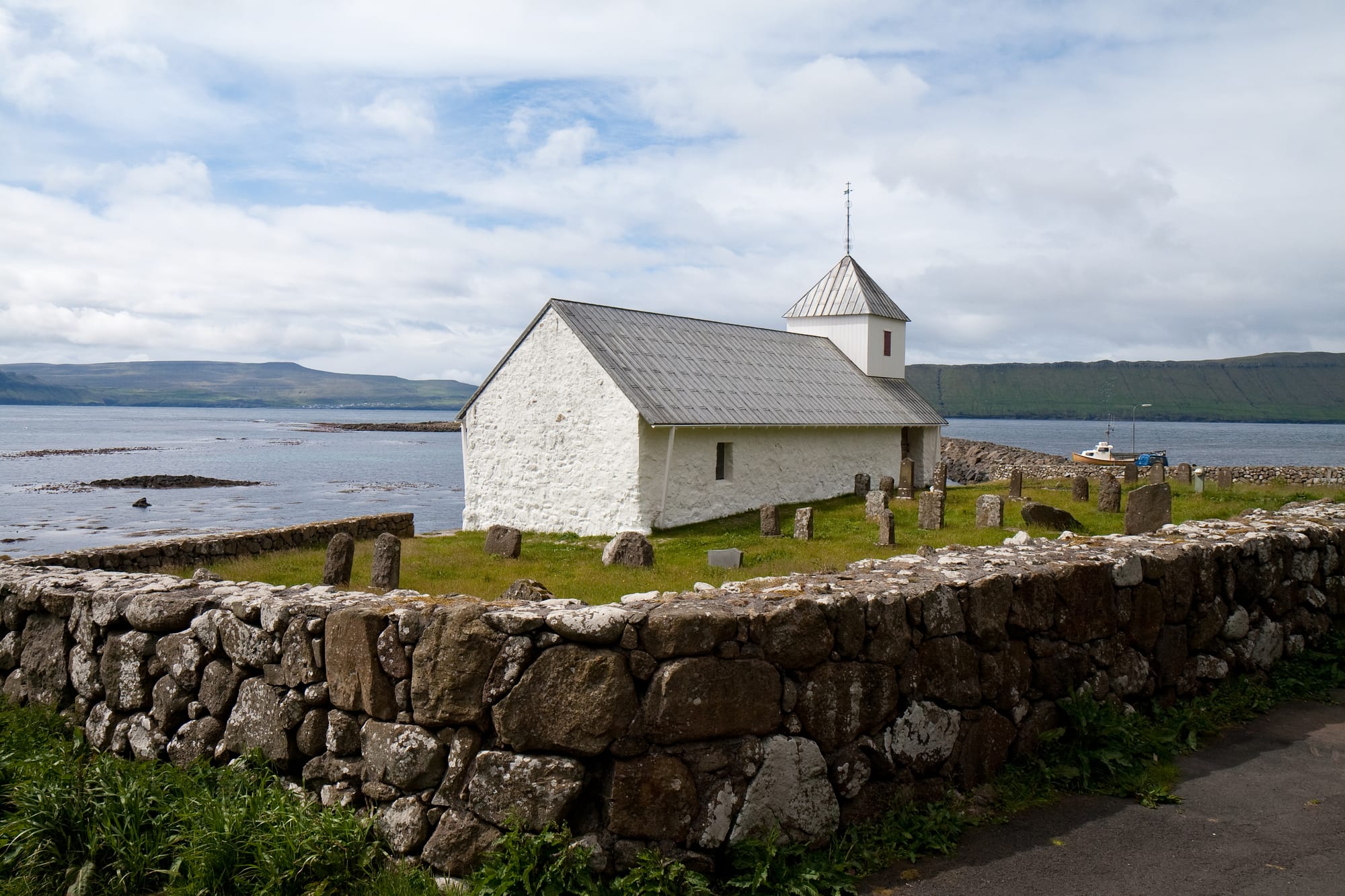
Religion plays an important role in Faroese life. About three-quarters of the population (76 per cent in 2025) belong to the Faroese Evangelical Lutheran Church, the Fólkakirkjan, which is organised as a single diocese with around 60 churches and chapels grouped into 14 parishes. The next largest community is the Plymouth Brethren, and there are smaller Catholic, Pentecostal, Adventist, Salvation Army and Bahá'í congregations. The Lutheran church also runs mission and youth organisations that are part of village life. After the Reformation, Danish became the language of worship, and it remained so into the twentieth century, until Faroese gained equal status in the 1920s. Sunday remains a quiet day in many households.
Social values lean strongly towards equality and cooperation. Faroese society prizes consensus, keeps differences of status understated, and has long used informal social pressure to discourage presumption or showing off; divisiveness is regarded as something close to scandalous. Conversation reflects this restraint. Speech tends to be deliberate and unhurried, people take turns rather than talking over one another, and a calm, understated manner is valued over display.
Few customs draw as much attention from outside as the grindadráp, the communal drive hunt of long-finned pilot whales. When a pod is sighted close to shore and weather and numbers allow, a flotilla of small boats drives the whales into a shallow bay, where they are killed on the shore. The hunt is regulated by law: Faroese rules on the use of whales go back to the Sheep Letter of 1298, specific pilot whaling regulations date from 1832 and have since been updated, and participants must be trained and work under the supervision of the police and appointed hunt foremen. The hunt is non-commercial, and the meat and blubber are divided free of charge among participants and local communities according to traditional rules. Many Faroese defend it as a sustainable local source of food and a practice that binds communities together. Animal welfare campaigners abroad have long condemned it, and health authorities have advised limiting consumption because of mercury and other contaminants in the meat and blubber. Visitors in summer may come across a hunt by chance.
Greetings and meeting people
Everyday greetings are casual and brief. A simple "good day" on arrival and "farewell" on leaving are usually enough, in keeping with a society that keeps differences of status understated. Physical displays such as kissing on the cheek are not part of an ordinary greeting, and much of the real business of getting to know people happens not in public but over coffee in someone's kitchen.
Hospitality and being a guest
Much of Faroese social life takes place during informal visits to people's homes. Traditionally, a visitor walks in without knocking, and shoes come off just inside the door. The host soon offers something to eat and drink, inviting the guest to help themselves with the phrase "ver so góð" or "ver so góður", roughly "be so good", and on leaving the guest offers thanks for the hospitality. Coffee or tea with cake, biscuits or bread and butter can appear at almost any hour.
That habit of opening the home to strangers has been turned into something visitors can join. Under the heimablídni, or "home hospitality", scheme, farmers, fishermen and other islanders cook traditional food for paying guests at their own tables, often telling stories of their village over the meal.
Being a good guest extends to the land. Much of the countryside is working pasture, and some popular hiking routes now require a fee or a local guide, so it is worth checking before setting out. Walkers are asked to keep to marked paths and cairns and to stay out of the infield, the grass near villages that is harvested as winter fodder. If shepherds are gathering sheep nearby, the advice is to keep out of sight, and if necessary to lie down and stay still until the flock has passed, because a startled herd can undo hours of work. It is also customary to pick up loose tufts of sheep's wool, which can tangle round the feet of birds such as oystercatchers.
Festivals and life's big moments
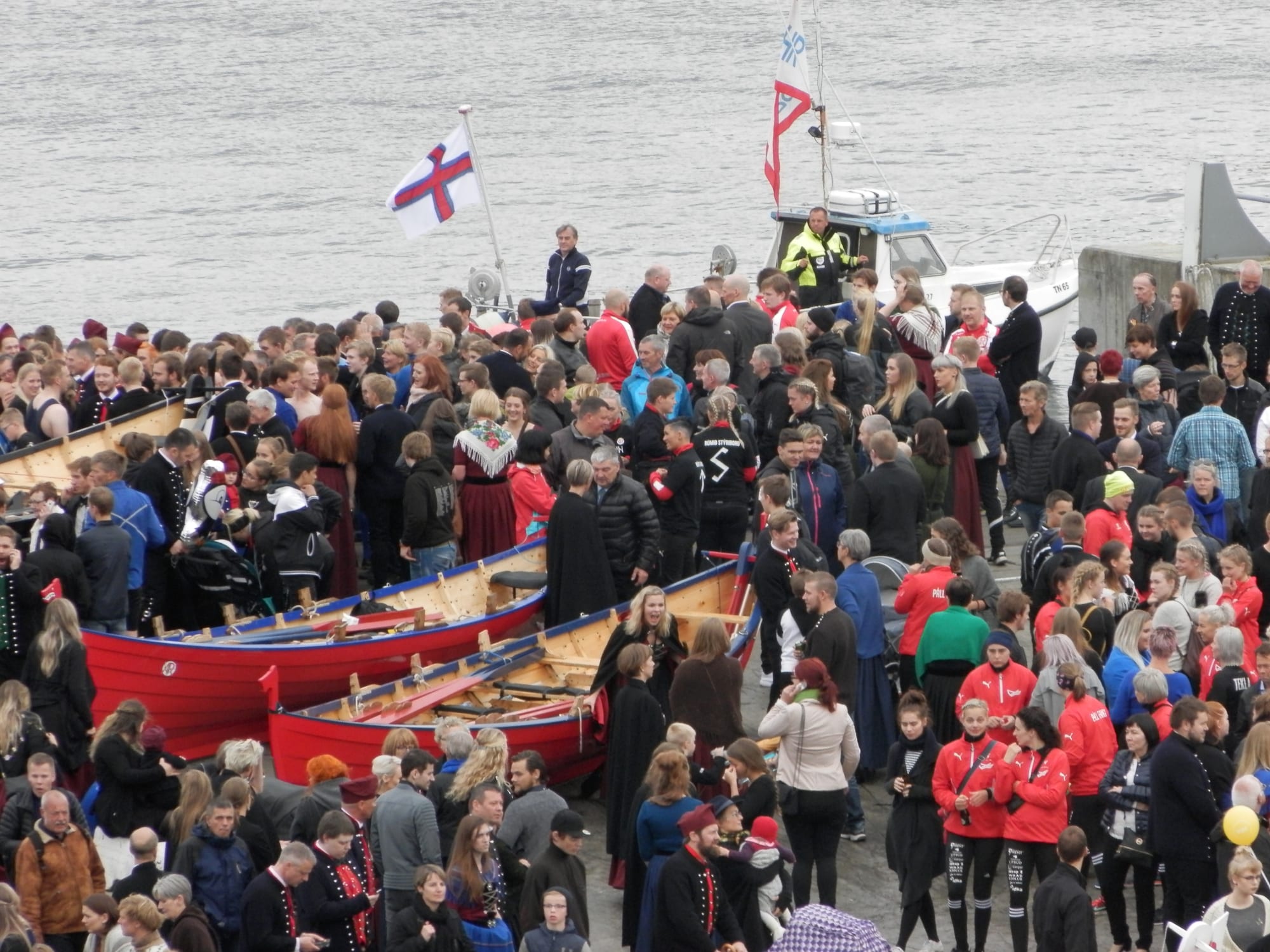
The great festival of the year is Ólavsøka, or St Olaf's Wake, held on 28 and 29 July in honour of Olaf Haraldsson, the Norwegian king who died in battle in 1030. It opens with a procession of athletes, councillors, a brass band and horse riders, and the finals of the national rowing competition, in the traditional wooden boats of the islands' national sport, draw crowds to the harbour. On 29 July, members of parliament, ministers, clergy and officials walk in procession to the cathedral for a service before the new session of the Løgting, the Faroese parliament, is opened, a ceremony with roots going back centuries, and the Prime Minister delivers an annual address. Many people wear national dress and spend the two days strolling and greeting friends, with concerts and exhibitions throughout, before the festival ends with the midnight song and chain dance. Christmas and Easter are the other high points of the church year.
The national dress is at the heart of these occasions. For men, it consists of a white shirt under a finely woven waistcoat with embroidery and silver buttons, a knitted jacket, black knee-breeches and long knitted socks. For women, a tight red and black knitted bodice laced with a silver chain over black velvet is worn with a long skirt, an embroidered shawl and a pinafore fastened with a silver brooch. Every piece is made by hand, often at great expense, and outfits are commonly assembled over years and handed down through generations. The dress comes out for Ólavsøka, for weddings and for the chain dance.
Life's milestones follow the church. Most children are christened in their home parish, with godparents chosen by the family. Confirmation, in the early teens, is a major family occasion, and many couples marry in church. Funerals begin with a service in church, followed by a procession to the graveyard and a gathering at the home of the deceased or a close relative. Because the cemetery is often some distance from the church, the coffin is usually driven there with mourners following, and it is a customary mark of respect for any driver who meets a funeral procession to stop, step out of the car and wait in silence until it has passed.
Arts, crafts and music
Music is woven unusually deeply into Faroese life. Until the nineteenth century there were few instruments on the islands, and the voice carried everything: the kvæði, long Faroese ballads recounting the heroes and events of Norse and Scandinavian history, and the Danish-language fólkavísur, both sung to the chain dance. Historically they were sung not only at dances but at home, during the long winter evenings when families worked wool together. A leader, the skipari, starts each verse and the dancers join in, and today a number of dance associations keep the tradition alive, meeting mostly in winter. Alongside it, the islands have produced internationally known musicians such as Eivør and Teitur, the metal band Týr, and a national symphony orchestra, while summer festivals such as G! Festival and Summarfestivalurin span everything from folk to metal.
Knitting is the craft most closely tied to Faroese identity. Wool from the islands' free-ranging sheep was once the backbone of the economy: records of knitwear exports go back to 1567, and in the 1840s knitted sweaters made up almost half of all Faroese exports. The traditional sweater, with a high collar, one base colour and patterns in one or two others, has never gone out of fashion, and a revival of interest in wool has brought new designers to reinterpret the old patterns.
The visual arts took shape in the twentieth century. Sámal Joensen-Mikines, whose paintings of death, grief and whale killing from the 1930s to the 1950s are among the most powerful in Faroese art, opened the way for a generation of artists such as the sculptor Janus Kamban and the painter Ingálvur av Reyni. Landscape and the relationship between people and nature remain the central themes, and the National Gallery, Listasavn Føroya, founded in 1989, holds a major collection of old and new Faroese art.
Dos and don'ts for visitors
- Do take shoes off when entering someone's home, and accept the coffee and cake that is offered.
- Do join the chain dance if invited; anyone can take a hand in the line.
- Do stop the car and step out in silence when meeting a funeral procession on the road.
- Do keep to marked paths and cairns, check whether a hiking route charges a fee, and stay out of the hay-growing infields near villages.
- Do keep out of sight, and lie still if necessary, when shepherds are gathering sheep nearby.
- Don't fly a drone near villages, roads or nesting seabirds, and back away from birds that call or dive at walkers.
- Don't expect a lively Sunday; many people keep it as a quiet day.
What to take away
Faroese culture joins hands rather than raising voices, and visitors who match its calm, respect its land and its Sundays, and step into the circle when invited will find a community far warmer than its weather.