Culture & Customs · Ethiopia
Ethiopia: Honour, Fasting and the Third Cup
An ancient church and a deep-rooted Islam side by side, greetings that bow to age, a guest fed by hand at the table, and a festival year lit by bonfires and carried to the water under embroidered umbrellas
By Worldlore Editorial · 30 September 2026
A guest has been in an Ethiopian home for barely a few minutes when the coffee things come out. The beans are roasted, the room fills with smoke and incense, and the first small cup is poured. It would be easy to drink up and make polite excuses, but that would be a mistake: the coffee is brewed and served three times, and leaving after the first round is considered inappropriate. So the guest settles in. Food follows, and at some point the host tears off a piece of injera, wraps it around a morsel of stew and lifts it straight to the guest's mouth. The right response is to smile and accept. Nothing in Ethiopian hospitality is hurried, and nearly all of it is designed to show that a visitor is worth the time.
Faith, identity and values
Religion is woven deeply into Ethiopian life. In the 2007 census, the most recent to record it, 43.5 per cent of Ethiopians identified as Ethiopian Orthodox Christians, 33.9 per cent as Muslims and 18.6 per cent as Protestants, with smaller Catholic and traditional communities. Observance is intense for many believers. The Ethiopian Orthodox Tewahedo Church has one of the strictest fasting regimes of any church, with about 180 obligatory fasting days for lay people and up to some 250 for clergy and the most observant, including most Wednesdays and Fridays, when the devout give up meat and animal products, and a fast of 55 days precedes Easter. Most Ethiopian Muslims are Sunni, and Sufi influences run through their devotional life, heard in the chanted religious poetry known as menzuma. Across both faiths, beliefs in the evil eye, known as buda, and in healing and spirit possession persist alongside formal religion.
Shoes come off before entering a church or a mosque, just as they do in a home. Women are often expected to wear a long dress and cover their hair before entering a place of worship, and many churches and mosques have separate entrances for men and women.
Ethiopia is home to more than 80 ethnic groups, each with its own language and customs, yet a strong national identity binds them, rooted in pride in the country's long independence and its standing as a symbol of African sovereignty. Behaviour is closely tied to honour: how people dress, speak and treat others is taken as a reflection of their own standing and their family's. Two ideas sit at the heart of social life. Mahiberawi nuro, or collective life, means that a person's welfare depends on the generosity of family and friends rather than on institutions. And yilugnta, a sense of being considerate of others' feelings and aware of how one's actions look through their eyes, encourages restraint, cooperation and deep respect for parents and elders.
This consideration shapes the way people talk. Ethiopians tend to be mild and unconfrontational, and they are reluctant to burden others with their troubles or to voice negative feelings openly. A refusal is often softened to "maybe" or "let me think about it". Sarcasm and irony can be misunderstood until people know one another well, though laughter and jokes are much enjoyed once they do.
Greetings and meeting people
A handshake is the standard greeting with someone new, given with the right hand or with both hands and usually with a lighter grip than a visitor may expect. Direct eye contact is normal between equals, though lowering the gaze is a sign of respect towards elders and superiors. Close male friends often embrace while shaking hands, patting each other on the back, and close friends of any gender commonly exchange three kisses on the cheeks, sometimes more if they have not met for a while.
Elders are greeted with particular care. Some people kiss an older person's hand, others bow slightly or lower their head. Formal titles are used until an invitation to do otherwise: Ato for a man, Woizero for a married woman and Woizerit for an unmarried one. Greetings differ by language and community; in Amharic, the question "Indemin nih?" asks a man how he is, while a respectful plural form is used for elders, and many Muslims greet one another with "Assalaam alaikum". Some Muslim women prefer not to have physical contact with men outside their family, so men usually wait for a woman to offer her hand first.
Gestures are kept modest. Pointing at people with a finger or a foot is considered inappropriate, and pointing at someone with the left hand is especially rude.
Hospitality and being a guest
Visiting is one of the foundations of Ethiopian relationships. In the countryside people often drop in unannounced, while city dwellers are more likely to arrange a time, and a visit is rarely expected to last less than an hour. Shoes are removed at the door. A gift is appreciated, and something from the visitor's home country is a thoughtful choice, but it should not be so expensive that the host feels unable to reciprocate, because returning a gift in kind is a firm obligation. Gifts are handed over with both hands or the right hand, never the left alone, and are usually set aside rather than opened in front of the giver.
At the table, hands are washed before the meal, sometimes with water brought to the diners where they sit. Food is served according to age or status, and everyone eats from a shared platter using the right hand only; passing or eating food with the left hand alone is avoided. Turning down food is considered impolite, and hosts will keep offering more. The gursha, in which a host or fellow diner places a choice mouthful directly into a guest's mouth, is an act of affection and respect, and the polite response is to accept it with a smile.
The coffee ceremony, buna maflat, is the ritual centre of hospitality. The three rounds, which in Amharic are called abol, tona and baraka, are each brewed from the same grounds, and guests are expected to stay for all of them, taking a moment to appreciate the aroma and sipping slowly rather than hurrying.
Festivals and life's big moments
The Orthodox year is the backbone of the national calendar, though Ethiopian Muslims also keep Eid al-Fitr, Eid al-Adha and the Prophet's birthday as public celebrations. The year begins on Enkutatash, New Year's Day, which falls on 11 September, or on 12 September in the year before a Gregorian leap year. The name is usually translated as "gift of jewels", and the holiday coincides with the end of the long rains, when the hillsides turn yellow with the daisies known as adey abeba. Girls in traditional dress gather the flowers and go from house to house singing New Year songs and handing out bouquets, and households thank them with a small gift or a little money. On the eve of the holiday, bonfires of branches and leaves are lit to see out the old year.
A fortnight later comes Meskel, which commemorates the finding of the True Cross and is on UNESCO's list of intangible cultural heritage. Its centrepiece is the damera, a tall conical pyre of poles decorated with green grass and the same yellow daisies. Clergy in colourful vestments chant hymns and perform their rhythmic dance before it, and at the largest gathering the Patriarch of the church himself sets it alight. UNESCO notes that the festival brings families together, draws migrant workers home, and is expected to be preceded by the settling of personal quarrels.
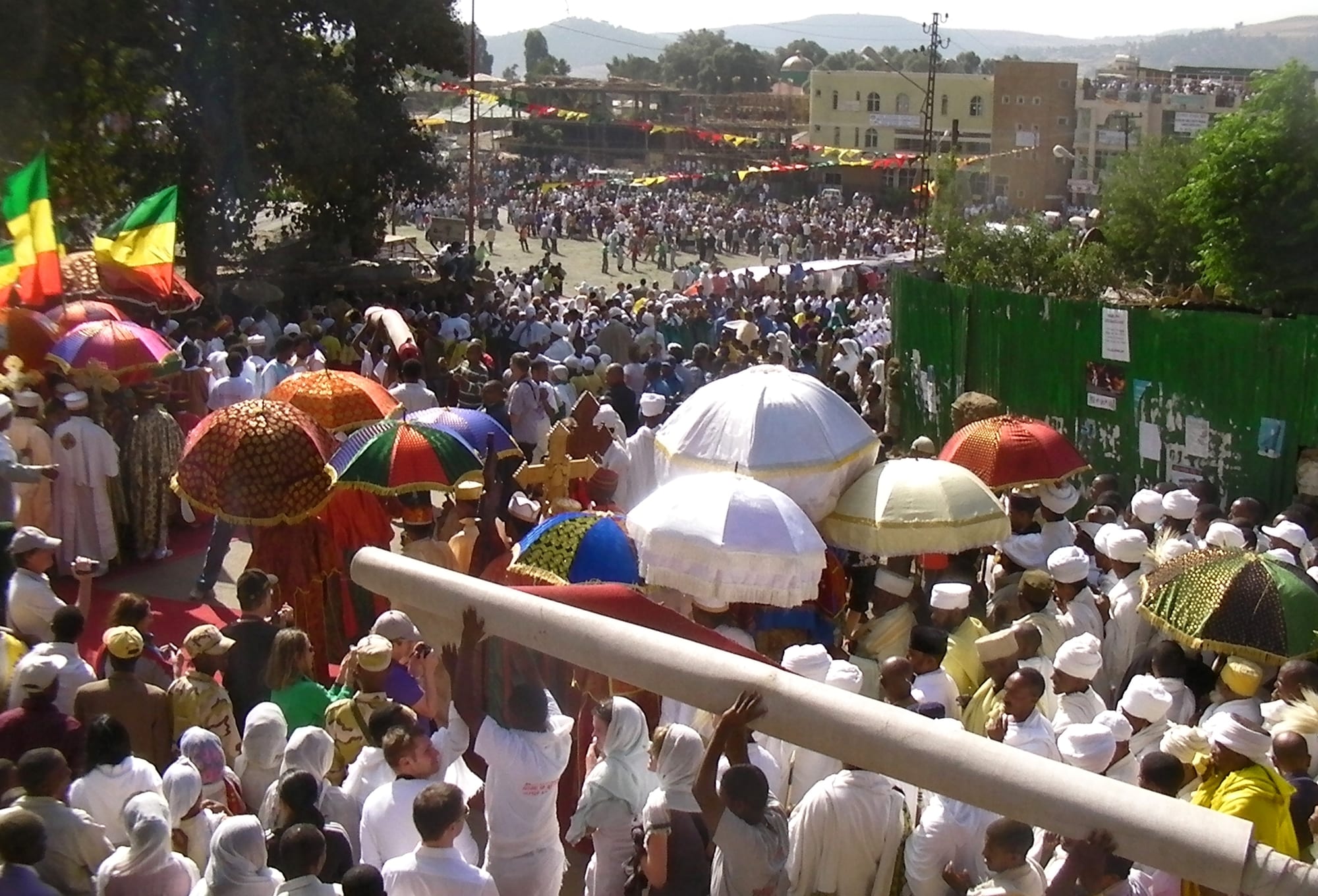
Timkat, the Ethiopian Epiphany, falls on 19 January (20 January in some years) and is also on UNESCO's list. On the eve, called Ketera, each parish's tabot is carried out of its church by priests, wrapped in rich cloth and shaded by embroidered umbrellas, and escorted in procession to a pool, river or reservoir. The faithful keep an all-night vigil of prayers and hymns, and after rituals before sunrise the water is blessed and sprinkled over the congregation. Later in the morning the tabots are carried home again amid singing and dancing, with hundreds of thousands taking part across the country.
Other communities keep their own great occasions. Irreechaa, the Oromo thanksgiving held at the end of the rainy season, sees crowds carrying bunches of fresh green grass to riversides and lakes, led by Gadaa elders, to give thanks to Waaqa, the Creator, for the harvest and for peace. The Gada system itself, the Oromo's traditional democratic institution, is on UNESCO's list, as are the New Year festivals of the Sidama and Wolaita peoples and the Shuwalid festival.
Marriage is traditionally a matter for two families rather than two individuals. Casual dating is uncommon, and both sets of parents must approve of the other family. In a traditional engagement, a delegation of elders, the shimagile, visits the bride's family to propose on behalf of the groom's, and negotiations over the dowry follow.
Death is an intensely communal event. Most neighbourhoods have an idir, a mutual association whose members pay in regularly and which, when someone dies, provides tents, chairs and food for the mourners and support for the family; many also help with weddings. Grief is expressed openly and together. Mourners dress in black or white cotton wraps, and funeral dirges known as lekso are led by a singer while the mourners respond, sometimes swaying and beating their chests. Vigils continue over several days so that everyone has the chance to come and mourn.
Arts, crafts and music
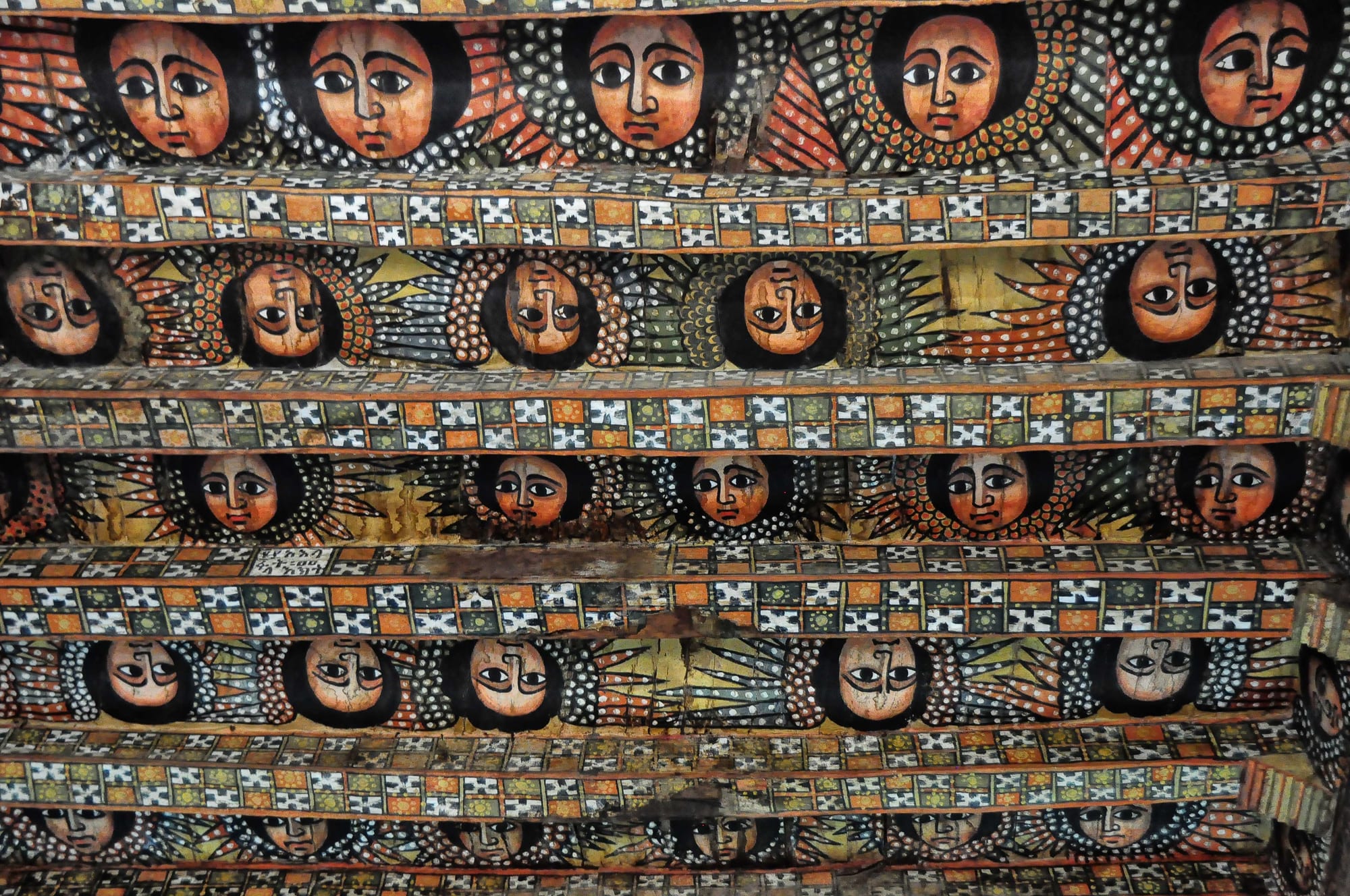
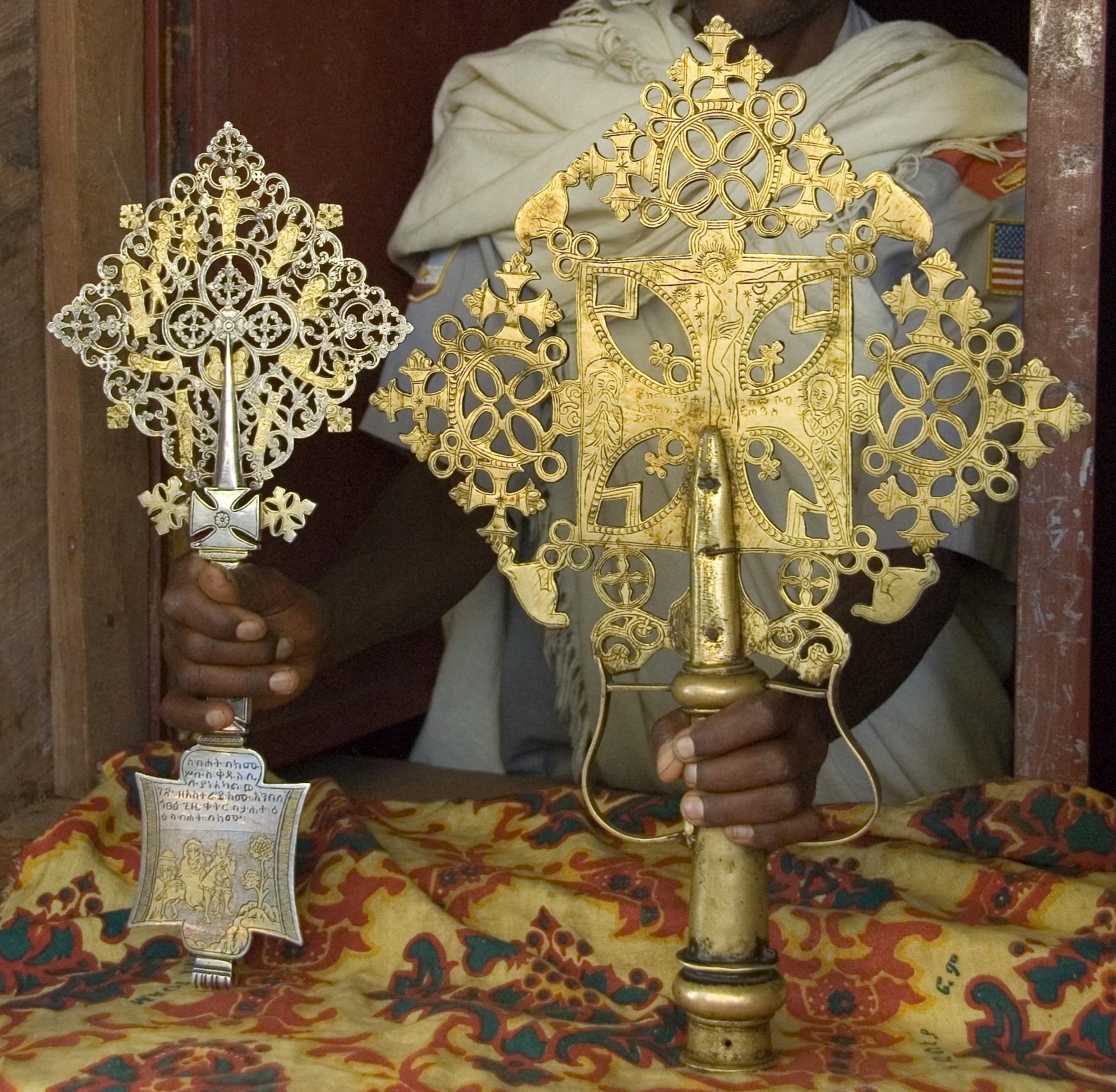
Much of Ethiopia's artistic heritage grew up around the church. Church walls and ceilings are painted with saints, biblical scenes and rows of angels, and church treasuries hold intricate metal crosses, from small hand crosses to tall processional crosses with lace-like openwork that clergy hold aloft in festival processions. The church's hymns, known as zema, are attributed to St Yared, regarded as the founder of Ethiopian Orthodox hymnody, and his compositions are sung before the Meskel bonfire.
Three stringed instruments sum up the highland musical tradition. The begena, a large ten-stringed lyre, is associated with devotional music. The krar, a smaller five- or six-stringed lyre with a bowl-shaped body, is emphatically secular, and in traditional lore it is even cast as the instrument of the devil. The masinqo is a single-stringed bowed fiddle. The fiddle and the lyre belong above all to the azmari, traditional minstrels who sing lengthy historical epics and love songs to their own accompaniment, a living tradition of song-stories still heard in azmari houses, where musicians perform for an evening audience.
The twentieth century added new sounds. Ethio-jazz, most closely associated with the vibraphonist and composer Mulatu Astatke, blended Ethiopian melodies with jazz and has since won an international following.
Dos and don'ts for visitors
- Do use titles such as Ato and Woizero until invited to use first names, and greet elders first and with a slight bow.
- Do check the latest government travel advice before travelling, as armed conflict and unrest have affected several regions and some areas are off-limits.
- Do take off shoes before entering a home, a church or a mosque; women should cover their hair and wear a long skirt or dress at places of worship.
- Do eat, pass food and hand over gifts with the right hand or both hands, never the left alone.
- Do stay for all three rounds when coffee is being made; leaving after the first cup is considered impolite.
- Do accept a gursha, a mouthful fed by hand, with a smile; it is a sign of warmth and respect.
- Don't refuse food outright, and expect to be offered more than once.
- Don't point at people, especially with the left hand, and avoid sarcasm with new acquaintances.
- Don't offer a handshake first to a woman who may prefer not to touch men outside her family; wait for her to extend her hand.
What to take away
Ethiopian customs rest on honour and on a steady consideration for others, and a visitor who slows down, respects age and lingers for the third cup will find that hospitality returned many times over.