Culture & Customs · Brunei
Brunei: Courtesy Under the Crown
A national philosophy built on Malay custom, Islam and monarchy, a working week that pauses for Friday prayers, and a palace that opens its doors to the public at the end of Ramadan
By Worldlore Editorial · 30 September 2026
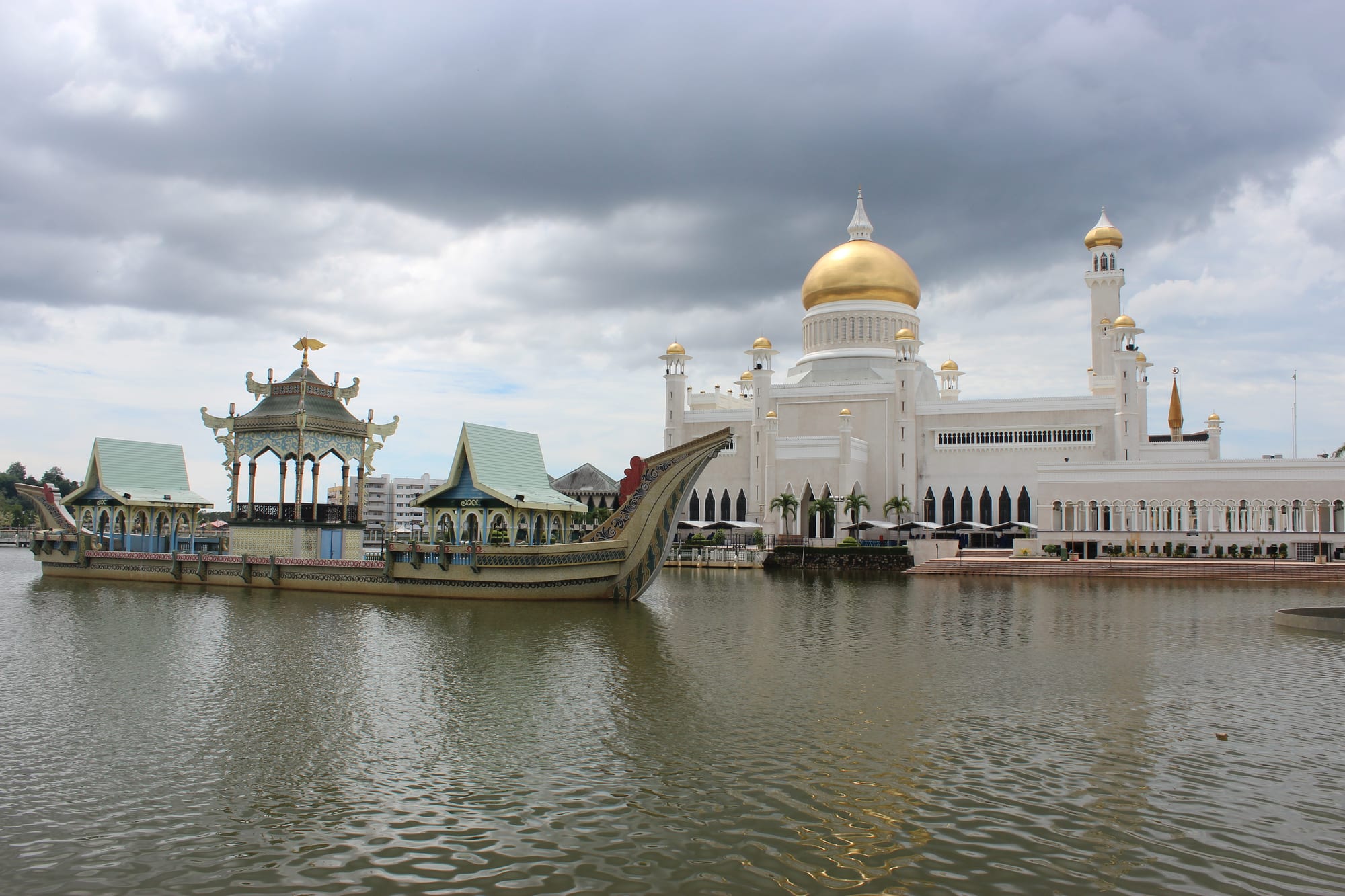
It is just before midday on a Friday, and the country is winding down. Banks, government offices, shops and restaurants close their doors between noon and two o'clock so that Muslim men can attend Friday prayers. The call to prayer, the azan, carries across the towns and over the water villages, and it is considered bad manners to make loud noise while it sounds. Then, in the early afternoon, the shutters go up and ordinary life resumes. The weekly pause says a great deal about Brunei: a calm, orderly and prosperous society in which faith sets the rhythm of the week and courtesy, restraint and respect are expected of everyone, visitors included.
Faith, identity and values
The foundation of national life is a philosophy called Melayu Islam Beraja, or Malay Islamic Monarchy, usually shortened to MIB. The government describes it as a system combining strong Malay cultural influence, the importance of Islam in daily life and governance, and respect for the monarchy as represented by the Sultan. It has guided the state since full independence in 1984. MIB is a compulsory subject in public and private schools and at university, and a supreme council exists to spread it and see that it is reflected in the country's laws. Islam of the Shafi'i school is the official religion under the constitution.
According to the 2021 census, just over four in five residents are Muslim, around 7 per cent Christian and around 6 per cent Buddhist, with the rest following other faiths, including Indigenous traditions. The ethnic Chinese community, roughly one person in ten, is mostly Buddhist, with a Christian minority, while Indigenous peoples such as the Dusun, Bisaya, Murut and Iban make up a small share of the population. Non-Muslim faiths operate within firm limits: promoting other religions to Muslims is prohibited, a non-Muslim marrying a Muslim is expected to convert first, and the authorities interpret the law as barring the public celebration of other religions, so Christmas decorations, for instance, are kept to private homes, even though 25 December is an official holiday. Brunei began introducing a Sharia penal code in phases in 2014, and its remaining provisions, including severe corporal and capital punishments, came into force in April 2019. The step drew concern from the UN human rights office and wider international criticism, and in May 2019 the government extended its moratorium on the death penalty to the code.
Reverence for the monarchy runs deep. The Sultan and the royal family are highly revered, and public criticism of them causes great offence and can lead to legal action. That respect sits alongside a set of values often described as part of the Malay inheritance — restraint, respect, kindness and humility — expressed as much through gentle, indirect speech as through formal rules. Calmness is read as a sign of self-control and good manners.
Greetings and meeting people
Malay is the official language and English is widely spoken; visitors generally find Bruneians open and ready to help. The most characteristic greeting is the salam. Between men it is a light handshake, after which the right hand is often brought back to touch the chest, a gesture of sincerity that says the greeting comes from the heart. Where it is unclear whether physical contact is welcome, a nod or a slight bow is a safe alternative. Between men and women contact is kept to a minimum: it is polite not to offer a handshake to a member of the opposite sex unless that person offers first.
Respect for age runs through the way people meet. In a home, the eldest person present is greeted first. At Hari Raya, younger relatives take their elders' hands in turn and ask forgiveness for any wrongs of the past year, a custom Bruneians describe as one of the most meaningful of the festival. Titles matter too. Pengiran signals descent from the nobility, while Awang and Dayang are courtesy titles for men and women, and it is wiser to follow the form on a business card or introduction than to guess which part of a name to use. The right hand is used to offer or receive food, gifts and other objects.
Closeness between the sexes in public is a sensitive matter. Public displays of affection may cause offence, and closeness in private between an unmarried man and woman is illegal if one of them is Muslim. Modest dress is the norm, especially in government buildings.
Politeness extends to the way things are said. The pantun, a traditional Malay verse form, has long allowed people to raise sensitive matters gently, and the value it places on indirect, courteous speech still shapes conversation. A direct refusal or a blunt criticism can seem rude, and softer phrasing is usually preferred.
Hospitality and being a guest
Visitors encounter Brunei's customs most directly in its mosques, which are open to non-Muslims outside prayer times. Footwear is removed before entering, silence is observed, and women cover the head, shoulders and knees. The same care for quiet applies whenever the call to prayer is heard.
In a private home, shoes come off at the door unless the host says otherwise. Guests wait to be shown where to sit and to be invited before starting to eat, and the eldest or the guest of honour is usually served first. Food and drink should be accepted graciously, since a refusal can cause offence, and when in doubt about how to eat, following the host's example is the safest course. A modest gift such as fruit or good chocolates is appreciated, provided any food is halal, and it is normal for a present not to be opened in front of the giver.
The fasting month of Ramadan changes daily life for everyone. During fasting hours, roughly from before dawn until sunset, it is against the law to be seen eating, drinking or smoking in public, a rule that applies to everyone; with many restaurants closed until dusk or serving only takeaway, non-Muslim visitors eat in private or in their hotel rooms. As sunset approaches the mood changes, and the evening meal to break the fast becomes the social heart of the day.
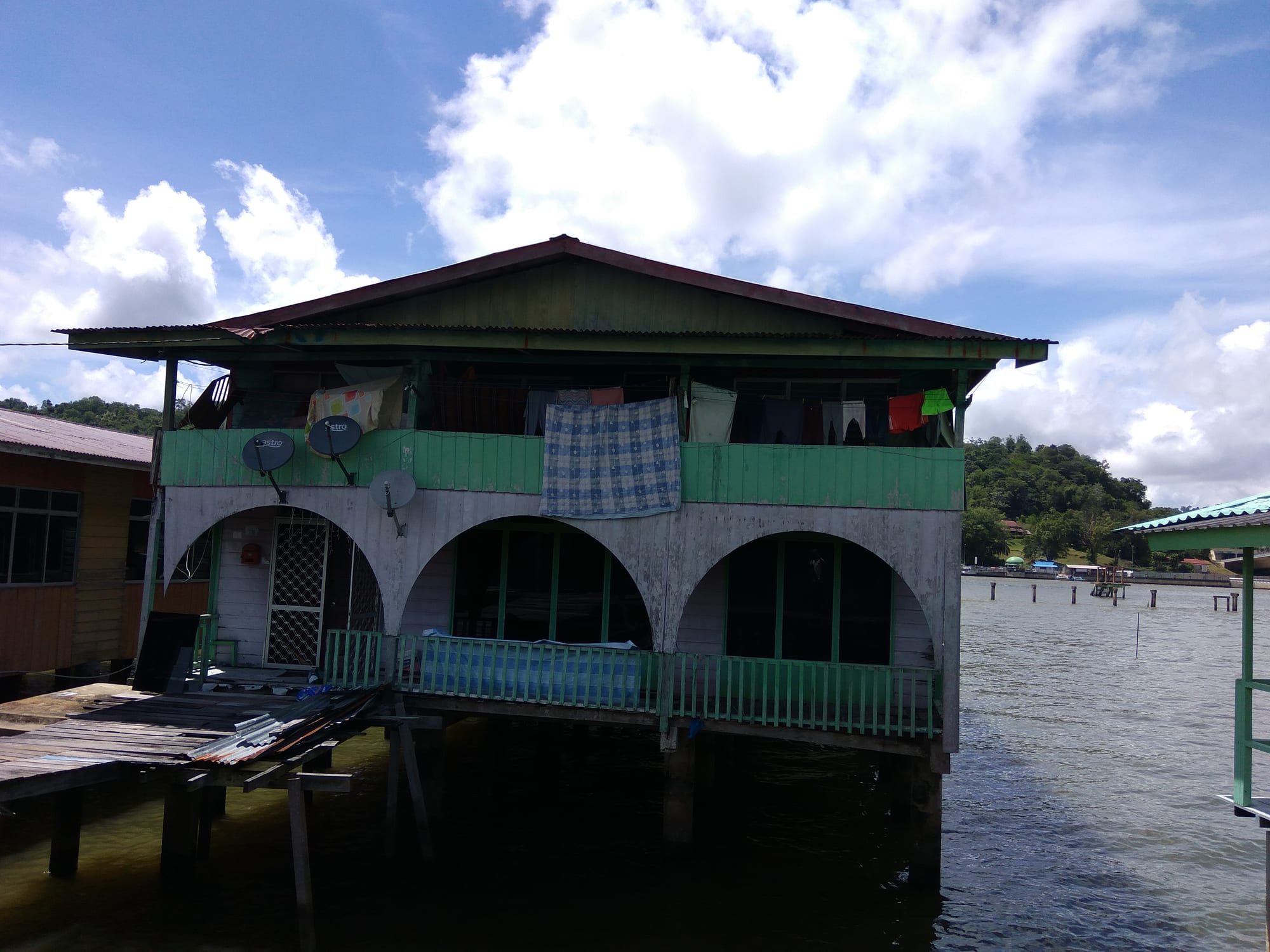
Alcohol has no place in public life. Its sale is illegal throughout the country and Muslims may not drink it at all; non-Muslim visitors aged 17 and over may bring in only a limited amount, which must be declared to customs on arrival and drunk in private. For a glimpse of traditional home life, Kampong Ayer, a water village with centuries of history, and the Iban and Dusun longhouses of the interior welcome visitors to see everyday customs, crafts and cooking. As a guest anywhere, following the host's lead, dressing modestly and accepting hospitality graciously are the essentials.
Festivals and life's big moments
The Islamic calendar shapes the year. The greatest celebration is Hari Raya Aidilfitri at the end of Ramadan, when families visit one another, homes are opened to a stream of guests, elders are asked for forgiveness, and the palace receives the public. Hari Raya Aidiladha, the festival of sacrifice, follows later in the year. Christmas is an official holiday, and Chinese New Year is marked too, though lion dance performances are limited to a few days and to the Chinese temple, Chinese school halls and private residences.
National occasions carry the monarchy's stamp. Brunei became fully independent on 1 January 1984, and 23 February was chosen as National Day, celebrated with a parade and performances; in 2026, when it fell during Ramadan, the celebrations were deliberately scaled back to honour the fast. The Sultan's birthday on 15 July brings a grand ceremonial parade in the capital, a royal address, and thanksgiving prayers held at mosques across the country.
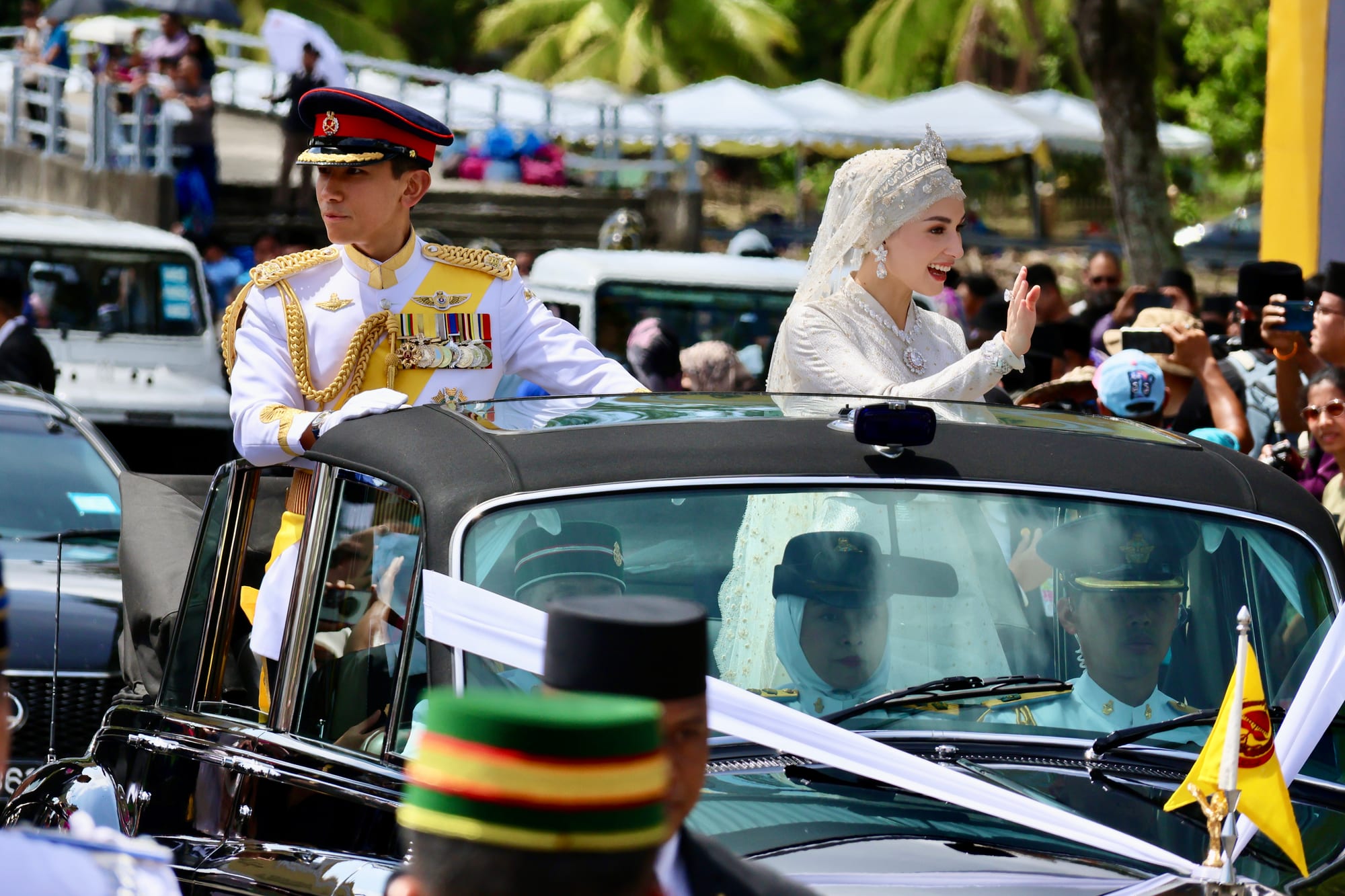
Weddings bring together Malay custom and Islamic law, and royal weddings display the full ceremony in public. The ten-day wedding of Prince Abdul Mateen in January 2024 moved through a formal proposal, a performance by royal court musicians and an engagement at which the groom's family brought symbolic gifts to the bride's home. At the berbedak, or powdering ceremony, senior members of the royal family applied scented powder and perfumed oils to the hands of the bride and groom as a blessing. The marriage vows were exchanged in a religious ceremony at the Omar Ali Saifuddien Mosque the next day. Days later came the bersanding, at which the couple sat side by side as husband and wife in the palace, and a procession through the capital past thousands of well-wishers, followed by a royal banquet for some 5,000 guests. Bruneian wedding music often includes responsive singing in which guests join, and the traditional song Alus Jua Dindang, in which the groom declares his devotion to his bride.
Funerals are simple and swift. Muslims are customarily buried soon after death, usually in a plain container and without a viewing, and local mosques generally coordinate the arrangements, often at minimal cost to the family, with funeral containers paid for from donations. The dead are remembered afterwards through gatherings for the recitation of Surah Yasin, followed by tahlil, collective prayers of remembrance, and doa arwah, prayers for the souls of the departed; whole villages sometimes gather for these ceremonies, and graves are traditionally tidied in the run-up to Ramadan. Non-Muslims may be buried or cremated, and the country's single crematorium is an open-air facility run by the Hindu community.
Arts, crafts and music
Two of Brunei's traditions are on UNESCO's list of intangible cultural heritage, both shared with its neighbours. The pantun, a Malay verse form listed jointly with Indonesia and Malaysia, is most often a quatrain rhyming a-b-a-b, used to express complex ideas and feelings. It is heard at weddings, customary rituals, performances and official ceremonies and is passed on through schools, workshops and competitions. Its verses often carry moral lessons about restraint, respect, kindness and humility, and it has served as a diplomatic way of raising difficult issues without causing offence.
The kebaya, listed with Indonesia, Malaysia, Singapore and Thailand, is a front-opening top, often finely embroidered and fastened with brooches or buttons, and worn with a sarong. It appears at celebrations, festivals and formal occasions as well as on stage. The skills of choosing fabrics, cutting and embroidering were traditionally passed from mothers to daughters, though they are now also taught in schools and workshops, and UNESCO notes that the garment transcends ethnicity, religion and borders.
Music and dance have their own traditions, shaped and somewhat restrained by the strong influence of Islam. The adai-adai began as a work song sung by fishermen at sea to ease their labour, and grew into a dance in which men mime rowing and hauling nets while women welcome the catch, now performed at festivals, official events and weddings. Jipin, or zapin, is danced by men and women to the gambus lute, violin and drums, while among the Kedayan the aduk-aduk is performed at harvest time and on holidays by dancers in warrior dress, moving to the rhythms of silat, the Malay martial art. Sets of small gongs such as the kulintangan add their bright, ringing sound to celebrations. The weaving of traditional textiles and brocades is taught at the national arts and handicrafts training centre, and Islamic calligraphy, including the Jawi script, is studied as an art in its own right.
Dos and don'ts for visitors
- Do dress modestly, and at mosques cover the head, shoulders and knees and remove footwear.
- Do stay quiet when the call to prayer sounds, and expect most businesses to close from noon to 2 p.m. on Fridays.
- Do greet the eldest person first, and use the right hand to give or receive anything.
- Do take off shoes when entering a home, and accept offered food or drink graciously.
- Don't eat, drink or smoke in public during fasting hours in Ramadan.
- Don't offer a handshake to someone of the opposite sex unless they offer first.
- Don't criticise the Sultan or the royal family, even in jest.
- Don't expect to buy alcohol; non-Muslim visitors aged 17 and over may bring only a limited amount, declared on arrival and drunk in private.
What to take away
Brunei asks visitors for the same restraint and respect it asks of its own people — and those who dress with care, speak gently and honour the pause for prayer will find a quiet, genuine warmth in return.