Culture & Customs · Benin
Benin: Where the Spirits Come Out to Dance
A national holiday for the country's own religions, ancestors who return as masked dancers, a UNESCO-listed tribute to mothers, and a code of manners built on greeting properly and never refusing a host
By Worldlore Editorial · 30 September 2026
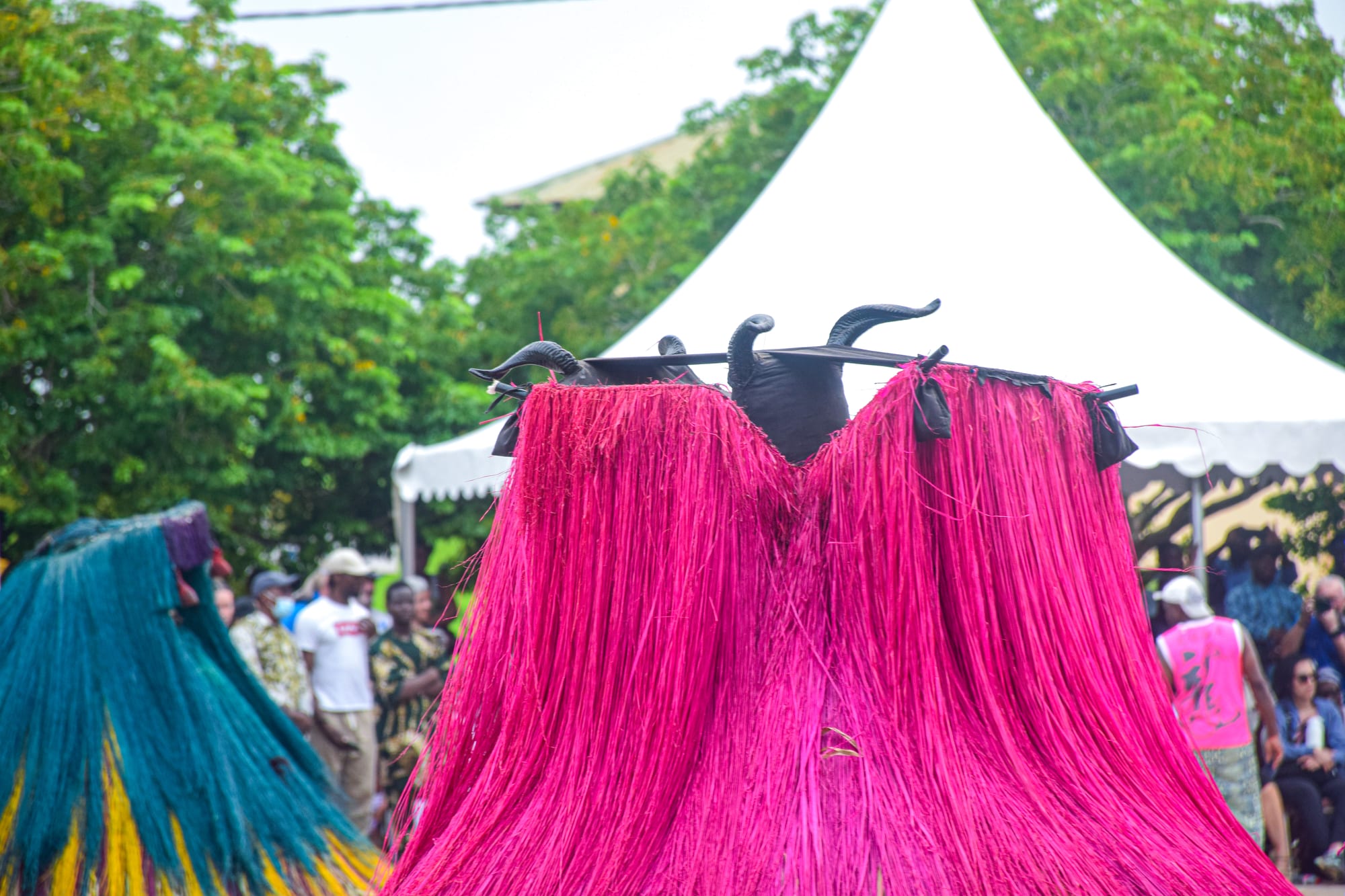
In the first days of January, the drums begin to sound. Devotees emerge from the Vodun convents, processions set out in honour of the divinities, and masked figures appear in the streets: Zangbeto, towering cones of raffia that whirl and sway as if nothing human were inside them, and Egungun, spinning layers of richly decorated cloth that are said to bring the ancestors back among the living. Then, in the second week of the month, the whole country stops for the national holiday of its endogenous religions, known simply as the Vodun holiday. Benin is the heartland of Vodun, and the day captures something essential about the country: a place where old and new faiths live side by side, where the dead remain part of the family, and where respect, whether for the spirits, the elders or a guest, is expressed through ritual and through good manners.
Faith, identity and values
Benin is one of the most religiously mixed countries in West Africa. In the 2013 census, the most recent, just under half the population described themselves as Christian and around 28 per cent as Muslim, most of them Sunni. Roman Catholics formed the largest single church, at about a quarter of the population, followed by the Celestial Church of Christ at nearly 7 per cent, with Methodists, Pentecostals, Baptists and many smaller denominations besides. Around 12 per cent named Vodun as their religion, and a few per cent more followed other Indigenous faiths. Estimates of the true reach of traditional belief vary widely, however, and some put it well above half the population, since it is so often practised alongside a church or a mosque rather than instead of one. Religious belief plays a large part in everyday life, and it is expected to be respected.
Vodun holds a public place that few traditional religions enjoy anywhere. It has its own national holiday, and the government has for decades promoted it as a pillar of the country's tourism policy. Its practices include divination and spirit possession, traditionally used to help people cope with problems such as illness or infertility, and only priests are held to be able to communicate with the divinities and the spirits of the dead. Fa, the divination system, is consulted at many of life's turning points, from the birth of twins to the question of whether a marriage should go ahead. Ancestors are considered to remain part of the community after death. Families keep shrines where offerings are made to "feed" them, and among the Fon, portable metal memorial altars known as asen are raised in honour of deceased ancestors and displayed at family shrines.
Society places great weight on respect and on age. Children are expected to be obedient and to show respect for their elders, and older people are treated with marked courtesy. Education has long been a route to advancement, and speaking French is itself a marker of status. French is the official language, but dozens of Indigenous languages are spoken across the country, the most widespread including Fon, Dendi, Bariba, Yoruba, Nago, Fulani and Mina.
Greetings and meeting people
Good manners begin with a proper greeting. Taking time to greet people, using the conventional spoken formulas and enquiring after them, is considered essential, and the time spent on it is part of the business of the day rather than a delay to it. It is customary to shake hands on arrival and on departure, and on entering a meeting or a gathering the usual courtesy is to shake hands with each person present rather than offering a general wave.
In Fon, one of the most widely spoken languages, a greeting takes the form of a small dialogue of question and answer. One common exchange runs "A fon gan dji a?", answered with "Oun fon gandji!", and the wording shifts slightly with the time of day. Greetings in the many other national languages follow patterns of their own, and a visitor who has learned even one exchange in the local language has a ready way to open a conversation.
Respect for age shapes how people are addressed and how conversations unfold, and elders are greeted with particular deference. Appearance is read as part of courtesy too. Being neat and cleanly dressed is regarded as a sign of respect and of pride; shorts, short skirts, low-cut or tight tops and dirty or torn clothing are widely considered inappropriate, and dress is especially conservative in Muslim communities. People may not say anything directly about a visitor's clothes, but they are likely to draw their own conclusions from them.
Hospitality and being a guest
Beninese people are known for their generous hospitality to foreigners, and much of social life revolves around food: people visit one another's homes to relax and share a meal and conversation. Offering food and drink to a visitor is an important part of hospitality, and refusing it is considered rude, so it is better to accept at least a little. Many people eat in the traditional style, using the fingers of the right hand.
Eating together is central to every significant occasion. Weddings, funerals and religious holidays all involve a shared meal, and a family hosting a funeral is expected to feed a large number of guests and relatives. At Tabaski, the Muslim festival of sacrifice, families mark the day by eating mutton. Two items recur in ceremonial exchanges between families: sodabi, a strong locally made liquor, and kola, both traditionally offered at funerals, with sodabi also among the gifts that pass between families before a marriage.
Festivals and life's big moments
The religious year is shared between faiths, with Christian and Muslim festivals alongside the Vodun holiday. For many years that holiday fell on 10 January, but in 2024 the National Assembly voted unanimously to move it to the second Friday of January, with the preceding Thursday also made a paid public holiday, creating a long weekend of celebration. The January festivities have grown into Vodun Days, a festival of several days that combines a grand Vodun ceremony attended by high dignitaries, the emergence of devotees from the convents, appearances by Zangbeto and Egungun masquerades, and evening concerts by Beninese and international musicians. Followers of particular deities perform circular dances to the drums, and high priests consult the Fa oracle. The public programme has limits, however: animal sacrifices are kept away from the tourist gaze, and initiation ceremonies continue privately. The secular calendar is marked by National Day on 1 August, the anniversary of independence in 1960.
Births can carry spiritual meaning. Twins are held in special regard, and their families consult Fa to learn what their arrival signifies. Parents are then expected to follow the guidance they receive closely, and the details vary from family to family.
Marriage was once largely arranged by families, and although individual choice has become more common, especially among the educated, families still play a central role. In its traditional Fon form, marriage unfolds in stages. An emissary opens contact between the two families, the Fa oracle is consulted on whether the marriage should proceed, and the groom's family presents gifts, among them cloth and sodabi, to the bride's family. A final ceremony marks the bride's full entry into her husband's family.
Funerals are the largest and costliest events in family life. In some communities, death is marked by a sequence of rituals that must be completed before the dead person is considered to have become an ancestor. Today a body may be kept in a mortuary for weeks or even months while relatives gather from far away, and funeral celebrations often cluster at the end of the week. Every member of the family is expected to contribute, and the costs of new clothes, mortuary fees, food for guests and a funeral band can leave families in debt for years. Egungun are closely tied to this relationship with the dead: the masked figures represent the ancestors among their living descendants, and after a burial an Egungun may appear to imitate the dead person and bring greetings to the family.
Arts, crafts and music
The Gelede ceremony is Benin's best-known performance tradition and its only element on UNESCO's intangible heritage list, the Oral heritage of Gelede, proclaimed in 2001, inscribed in 2008 and shared with Nigeria and Togo. It is held each year after the harvests, at important events, and in times of drought or epidemic, usually at night on a public square. It features carved masks, dances and chants sung in Yoruba that recount the history and myths of the Yoruba-Nago people. The masks often carry animal figures, the serpent as a symbol of power and the bird as the messenger of "the mothers". UNESCO notes that the tradition is under pressure from the gradual loss of traditional know-how and from tourism turning it into a folklore product.
Masquerade is at the heart of Beninese performance more broadly. Once inside the costume the performer is understood to become the returning ancestor. Egungun costumes are built from layer upon layer of the finest cloth a family can afford, added over time, with a mesh panel that hides the face and decorations of cowrie shells, beads, coins, sequins and amulets. As the dancer spins, the layers fly open in a whirl of colour. Only men wear them, and attendants carrying whips keep onlookers from coming too close.
The Zangbeto, whose name is usually translated as "men of the night", are cone-shaped figures of layered raffia or straw, often dyed in bright colours and sometimes crowned with horns. Traditionally they were the guardians of the night, patrolling to keep order and ruling on disputes, and according to tradition there is no person beneath the costume at all, only the spirit itself. Touching the raffia robes, or suggesting that someone wears them, is considered a serious offence.
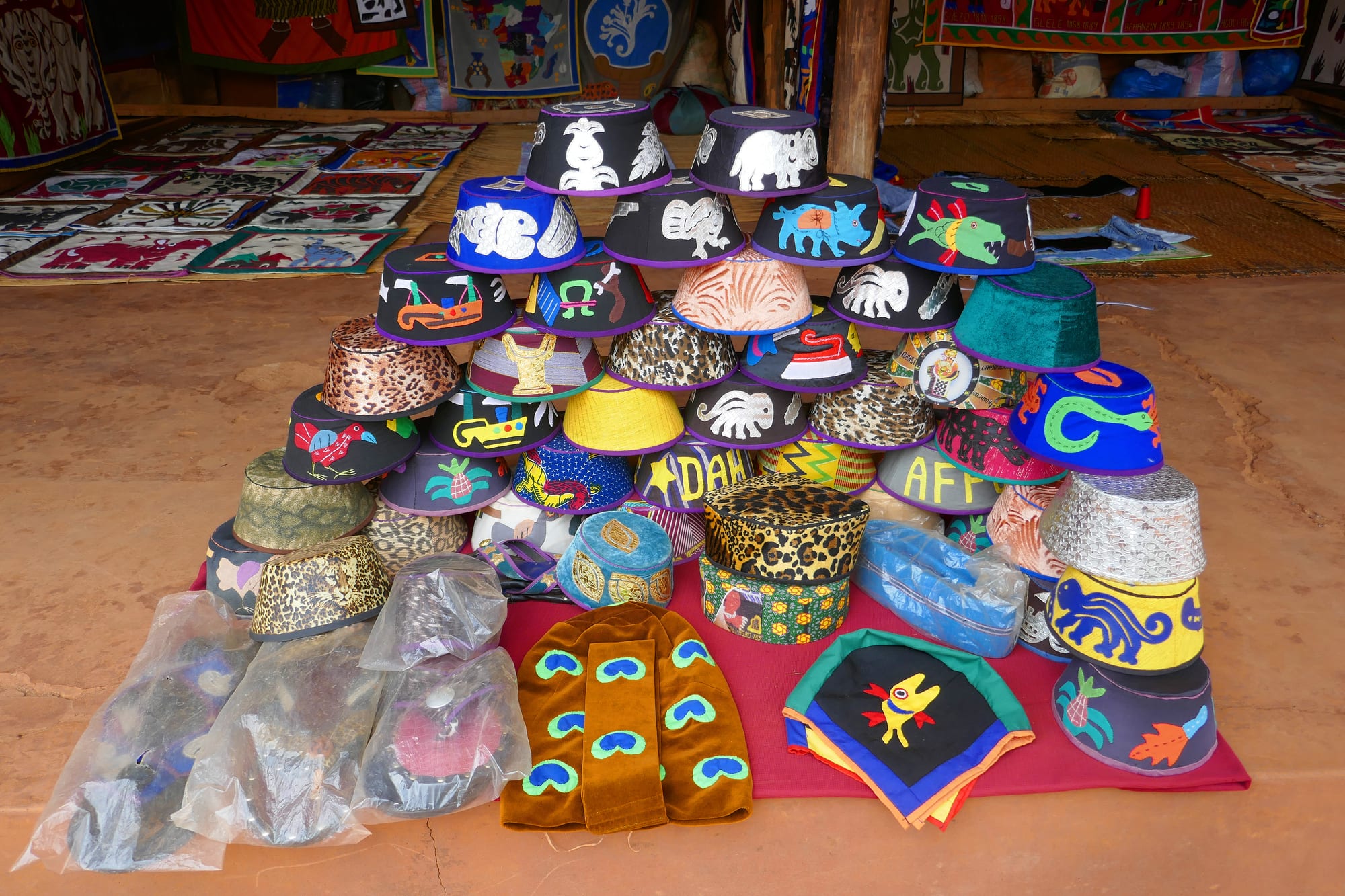
The visual arts carry the legacy of the old kingdom of Dahomey. Fine ironwork and brasswork remain highly regarded, and the cloth appliqué banners once made for the royal court, with bold figures cut from coloured fabric and stitched onto a plain ground, are still made by hand today and sold as wall hangings, caps and cloths.
Dos and don'ts for visitors
- Do check the latest government travel advice before any trip; most governments advise against all or all-but-essential travel to the northern departments and the national parks.
- Do take time over greetings, and shake hands with each person present on arrival and when leaving.
- Do accept at least a little of the food or drink a host offers; refusing is considered rude.
- Do eat with the right hand when a meal is taken in the traditional way.
- Do dress neatly and modestly; clean, untorn clothing is read as a sign of respect, and shorts and revealing tops are best avoided.
- Do show particular respect to elders, and treat Vodun shrines, ceremonies and every faith with respect.
- Don't approach or touch an Egungun masquerade, and keep back when its whip-carrying attendants signal.
- Don't intrude on rites that are kept away from public view, such as initiations and sacrifices.
What to take away
In Benin, the living, the ancestors and the spirits are all part of the same community, and visitors who greet people with care, accept a host's hospitality and treat every faith with respect will find themselves warmly received.