Wooden houses on stilts standing in shallow lake water, with dugout canoes moving between them under a wide sky

Benin

Ganvié, a town of tens of thousands built on stilts in Lake Nokoué, founded by people escaping Dahomey's slave raiders. (AMADOU BAHLEMAN FARID / Wikimedia Commons · CC BY-SA 4.0)

A narrow strip of West Africa running from a short Atlantic coast to the Niger River — the historic seat of the Kingdom of Dahomey and the birthplace of Vodun.

Explore Benin

History

Benin was the seat of the Kingdom of Dahomey, a highly militarised state centred on Abomey that rose around 1600. It is remembered for the painted bas-reliefs of its royal palaces, for the female regiment Europeans called the "Amazons," and for its central, brutal role in the Atlantic slave trade: Dahomey raided its neighbours for captives and sold them to European traders at the coast, above all through Ouidah, one of the largest slaving ports in Africa.

France conquered Dahomey in 1894. Independence in 1960 was followed by a decade of coups, then a Marxist-Leninist one-party state under Mathieu Kérékou, who renamed the country Benin in 1975. In 1990 a pioneering national conference peacefully ended the dictatorship and introduced multiparty democracy, a transition widely admired across Africa.

Benin held competitive elections for about three decades. Since 2016, under President Patrice Talon, changes to party and candidacy rules have squeezed the opposition, and international observers judge recent elections less free, so the country's democratic standing has slipped. Jihadist violence spilling south from the Sahel now affects the far north.

  • Benin: Dahomey and the Slave Coast The militarised kingdom of Dahomey, the port of Ouidah at the centre of the Atlantic slave trade, French conquest, a Marxist experiment, and an African model of democracy

Culture & Customs

Benin is the birthplace of Vodun — "voodoo" in its diaspora forms — a formally recognised religion here, practised alongside and blended with Christianity and Islam. National Vodun Day on 10 January is a public holiday, with major ceremonies at Ouidah involving drumming, offerings, and the Egungun and Zangbeto masked spirits.

The population is a patchwork: Fon around Abomey and Cotonou, Yoruba in the southeast, Bariba and Dendi in the north, Fulani herders, and the Betammaribe of the Atakora, known for their fortress-like mud tower-houses. Descendants of Afro-Brazilian former captives who returned in the nineteenth century, the "Agudás," give Ouidah and Porto-Novo a Brazilian flavour in their architecture and food.

Music, dance, and masquerade run through community life, and hospitality to guests is a strong obligation. The appliqué textiles of Abomey, once made for the royal court, are still produced by hand.

Daily Life

Benin is among the poorer countries in the world, and its economy leans heavily on cotton — the top export — the port of Cotonou, subsistence farming, and lively cross-border trade with Nigeria, whose currency and fuel policy ripple through daily life; bootleg petrol sold in glass bottles at the roadside is a common sight.

Cotonou is defined by the zémidjan, tens of thousands of yellow-shirted motorcycle taxis weaving through traffic, and by Dantokpa, one of West Africa's largest markets. Porto-Novo, the official capital, is quieter and more colonial in feel. Most of the country is rural, farming maize, cassava, yams, and beans.

The year follows the farming calendar, the rains, the Islamic and Christian holidays in their respective regions, and the Vodun ceremonies that punctuate life in the south.

Food

The staples are maize, cassava, yam, and beans. A stiff dough — akassa or amiwo from maize, or pounded yam — is eaten with a sauce of tomato, peanut, okra, or the pungent fermented néré seed, often with fish. Bean fritters (akara), grilled fish and chicken, and fried Fulani cheese (wagasi) are common.

Benin grows some of the sweetest pineapples in West Africa, a major crop, and is known for palm wine and sodabi, a strong spirit distilled from it. Among the Agudás of Ouidah and Porto-Novo, Brazilian-derived dishes and stews have stayed on the menu for generations.

Meals are shared from communal bowls, eaten by hand, and offered generously to any visitor.

  • Benin: Food and the National Dish A red corn dough eaten with chicken or fish, a rare West African cheese made by Fulani herders, and a kingdom's cooking shaped by the coast and the Sahel alike

Attractions & Natural Wonders

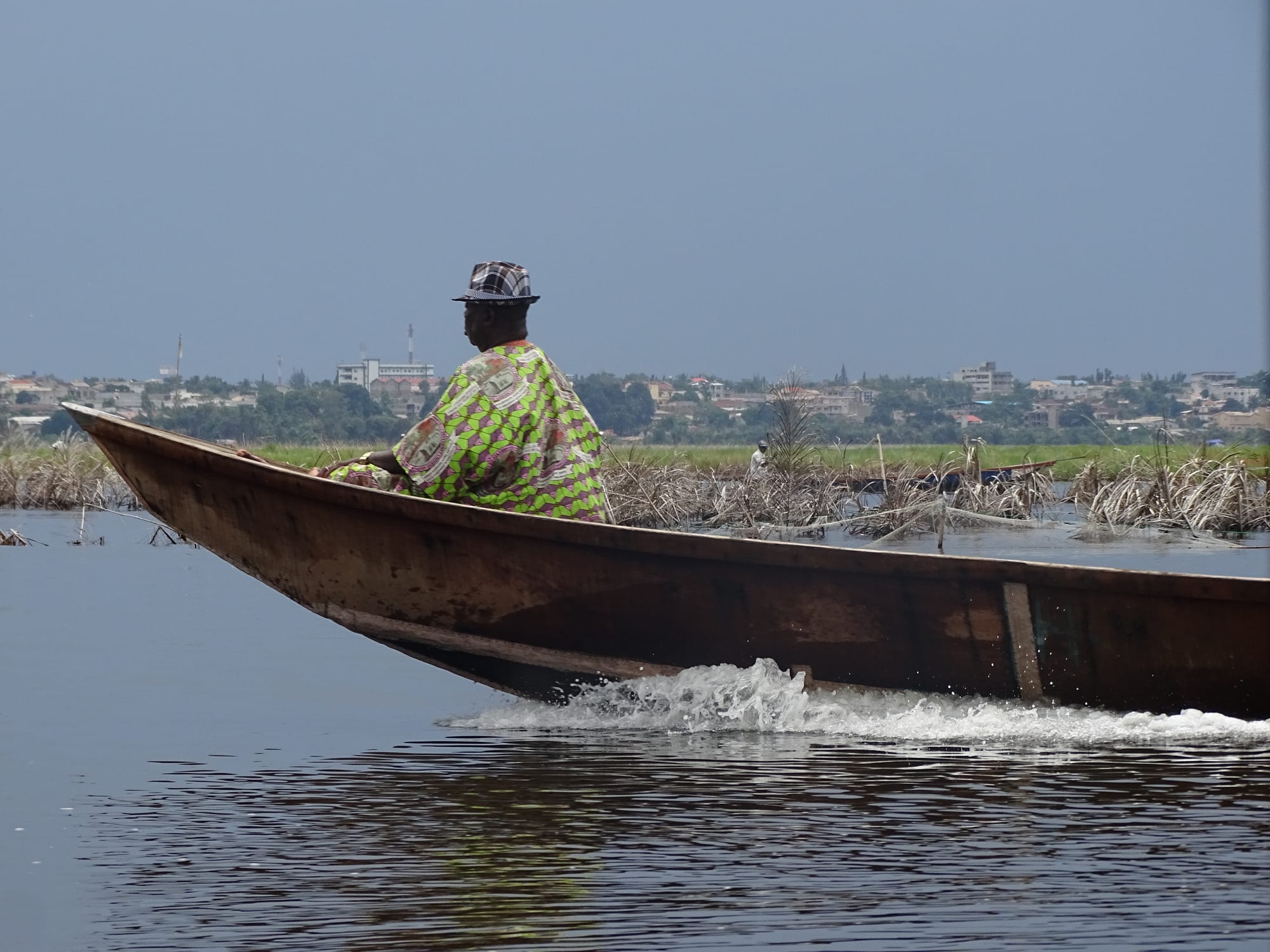
Ganvié, a town of tens of thousands living in stilt houses on Lake Nokoué near Cotonou, is the country's signature sight. It was founded by Tofinu people fleeing Dahomey's slave raiders, whose beliefs forbade attacking people living on water, and is reached by pirogue through the reeds and floating markets.

Ouidah is the place to understand the slave trade: the Python Temple facing the Catholic basilica, the Sacred Forest of Kpasse with its Vodun sculptures, and the four-kilometre Slave Route ending at the Door of No Return, an arch on the beach where captives were loaded. Abomey holds the Royal Palaces of Dahomey, a UNESCO World Heritage Site, with a museum of thrones, weapons, and appliqué banners.

Porto-Novo has the candy-coloured Great Mosque, a former Afro-Brazilian church, and King Toffa's palace. In the northwest, the Somba country around Natitingou has the tata tower-houses of the Koutammakou landscape. The Pendjari and W parks hold the best savanna wildlife in West Africa but are currently unsafe and largely closed.

Planning basics

Budget

Benin is inexpensive, though a hired car with driver — often the practical way to travel — is the biggest cost. Cotonou has a few mid-range hotels; elsewhere lodging is basic and cheap. Cash dominates; ATMs in Cotonou, Porto-Novo, and Parakou take Visa more reliably than Mastercard.

Source
Traveller reports and price observation, 2022–2024 — verify against a current source.
Zemidjan Ride
A few hundred CFA francs for a short motorcycle-taxi hop in Cotonou
Daily Budget Midrange
USD 60–130 (comfortable hotel, hired car with driver, guides)
Daily Budget Shoestring
USD 25–45 (basic hotel, street and market food, bush taxis)

Carry CFA francs in cash outside the cities; euros are the easiest currency to exchange.

Source: Traveller reports and price observation, 2022–2024 — verify against a current source.

Visa Requirements

A visa is required for most nationalities. Benin runs a straightforward e-visa portal — apply online, usually a 30-day single or multiple entry, approved within a few days. A yellow fever vaccination certificate is mandatory for entry.

Typical Validity
30 days via the e-Visa Bénin portal

Apply for the e-visa before you fly rather than relying on visa on arrival.

Safety

The south — Cotonou, Porto-Novo, Ouidah, Abomey, the coast — is generally calm, with petty crime in markets and after dark the main concern. The serious warning is the north: since around 2021, jihadist groups from the Sahel have carried out attacks in and around the Pendjari and W national parks and the Atakora and Alibori border zones.

Source
US Department of State and French diplomatic advisories — check for the latest wording.

Most governments advise against all or all-but-essential travel to the northern departments and the parks. Check current advisories; northern park tourism has largely halted. Don't photograph government or military sites.

Source: US Department of State and French diplomatic advisories — check for the latest wording.

Climate

Tropical. The south has two rainy seasons — a long one from about April to July and a short one in September and October — with heat and humidity all year. The north has a single rainy season from May or June to September and a long dry season, including the dusty Harmattan wind from roughly December to February.

North
one wet season; hazy, cooler nights during the Harmattan
South
hot and humid, 25–33°C, two wet seasons

Transportation

Cadjehoun Airport at Cotonou is the main gateway. There is no working passenger rail. Road is everything: the coastal highway links Cotonou with Ouidah, Grand-Popo, and Porto-Novo, and the RNIE 2 runs north to Bohicon (for Abomey), Parakou, and Natitingou. Bush taxis and intercity coaches connect the main towns; in Cotonou, the zémidjan motorcycle taxi rules.

Driving
Main axes are paved; rough elsewhere. Night driving is dangerous.

Rental cars usually come with a driver; agree the fare with zémidjan riders before setting off.

Best Time to Visit

November to February — the main dry season, cooler and less humid, though the north is hazy with Harmattan dust. The national Vodun celebration, centred on Ouidah, falls on the second Friday of January, with the Thursday before also a public holiday. Wildlife in the northern parks concentrates at water late in the dry season, but see the safety note.

Avoid
The peak rains, which turn unpaved roads to mud.

Currency

The currency is the West African CFA franc (XOF), shared across eight countries and pegged to the euro at a fixed rate. It cannot be obtained easily outside the region.

Symbol
FCFA
Cash To Bring
Euros, to exchange on arrival
Currency Code
XOF — West African CFA franc

Language

French is the official language, used in government, schools, and media. Fon and Yoruba dominate the south; Bariba, Dendi, and Fulfulde the north, among dozens of languages in all. English is limited, more common in tourism and near the Nigerian border.

English
Limited
Official Language
French
Main Local Languages
Fon, Yoruba, Bariba, Dendi, Fulfulde