Culture & Customs · Bangladesh
Bangladesh: Songs of the Mother Tongue
Barefoot walks at dawn to honour a language, a Muslim-majority country that fills its streets for Durga Puja, wandering mystic singers, and a code of manners built on family, age and the duty to feed a guest
By Worldlore Editorial · 30 September 2026
In the first hours of 21 February, long before the working day begins, people across Bangladesh leave their shoes at home and walk barefoot through the streets carrying wreaths, flowers and banners. Their destination is a Shaheed Minar, a monument to the students and others killed in 1952 while demanding recognition for the Bengali language, and by morning its steps are heaped with petals. Replicas of the monument, many of them temporary, are raised in towns, schools and colleges across the country for the day. It is a sombre occasion, but a telling one: in few countries is national feeling so closely bound up with a language, and with the poems and songs written in it. Bangladeshi culture is devout, family-centred and deeply respectful of age, yet it is also unusually literary and musical, and it wears its Bengali identity with pride.
Faith, identity and values
Islam is the religion of the great majority. Around nine in ten Bangladeshis are Muslim, most of them Sunni, and Hindus make up most of the remainder, with smaller Buddhist and Christian communities. Islam was made the state religion by a constitutional amendment in 1988, while the constitution also protects the practice of other faiths. The sounds and symbols of Islam, above all the call to prayer, are part of everyday life, and even those who do not practise regularly generally respect its core tenets. For some, religious identity comes before nationality when describing who they are.
Alongside faith sits a strong Bengali identity. The word Bengali describes both an ethnicity and a language, and Bangla is spoken by almost everyone. Many Bangladeshis are proud of a heritage distinct from that of both Pakistan and neighbouring India, and comparing the country with either can cause offence. The culture also prizes a tradition of tolerance, with an ideal of placing common humanity above differences of religion or ethnicity, and different faith communities have generally lived side by side peacefully.
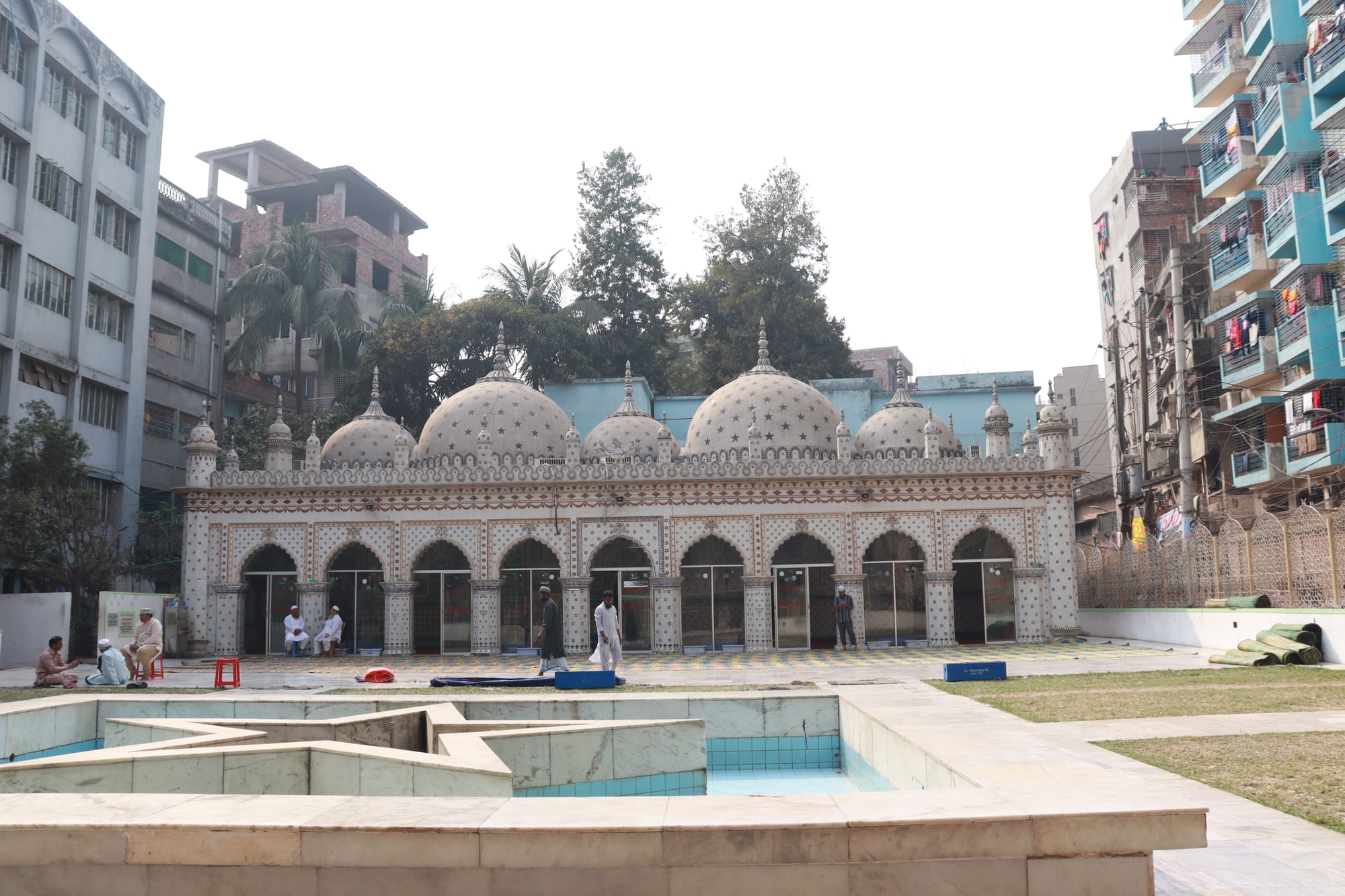
Society is collectivist: the interests of the family and the wider community are expected to come before those of the individual, and extended family ties remain strong. People keep a lasting attachment to the village their family comes from, wherever they now live, and rural life holds a special place in the national imagination. Age and social standing shape almost every interaction. Elders are regarded as wise and are given a high degree of respect, and younger people adjust their language and behaviour accordingly.
Greetings and meeting people
Among Muslims the usual greeting is "assalamu alaikum", "peace be with you", answered with "walaikum assalam", "and with you". Men of similar standing often shake hands, and the handshake tends to be gentle rather than firm. A common way of adding warmth and respect is to place the right hand over the heart afterwards. Men and women rarely shake hands with each other, so visitors do best to let a Bangladeshi take the lead.
Personal names are used less than in many Western countries. People of higher standing are addressed by a title or a kinship term, and words for "brother", "sister", "uncle" and "aunty" are used widely among friends and colleagues as well as within families, giving even casual relationships a familial tone. Respect for elders runs through everyday manners. Young people may touch the feet of an older relative as a sign of respect, particularly on festival days, and it is considered disrespectful to cross one's legs or smoke in front of elders. Getting to know someone personally matters, but questions about income are best avoided, and time spent building a one-to-one relationship is valued in business as well as friendship.
Hospitality and being a guest
Hosts consider themselves obliged to offer guests something to eat, and a visit of any length will bring tea and snacks at the very least. Shoes are normally removed at the door of a home, and at a larger gathering it is best to arrive neither first nor last. Good manners also mean anticipating what others need, offering help or refreshment before being asked. Invitations are often extended to an entire family rather than to one person, and turning one down is done gently, since a blunt refusal can seem hurtful.
Many Bangladeshis eat with their hands, and the right hand is used for eating, while the left is associated with cleaning and is not used for eating, serving or passing food. Things are handed over with the right hand or with both hands. A host will press further helpings on a guest, and it is customary to decline politely at first before accepting, since the offer is expected to be repeated. Refusing everything outright can be taken as a sign that the food was not appreciated.
Gifts are usually exchanged at religious festivals and within families, and their presentation counts for more than their price. They are offered with both hands and are generally opened later, not in front of the giver. Some choices are best avoided: white flowers and frangipanis, which are associated with funerals; pork products or alcohol for Muslims; and beef or leather goods for Hindus.
Festivals and life's big moments
The two Eids are the biggest holidays of the year. Eid al-Fitr, which ends Ramadan, begins with morning prayers and continues with new clothes and visits to relatives. Children receive salami, gifts of money from elders and relatives, traditionally given in crisp new notes. At Eid al-Adha, families who can afford it sacrifice an animal and share the meat among relatives, neighbours and people in need.
Durga Puja is the most important festival for Bangladesh's Hindus and is widely enjoyed by people of other faiths. Temporary pavilions called mandaps, housing images of the goddess, go up in their tens of thousands across the country. On the final day, Bijoya Dashami, women devotees smear vermilion on the goddess and on one another in the sindur khela, and the images are carried to rivers and ponds for immersion to the sound of drums, conch shells and ululation.
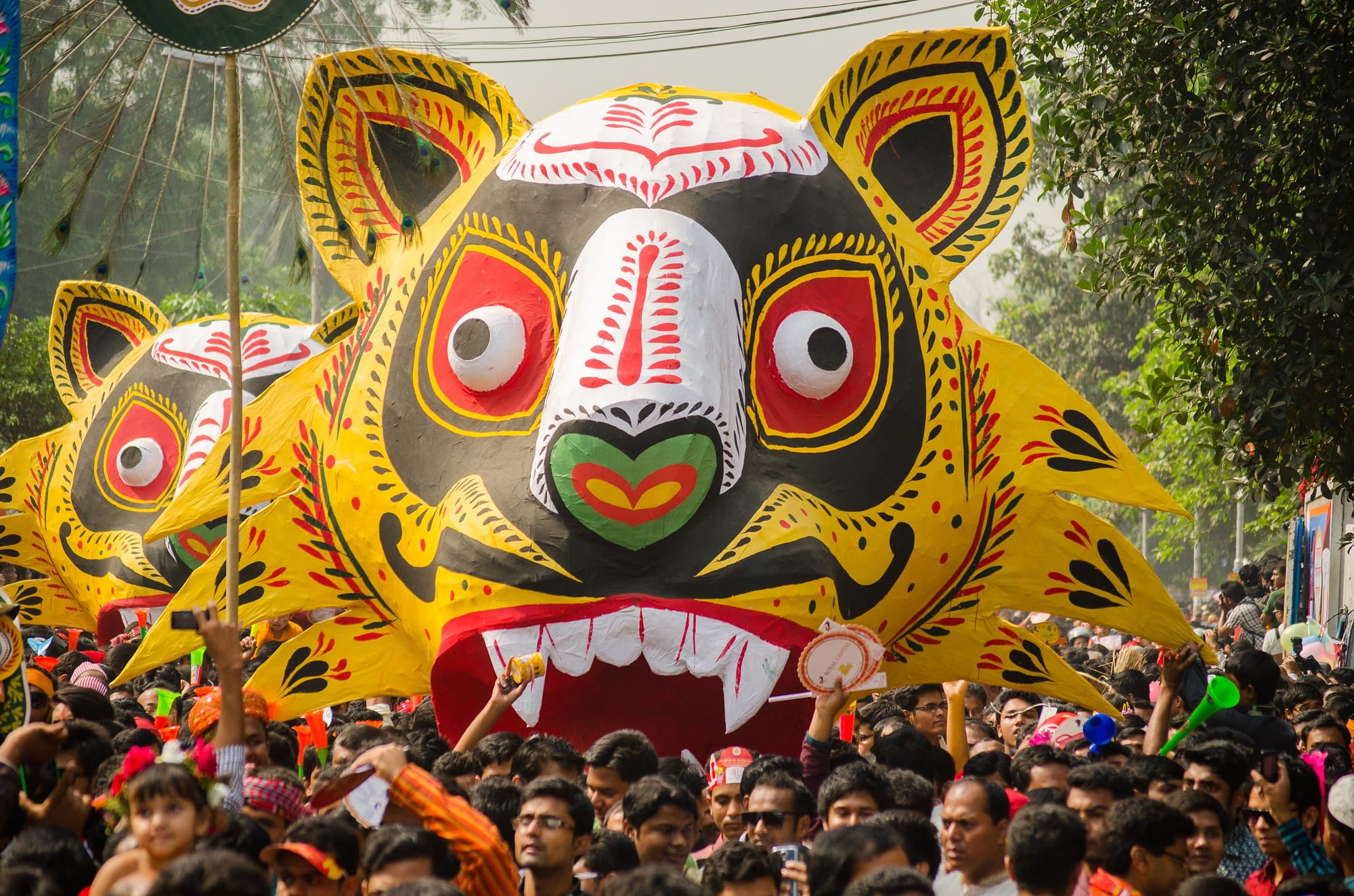
Pahela Baishakh, the Bengali New Year on 14 April, is a festival shared by all communities. Women wear white saris with red borders and flowers in their hair, and men wear the long panjabi shirt. The day begins with songs at sunrise, a custom begun by the cultural organisation Chhayanaut in the 1960s, and traders open fresh account books and hand out sweets to customers. Its best-known event, the Mangal Shobhajatra, is a procession of giant masks, animal figures and folk motifs made by fine-arts students and teachers, and it was added to UNESCO's list of intangible cultural heritage in 2016. In 2025 the organisers restored its earlier name, the Barshabaran Ananda Shobhajatra, and since 2026 it has officially been called the Boishakhi Shobhajatra; the renaming drew debate. The civic calendar adds Independence Day on 26 March and Victory Day on 16 December, both marked with flags, parades and patriotic songs.
Weddings are multi-day affairs. The best-loved ceremony is the gaye holud, or "turmeric on the body", in which family and friends, often dressed in yellow and orange, smear turmeric paste on the bride or groom amid songs and dancing. Among Muslims, the marriage itself is the nikah, a contract concluded before a religious official, and celebrations continue with a reception, the bou bhat, hosted by the groom's family.
When a Muslim dies, the burial takes place quickly, usually within a day. Large crowds gather for the funeral prayer, often held in open ground near a mosque, and neighbours visit the family to console them. Usually on the fourth day after the burial, relatives, friends and neighbours gather at the family home to pray for the dead at a remembrance known as the kulkhani. Hindus cremate their dead and hold a memorial rite, the shraddha, a few days afterwards.
Arts, crafts and music
Music and poetry run deep. Rabindranath Tagore, the Nobel-winning Bengali poet, wrote "Amar Sonar Bangla", the national anthem, a hymn to the beauty of the Bengali countryside; its tune was composed by a Baul musician. Kazi Nazrul Islam, whose poems and songs speak of freedom and communal harmony, is honoured as the national poet, and songs by both men are still sung at public occasions and learnt by children.
The Bauls themselves are among the most distinctive figures in Bengali culture. These mystic minstrels, found in rural Bangladesh and neighbouring West Bengal, draw on Sufi Islam, Hindu devotional traditions and older Buddhist ideas, rejecting caste and teaching that God resides within the human body. Their songs are accompanied by the one-stringed ektara, the dotara and a small drum, and UNESCO proclaimed the Baul tradition of Bangladesh a masterpiece of intangible heritage in 2005.
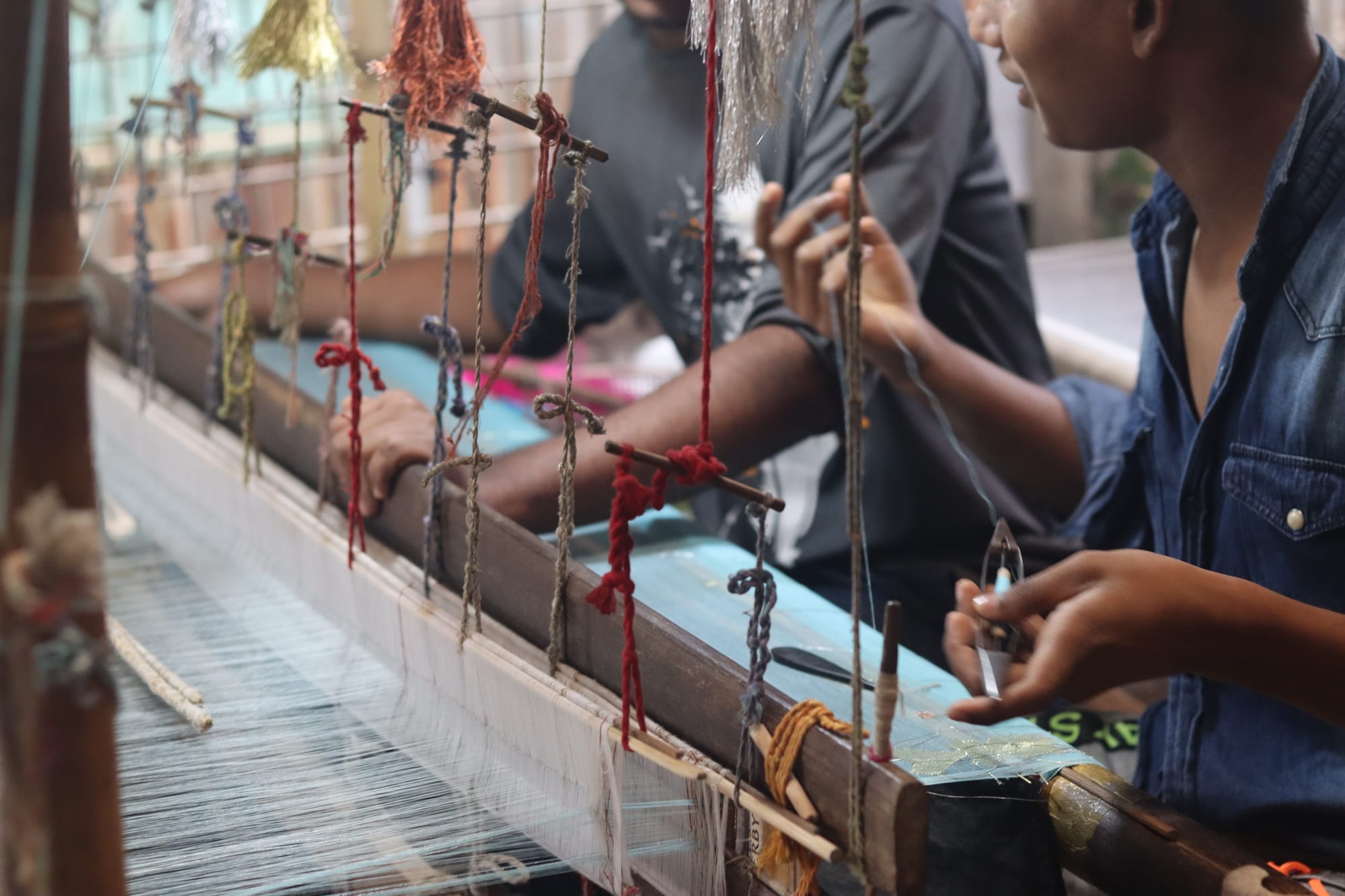
Crafts are equally celebrated, and several are also on UNESCO's list. Jamdani is a sheer, finely patterned cotton cloth woven on a handloom, with its motifs worked directly into the fabric as it is woven. Skills pass from parents to children in home workshops, and a jamdani sari is regarded as a symbol of identity and dignity. The weaving of shital pati, cool mats made from split cane in Sylhet, and the weaving of Tangail saris, listed in 2025, are also inscribed.
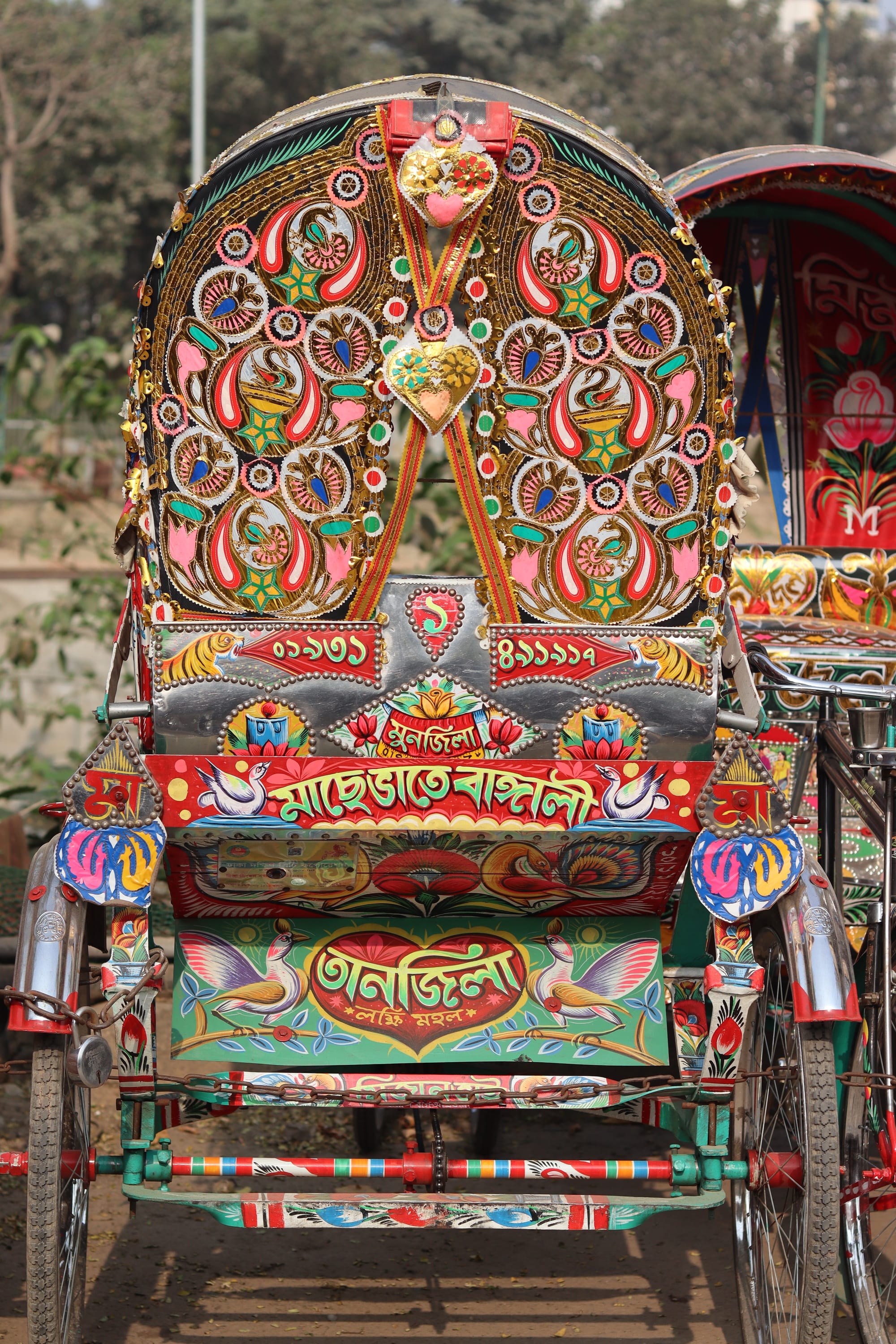
The most visible art form of all is on the move. Almost every part of a cycle rickshaw may be painted with flowers, birds and animals, scenes from history and fables, national heroes and film stars, and trimmed with tassels and tinsel, turning each vehicle into a roving exhibition. Rickshaw painters work on commission and usually pass their skills on to their children and close relatives; while all rickshaw builders are men, painters include both men and women. Rickshaws and rickshaw painting were added to UNESCO's list in 2023.
Dos and don'ts for visitors
- Do greet people with "assalamu alaikum", and let a Bangladeshi take the lead on handshakes between men and women.
- Do use the right hand, or both hands, for eating and for giving and receiving things.
- Do accept food when it is offered, and expect a host to insist on second helpings.
- Do remove shoes when entering a home or a mosque, and dress modestly, with shoulders and knees covered.
- Do ask before photographing people, especially women.
- Don't smoke, sit with legs crossed or speak dismissively in front of elders.
- Don't compare Bangladesh with India or Pakistan, or joke about national pride.
- Don't give white flowers, alcohol, or pork or beef products as gifts.
What to take away
Bangladeshi customs rest on faith, family and respect for age, but the country's heart lies in its language and the songs sung in it, and visitors who show interest in both will find a welcome that is as warm as it is generous.