Culture & Customs · The Azores
The Azores: One Heart Home, One Heart Away
A silver crown carried from house to house, a free meal laid out for anyone who comes, and a guitar with two hearts cut into it, one for the islanders who stayed and one for those who left
By Worldlore Editorial · 30 September 2026
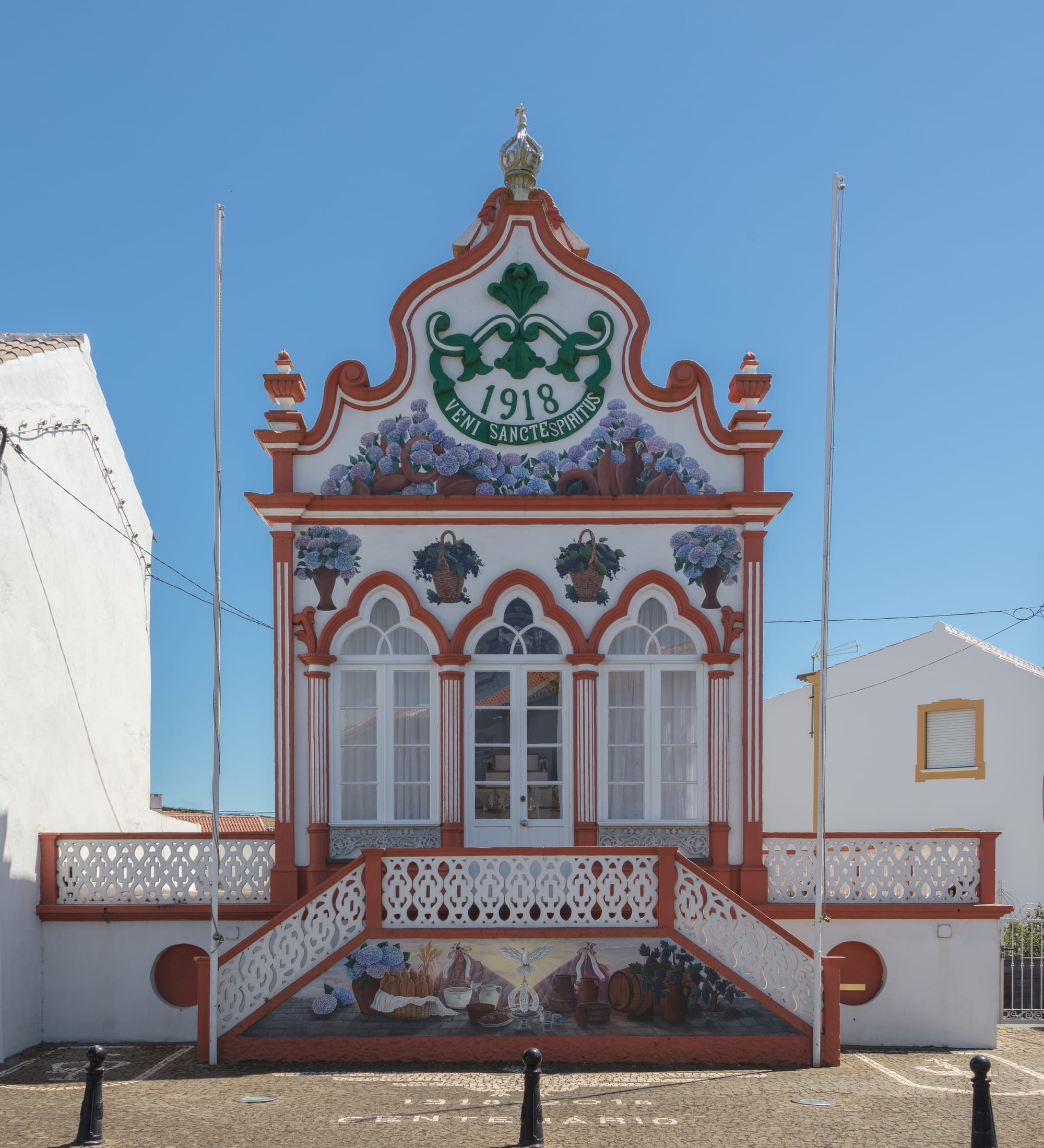
On a Sunday in late spring, the doors of a small painted chapel stand open beside a village road. Inside, on a draped table, sits a silver crown topped with a dove, and beside it a red banner. Outside, long tables have been laid, and volunteers carry out bowls of bread soaked in meat broth to whoever sits down: neighbours in their Sunday clothes, a family home from Massachusetts or Ontario for the summer, a hiker who happened to be passing. Nobody pays and nobody is turned away. The meal is an old act of charity in honour of the Holy Spirit, and it says a great deal about the Azores — a devout, close-knit island society that measures itself by what it shares, and that keeps one eye always on the relatives who crossed the ocean.
Faith, identity and values
The Azores are overwhelmingly Roman Catholic, and religion here is woven more tightly into community life than in much of mainland Portugal, where, according to the Cultural Atlas, most people who call themselves Catholic are not regular churchgoers. On the islands, the parish church, the saint's day and the religious procession remain the fixed points of the year, and faith is expressed above all through shared, public ritual.
The most distinctive of these devotions is the cult of the Holy Spirit, the Espírito Santo. Its roots lie in medieval Portugal, and it came to the islands with the first settlers, taking hold with a strength it never retained on the mainland. Its emblems are a silver crown, a sceptre and a flag, usually red with a white dove. For weeks after Easter these emblems pass from household to household through the parish, and each family that keeps them for a week hosts prayers and visitors. The festivities are centred on the impérios, small, brightly painted chapels found in villages across the islands, where the crown is displayed and food is handed out. Terceira's own island tourism body describes the tradition as a charitable celebration in which all are invited, "rich and poor, inhabitants or strangers".
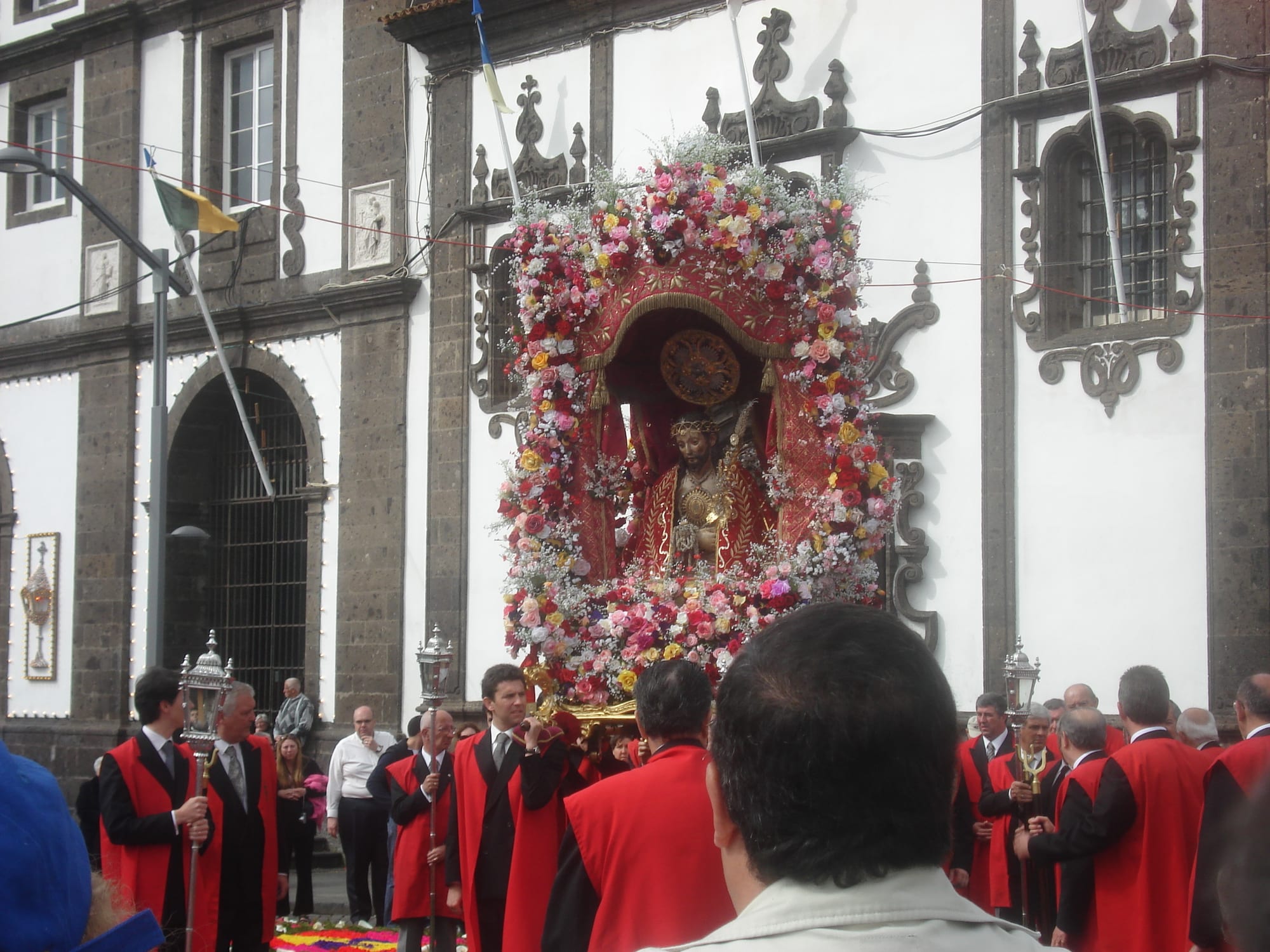
Other devotions grew out of the islands' volcanic nature. Earthquakes and eruptions have shaken the Azores repeatedly since settlement, and several of the most important religious traditions began as communal pleas for protection. The great May festival of the Senhor Santo Cristo dos Milagres, an image of Christ kept in a convent in Ponta Delgada, traces its procession to around 1700 and to a series of earthquakes. The Lenten walk of the romeiros, described below, is believed to date from an earthquake in the 16th century.
Emigration is the other great shaper of Azorean identity. Since the 17th century large numbers of islanders have left, above all for the United States, Canada and Brazil, and families across the archipelago keep close ties with relatives in New England, California and Canada. The Portuguese word saudade, a longing for people and places that are absent, is used often and meant sincerely. Alongside it sit the values common to Portuguese culture more widely: loyalty to family above most other commitments, courtesy in everyday dealings, and a strong dislike of boasting about wealth, status or achievement.
Greetings and meeting people
A handshake is the standard greeting between people who do not know each other well, and it is usually firm. Among friends and family, women greet each other, and greet men, with two light kisses, one on each cheek, beginning on the right; often this is little more than a brushing of cheeks with a kiss in the air. Close male friends may hug briefly or pat each other on the back. Men tend to wait for a woman to offer her hand first.
On arriving at a gathering, it is polite to greet everyone present, and on leaving, to say goodbye to everyone again rather than slipping away. Children often greet older relatives with a kiss. Everyday greetings follow the time of day: bom dia in the morning, boa tarde in the afternoon and boa noite in the evening. Strangers and older people are addressed formally, as senhor or senhora, and first names are kept for friends, young people and children until an invitation to use them is given.
Conversation is warm and fairly tactile. People commonly touch an arm or a shoulder while talking, and they tend to be direct while taking care to be polite. Pointing at someone with a single finger is considered rude. Many islanders speak some English, often thanks to family in North America, but an attempt at a Portuguese greeting is noticed and appreciated.
Hospitality and being a guest
Hospitality is taken seriously, and a visitor invited into a home is treated as an honoured guest. Guests are expected to wait at the door until asked in, and to wipe their shoes before entering. Refreshments will almost certainly be offered, and turning them down altogether can seem ungracious. A compliment about the house is well received, and at the table the host decides where everyone sits. A small gift such as chocolates or flowers is customary; wine is best avoided unless the host's taste is known. Gifts are usually opened as soon as they are received.
At the table, nobody starts until the host has wished everyone "bom apetite". Toasts are made by raising glasses with a "saúde", meaning "health". A knife and fork laid parallel across the plate signal that the meal is finished. Lunch has traditionally been the main meal of the day, and shared meals are unhurried: guests are expected to linger in conversation before and after eating, and leaving promptly can come across as abrupt. The natural way to return an invitation is to invite the hosts in turn.
The Holy Spirit festivals extend this hospitality to the whole community. At the public meal served at an império, visitors are welcome to accept a bowl, and doing so with thanks and a little patience in the queue is entirely in keeping with the spirit of the day. Hospitality of a quieter kind surrounds the romeiros during Lent: in the villages they pass through, families open their homes to groups of pilgrims they may never have met, giving them a meal and a place to sleep.
Festivals and life's big moments
The Holy Spirit cycle dominates the festive year. It runs from the Sundays after Easter to Pentecost and Trinity Sunday, and in some places well into the summer. Its high point is the coronation, a church ceremony in which the parish priest places the silver crown on the head of the chosen "emperor", who then presides over the celebrations. Processions, blessings and the free distribution of bread, meat and soup follow. The Monday after Pentecost, known as Holy Spirit Monday, is also Azores Day, the regional holiday that marks the political autonomy the islands gained in 1976. It honours both the archipelago's religious traditions and its self-government, binding civic and religious identity together.
The Senhor Santo Cristo festival, held in May around the fifth Sunday after Easter, is regarded as one of the largest religious celebrations in the Azores. Streets along the route of the procession are decorated with flowers, and pilgrims include large numbers of emigrants who return from North America and elsewhere especially for it. Across the islands, summer brings a long run of parish festas in honour of patron saints, with Mass, a procession behind the local band, and an evening fair.
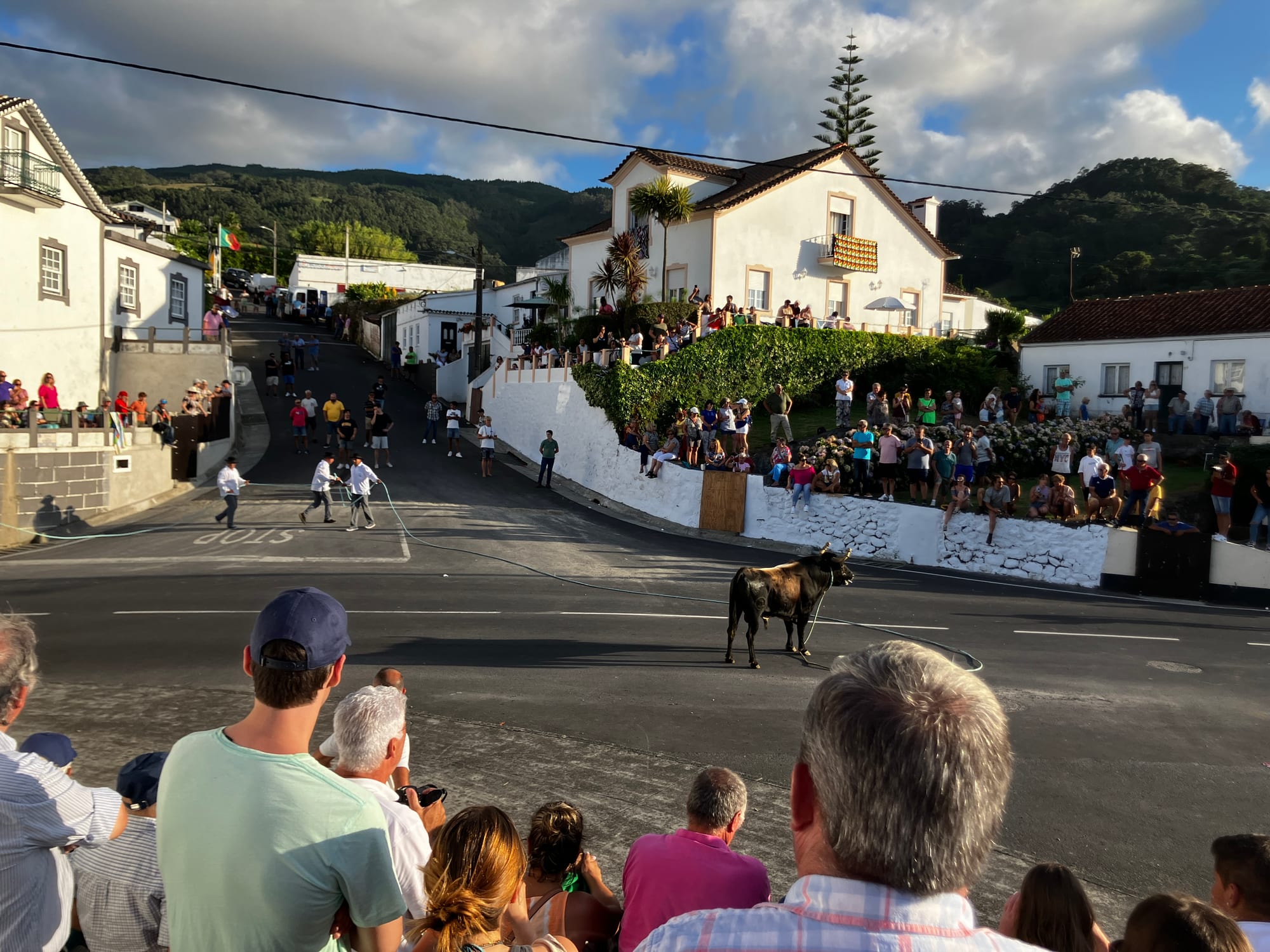
On Terceira, many festivals include a tourada à corda, a bull on a rope. The bull runs through the street on a long rope tied round its neck, held by a team of men known as pastores, whose job is to keep it within the stretch of road set aside for it. The bravest onlookers taunt it and dodge out of its way, while everyone else watches from behind walls and other barriers. The tips of the horns are fitted with balls or leather, and each bull usually stays in the street for between a quarter of an hour and half an hour. The season runs from 1 May to 15 October, with more than two hundred of these festivities on Terceira alone, and rope bullfights are also held on some of the other islands. The custom is governed by regional rules meant to safeguard both the animal's well-being and the safety of the public.
Carnival on Terceira takes an unusual form. Instead of floats and masks, it is celebrated through danças and bailinhos, comic and satirical stage shows in verse, song and costume. Groups spend weeks writing and rehearsing, then tour from hall to hall performing through the Carnival weekend, and halls across the island open their doors to the public for this popular theatre.
Life's milestones follow Catholic tradition. Baptism is an important family occasion, and godparents, padrinhos and madrinhas, take on a lifelong responsibility for the child's welfare. Many couples still marry in church, although, as elsewhere in Portugal, a growing number choose a civil ceremony only. Funerals and the rites that follow a death are occasions when the extended family and the wider village gather, and they are treated with great seriousness.
Arts, crafts and music
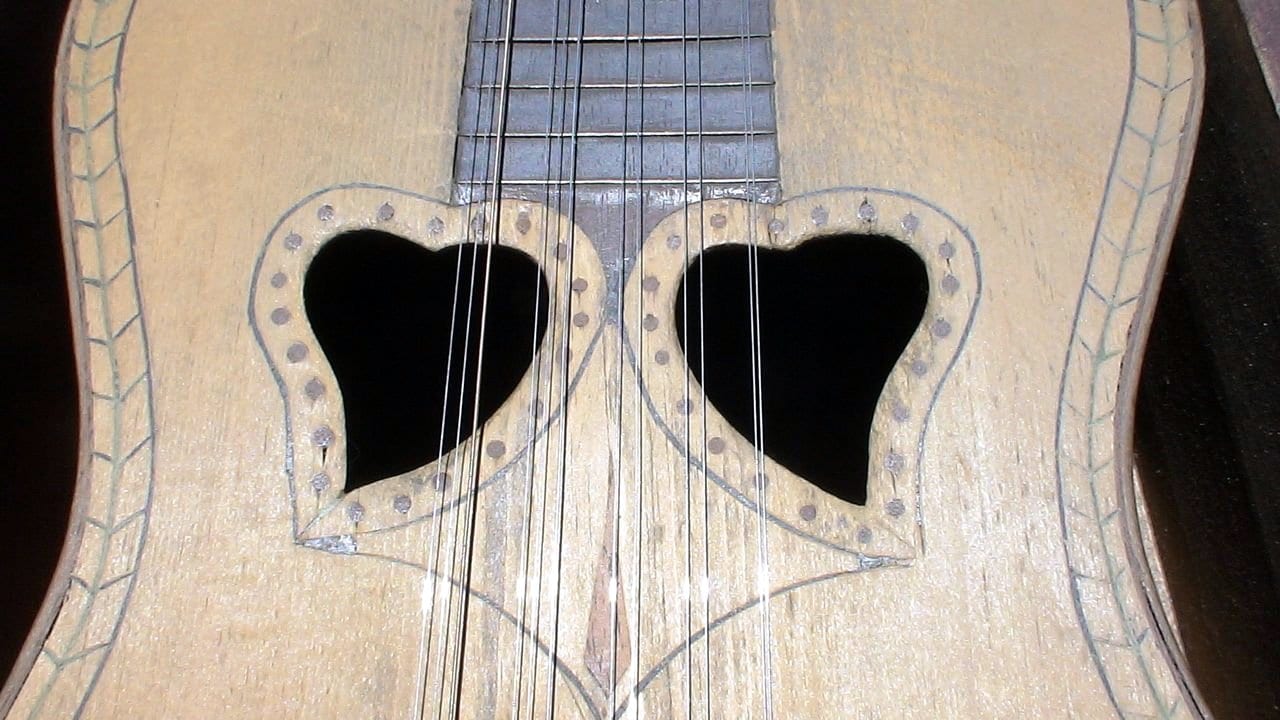
The instrument that best expresses the islands is the viola da terra, a small guitar with twelve or fifteen steel strings. Its soundhole is cut in the shape of two hearts, and islanders say one heart stands for those who stayed and the other for those who emigrated, with the strings between them as the cord that joins the two. The music most closely tied to it is saudade itself. Emigration and changing tastes left the instrument in decline for a time. Today a revival led by musicians and teachers has brought it back into concerts and schools.
Brass bands are the other great musical institution. Community bands, or filarmónicas, are found in towns and villages across the islands. They lead processions, play at every festa and serve as music schools and social clubs for their villages, and Azorean emigrants founded similar bands in California and New England.
Crafts draw on both land and sea. Embroidery is among the best known, and the regional government's "Artesanato dos Açores" certification mark guarantees the origin and quality of Azorean handicrafts. Other traditions include delicate miniatures cut from the white pith of fig-tree branches, whose masterpieces are kept in the museum at Horta, and scrimshaw, the engraving of sperm-whale teeth and bone with ships and sea scenes, a skill brought to the islands in the whaling era and now shown in a small museum devoted to it in Horta, on Faial.
Dos and don'ts for visitors
- Do greet everyone when arriving at a gathering, and say goodbye to each person when leaving.
- Do use senhor or senhora with older people and strangers until invited to use first names.
- Do accept a bowl if offered food at a Holy Spirit império; the meal is meant for everyone.
- Do dress modestly for churches and processions, and stand back quietly as a procession passes.
- Do watch a tourada à corda from behind a wall or barrier, well outside the white lines that mark the bull's range.
- Don't start eating before the host says "bom apetite", and don't rush away after a meal.
- Don't compare the Azores to Spain or assume islanders share every mainland habit.
- Don't boast about money or status; modesty is valued.
What to take away
Azorean customs rest on faith, family and an open table, and a visitor who greets people properly, accepts hospitality gracefully and shows respect for the islands' festivals will be treated much like one more relative home for the summer.