Culture & Customs · Armenia
Armenia: Bread, Salt and Stone Crosses
A national church older than almost any other, a welcome of bread and salt, a calendar of fire, water and remembrance, and music played on a pipe of apricot wood
By Worldlore Editorial · 30 September 2026
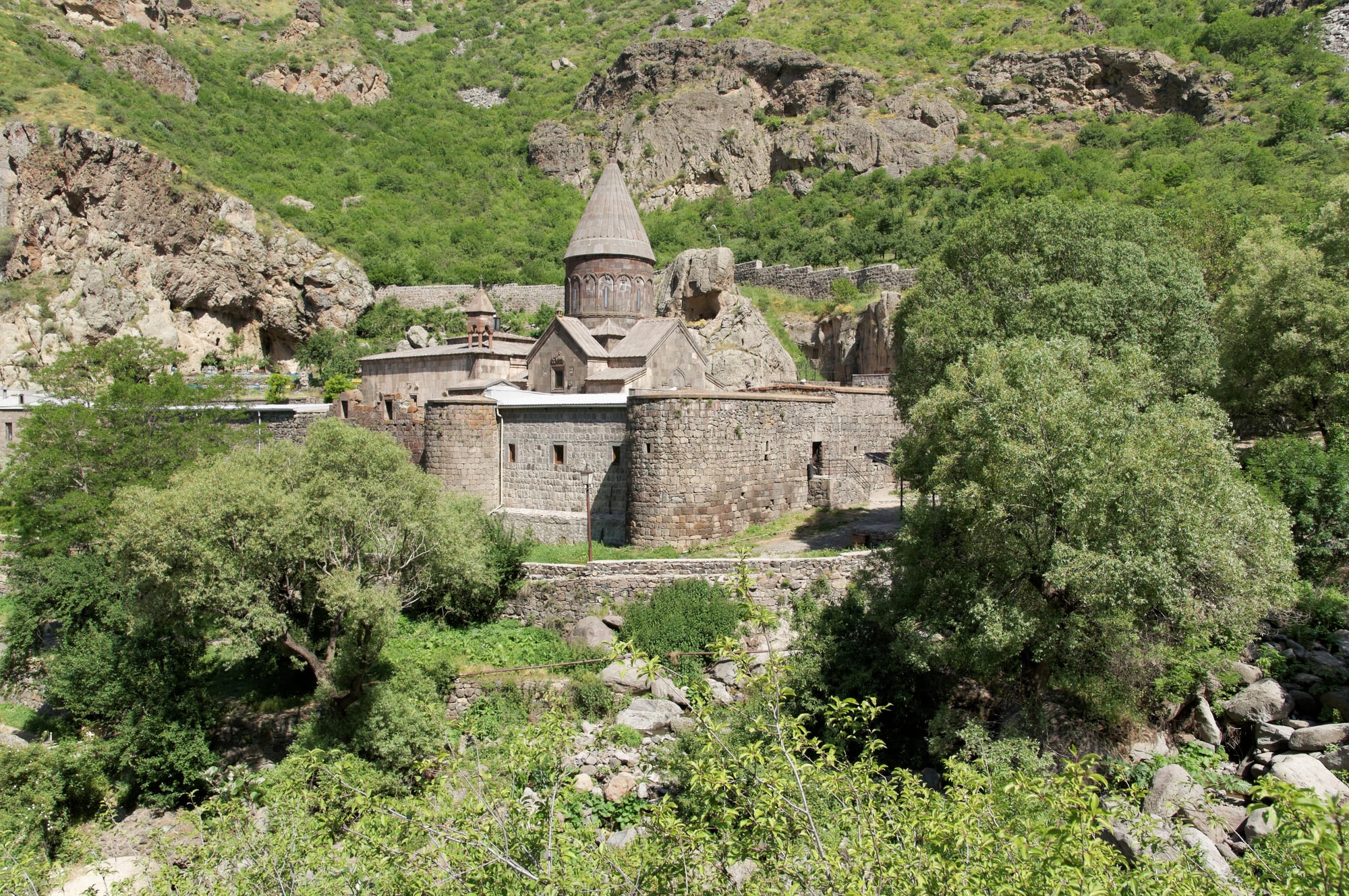
On the evening of 13 February, a crowd gathers in a churchyard as the light fades. A priest lights a candle from the altar, carries the flame out to a heap of wood in the yard and sets it alight, and the flame is passed from candle to candle among the congregation. Then the jumping begins: couples, many of them newly married, take a run and leap over the fire together, hoping for prosperity and children. The feast is Trndez, which marks the presentation of the infant Christ in the Temple, forty days after Armenian Christmas, yet its fire belongs to purification rites far older than the church that blesses it. That blend of deep Christian faith with customs older still, kept alive by families across the centuries, runs through almost everything in Armenian life.
Faith, identity and values
Armenia takes great pride in having been the first country to adopt Christianity as its state religion, in an event traditionally dated to
- Its
national church, the Armenian Apostolic Church, has its own liturgy and traditions and belongs to neither the Catholic nor the Eastern Orthodox communion. In the 2022 census, just over 95 per cent of the population identified with it. The constitution separates religious organisations from the state but recognises the church's exclusive mission as the national church in the spiritual life of the people, the development of national culture and the preservation of national identity. The largest minorities are small: Catholics, evangelical Christians and followers of the Yazidi faith each account for around half of one per cent.
For many Armenians the church is as much the home of the nation as a place of worship. It has two catholicosates: the Catholicos of All Armenians sits at Etchmiadzin, while a second see, in Lebanon, serves much of the diaspora. Priests may be married or celibate, and women are not ordained. Worship centres on the badarak, the Divine Liturgy, which is often followed by a memorial service for the dead.
Church etiquette is simple but noticed. Visitors are expected to dress modestly, and those showing too much skin may be turned away. The faithful cross themselves on entering, and it is customary to light a candle before an image of a saint with a moment of quiet prayer. Women traditionally cover their heads during services, while men remove hats. Talking during the liturgy is avoided, and many worshippers stand through the whole service. At the end, pieces of mas, blessed bread, are handed out; it is kissed, then eaten. Before leaving, worshippers turn to face the altar and cross themselves once more.
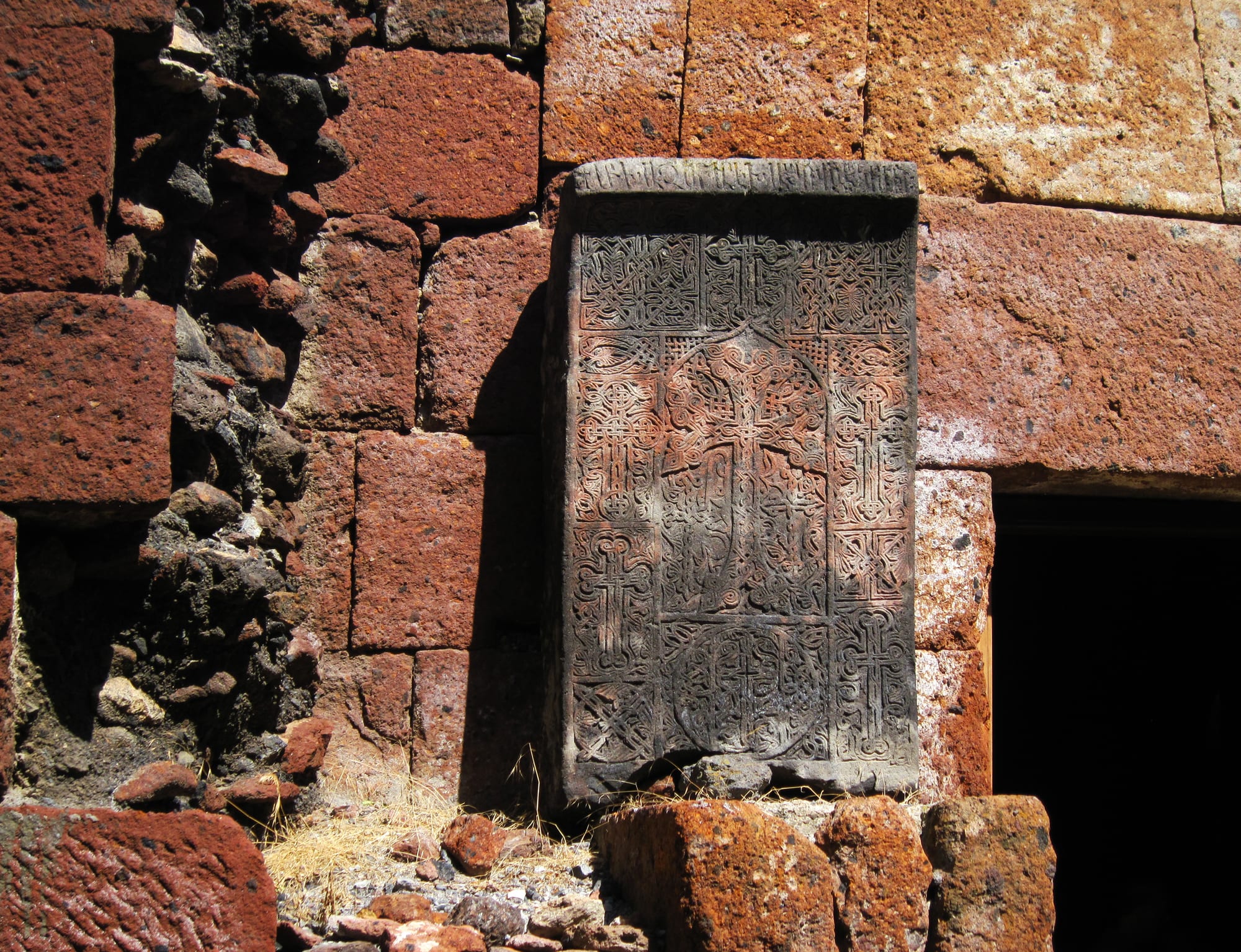
Faith is also carved into the landscape. The khachkar, or cross-stone, is an upright stone slab up to a metre and a half tall with a cross at its centre, resting on a sun or wheel of eternity and surrounded by plant and geometric patterns, saints and animals. Khachkars serve as focal points for worship and as memorials, and once blessed and anointed they are believed to offer help and protection. They stand in churchyards and beside roads across the country, and in 2010 UNESCO inscribed "Armenian cross-stones art. Symbolism and craftsmanship of Khachkars" on its list of intangible cultural heritage.
Beneath the religious framework sit strong social values: hospitality and generosity, great respect for guests, and a close bond with family, living and dead. The killing of up to 1.5 million Armenians in the Ottoman Empire from 1915, recognised as genocide by Armenia, by many historians and by a growing number of governments, though Turkey rejects the term and attributes the deaths to wartime strife, left a worldwide diaspora larger than the population of the republic itself. Memory, of ancestors, of lost places and of those who died, is a constant presence in national life.
Greetings and meeting people
Armenians can seem reserved with strangers but become warm and welcoming once introduced. The everyday greeting is barev, "hello", or the more courteous barev dzez, "hello to you", and a man may be addressed as paron, the equivalent of "Mr". Handshakes are customary on meeting, and among family and close friends greetings grow more physical: a kiss on the cheek, an arm around the shoulder, a face held affectionately in both hands. Physical contact between people of the same sex, such as walking arm in arm or holding hands, is a common sign of friendship and carries no further meaning.
Affection is also carried in language. The word jan, meaning "dear", is added to a person's name, often shortened, among family, friends and anyone held dear. A loved one may be greeted with tsavt tanem, literally "I take your pain", a phrase of tenderness rather than sorrow. Respect for age runs through daily life, and in many multi-generational households grandparents are treasured members of the family.
Armenian has its own alphabet, created in the early fifth century and so central to national identity that "Armenian letter art and its cultural expressions" was added to UNESCO's list in 2019. Russian is widely understood as a second language, and English is increasingly common among younger people. A few words of Armenian are warmly received: the word for thank you is shnorhakalutyun, though many people simply say "merci", borrowed from French.
Hospitality and being a guest
Hospitality is a point of honour, and being a guest is treated as a privilege for the host as much as the visitor. The old symbols of welcome are bread and salt; in state protocol, visiting dignitaries are still presented with them, and Armenians speak of friendship with the phrase "we have bread and salt among us". Bringing a small gift when invited to a home is a thoughtful gesture, and an invitation to eat should be accepted if at all possible.
Hosts make sure that no guest is ever hungry or thirsty. Dishes are shared from the middle of the table, and a host will press guests to eat more as an expression of affection. An empty plate or glass is simply refilled, so the way to signal that enough is enough is to leave a little food on the plate or wine in the glass. Each refill brings another toast, usually led by a chosen toastmaster, the tamada, who guides the table from one toast to the next, to friendship, to peace or to unity. Taking part is part of being a good guest. Drinking to excess is another matter, however; heavy drunkenness is not accepted in Armenian society, and drunken behaviour in public can lead to trouble with the police.
Festivals and life's big moments
The year runs through church feasts and national days. New Year is the biggest family celebration, with families staying up together to see in 1 January, exchanging gifts and then visiting one another over the following days. Christmas follows on 6 January, a date the Armenian Church has kept since early Christian times, when it celebrates the birth and the baptism of Christ together. A candlelit liturgy is held on the eve, and on the day itself the Blessing of Water recalls the baptism in the Jordan: a cross is immersed, holy oil is poured from a dove-shaped vessel, and worshippers take some of the blessed water home. Trndez lights its bonfires in February. At Easter, eggs are dyed red with onion skins and used in egg battles, in which the egg that survives unbroken wins, and people greet one another with "Christ is risen from the dead". In mid-August, after the liturgy for the Assumption, baskets of grapes from the new harvest are blessed in church and shared out; by tradition, many people wait until this day to eat the new grapes.
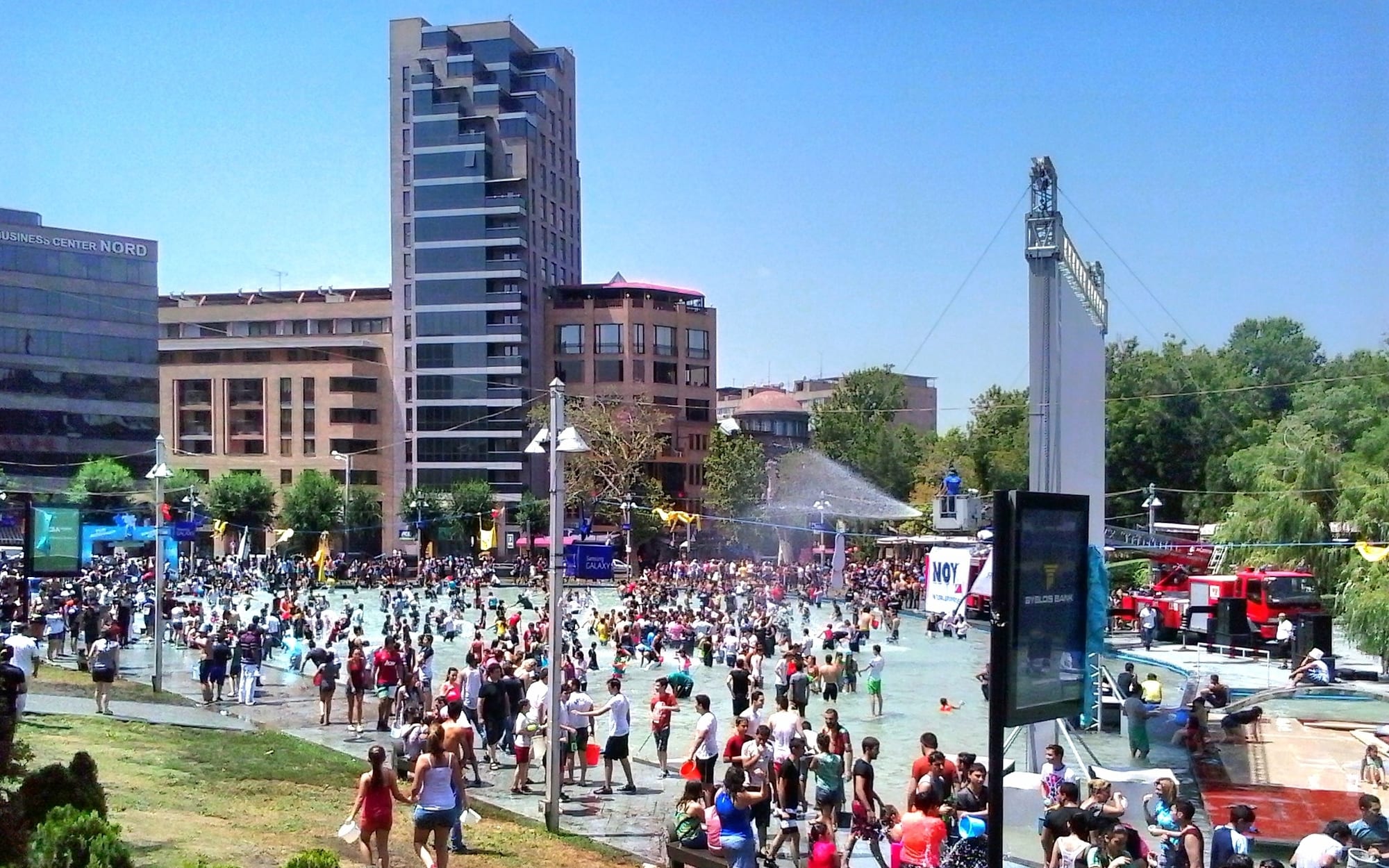
The most joyful day of summer is Vardavar, the feast of the Transfiguration, which falls 98 days, or fourteen weeks, after Easter. Its custom of drenching friends, neighbours and passers-by with water comes from older celebrations linked to Astghik, the ancient goddess of beauty, love, fertility and water, and on the day people of all ages roam the streets with bottles, buckets and water pistols. Anyone out of doors can expect to be soaked, and resisting only invites more.
Other dates are solemn. 24 April, Genocide Remembrance Day, is the country's principal day of national mourning, chosen because it marks the deportation of Armenian intellectuals in 1915. A torch march is held the evening before, and on the day itself large crowds, often put in the hundreds of thousands, walk to the memorial at Tsitsernakaberd to lay flowers around the eternal flame. Visitors are welcome to join, and quiet respect is expected. Republic Day on 28 May, marking the first republic of 1918, is celebrated with concerts and fireworks, and Independence Day on 21 September marks the break from the Soviet Union in 1991.
Weddings are elaborate and full of symbolism. They traditionally begin with the khosk kap, the formal request for the bride's hand. The couple are married in church in a sacrament that includes their crowning and drinking from a shared cup, supported throughout by a godfather and godmother, the kavor and kavor kin. When the newlyweds arrive at the groom's house, folded lavash, the thin traditional bread, is laid across their shoulders to bring fertility and prosperity. At the feast a tamada leads the toasts, guests often toss money to the bride for luck, and the kochari, the national group dance, is a fixture.
Remembrance of the dead is equally important. Memorial services are held on the seventh day after a death, on the fortieth, and on each anniversary; families visit graves often, food and brandy are offered to the dead, and the birthdays of loved ones who have died may still be marked.
Arts, crafts and music
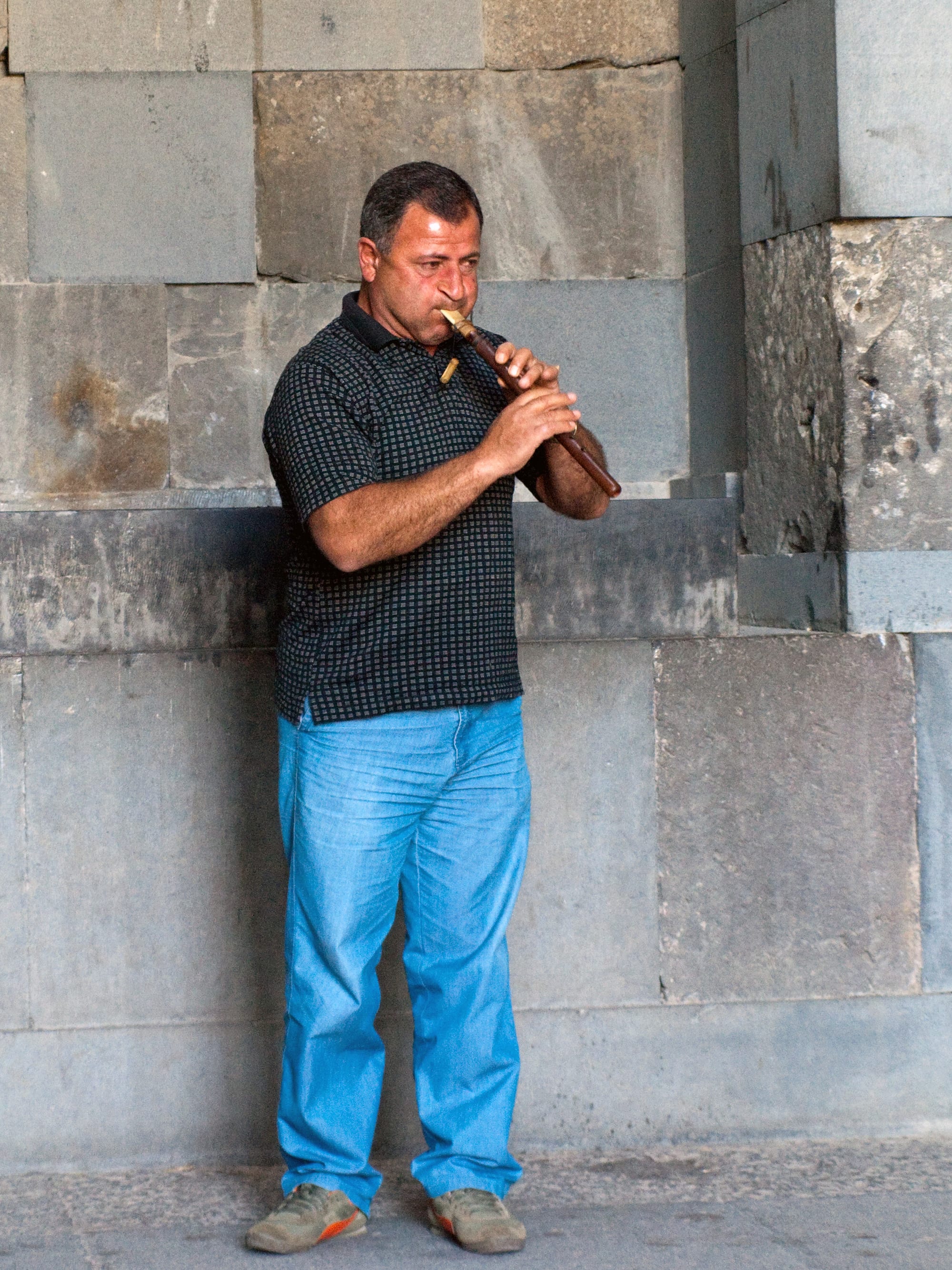
No sound is more closely identified with Armenia than the duduk, a double-reed pipe made from apricot wood, with a warm, soft, slightly nasal tone. It is traditionally played by two musicians: one sustains a continuous drone by circular breathing while the other carries the melody and improvises around it. Its music is heard at both weddings and funerals, and "Duduk and its music" was inscribed on UNESCO's list of intangible cultural heritage in 2008.
Dance is just as central. The kochari, a group dance performed at holidays, festivals, family ceremonies and other gatherings, is open to everyone regardless of age, gender or social standing, and it gives those who dance it a shared sense of identity and solidarity. UNESCO notes that its chain of transmission has never been broken: it passes within families and informal dance groups, folk ensembles have kept it alive since the 1960s, and a folk song and dance course has been taught in Armenian schools since 2004.
The visual arts reach back more than a millennium. Illuminated manuscripts are prized for their vivid colours and ornament, and the national manuscript repository, the Matenadaran, holds some 23,000 manuscripts and scrolls, including fragments, a collection listed on UNESCO's Memory of the World register. Weavers have long produced carpets and rugs, and stone carving lives on in the khachkar. UNESCO's list for Armenia also includes "Lavash, the preparation, meaning and appearance of traditional bread as an expression of culture in Armenia" (2014), the performance of the national epic of David of Sassoun (2012) and the tradition of blacksmithing in Gyumri (2023).
Dos and don'ts for visitors
- Do greet people with barev dzez, and learn shnorhakalutyun, thank you, though "merci" is also widely used.
- Do accept invitations to eat, join in the toasts led by the tamada, and leave a little on the plate or in the glass when finished.
- Do dress modestly at churches and monasteries, keep quiet during services, and face the altar before leaving.
- Do expect to be soaked on Vardavar, and take it in good spirit.
- Do show quiet respect on 24 April and at the genocide memorial at any time of year.
- Don't drink to excess; public drunkenness is frowned upon and can bring trouble with the police.
- Don't photograph military installations; visitors have been detained for doing so.
- Do leave a tip in restaurants where service is not included, and feel free to bargain at markets.
What to take away
Armenian customs are those of an old people who hold tight to faith, family and memory, and visitors who accept the bread and salt of their hosts will find a welcome as generous as any in the world.