Culture & Customs · Andorra
Andorra: Fire, Bears and a Shared Pot
A Catholic patron saint at the heart of the national day, a Catalan greeting in a crowd of languages, and a year marked by torches, bear hunts and stew ladled out to the whole street
By Worldlore Editorial · 30 September 2026
Early on the morning of 8 September, people from every corner of Andorra set off up the valley towards a single sanctuary in the mountains. Some walk the whole way; by the time the first Mass begins, thousands have gathered. It is the feast of Our Lady of Meritxell, patron of the country, and also its national day. Later come concerts, stalls of local produce, and circles of people dancing the sardana in the open air. For a country where more than half the residents hold another passport and several languages are heard on every street, it is the one morning of the year when Andorra most clearly gathers around what it shares: a patron saint, a language and a sense of continuity kept up for centuries in the mountains.
Faith, identity and values
Andorra's culture is rooted in the Catholic tradition. The constitution does not name a state religion, but it acknowledges a special relationship with the Catholic Church "in accordance with Andorran tradition" and gives the Church's bodies full legal standing. The link runs to the top of the state: one of the country's two co-princes is the Bishop of Urgell, whose diocese has included Andorra since the Middle Ages. The parish church, the saint's day and the pilgrimage still set the framework of the year.
At the centre of it all stands Our Lady of Meritxell. According to tradition, villagers on their way to Mass found an image of the Virgin beneath a wild rose that had bloomed out of season, on the feast of the Epiphany. The villagers carried it to their own church, but it was found back in the same spot each time, and so a sanctuary was built where it had appeared. The General Council declared her patron and special protector of Andorra in 1873, and the Pope gave her canonical recognition in 1914. Today a modern basilica by the architect Ricardo Bofill stands beside the ruins of the older sanctuary.
Identity here is also a matter of language and place. Catalan is the only official language, and it is used in government, in schools and in public life, even though Spanish, French and Portuguese are all part of everyday conversation. The country is divided into seven parishes, each with its own council, patron saint and festivals, and loyalty to the parish runs deep. Mountain life has left its own values: a practical respect for weather and terrain, strong ties within small communities, and quiet pride in having remained independent and neutral while larger powers came and went around the valleys.
Greetings and meeting people
A handshake is the usual greeting on first meeting and in any formal or business setting. Among friends and family, as in neighbouring Catalonia and Spain, it is customary to exchange a kiss on each cheek, beginning with the left, particularly when women are involved. Visitors are not expected to initiate this with people they have only just met.
Language is the courtesy that matters most. Greetings change with the time of day: "bon dia" in the morning, "bona tarda" in the afternoon and early evening, and "bona nit" at night, with "gràcies" for thank you. Even a few words of Catalan are warmly received, precisely because the language's position is a sensitive one. Andorrans and visitors alike have in recent years complained that staff in shops, hotels and restaurants often reply in Spanish even when spoken to in Catalan, and the question of keeping the national language in daily use is a live public debate. Starting a conversation in Catalan, or at least greeting in it, is read as a sign of respect for the country rather than for any neighbour.
Otherwise, everyday manners are close to those of neighbouring Spain, where people move on to first names fairly quickly and formal titles are kept for formal settings.
Hospitality and being a guest
As in neighbouring Spain, much social life takes place in bars, cafés and restaurants rather than at home, and an invitation into a private house is a sign of genuine friendship that should not be expected quickly. A guest who is invited usually brings something that can be shared, such as a bottle of wine, chocolates or pastries, and gifts are generally opened on the spot. At the table, it is polite to wait for the host to begin, to keep hands visible above the table, and to join the first toast. Meals are long, and the conversation that lingers over coffee afterwards is as much a part of the occasion as the food.
Hospitality also has a public, community form. Several of Andorra's best loved customs involve a whole neighbourhood eating together. On the feast of Sant Antoni, 17 January, one tradition began in the early 1970s when a group of friends celebrating their shared name day decided to serve a plate of escudella, the hearty winter stew, to their neighbours and fellow townspeople in the street; it has since become an annual event. Summer festivals, too, often include a shared meal as part of the programme. Taking part in these is the easiest way for a visitor to be a guest of the country as a whole.
Festivals and life's big moments
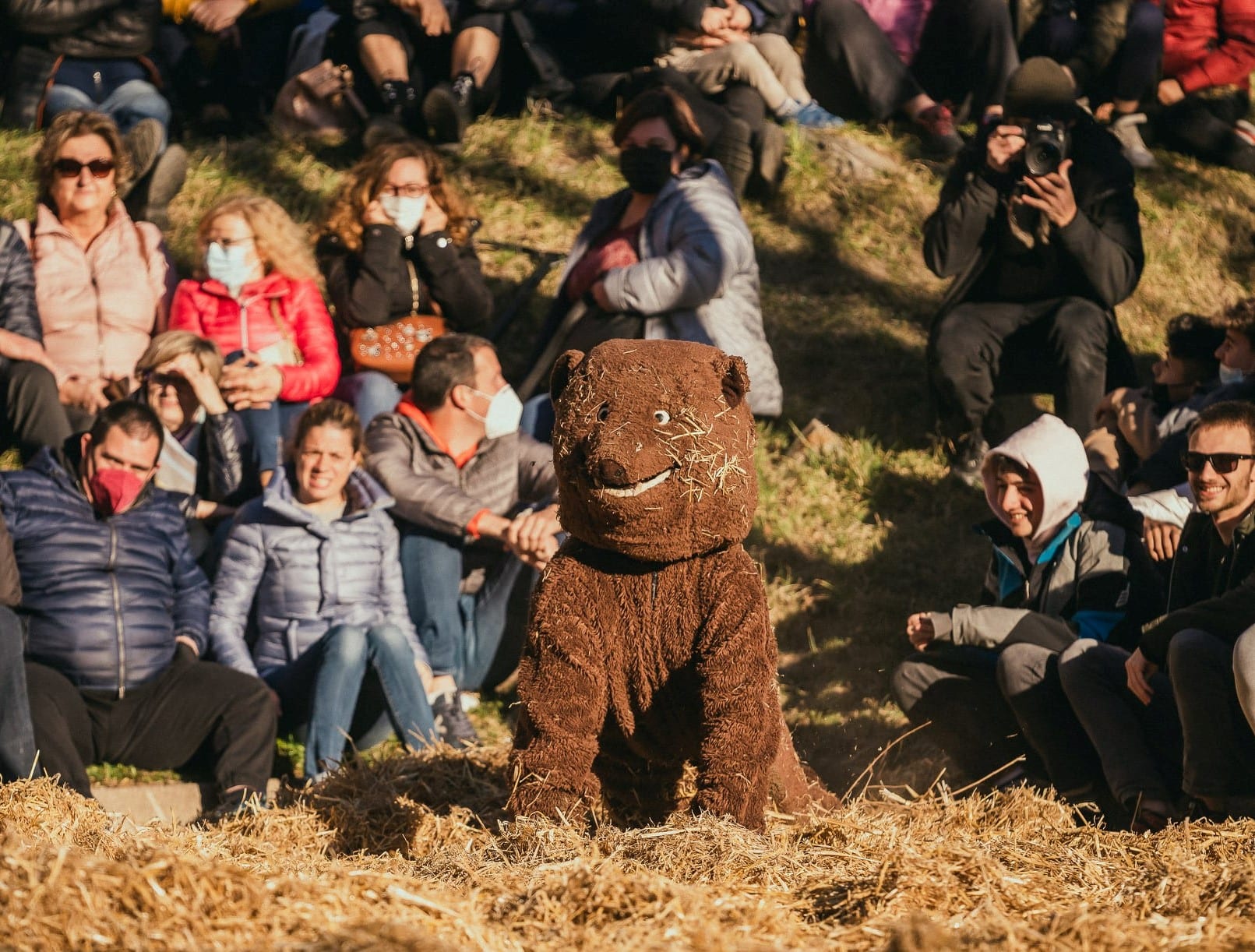
The festival year follows the Catholic calendar and the seasons of the mountains. Winter brings Sant Antoni and Carnival, and with it one of the country's oldest and strangest customs: the bear festivities. In two Andorran parishes, one on Carnival Monday and the other in early December, performers disguised as bears chase participants through the streets, amid dances, music and speeches in Catalan. The scene is read as the end of winter, the bear waking from hibernation, and a portrait of the relationship between people and nature. Having faded in the twentieth century, the bear festivities were revived and are now on UNESCO's list, shared with villages across the border in France.
On 23 April comes Sant Jordi, shared with Catalonia, when books and roses are exchanged between partners, friends and colleagues, and bookstalls, florists and author signings fill the main squares. Two months later, on the night of Sant Joan, 23 June, the fire festivals of the summer solstice light up the valleys. In Andorra these are the falles, when young people known as fallaires swing blazing torches around their heads. Across the Pyrenees, the tradition of carrying fire down from the mountains and lighting beacons is on UNESCO's list, and it is described as a rite of passage for the young and a way of renewing a community's sense of belonging; embers or ashes are kept afterwards as protection.
Summer is the season of the festes majors, the patron-saint festivals held by each parish and by many villages, with music, dances and fireworks through the warm evenings. There are also aplecs, pilgrimages to chapels and sanctuaries dedicated to local patrons. Then, on 8 September, the whole country comes together at Meritxell. At Christmas, homes keep the Catalan custom of the tió, a log covered with a blanket that children feed in the days before Christmas and then tap with sticks while singing, until it "produces" sweets and small presents; larger public tiós are set up in the towns.
Life's milestones are marked in ways shared with the wider Catholic and Catalan world, from baptism to the church wedding. The place of the Church shows in the law: Andorra's 1995 marriage law recognised two forms of marriage, civil and canonical, and gave the religious ceremony equal legal standing with the civil one.
Arts, crafts and music
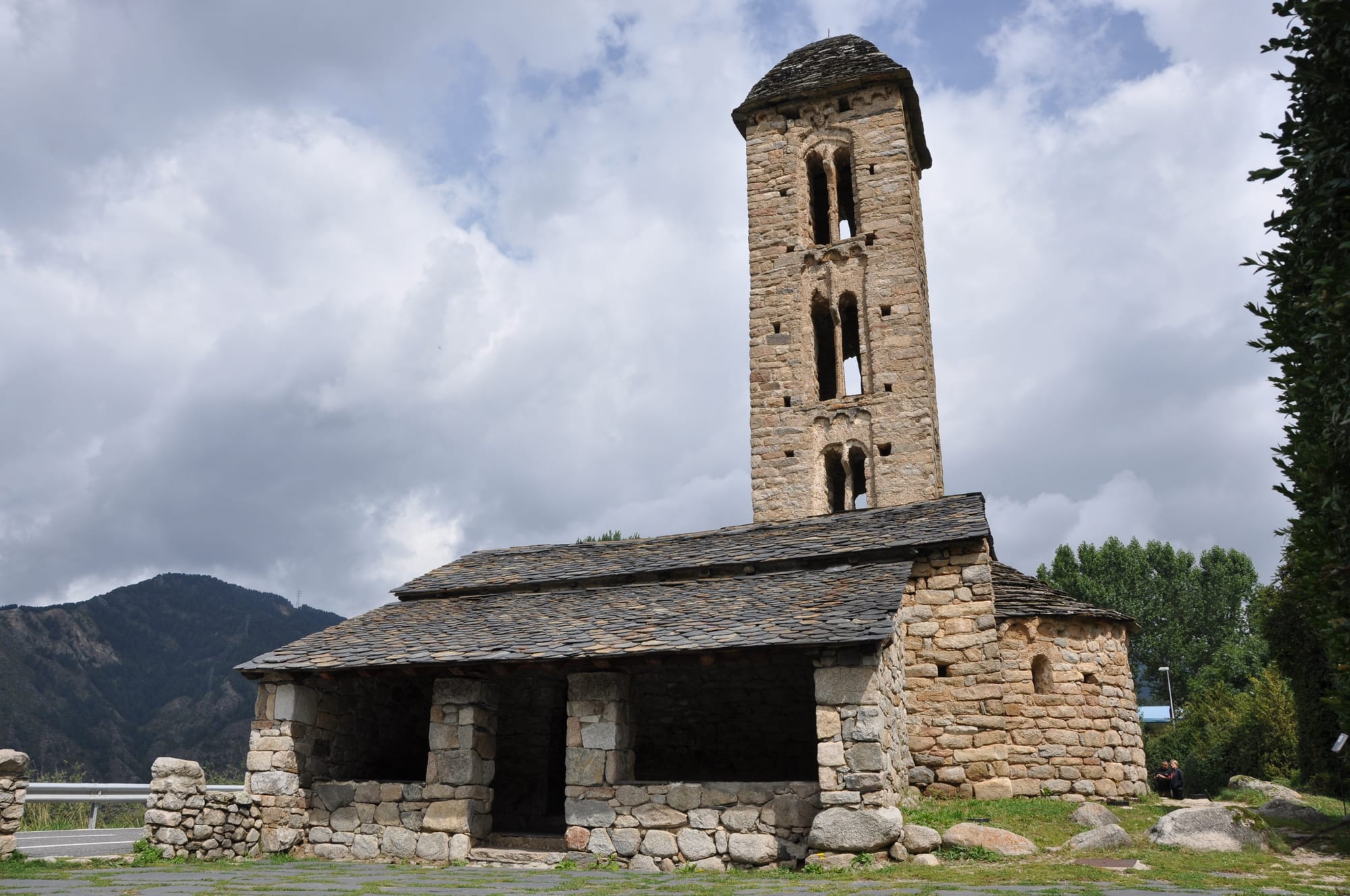
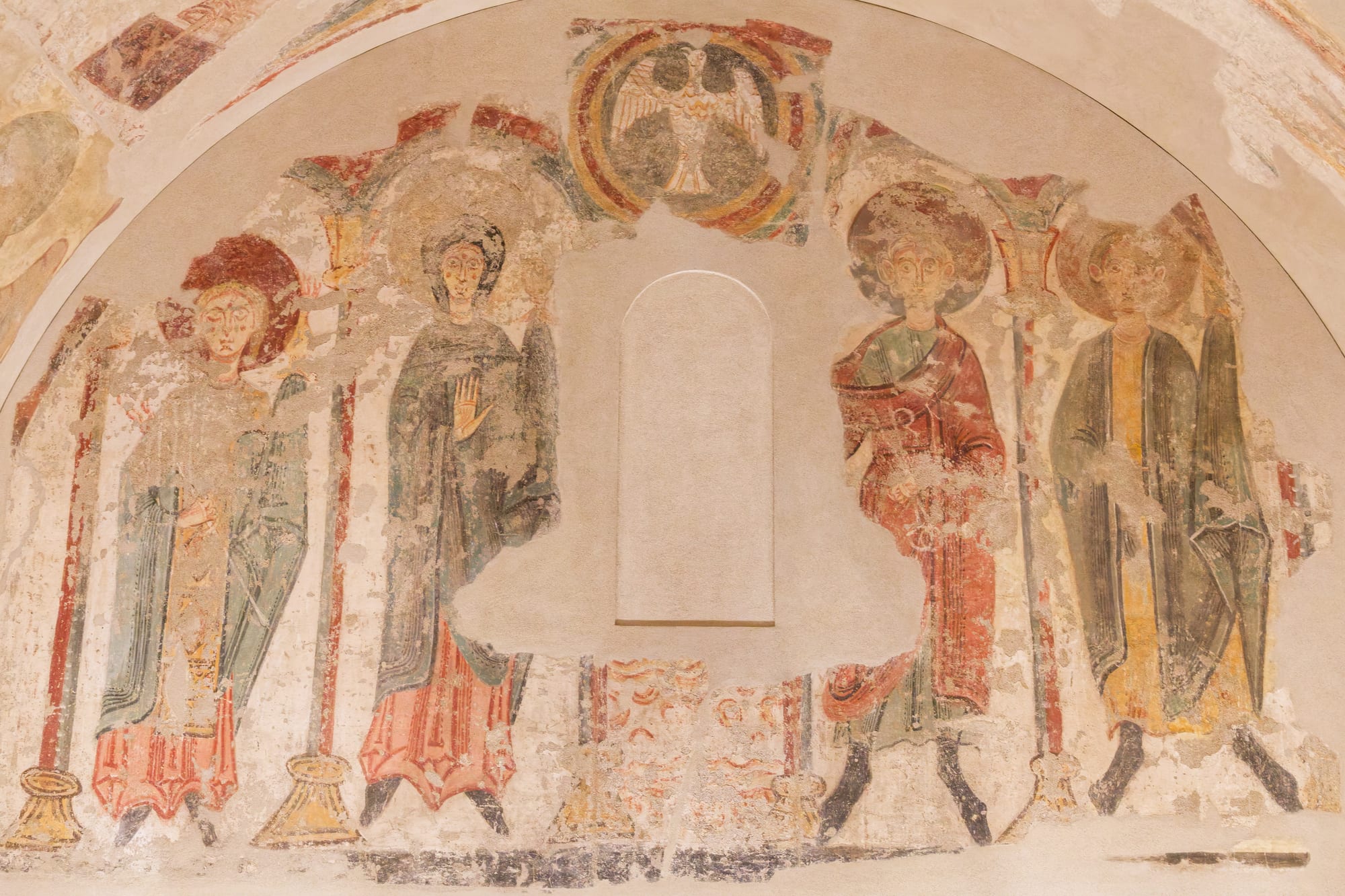
Andorra's great artistic inheritance is Romanesque. Dozens of churches from the Middle Ages survive across the parishes, small and sober buildings of rough stone, many with tall Lombard bell towers of the kind seen across the Pyrenees. Several were once painted inside with brightly coloured murals of Christ, the apostles and the saints. Some of these paintings, removed from their walls in the twentieth century, have been returned and put on display, and an interpretation centre gathers objects from every church in the country.
Folk dance is the living art most visitors will see. The contrapàs, the marratxa, the ball de Santa Anna and the ball de tarda are among the dances particular to Andorran folklore, each associated with a parish, and the sardana, the circle dance shared with Catalonia, is danced at festivals across the country. Traditional dance groups, known as esbarts, keep these alive and perform them in costume at festivals, presenting a picture of the customs of mountain life.
The landscape itself carries crafts. The dry-stone walls, terraces and huts built without mortar across the valleys belong to a building tradition now on UNESCO's list, as does transhumance, the seasonal moving of herds between winter valleys and summer pastures, a practice Andorra shares with other European countries. For a country of its size, Andorra also has an unusual number of museums, and its tourism board claims the highest density of museums per inhabitant anywhere.
Dos and don'ts for visitors
- Do greet people in Catalan where possible: "bon dia", "bona tarda", "bona nit" and "gràcies" are always appreciated.
- Do offer a handshake on first meeting, and leave the kiss on each cheek to friends and family.
- Do bring something to share, such as wine, chocolates or pastries, if invited to someone's home.
- Do wait for the host to start eating and to make the first toast.
- Do join the public festivals, from the bear chases to the festes majors, which welcome spectators.
- Do stand well back from the fallaires and their burning torches on the night of Sant Joan.
- Don't assume that Spanish or French is the national language; Catalan is the only official one.
What to take away
Andorran customs are those of a small mountain community that has kept its saints, its language and its fire festivals through the centuries, and visitors who greet it in Catalan and join in its feast days are welcomed into that continuity.