Culture & Customs · Algeria
Algeria: Honour, Henna and the Open Door
A faith that sets the rhythm of the year, greetings that are never rushed, a strong sense of family honour, and weddings that can run for days in seven changes of dress
By Worldlore Editorial · 30 September 2026
A visitor arrives at an Algerian home. The first handshake is not the end of the greeting but the start of it: questions follow about the journey, about family, about health, and each is answered and returned before anyone sits down. The eldest person in the room is greeted first, and the guest works around the others one by one. Coffee or tea appears almost at once, with something sweet beside it, and no one mentions the reason for the visit until it has been drunk. Nothing is hurried, because the time taken is itself the message. In Algeria, respect is shown less by what is said than by the attention paid, and by the sense that a guest reflects on the honour of the house.
Faith, identity and values
Islam is the state religion, and more than 99 per cent of Algerians are Sunni Muslims following the Maliki school of law, the tradition long dominant across North Africa. The remaining fraction includes a small Ibadi Muslim community, and Christian and Jewish communities that together number well under one per cent. Religion is closely bound up with the state: mosques are led by imams whom the government trains and appoints, and while conversion itself is not illegal, attempting to convert a Muslim to another faith is a criminal offence. Faith sets the rhythm of the week and the year. Friday is the day of communal prayer, the five daily calls to prayer mark out the hours, and Ramadan reshapes the whole country for a month.
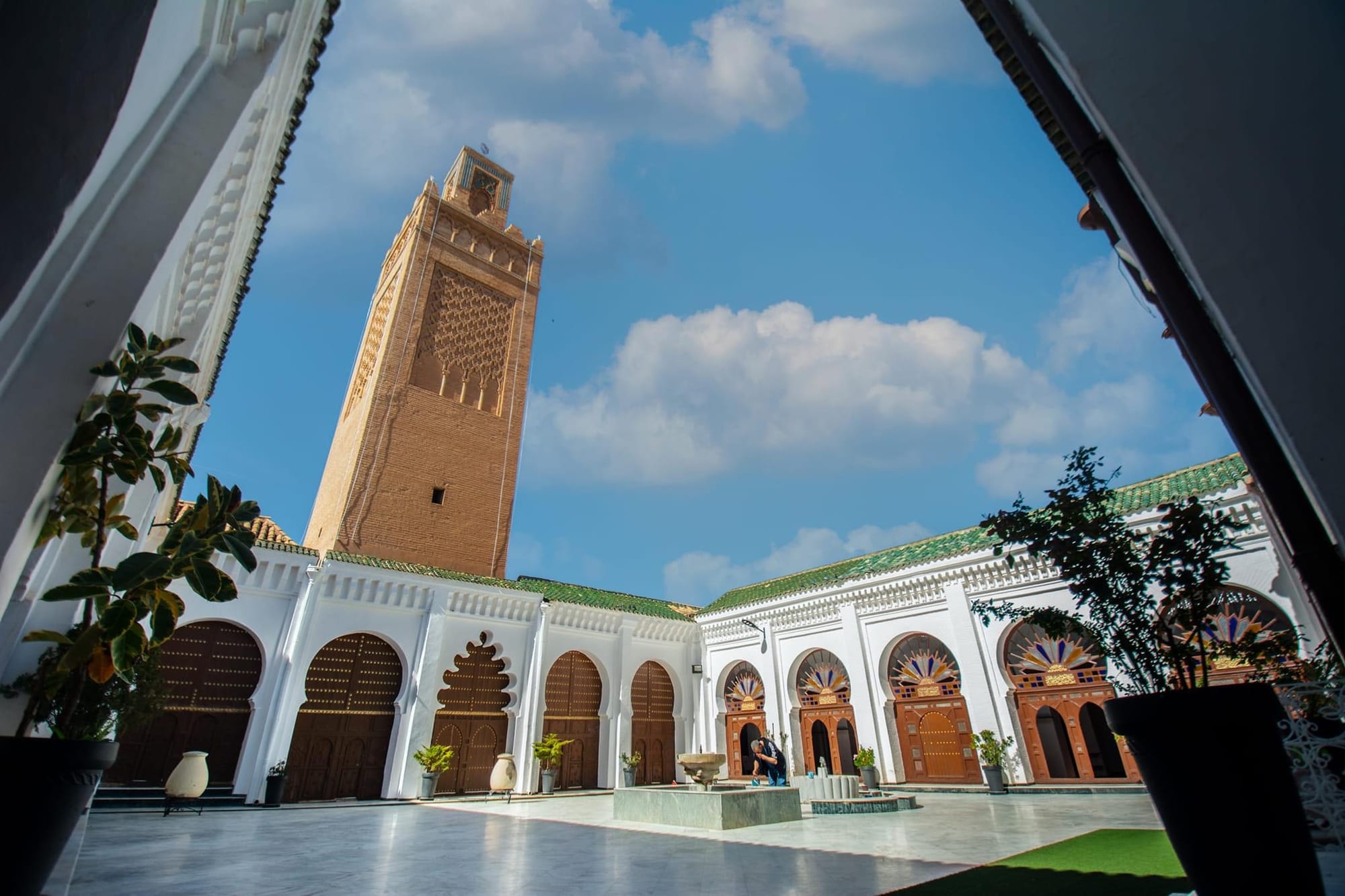
Identity rests on two deep roots, Arab and Amazigh (Berber), and both Arabic and Tamazight are official languages. Many families speak one, the other, or both at home, with French widely used alongside them. What unites most Algerians across these lines is the importance of family. Households have traditionally been extended and led by the senior man, and although younger, urban families increasingly live on their own, the ties of loyalty and respect between relatives remain strong. Closely linked is the idea of honour: a family's reputation depends on the conduct of each of its members, and public embarrassment is felt by the whole group, not just the individual. That explains a good deal of everyday behaviour, from the care taken over dress and manners to the strong preference for raising criticism privately rather than in front of others.
Communication blends warmth with a degree of indirectness. Animated, even loud discussion is not a sign of conflict, and a reply such as "that will be difficult" may be a polite way of saying no. Early conversation tends to stay on safe ground such as family, football, food and music, while politics, religion and sexuality are best left alone until a relationship is well established.
Greetings and meeting people
A light handshake is the usual greeting, and it is not rushed. It comes with an exchange of enquiries about family, work and health, and cutting this short can seem cold or dismissive. People who already know each other often add a kiss on the cheek, though this is generally between people of the same sex. When entering a room, the eldest person is greeted first, and in formal or professional settings titles matter: people are addressed as Docteur, Professeur or Maître, or by title and family name, until invited to do otherwise.
Between men and women, more care is needed. A man meeting a woman usually nods first and waits to see whether she offers her hand, and some religious men prefer not to shake hands with women at all; a polite nod is then the courteous alternative. Friends of the same sex often walk arm in arm or hold hands in public, but displays of affection between men and women in public are generally frowned upon.
Algerians tend to stand closer when talking than many visitors are used to, a little under an arm's length, and stepping back can seem unfriendly. Eye contact on being introduced is a sign of respect, though a long, fixed stare is not. Wagging or pointing with the index finger is considered rude; a gesture with the whole hand is preferred. As across the Muslim world, the right hand is used for giving and receiving things, including money and gifts.
Hospitality and being a guest
Hospitality is a matter of pride, and an invitation to a family home is a mark of real warmth. Shoes are often removed at the door, and it is worth watching what the household does. The guest greets the eldest first and follows the host's lead on where to sit. Coffee, tea and something to eat are offered almost immediately, and turning them down too quickly can come across as distant. Accepting at least a little is the gracious response.
A small gift is appreciated: pastries, sweets, fruit or flowers are all suitable, presented with the right hand or both hands. Alcohol should not be brought unless the host is known to drink. Gifts are often set aside unopened rather than unwrapped in front of the giver, and the gesture counts for more than the price.
At the table, the right hand is used for eating and for passing food, and the left is kept out of shared dishes. Hosts press food on their guests generously and will keep refilling a plate that is left empty, so leaving a little is the signal that one has had enough. Honour and dignity matter at the table as elsewhere, and any criticism is kept private rather than voiced in company. During Ramadan, visitors are expected not to eat, drink, smoke or chew gum in public during daylight hours, and to keep music, dancing and swearing out of public view. Being drunk in a public place is illegal at any time of year.
Festivals and life's big moments
The religious calendar shapes the biggest occasions. The month of fasting ends with Eid al-Fitr, a public holiday and one of the two great feasts of the Muslim year. The other, Eid al-Adha, the feast of sacrifice, remembers the prophet Ibrahim's readiness to sacrifice his son, and many households mark it by slaughtering a sheep; the custom is so central that in 2025, with drought having driven prices out of reach, the government arranged to import a million sheep so that families could keep it. The meat is traditionally shared between the household, relatives and people in need. Mawlid, the birthday of the Prophet, is also a public holiday.
National days carry strong feeling too. Independence Day on 5 July and Revolution Day on 1 November, which marks the start of the war of independence in 1954, are occasions for flags, speeches and remembrance. Since 2018 the country has also marked Yennayer, the Amazigh New Year, as a national holiday on 12 January, five years before Morocco followed suit. It is celebrated with family feasts and the greeting "aseggas ameggaz", happy new year, and in some homes sweets and nuts are tossed over the youngest child as a wish for a year of plenty.
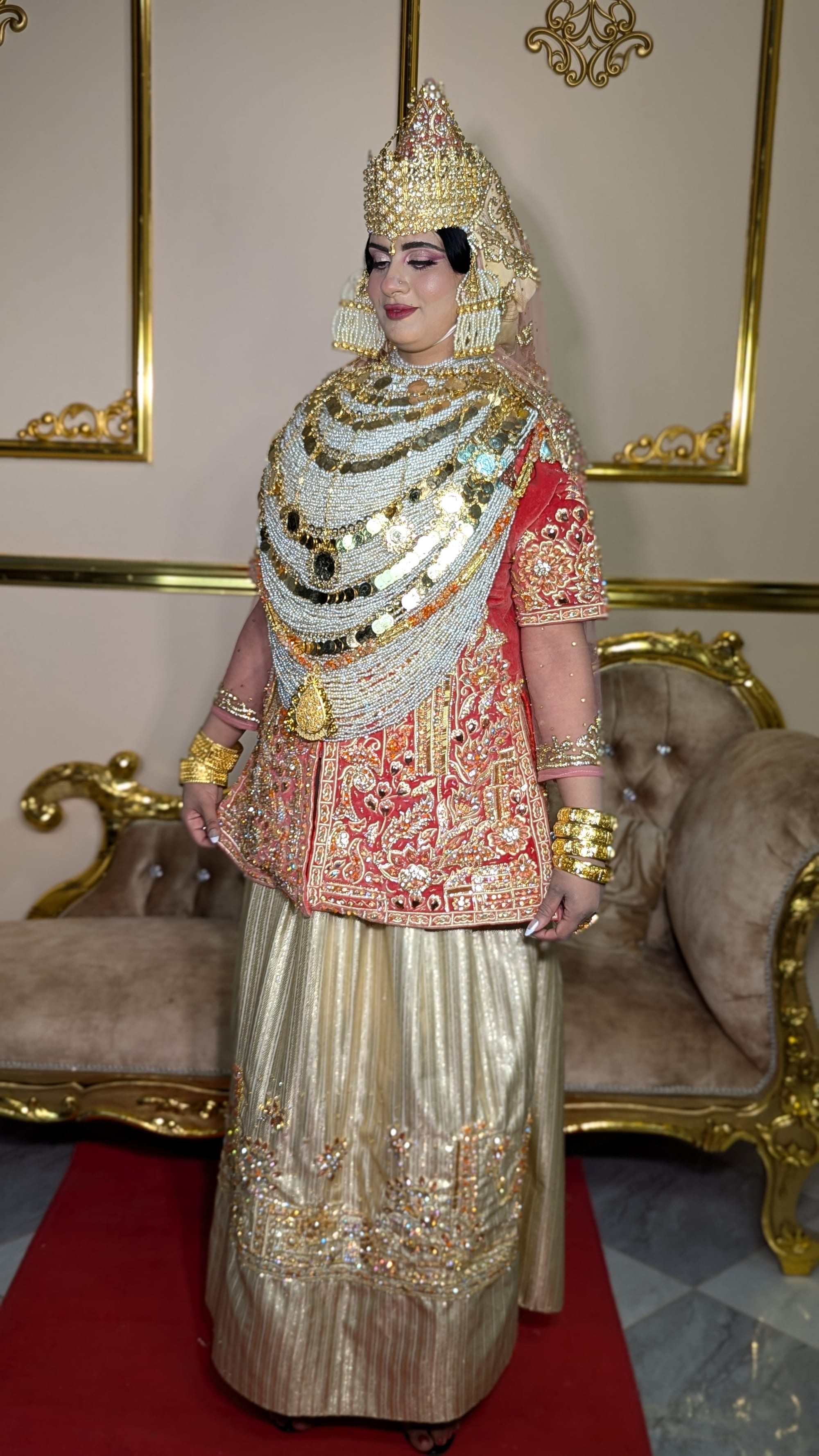
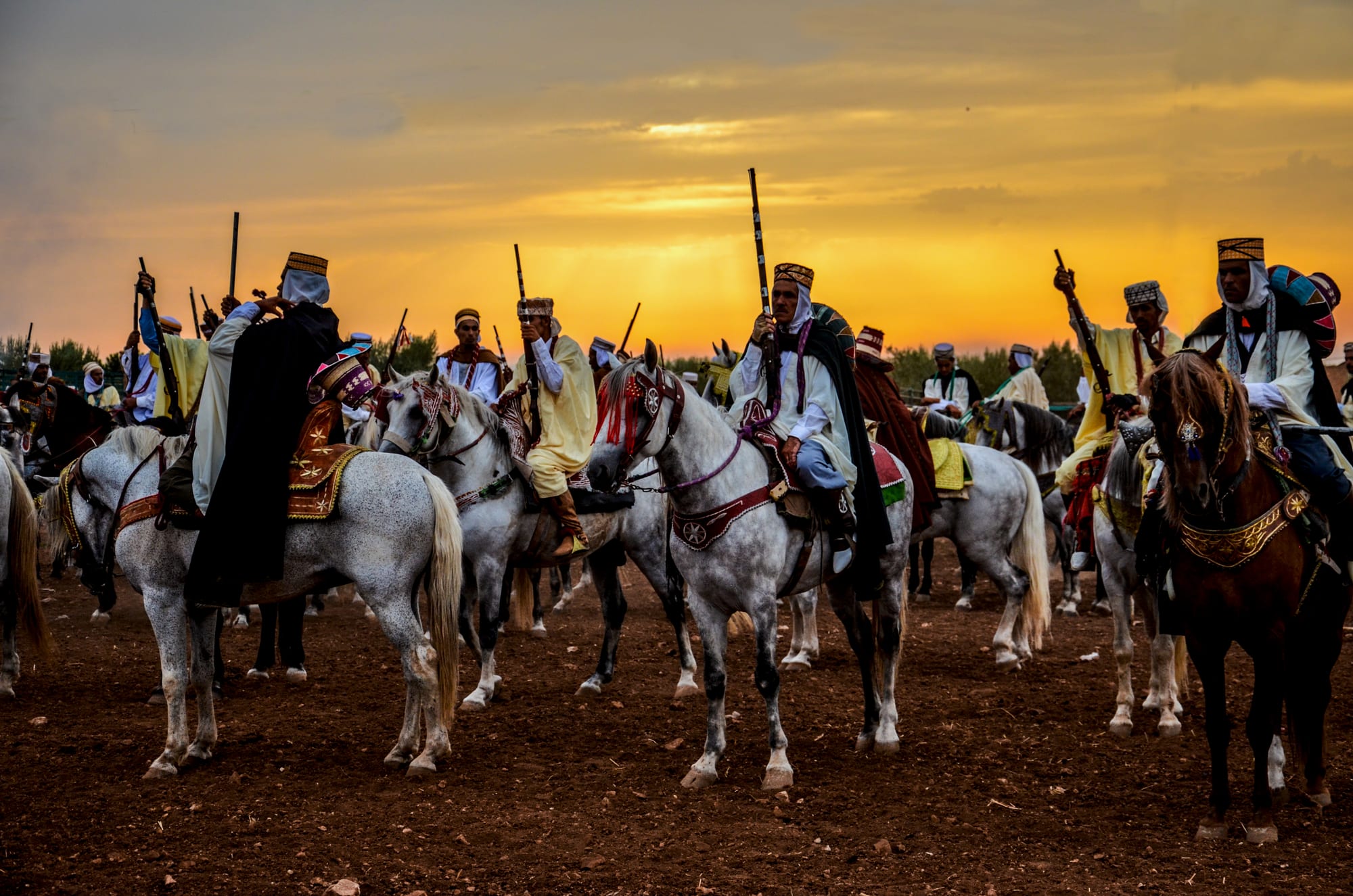
Weddings are the great family events and can last several days, though some families now opt for a simpler occasion around the signing of the marriage contract. Marriage has long been seen as an alliance between two families as much as a union of two people. Preparations often begin with a visit to the hammam, the steam bath, for the bride and her closest female relatives, followed by a henna night at which intricate designs are painted on her hands and feet amid music and dancing. Henna, used for adornment and as a symbol of joy at births and weddings, is on UNESCO's list, shared with other Arab states. At the celebration itself the bride may appear in as many as seven different outfits in turn, a practice known as the tasdira, each honouring a city or region and many of them part of her trousseau. Two of these bridal and ceremonial costume traditions are themselves inscribed on UNESCO's list. Processions can be escorted by horsemen performing a fantasia, a display of galloping and synchronised musket fire, and the celebration fills with music and ululation.
Funerals follow Islamic practice and move quickly: the body is washed and buried as soon as possible, and in the days that follow relatives, friends and neighbours call at the family home to offer condolences.
Arts, crafts and music
Music is where Algeria's culture travels furthest. Raï, which grew up in and around Oran from a blend of rural Bedouin sung poetry and city cabaret music, became in the twentieth century a voice for subjects usually left unsaid, love, desire, freedom and the pressures of daily life, and its stars carried it from wedding parties to the world stage. It is on UNESCO's list, described as a genre through which young people express their feelings and push against social constraints. Alongside it runs a wide range of other traditions, from the imzad music of the Tuareg to the ahellil, a form of sung poetry and dance from the oases of the Sahara, also on UNESCO's list.
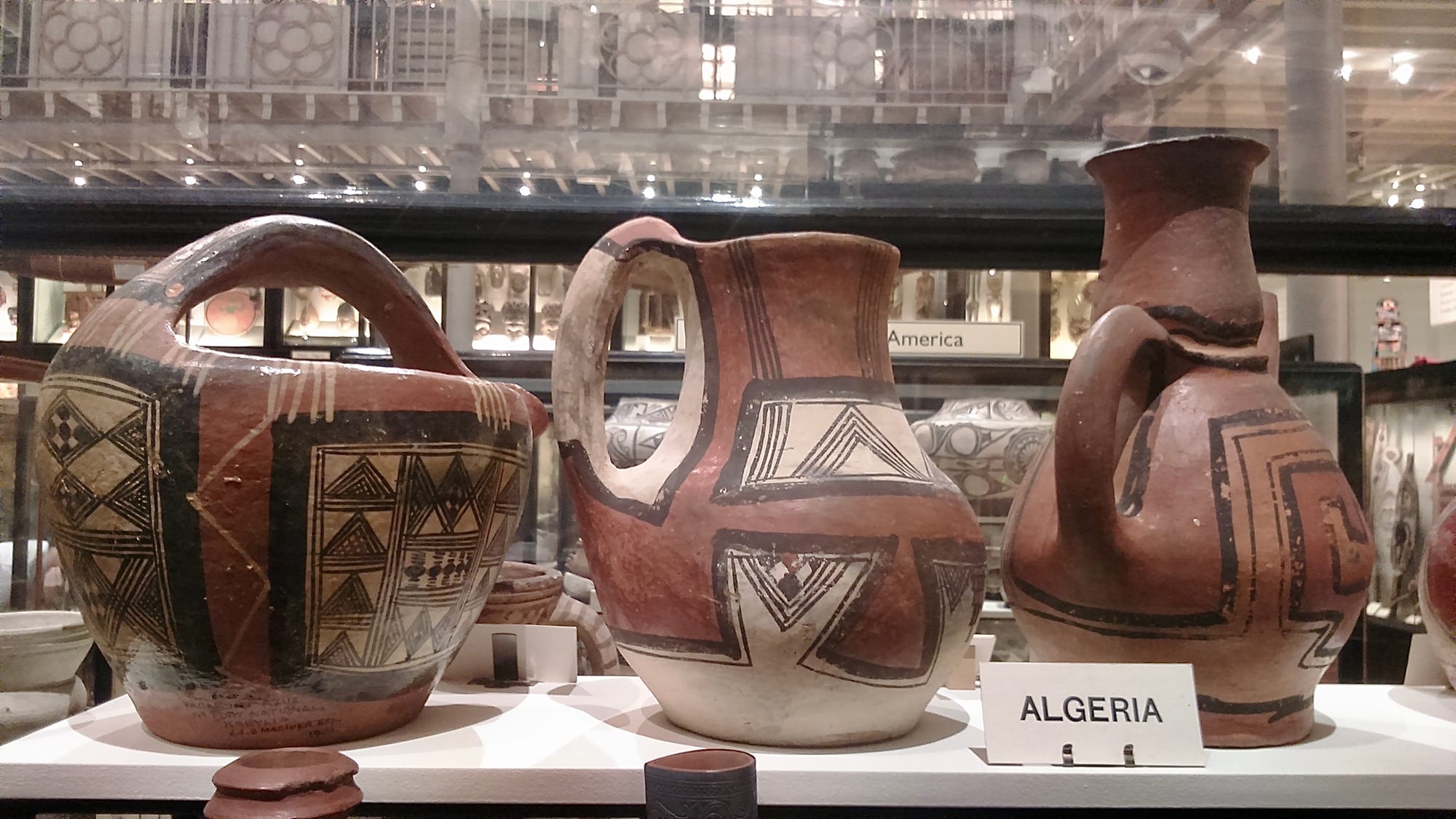
Crafts are often a family inheritance, and many have long been the work of women. Kabyle pottery, shaped by hand using thumb and coiling methods rather than a wheel, is decorated with slips and oxides in blocks of red and white, overlaid with geometric designs in black. The motifs once signalled which community a pot came from and were thought to protect what it held. Pots were made for storing water, cooking and lighting, and for rites around births and weddings, and although modern pieces are largely decorative, the craft is still passed from mother to daughter.
UNESCO's list for Algeria reads almost like a catalogue of its skills: the weaving, embroidery and jewellery of bridal costumes, engraving on metals, Arabic calligraphy, and the knowledge of the water measurers who share out irrigation water in the Saharan oases. Taken together, they point to a culture in which beauty, faith and everyday usefulness have rarely been kept apart.
Dos and don'ts for visitors
- Do take time over greetings, ask after the other person's family and health, and greet the eldest person first.
- Do wait for a woman to offer her hand before shaking it; a polite nod is a respectful alternative.
- Do use the right hand for eating, passing food, and giving or receiving anything, including money.
- Do accept at least a little of the coffee, tea or food offered in a home, and leave a small amount on the plate when full.
- Do dress modestly, covering shoulders and knees, especially at religious sites and during Ramadan.
- Don't eat, drink or smoke in public during daylight hours in Ramadan.
- Don't bring alcohol as a gift unless certain the host drinks, and never be drunk in public.
- Don't criticise anyone in front of others, or raise politics and religion with new acquaintances.
What to take away
Algerian customs turn on patience and respect, taking time to greet, to eat and to honour the family, and visitors who show that same care will find the door opened to them readily and warmly.