History · Afghanistan
Afghanistan: Crossroads of Empires
Three thousand years at the pivot of Asia, from the Silk Road to the present day
By Worldlore Editorial · 19 September 2026
The land between
Afghanistan is often described as remote, but for most of history it was the opposite: a corridor. Its mountains are cut by a handful of passes that link the Iranian plateau to the Central Asian steppe and to the plains of northern India, and whoever wanted to move an army, a caravan, or a religion between those worlds came through them. That geography made the region rich, made it a prize, and made it almost impossible to hold.
The pattern repeats for three thousand years. A great power arrives, takes the cities, and finds that the valleys and the tribes do not stay taken. Persians, Greeks, Kushans, Arabs, Mongols, Mughals, Britons, and Soviets all learned the same lesson. What each of them left behind — a language, a faith, a style of building, a border — is still layered into the country today.
Three thousand years, in brief
The dates below compress an enormous amount; the sections that follow fill them in.
- c. 550 BCE
The Achaemenid Persians
The region's cities and farmland become provinces of the first Persian Empire.
- 329 BCE
Alexander the Great
The Macedonian army fights its way through Bactria; Alexander marries Roxana, a local noblewoman.
- c. 250 BCE – 200 CE
Greek and Kushan kingdoms
Greco-Bactrian, then Kushan rulers make the region a hub of Silk Road trade and of Buddhism.
- c. 600 CE
The Bamiyan Buddhas
Two colossal Buddhas are carved into a cliff in the central highlands.
- 7th–10th c.
Islam arrives
Arab armies reach the region; conversion spreads slowly over centuries.
- 998–1030
Mahmud of Ghazni
The Ghaznavid empire, centred on Ghazni, raids deep into India and patronises Persian poetry.
- c. 1150–1215
The Ghurids
Rulers from Ghor sack Ghazni, build the Minaret of Jam, and push into India.
- 1221
Genghis Khan
Mongol armies destroy Herat, Balkh, and Bamiyan.
- 15th c.
Timurid Herat
Under Shah Rukh and Gawhar Shad, Herat becomes one of the great cultural capitals of the Islamic world.
- 1747
Ahmad Shah Durrani
A tribal assembly at Kandahar elects a king; the modern Afghan state is usually dated from here.
- 1839–1919
The Great Game
Three wars with Britain and the drawing of the Durand Line; full independence in 1919.
- 1979–2021
Forty years of war
Soviet invasion, civil war, the first Taliban government, two decades of US and NATO involvement, and the Taliban's return in August 2021.
Alexander, the Kushans, and the Buddhist centuries
When Alexander of Macedon reached Bactria — the plains around modern Balkh — in 329 BCE, he found a settled, irrigated country that had already been Persian for two centuries. He spent nearly three years subduing it, founded garrison cities, and married a Bactrian noblewoman, Roxana. After his death his successors held on for a while, and for roughly a century a genuinely Greek kingdom minted coins and built colonnaded cities on the Oxus.
The more lasting power was the Kushan Empire, which ruled the region and much of northern India from around the first to the third century CE. The Kushans sat astride the Silk Road at its most profitable point, and under their patronage a distinctive Buddhist art — the Gandhara style, with its Greek-looking drapery and faces — spread east along the trade routes toward China. For several centuries this was one of the Buddhist world's great centres. Its most famous monument, the pair of giant Buddhas at Bamiyan, was carved into the cliffs around the sixth century, when the surrounding valley was full of monasteries.
Islam, the Ghaznavids, and the Ghurids
Arab armies carrying Islam reached the region in the seventh century, but conversion was slow and uneven; some mountain areas held onto older religions for centuries, and the last non-Muslim pocket, in what is now Nuristan, was not converted until the 1890s. The decisive change came under local Muslim dynasties who ruled in their own right rather than as Arab governors.
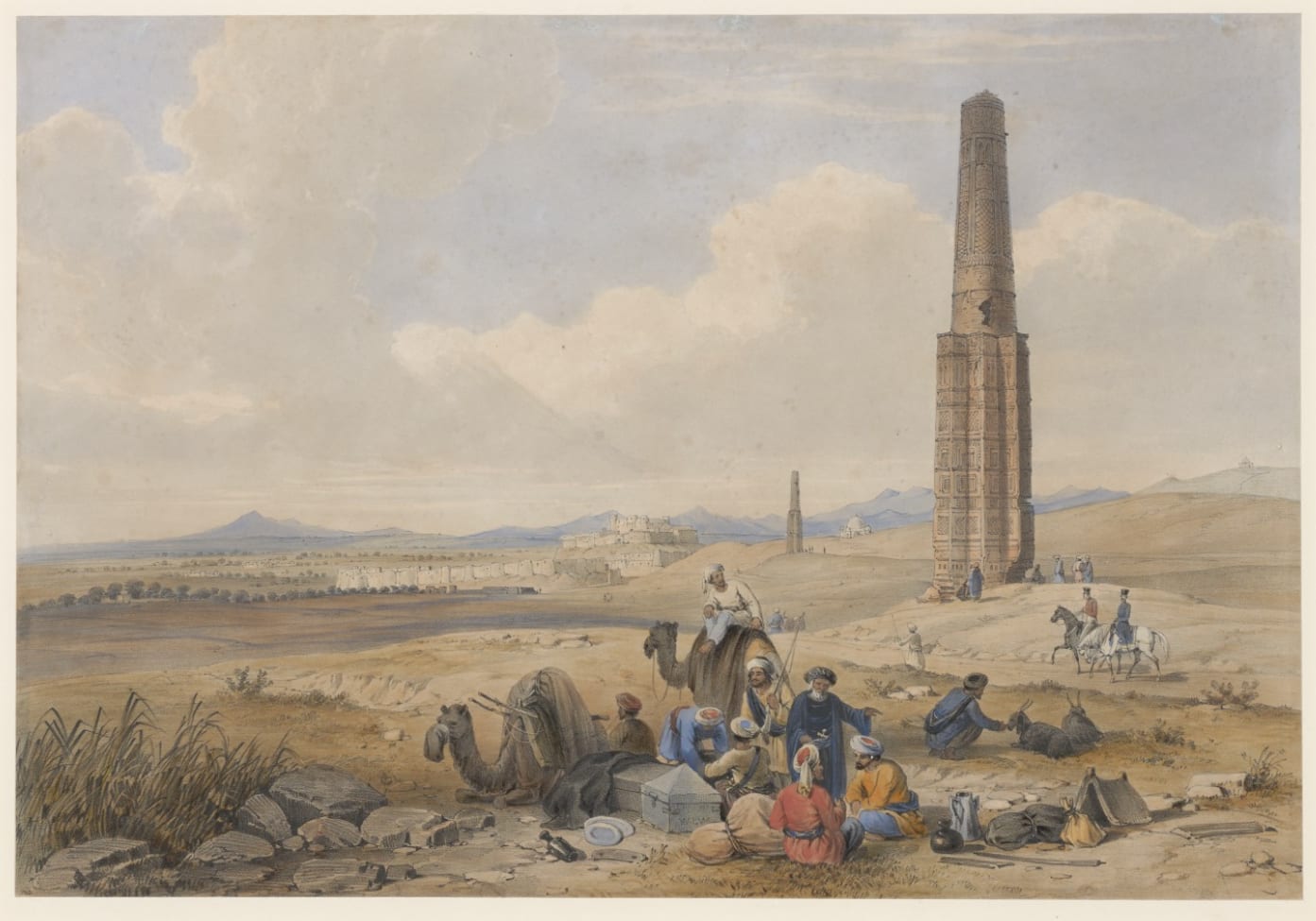
The first of these was the Ghaznavid empire. From their capital at Ghazni, south of Kabul, Sultan Mahmud (ruled 998–1030) launched some seventeen campaigns into northern India, returning each time with plunder that he used to make Ghazni a showcase of Persian art and letters. A century later the Ghaznavids were overthrown by the Ghurids, a dynasty from the remote central highlands of Ghor. The Ghurids burned Ghazni, campaigned successfully in India — their commander there founded what became the Delhi Sultanate — and left behind the Minaret of Jam, a 65-metre brick tower covered in Kufic inscription, standing alone in a gorge where their summer capital once stood.
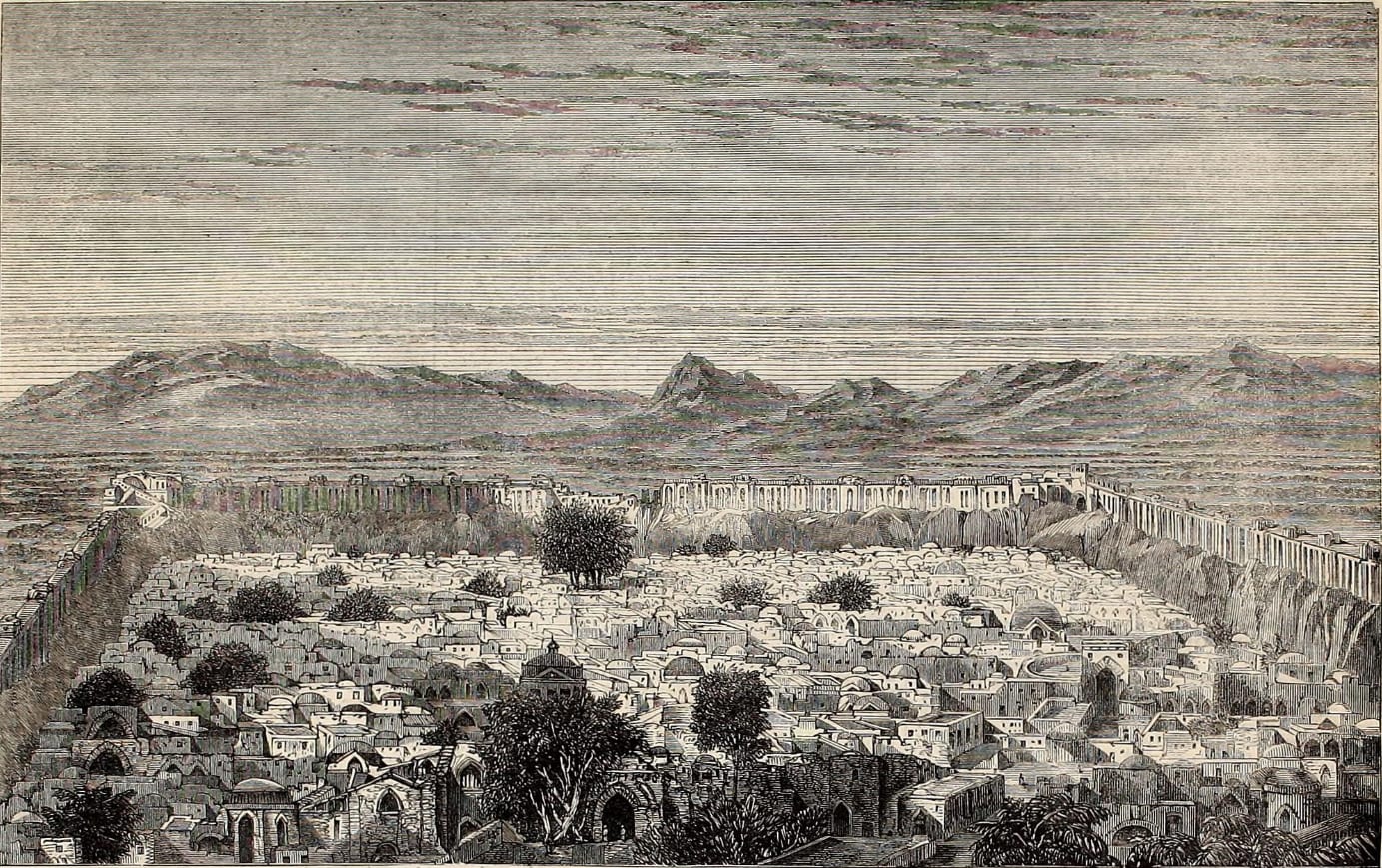
Herat, on the western route into Persia, was fought over by every one of these dynasties. Its citadel sits on foundations that reportedly go back to Alexander, and the city's real golden age was still to come.
The Mongols, the Timurids, and Herat's golden age
In 1221 the Mongol armies of Genghis Khan swept through. Herat, Balkh, and the fortified town below the Bamiyan cliffs were destroyed and their populations massacred; the Bamiyan ruin is still called Shahr-e Gholghola, the City of Screams. Recovery took generations.
The rebound, when it came, was spectacular. Timur — Tamerlane — made the region part of a new empire in the late fourteenth century, and his son Shah Rukh moved the capital to Herat. For most of the fifteenth century Herat was arguably the most cultured city in the Islamic world: the painter Bihzad worked there, the poet Jami lived there, and Shah Rukh's wife Gawhar Shad endowed a vast complex of mosque, madrasa, and minarets. A handful of those minarets still stand, leaning, on the edge of the modern city — most of the complex was deliberately demolished in 1885 to deny cover to a Russian army that never came.
The making of a state
Modern Afghanistan is usually dated to 1747. In that year, after the assassination of the Persian conqueror Nader Shah, a council of Pashtun tribal leaders met at Kandahar and chose one of their own, Ahmad Shah Durrani, as king. His Durrani Empire briefly stretched from eastern Iran across present-day Pakistan into Kashmir and Delhi, making it for a moment one of the largest states in the Muslim world. It shrank quickly after his death, but the kingdom itself held, passing in the 1820s to a related line, the Barakzai, who would rule until 1973.
The Great Game and the Durand Line
In the nineteenth century Afghanistan became a chessboard for two empires that barely touched it directly. Britain, ruling India, feared Russian expansion toward the subcontinent; Russia was indeed expanding south across Central Asia; and Afghanistan lay between them. The result was the "Great Game" — decades of espionage, subsidy, and occasional invasion.
The invasions went badly for Britain. In the First Anglo-Afghan War the British installed a puppet king in Kabul in 1839, then watched their position collapse; in January 1842 a retreating column of some 16,000 soldiers and camp followers was destroyed in the passes east of the city, with only a handful surviving. A second war, in 1878–80, ended with Britain controlling Afghan foreign policy and the ruler Abdur Rahman Khan — the "Iron Amir" — using a British subsidy to crush internal rivals and build a centralised state for the first time. It was Abdur Rahman who, in 1893, agreed to the Durand Line: a border with British India drawn straight through Pashtun and Baloch territory. No Afghan government has ever formally accepted it as the permanent frontier with Pakistan, and it remains a live dispute. A brief third war in 1919 finally returned control of foreign affairs to Kabul, and Afghanistan marks its independence from that year.
Monarchy, coup, and forty years of war
The new king, Amanullah, pushed hard and fast at reform — schools, unveiling, an end to slavery — and was overthrown by a rural revolt in 1929. Order was restored under Nadir Shah and then his son Zahir Shah, whose forty-year reign (1933–1973) was the longest stretch of peace the country would see. A 1964 constitution opened a cautious experiment with elected politics.
It ended in 1973, when Zahir Shah's cousin Daoud Khan seized power and declared a republic. Five years later, communist officers overthrew and killed Daoud in the Saur Revolution of 1978. Their government's reforms and repression triggered uprisings across the country, and in December 1979 the Soviet Union invaded to prop it up. The war that followed lasted a decade, killed perhaps a million Afghans, and drove five to six million more into Pakistan and Iran as refugees, while the mujahideen resistance drew money and weapons from the United States, Saudi Arabia, and Pakistan.
The Soviets left in 1989; the communist government fell in 1992; and the victorious factions promptly turned on each other, shelling Kabul to rubble. Out of that chaos the Taliban emerged near Kandahar in 1994, took the capital in 1996, and imposed a harsh religious order while a northern alliance held out in the mountains. After the attacks of 11 September 2001, a US-led invasion drove the Taliban from power within weeks. The two decades that followed brought a new constitution, elections, and enormous outside spending, alongside a grinding insurgency that never stopped. When American and NATO forces withdrew in 2021, the Republic collapsed in days, and on 15 August 2021 the Taliban returned to Kabul.
What the crossroads leaves behind
The throughline of Afghan history is movement. This is a country that was made by what passed through it — Persian administration, Greek city planning, Buddhist art, Islamic scholarship, Turkic and Mongol conquest, Pashtun tribal law — and that absorbed all of it without ever being fully absorbed by anyone. The empty niches at Bamiyan, where the Buddhas stood for fourteen centuries, are as good an emblem as any: a mark left by one of the many worlds that met here, and then moved on.