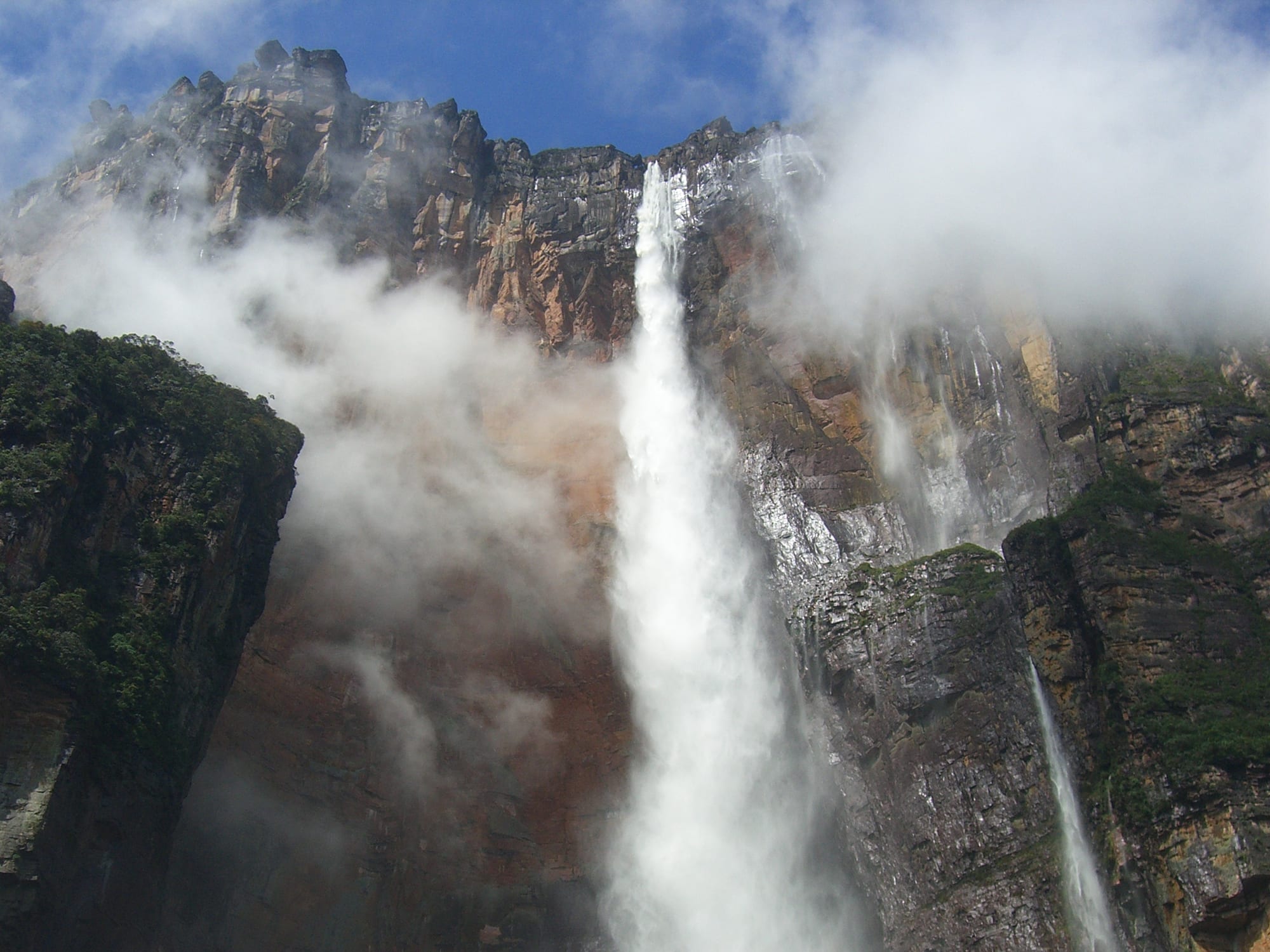
A thin ribbon of waterfall plunging from the top of a sheer, flat-topped jungle mountain into cloud and forest below

Venezuela

Angel Falls (Salto Ángel) dropping from the Auyán-tepui in Canaima National Park — at 979 metres, the world's highest uninterrupted waterfall. (Diego Delso / Wikimedia Commons · CC BY 3.0)

An oil-rich country on the Caribbean coast of South America, holding the world's largest proven petroleum reserves — the birthplace of Simón Bolívar, transformed by Hugo Chávez's "Bolivarian Revolution", and since the mid-2010s in economic collapse that has driven nearly eight million people to leave. Most governments advise against most or all travel.

Explore Venezuela

History

The coast and interior were home to Carib, Arawak, and other peoples when Columbus reached the mainland here in 1498; the name "Venezuela" — "little Venice" — is usually traced to stilt villages seen on Lake Maracaibo. Spain ruled the region from Caracas, and it became the launchpad of South American independence: Simón Bolívar, born in Caracas, led the wars that freed Venezuela, Colombia, Ecuador, Panama, Peru, and Bolivia, briefly uniting several as Gran Colombia before it broke apart in 1830.

The nineteenth century was dominated by caudillos (strongmen). Oil, found in commercial quantities around Lake Maracaibo in the 1910s, made Venezuela one of the world's top exporters and, for decades, the richest country in Latin America, though the wealth was unevenly shared. A stable two-party democracy from 1958 frayed amid corruption and the 1980s debt crisis, and the 1989 Caracazo riots, put down with hundreds of deaths, marked a turning point.

Hugo Chávez, a former coup leader, won the presidency in 1998 and launched the "Bolivarian Revolution" — a self-described socialism funded by high oil prices, with wide social programmes, growing state control, and sharp polarisation. After his death in 2013, Nicolás Maduro took over as oil prices fell, and the economy collapsed: hyperinflation, a contraction of around three-quarters of GDP, shortages of food and medicine, and the flight of nearly eight million people, one of the largest displacement crises in the world. The 2024 presidential election was claimed by Maduro but widely regarded, including on the basis of published tally sheets, as won by the opposition; a crackdown followed. Venezuela has also revived its long-standing claim to the Essequibo region of neighbouring Guyana, raising regional tensions.

  • Venezuela: The Oil State That Broke Down The birthplace of Simón Bolívar and, for most of the 20th century, one of Latin America's richest and steadiest democracies — undone by dependence on a single commodity, and since 2013 the scene of an economic collapse and a mass exodus with few peacetime parallels

Culture & Customs

Venezuelan culture is Caribbean and llanero (plains) as much as Andean, warm, loud, and music-filled. Joropo, the harp-and-cuatro music of the plains, and gaita at Christmas are the folk sounds, and the country has produced global figures in music (the youth-orchestra movement El Sistema, the conductor Gustavo Dudamel) and, above all, in beauty pageants and baseball, which is the national sport far more than football.

Family is central, Catholicism is the majority faith (blended with popular devotions such as the cult of María Lionza), and hospitality is generous even amid scarcity. The diaspora has spread Venezuelan food, music, and the arepa across the Americas and Europe, and the crisis has made emigration and the support of relatives abroad part of almost every family's story.

Regional identities are strong — the Andean states, the plains, the oil-and-lake world of Zulia (whose people, maracuchos, have their own accent and pride), and the Caribbean coast — as is a shared, contested reverence for Bolívar, whose image and words are invoked across the political divide.

Daily Life

Around 28 million people remain in Venezuela, down from a peak as emigration continues. Most live in the northern coastal and Andean band, with Caracas — a valley city hemmed by mountains and ringed by hillside barrios — the largest by far, followed by Maracaibo, Valencia, and Barquisimeto.

Daily life is organised around scarcity and improvisation: queues and shortages, rolling blackouts and water rationing (worst in Zulia), a minimum wage worth only a few dollars a month, and reliance on dollar remittances, informal work, and government food boxes. The oil industry, the state's lifeblood, has seen production fall sharply through underinvestment, mismanagement, and sanctions, though it has partly recovered.

For those who stay, resilience, black humour, family networks, and the hope of political change coexist with the daily grind of getting by.

Food

The staple is the arepa, a split disc of griddled maize dough stuffed with cheese, shredded beef, black beans, avocado, or ham — eaten at any meal and a symbol of the country abroad. The national dish is pabellón criollo: shredded beef, black beans, white rice, and fried plantain on one plate.

Hallacas — a cornmeal parcel of stewed meat, olives, raisins, and capers wrapped in plantain leaf — are the labour-intensive centrepiece of Christmas. Cachapa (a sweet fresh-corn pancake with cheese), tequeños (fried cheese sticks), empanadas, and cachitos (ham croissants) are everyday favourites, and the pan de jamón is another festive bread.

Strong black coffee (a guayoyo or a marrón) is drunk throughout the day. Venezuela produces some of the world's finest cacao and, historically, excellent rum; chicha, papelón con limón (raw-sugar lemonade), and malta are the common non-alcoholic drinks.

Attractions & Natural Wonders

Venezuela's landscapes are spectacular but, at present, mostly reached only on organised trips. Canaima National Park, a UNESCO World Heritage Site in the southeast, is a plateau of tepuis — sheer-sided table mountains — from one of which, the Auyán-tepui, Angel Falls drops nearly a kilometre, the highest waterfall on Earth. Mount Roraima, on the triple border with Guyana and Brazil, is the most famous tepui to climb.

The Caribbean coast has the coral archipelago of Los Roques, a national park of white sand and turquoise lagoons, along with Morrocoy and the Península de Paria. The Andes around Mérida rise to Pico Bolívar and are served by the world's highest and longest cable-car system, and the llanos — the vast seasonal wetlands of the interior — are among the best places in South America to see capybara, caiman, anacondas, and abundant birds.

Other natural marvels include the near-permanent lightning storms over the mouth of the Catatumbo River on Lake Maracaibo, the coastal desert and shifting dunes of the Médanos de Coro, and the Orinoco Delta with its Warao stilt communities. The colonial towns of Coro (also UNESCO-listed) and Ciudad Bolívar hold the human history.

  • Venezuela: Seven Attractions and Natural Wonders The tallest uninterrupted waterfall on earth, a flat-topped tabletop mountain so ancient it inspired the setting of a Conan Doyle novel, and a Caribbean archipelago of nearly 300 uninhabited coral islets

Planning basics

Budget

Venezuela's economy is so distorted that meaningful budget figures are hard to give. For visitors carrying US dollars in cash, many things are cheap; but fuel shortages, unreliable power and water, scarce flights, and the need to use trusted local operators make organised trips (typically to Canaima or Los Roques) the practical and safer option, and those are not cheap.

Daily Budget Note
Independent budget travel is not advisable; organised trips to Canaima or Los Roques run to several hundred US dollars a day

Do not plan independent travel in the current climate; if you go, use an established operator and bring all the US dollars cash you will need.

Visa Requirements

Citizens of the EU, UK, and many other countries do not need a visa for tourist stays of up to 90 days; US citizens require a visa, and consular services are disrupted by the breakdown in relations. Entry and exit rules can change at short notice.

Typical Stay
Up to 90 days visa-free for many European passports; visa required for US citizens

Confirm the current position with a Venezuelan consulate shortly before travel, and check your government's travel advice.

Safety

Most governments advise against all or all-but-essential travel. Violent crime, including armed robbery, kidnapping, and carjacking, is high, especially in Caracas and other cities; arbitrary detention of foreigners has occurred; the borders with Colombia and Brazil and the disputed Essequibo region are dangerous; and shortages of fuel, power, water, food, and medicine are widespread. Political unrest and a heavy security-force presence followed the disputed 2024 election.

Health
Malaria (notably in mining areas of the south), dengue, and measles circulate; hospitals lack supplies; there is no reliable emergency care or evacuation

Follow your government's travel advice; if you travel, go only with a reputable operator on a fixed itinerary, avoid all demonstrations, and never photograph security forces or installations.

Climate

Tropical, varying with altitude. The coast and llanos (plains) are hot year-round; the Andes around Mérida are cool to cold; and the Guayana highlands are humid. There is a dry season roughly December to April and a wet season May to November; Angel Falls is fullest in the wet season but access is easier when rivers are navigable.

Dry Season
December–April
Wet Season
May–November

Transportation

Maiquetía (Caracas) is the main airport, with a reduced network of international flights because of sanctions and airline withdrawals. Domestic aviation has shrunk and is unreliable, and fuel shortages disrupt road and air travel. Canaima and Los Roques are reached by small chartered aircraft as part of tours; independent overland travel is not advised.

Treat all transport as subject to fuel shortages and cancellations; internal trips to the parks are effectively fly-in only, via operators.

Best Time to Visit

December to April, the dry season, is generally the most reliable time for the coast, the tepuis, and Los Roques. Angel Falls carries far more water in the June–November wet season, when boat access up the rivers is possible but cloud often hides the top. Security conditions matter more than the season.

Events
Carnival (Feb/Mar); Holy Week; the Dancing Devils of Yare (Corpus Christi); the Feast of the Divina Pastora in Barquisimeto (January); Christmas gaita music season

Currency

The currency is the bolívar, which has been through repeated redenominations and bouts of hyperinflation and is largely shunned for savings. The economy is heavily dollarised in practice; US dollars in cash are essential, card and ATM access for foreigners barely functions, and international sanctions complicate banking.

Symbol
Bs.
Currency Code
VES — bolívar (US dollars used in practice)

Language

Spanish is the official language, spoken in a Caribbean variety. More than 30 indigenous languages are also official within their communities, spoken mainly in the Amazonas, Delta Amacuro, and Zulia regions. English is limited outside tourism and business.

Also Official
Indigenous languages within their territories
Official Language
Spanish