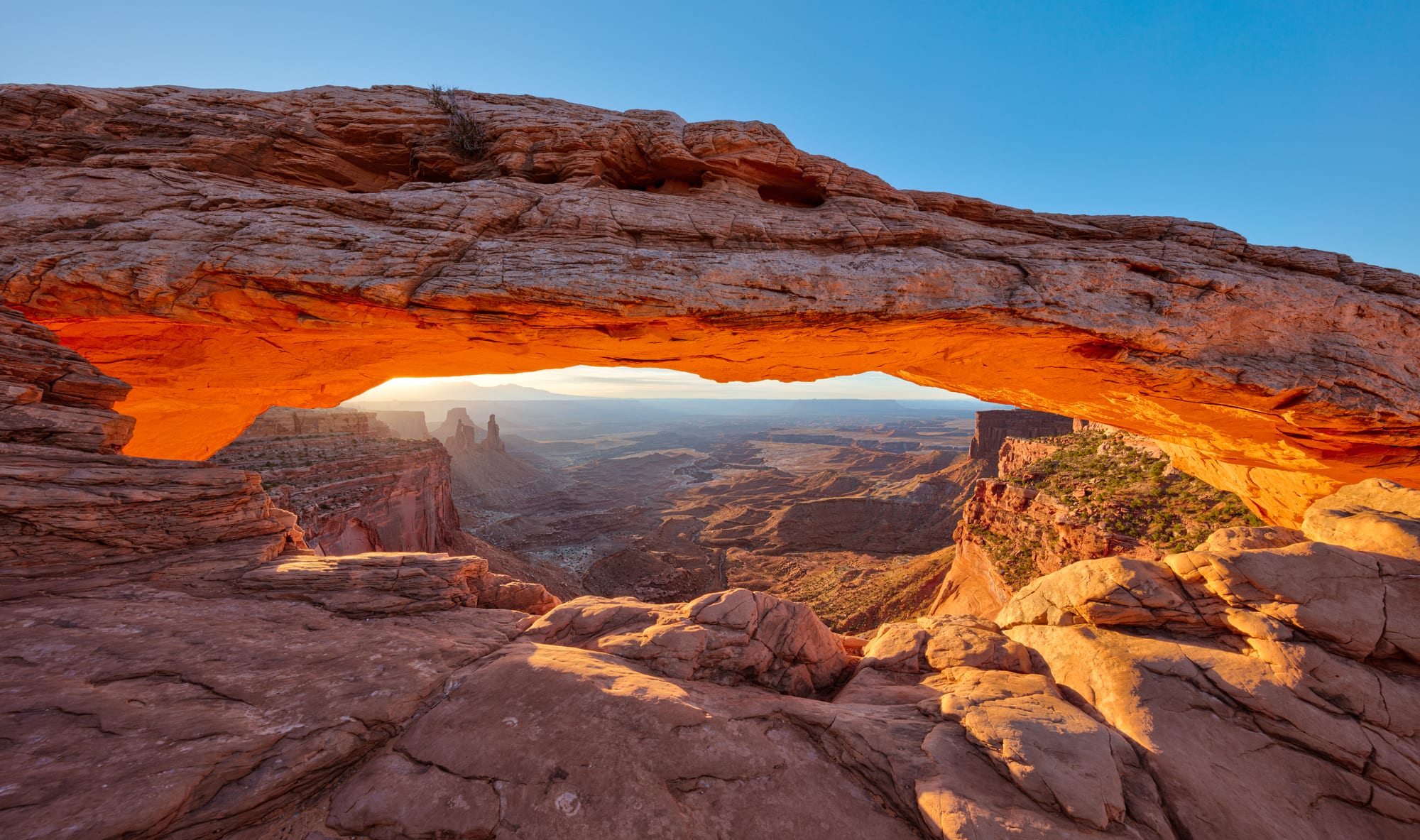
A low sandstone arch glowing fiery orange on its underside at sunrise, framing a vast desert canyon of buttes and spires under a clear blue sky

United States

Sunrise at Mesa Arch in Canyonlands National Park, Utah, with the canyon country spread out below the arch. (Thomas Wolf, www.foto-tw.de / Wikimedia Commons · CC BY-SA 3.0)

A federal republic of fifty states spanning a continent — the world's largest economy and a military and cultural superpower, built by Indigenous nations, colonisation, slavery, and waves of immigration, and defined by the wide autonomy of its states.

Explore United States

History

The land was home to hundreds of Indigenous nations for millennia before European contact. Spanish, French, Dutch, and English colonisation began in the sixteenth and seventeenth centuries; thirteen British colonies along the Atlantic seaboard declared independence in 1776, won it by 1783, and adopted the Constitution in 1787. The new republic expanded rapidly west across the continent through purchase, war, and treaty, displacing Native Americans in the process.

Slavery, concentrated in the plantation South, was the central unresolved contradiction. It brought on the Civil War of 1861–65, the deadliest conflict in US history, which preserved the Union and ended slavery — but Reconstruction gave way to the Jim Crow system of racial segregation and disenfranchisement in the South that lasted into the 1960s. Industrialisation and huge waves of immigration, mostly from Europe, transformed the country between the Civil War and the First World War.

The twentieth century saw the US emerge from the two world wars as the leading Western power, contend with the Great Depression and the New Deal, wage the Cold War against the Soviet Union, and go through the Civil Rights Movement that dismantled legal segregation. Recent decades have brought the end of the Cold War, the 9/11 attacks in 2001 and the wars that followed, the 2008 financial crisis, the election of Barack Obama as the first Black president in 2008, and a period of deep political polarisation spanning the two presidencies of Donald Trump and that of Joe Biden.

  • United States: The Republic That Spread Across a Continent Thirteen rebel colonies that became a federal republic, expanded across a continent already inhabited, split apart over slavery and reunited by war, and rose in the 20th century to be the world's dominant economic and military power

Culture & Customs

The US is less a single culture than a federation of regional and communal ones — New England, the South, the Midwest, Texas, the Southwest, the Pacific Northwest, California — plus the distinct worlds of its big cities and its rural areas. Federalism means that laws on guns, abortion, cannabis, taxes, alcohol, and much else differ significantly from state to state, and Americans are used to those differences.

Common threads are often described as an emphasis on individualism, mobility, optimism, informality, entrepreneurialism, and patriotism, alongside a strong (if declining) religiosity and a deep, unresolved reckoning with race. Social etiquette tends to be friendly and direct; small talk with strangers is normal; and tipping is a genuine part of many workers' income rather than an optional extra.

Sport (American football, baseball, basketball), Hollywood and streaming television, and popular music from jazz and blues to hip-hop and country are central to national life and are among the country's largest cultural exports. Immigration continues to reshape the culture, and roughly one in seven residents was born abroad.

Daily Life

About 335 million people live in the United States, the third most populous country, spread very unevenly — dense on the coasts and around the Great Lakes, sparse across the interior West. Most people live in suburban areas and drive for almost everything; only a few cities have transit systems that make car-free life practical.

The economy is the world's largest, led by technology, finance, healthcare, energy, entertainment, and agriculture, with high average incomes but also high inequality and no universal healthcare — medical costs are a leading cause of personal bankruptcy. Work culture features relatively few holidays and no statutory paid vacation, though norms vary by employer and sector.

Daily life is shaped by the car, the strip mall and big-box store, the neighbourhood and its school district, and, for many, church, youth sports, and the seasonal calendar of holidays from the Fourth of July to Thanksgiving.

Food

American food is regional and immigrant-driven. Barbecue alone splits into Texas brisket, Carolina pulled pork, Kansas City ribs, and Memphis styles; the South adds fried chicken, biscuits and gravy, grits, gumbo, and jambalaya; New England has clam chowder, lobster rolls, and the clam bake; the Southwest and California have Tex-Mex, Cal-Mex, and farm-to-table cooking.

City food cultures are strong: New York pizza, bagels, and delis; Chicago deep dish and the Italian beef; the Philly cheesesteak; New Orleans Creole and Cajun. Diners, food trucks, and the drive-through are institutions, portions are large, and the hamburger, the hot dog, and apple pie are the national shorthand. Every sizeable city has deep Chinese, Mexican, Vietnamese, Indian, Ethiopian, Korean, and other communities with the restaurants to match.

Craft beer is now everywhere after a decades-long boom, American wine (California, Oregon, Washington, New York) is world-class, bourbon and rye whiskey are the native spirits, and coffee culture runs from the bottomless diner cup to third-wave roasters.

Attractions & Natural Wonders

The national parks are the country's greatest travel asset: the Grand Canyon, Yellowstone with its geysers and wildlife, Yosemite, Zion, Grand Teton, Glacier, Rocky Mountain, Great Smoky Mountains (the most visited), Acadia, the Everglades, and the desert parks of Utah and California, linked by classic road trips.

The cities each offer something distinct: New York's skyline, museums, and neighbourhoods; Washington's monuments and free Smithsonian museums; New Orleans's music and food; Chicago's architecture and lakefront; San Francisco's bay and the Pacific Coast Highway south to Big Sur; Los Angeles and Hollywood; Las Vegas; and the historic cities of the Northeast and the South.

Beyond them: the Southwest's Monument Valley, Sedona, and Santa Fe; the Civil Rights trail through Alabama, Georgia, and Tennessee; New England's autumn foliage; the Pacific Northwest's volcanoes and coastline; the Florida Keys and theme parks; and the very different worlds of Hawaii's volcanic islands and Alaska's glaciers, fjords, and wildlife.

  • United States: Ten Attractions and Natural Wonders A canyon so vast it holds nearly two billion years of exposed geological history, a geyser that erupts on a schedule reliable enough to set a watch by, and lava still actively adding new land to an island chain

Planning basics

Budget

The US is expensive and getting more so, with wide regional variation. Big coastal cities and popular national-park gateways are dear; the interior, the South, and smaller cities are cheaper. Sales tax is added at the register, and tipping of roughly 18–22 per cent in restaurants and for many services is expected on top of listed prices.

Daily Budget Midrange
USD 220–450 (mid-range hotel, restaurants with tips and tax, rental car and fuel, paid attractions)
Daily Budget Shoestring
USD 90–160 (hostel or motel, self-catering and diners, intercity bus or shared car, national-park camping)

Budget for tax and tips on top of prices, get the America the Beautiful annual pass if visiting several national parks, and expect to need a rental car outside the big cities.

Visa Requirements

Citizens of the roughly 40 Visa Waiver Program countries (most of the EU, the UK, Australia, Japan, and others) can visit for up to 90 days for tourism on an approved ESTA, applied for online before travel. Everyone else needs a B-2 visitor visa, which can involve a consular interview and long waits. Canadians generally need neither.

Typical Stay
Up to 90 days on ESTA (Visa Waiver Program); otherwise a B-2 visa

Apply for the ESTA online at least 72 hours before travel through the official government site; carry proof of onward travel and accommodation.

Safety

For most visitors the US is safe, with the main risks being petty theft and car break-ins in tourist areas of some cities, road accidents over long distances, extreme weather, and the hazards of the outdoors. Violent-crime rates vary enormously by neighbourhood and city and are far higher than in most peer countries, and the US has by far the most guns and gun deaths in the developed world, though tourists are very rarely involved. Healthcare is excellent but extremely expensive without insurance.

Health
Tap water is safe in cities; medical care costs are very high — comprehensive travel insurance is essential; heat, altitude, and wildlife are real risks in the parks

Take out full medical travel insurance, don't leave valuables visible in parked cars, check weather and park-service alerts before hikes, and be aware that laws (including on cannabis, alcohol, and firearms) differ sharply from state to state.

Climate

Nearly every climate exists somewhere: humid subtropical in the Southeast, arid desert in the Southwest, Mediterranean in coastal California, continental across the Midwest and Northeast, subarctic and arctic in Alaska, and tropical in Hawaii and south Florida. Hurricane season on the Gulf and Atlantic coasts runs June to November; tornadoes strike the central plains mainly in spring.

Range
From desert to arctic to tropical, by region
Hazard Seasons
Atlantic/Gulf hurricanes Jun–Nov; Plains tornadoes spring; Western wildfires summer–autumn

Transportation

A vast country built around the car and the plane. Domestic flights are the practical way to cover long distances, and a rental car is essential for most road trips and national parks. Passenger rail (Amtrak) is limited and slow outside the Northeast Corridor; intercity buses (Greyhound, FlixBus) are cheap but slow. Only a handful of cities — New York above all — have transit good enough to manage without a car.

Plan around flying between regions and driving within them; in New York, Chicago, Boston, San Francisco, and Washington you can rely on public transport.

Best Time to Visit

Depends entirely on the region. Late spring and early autumn are good almost everywhere; summer is peak for national parks and the north but hot and crowded; New England's autumn foliage peaks in October; the Southwest and Florida are best in winter; ski season runs roughly December to March.

Events
Independence Day (4 July); Thanksgiving (fourth Thursday in November); Mardi Gras in New Orleans (Feb/Mar); SXSW in Austin (March); college and pro sports seasons; regional state fairs

Currency

The currency is the US dollar. Cards and mobile payment are accepted almost everywhere and often preferred; some places no longer take cash. Keep small bills for tipping housekeeping, valets, and drivers.

Symbol
$
Currency Code
USD — United States dollar

Language

English is the common language and, since a 2025 executive order, the official language at federal level. There is no nationwide second language, but Spanish is very widely spoken, especially in the Southwest, Florida, and large cities, and hundreds of other languages are used by immigrant and Indigenous communities.

Also Widespread
Spanish
Common Language
English (official at the federal level since 2025)