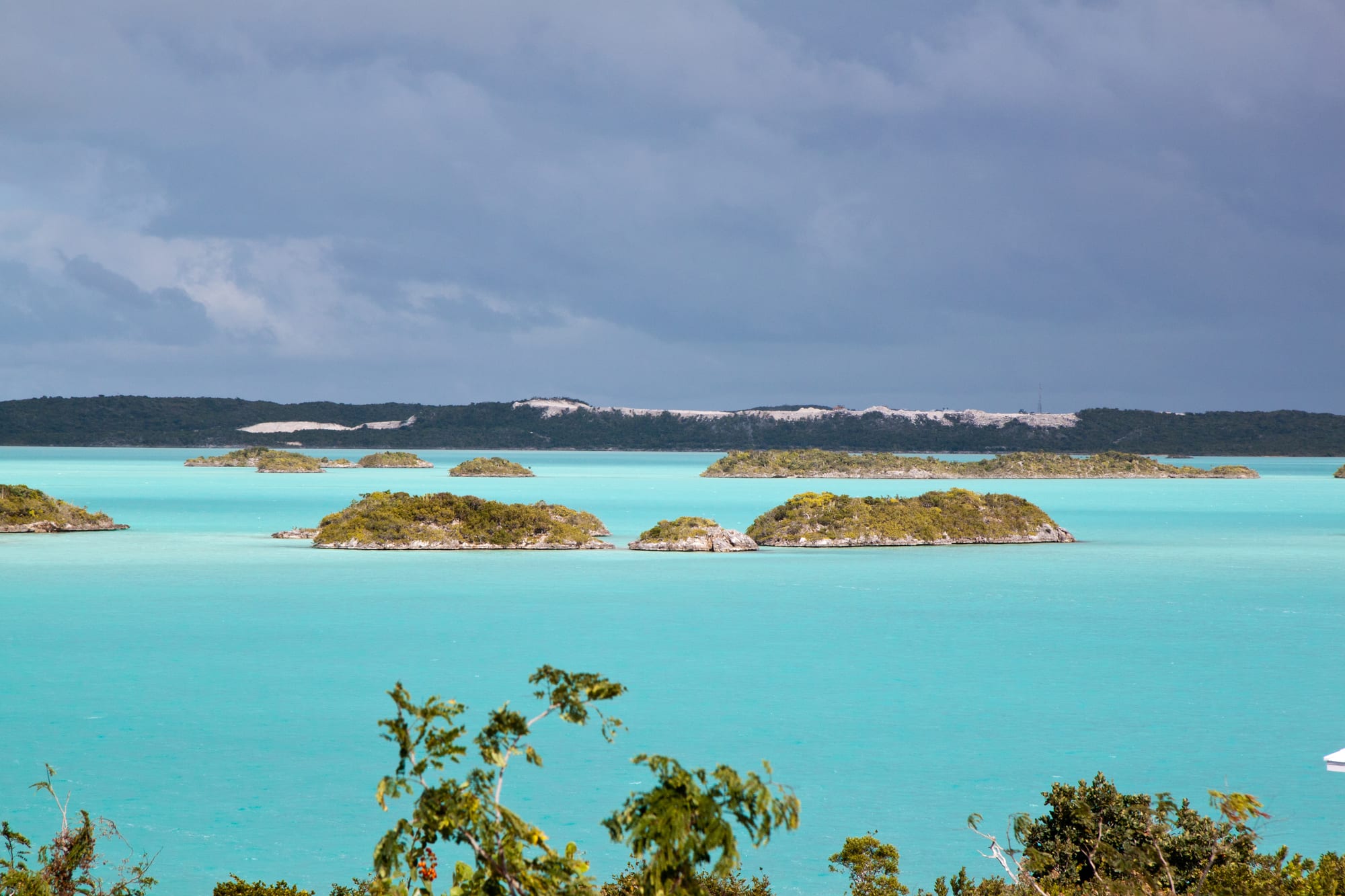
A lagoon of vivid, uniform turquoise water dotted with small, low, scrub-covered rocky islets, under a dark storm-grey sky

Turks and Caicos Islands

Chalk Sound on Providenciales, a lagoon of bright turquoise water scattered with small rocky cays. (Tim Sackton / Wikimedia Commons · CC BY-SA 2.0)

Two low limestone island groups at the southeastern end of the Bahamas chain, a British Overseas Territory — built on salt, then long neglected, and since the 1980s transformed by luxury beach tourism centred on Providenciales and the twelve-mile Grace Bay.

Explore Turks and Caicos Islands

History

The islands were home to the Lucayan (Taíno) people until Spanish slave raids emptied them by the 1520s. Bermudian salt rakers settled Grand Turk and Salt Cay from the 1680s, and after the American Revolution Loyalist planters arrived on the Caicos islands with enslaved Africans to grow cotton, then turned to salt. For two centuries "white gold", raked by hand from shallow ponds, was the entire economy.

Administered at different times with the Bahamas and then Jamaica, the Turks and Caicos became a separate British colony in 1962 when Jamaica gained independence. The salt industry collapsed soon after, leaving the islands very poor and dependent on Britain. An airport on Providenciales and the opening of a Club Med in the 1980s began the tourism era that has reshaped the territory.

In 2009 the United Kingdom suspended the elected government over serious corruption and ruled directly until fresh elections in 2012. Hurricanes Irma and Maria caused heavy damage in 2017. Today the economy is high-end tourism and offshore finance, the population is growing fast with workers from Haiti, the Dominican Republic, and the Philippines, and there is no income tax.

  • Turks and Caicos Islands: Salt and Sand A low archipelago at the south-east end of the Bahamas chain — raked for sea salt by Bermudians for two centuries, shuffled between colonial administrations, and now a British territory living on beach tourism and offshore finance

Culture & Customs

Islanders with roots in the territory are known as "Belongers", an English-speaking, Christian people descended from enslaved Africans and the salt-raking communities. Ripsaw music — a rhythm scraped on a carpenter's handsaw — is the national sound, played by string bands at festivals and at the Boxing Day Maskanoo parade. Sloop building and model-sloop racing survive on Middle Caicos, and the queen conch is woven through island identity, celebrated each November at the Conch Festival.

The resident population is small and heavily outnumbered by tourists and by migrant workers, especially the large Haitian community, whose status and periodic immigration crackdowns are a recurring local issue. Society is conservative and church-centred, and the wild donkeys and the endangered rock iguana are unofficial island emblems.

Daily Life

Around 46,000 people live in the Turks and Caicos, most on Providenciales ("Provo"), the tourism and business island; Cockburn Town on Grand Turk is a tiny capital. The economy is overwhelmingly tourism — resorts, private villas, and a cruise pier on Grand Turk — supplemented by offshore financial services.

There is no income tax; the cost of living is very high because nearly everything is imported; and daily life is car-dependent. Provo has grown rapidly and unevenly, with luxury development along Grace Bay and working settlements inland, while the "family islands" — North, Middle, and South Caicos, Salt Cay — remain small, quiet, and slowly emptying.

Food

Conch is the staple and the symbol: cracked (pounded and fried), as fritters, in a chowder, or raw as a lime-marinated "conch salad" made to order at the shacks. Fresh grouper, snapper, and spiny lobster (in season roughly August to March) round out the seafood, and breakfast is often boiled fish with grits or "peas and grits".

Johnnycake and hominy are traditional sides, and the Haitian community has made griot (fried pork) and rice widely available on Provo. Da Conch Shack on Providenciales is the best-known of the roadside spots. Rum and the local Turk's Head beer are the usual drinks.

Attractions & Natural Wonders

Grace Bay Beach on Providenciales is the centrepiece — a long, calm, reef-shielded stretch of white sand regularly rated among the world's best — with the Bight Reef ("Coral Gardens") and Smith's Reef for snorkelling straight off the shore. The turquoise, shallow Chalk Sound, a national park, and the wall dives at West Caicos and Northwest Point are close by.

Grand Turk keeps a small, salt-era capital of Bermudian buildings around Cockburn Town, with the Turks and Caicos National Museum (home to remains of the Molasses Reef wreck), a nineteenth-century lighthouse, and a cruise centre. Middle Caicos has the territory's grandest scenery: the Conch Bar Caves and the cliffs and beach at Mudjin Harbour. North Caicos has flamingo ponds and the ruins of Wade's Green plantation.

The Columbus Passage between the Turks and Caicos banks is a migration route for humpback whales from January to April, watched from Salt Cay and Grand Turk, and Long Bay on Provo is a leading kiteboarding beach.

Planning basics

Budget

One of the Caribbean's most expensive destinations. The Grace Bay resorts and villas are very costly; Providenciales has a handful of guesthouses and mid-range condos, and self-catering plus the roadside conch shacks are the way to keep spending down.

Daily Budget Midrange
USD 400–900 (Grace Bay condo or hotel, restaurants, a reef or whale trip, car hire)
Daily Budget Shoestring
USD 150–280 (guesthouse or budget condo, self-catering and conch shacks, shared car)

Stay in a condo with a kitchen a short walk back from Grace Bay, eat at the conch shacks, and pick one boat trip rather than several.

Visa Requirements

Citizens of the UK, EU, US, Canada, and many other countries enter visa-free for up to 90 days. A passport valid for the stay, an onward or return ticket, and proof of accommodation are expected. An accommodation tax is added to hotel and villa bills.

Typical Stay
Up to 90 days visa-free for most Western passports

Budget for the accommodation tax on top of the room rate.

Safety

Generally safe for visitors. The main issues are petty theft from cars and villas and a rise in gang-related gun violence among residents in parts of Providenciales, away from the resorts, with occasional armed robberies. Strong currents occur at some beaches and on the wall dives, and the islands are in the hurricane belt.

Health
Tap water is desalinated; bottled water is common; the sun is very strong; medical care is limited and serious cases are flown out

Lock valuables away, take normal night-time precautions away from the resort strip, respect current warnings when snorkelling, and check the forecast in hurricane season.

Climate

Tropical and unusually dry and sunny — one of the drier corners of the Caribbean — with temperatures around 27–32°C year-round. The hurricane season runs June to November; Hurricanes Irma and Maria both struck in 2017. December to April is slightly cooler and breezier.

Dry And Sunny
Most of the year
Hurricane Season
June–November

Transportation

Providenciales International Airport is the hub, with direct flights from the US East Coast, Toronto, London, and regional centres. Domestic flights and a ferry (Providenciales to North Caicos) connect the islands, and Grand Turk has its own airport and cruise port. Hire a car on Providenciales; driving is on the left, and taxis are expensive.

Rent a car on Providenciales — the island is spread out and taxis add up fast.

Best Time to Visit

December to April is the dry, calm high season, and also when humpback whales pass through the Columbus Passage off Salt Cay and Grand Turk (roughly January to April). May, June, and November are good-value shoulder months; August to October carries the hurricane risk.

Events
Maskanoo (Junkanoo) street parade on Boxing Day; the Conch Festival on Providenciales (November); the annual Fools Regatta model-sloop races

Currency

The US dollar is the official currency. Cards are accepted everywhere; carry some cash for the conch shacks, taxis, and small shops.

Symbol
$
Currency Code
USD — United States dollar

Language

English is the official and everyday language, in a local creole-influenced form. Haitian Creole and Spanish are widely spoken among the large migrant workforce from Haiti and the Dominican Republic.

Official Language
English