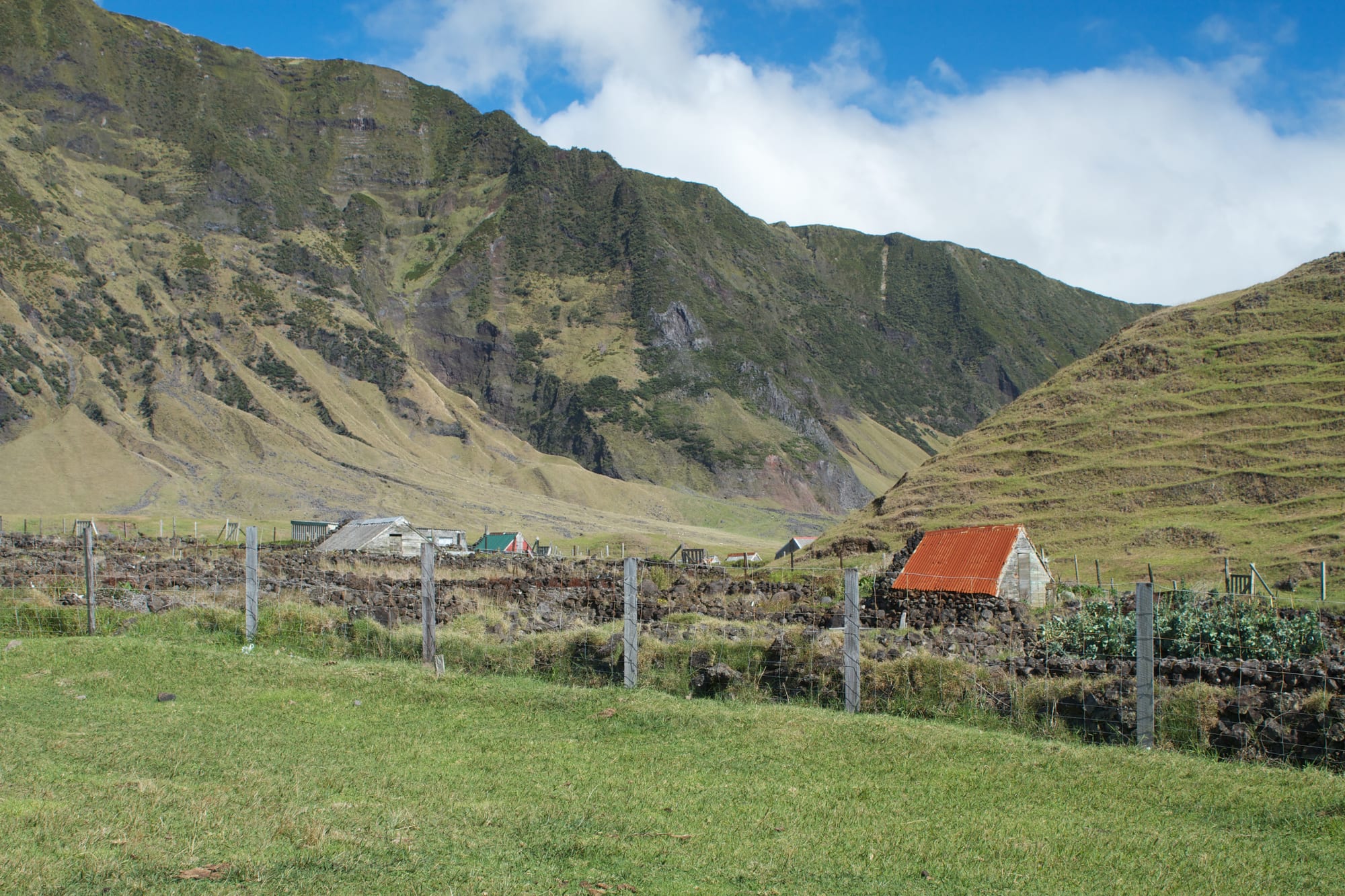
Small stone-walled plots and tiny huts, one with a rust-red roof, on a green plain beneath towering grass-covered volcanic cliffs with cloud spilling over the top

Tristan da Cunha

The Potato Patches on Tristan da Cunha, small walled plots and huts laid out beneath the island's steep green cliffs. (Brian Gratwicke / Wikimedia Commons · CC BY 2.0)

The most remote permanently inhabited place on Earth — a single volcanic island in the far South Atlantic, part of the British Overseas Territory of Saint Helena, Ascension and Tristan da Cunha — home to about 240 people who share seven surnames, farm and fish communally, and can be reached only by a six-day boat trip from Cape Town.

Explore Tristan da Cunha

History

Tristan da Cunha was uninhabited when the Portuguese explorer Tristão da Cunha sighted it in 1506. An American, Jonathan Lambert, tried to settle it in 1810–12, declaring it the "Islands of Refreshment", and died soon after. Britain annexed the island in 1816 — partly to forestall any attempt to use it as a base to rescue Napoleon from Saint Helena — and left a garrison. When the garrison withdrew, Corporal William Glass and a few companions stayed and founded the settlement, later joined by shipwreck survivors, a handful of New England whalers, and women brought from Saint Helena. From them come the island's seven surnames — Glass, Green, Hagan, Lavarello, Repetto, Rogers, and Swain — and a deliberately egalitarian community with land held in common.

In the twentieth century the economy came to rest on the crawfish, or rock lobster, fishery. In October 1961 the volcano erupted right beside the settlement, and the entire population was evacuated to England; after two years, almost everyone chose to return in 1963. A 2001 hurricane and a 2019 storm caused heavy damage. In 2020 Tristan declared a Marine Protection Zone over its waters — at the time the fourth largest in the world.

  • Tristan da Cunha: The Remotest Settlement A single volcanic island in the South Atlantic, 2,400 kilometres from anywhere — garrisoned by Britain to guard against a Napoleonic rescue, settled by a Scottish corporal who stayed, and evacuated whole when the volcano erupted in 1961

Culture & Customs

About 240 people live in the one settlement, Edinburgh of the Seven Seas, known simply as "the Settlement". They speak English in a dialect of their own and are Christian, with one Anglican and one Catholic church. Land is held in common; cattle numbers and the potato "patches" are shared out to keep things even.

The year is structured by communal work: the sheep shearing, the potato planting and lifting, "Ratting Day", and the crawfish season. When the flag flies for a "fishing day", every able adult turns out for the boats. There is one pub, one shop, one school, one doctor, and an Island Council; the ethos is mutual aid, and decisions are made together.

Daily Life

The islanders live by subsistence farming — potatoes above all, grown in the Patches a couple of kilometres from the Settlement, plus cattle and sheep on the common grazing — and by the commercial crawfish fishery, which is exported frozen and provides most of the island's income, supplemented by the sale of famous stamps and coins and by British support.

The harbour at Calshot is small and often unusable in swell, and supplies come by fishing vessel and the occasional research ship from Cape Town, a week away. Power is from a diesel station, with solar being added. Everyone has a job, and most have several.

Food

Potatoes appear at almost every meal — the staple crop, grown in the Patches. Crawfish, fish (bluefish, "five-finger", tuna), and mutton and beef from the common herd fill out the diet, along with "Tristan potato salad", milk tart, and other Saint Helenian and South African bakes. Canned and imported goods from the shop bridge the gap between ships, and the Albatross Bar serves home-brewed and imported drink.

Attractions & Natural Wonders

Getting there is the attraction. The island receives only a few dozen visitors a year, almost all arriving on the fishing and supply vessels from Cape Town or on a rare expedition cruise. On the island, Queen Mary's Peak (2,062 metres) is a hard full-day climb to a crater lake when the weather allows; the 1961 eruption cone sits right at the edge of the Settlement; and the potato Patches, the northern rockhopper penguin and seabird colonies, the small museum, and a thatched "Tristan hut" fill a short list.

Weather permitting, boats go to Nightingale and Inaccessible Islands, a UNESCO World Heritage Site of untouched seabird breeding grounds. There is also a nine-hole golf course, a café, and the pub — a complete inventory of the island's diversions.

Planning basics

Budget

There is no hotel. Visitors stay in islanders' homes or a small guesthouse by prior arrangement, and everything — transport, accommodation, permission — must be organised in advance with the island administration. The cost and difficulty are almost entirely the sea passage.

Daily Budget Note
Set by the boat fare from Cape Town and a modest home-stay rate; there is little else to spend money on

Contact the Tristan da Cunha administration months ahead; nothing about a visit can be arranged on arrival or on spec.

Visa Requirements

You must apply to the Island Council for permission to land, well in advance, and provide proof of comprehensive medical and evacuation insurance, sufficient funds, and confirmed transport both ways. Landing is entirely at the Council's discretion and depends on the sea. There is no casual or independent access.

Typical Stay
Tied to the ship's schedule — often several days, sometimes weeks between sailings

Budget for the real possibility that heavy swell prevents landing at all, even after a six-day voyage.

Safety

Crime is essentially nonexistent. The dangers are the sea and the weather: landings and boat trips are frequently unsafe, Queen Mary's Peak is a serious mountain with rapidly changing conditions, and the coast is rugged with large swells. The island has a small hospital and one resident doctor; a serious emergency means waiting for a ship, as there is no air evacuation — which is why insurance and self-reliance are essential.

Health
No tropical disease risk; the concern is that advanced care is many days away by sea

Carry comprehensive medical and evacuation insurance, follow the islanders' guidance on the Peak and the coast absolutely, and accept that the sea may change your plans.

Climate

Cool, wet, cloudy, and extremely windy oceanic climate. Temperatures are mild and even at roughly 11–20°C, but gales are frequent year-round and the weather changes constantly. Queen Mary's Peak holds snow in winter, from July to September.

Winter
Snow on the Peak, July–September
Year Round
Mild but very windy, 11–20°C

Transportation

There is no airstrip. Access is by sea from Cape Town — about six days each way — on the fishing and supply vessels, which carry a few passengers, or a very occasional expedition cruise. Even then, landing depends entirely on the swell at the tiny Calshot harbour and is often delayed or cancelled. On the island there are a few kilometres of road and a couple of vehicles; everything is within walking distance of the Settlement.

Book a passenger berth on a supply vessel through the administration many months ahead, and keep your onward plans flexible.

Best Time to Visit

The southern summer, roughly November to March, gives the calmest seas and the best chance both of landing and of climbing the Peak. Sailings from Cape Town run only a handful of times a year and must be booked far ahead.

Events
Ratting Day; the annual sheep shearing; the potato planting and lifting at the Patches; Anniversary Day (14 August), marking the 1816 settlement

Currency

The pound sterling, with the Saint Helena pound at par. It is a cash economy — bring sterling, as card facilities are minimal.

Symbol
£
Currency Code
GBP — pound sterling (Saint Helena pound at par)

Language

English, in a distinctive local dialect rooted in nineteenth-century English, Saint Helenian, and other origins.

Language
English (local dialect)