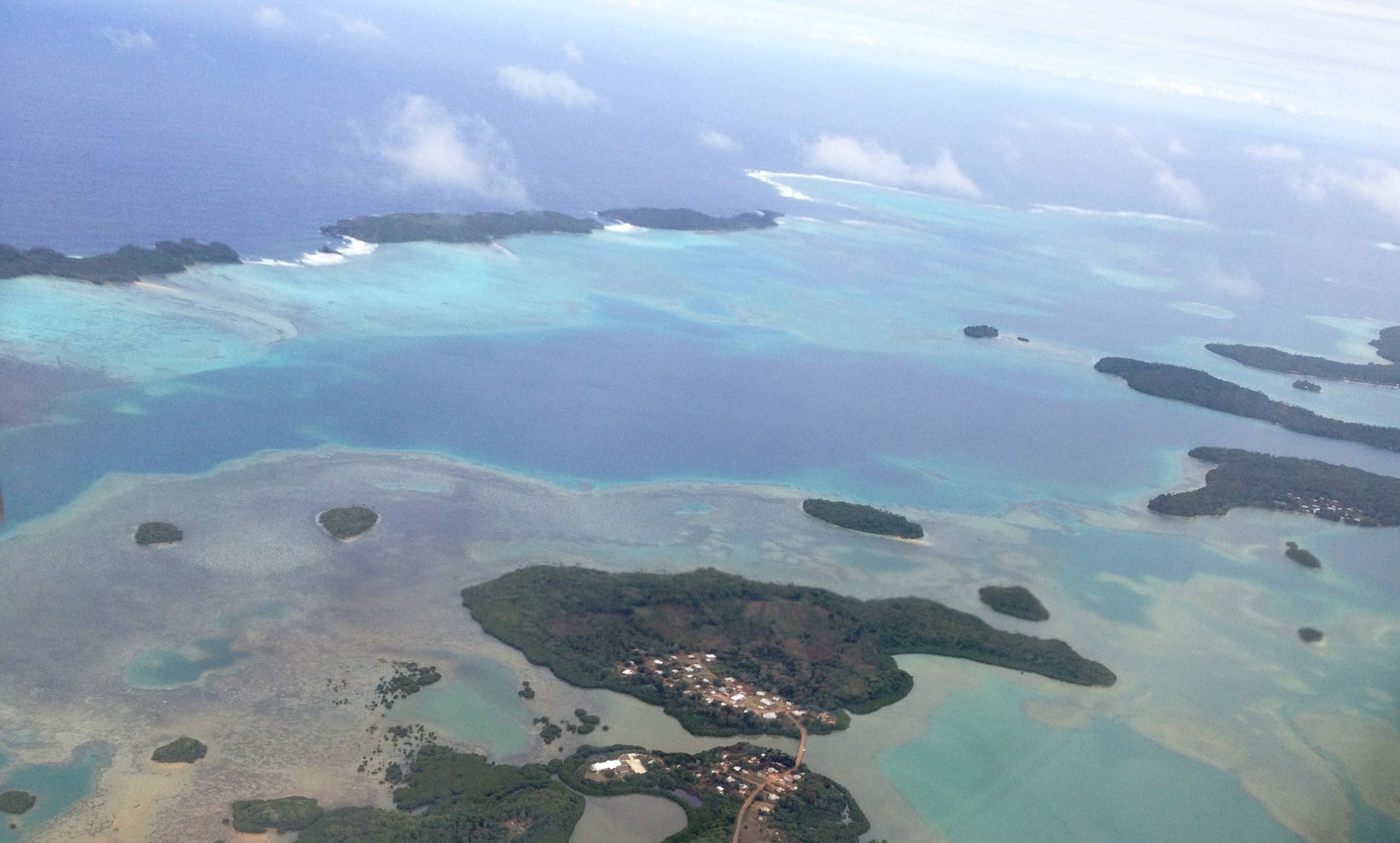
Aerial view of forested islands and reefs scattered across a calm blue sea under a partly clouded sky

Tonga

The islands and reefs of the Vavaʻu group in northern Tonga, a sheltered maze of channels popular with sailors and whale-watchers. (David Broad / Wikimedia Commons · CC BY 3.0)

A Polynesian kingdom of some 170 islands in the South Pacific — the only Pacific nation never formally colonised, still ruled by a monarch, deeply Christian and Sabbatarian, and rebuilding from a massive 2022 volcanic eruption and tsunami.

Explore Tonga

History

Tonga was settled around three thousand years ago by the Lapita people, ancestors of the Polynesians. From roughly the tenth century the Tuʻi Tonga, a sacred paramount line based on Tongatapu, built an influence that reached across much of western Polynesia through tribute, marriage, and voyaging — a maritime "empire" recalled in the great stone tombs (langi) and the trilithon of Haʻamonga ʻa Maui.

European contact came with the Dutch in 1616 and, more consequentially, Captain Cook in the 1770s, who called the group the "Friendly Islands". Civil wars in the late eighteenth and early nineteenth centuries were ended by Tāufaʻāhau, a chief who converted to Wesleyan Christianity, unified the islands by conquest and diplomacy, and in 1845 took the throne as King George Tupou I, giving Tonga a constitution in 1875.

In 1900 Tonga became a British protected state, keeping its monarchy and internal self-government while Britain handled foreign affairs — so it was never a colony — and it regained full independence in 1970. The long reign of Queen Sālote (1918–65) is fondly remembered. Pressure for democratic reform grew in the 2000s, and after riots in 2006 that destroyed much of central Nukuʻalofa, a 2010 reform made most parliamentary seats elected, though nobles retain a bloc of seats and the monarch keeps significant powers. King Tupou VI has reigned since 2012. In January 2022 the eruption of the undersea Hunga Tonga–Hunga Haʻapai volcano triggered a Pacific-wide tsunami, severed the country's internet cable, and coated islands in ash, killing several people and damaging villages.

  • Tonga: The Last Polynesian Kingdom A seafaring empire that once dominated the western Pacific — the only island nation never formally colonised, still ruled by a king, and shifting only recently and reluctantly toward democracy

Culture & Customs

Two institutions define Tonga: the monarchy, with its layered system of king, nobles, and commoners and its elaborate etiquette, and the Christian church, overwhelmingly Methodist and Catholic, which structures the week and the year. The Sabbath is written into the constitution — on Sundays shops, businesses, and most activities close, and even swimming and sport are frowned upon.

Respect (faka'apa'apa) governs behaviour: toward elders, chiefs, and especially the sister-brother relationship, and it is expressed in seating, speech, and the lowering of the body when passing someone of higher rank. The taʻovala, a woven mat worn around the waist over clothing, and the kiekie girdle are formal dress.

Feasting, kava circles, church choirs, brass bands, and dances such as the lakalaka and tau'olunga mark ceremonies. Community and church obligations, and remittances from the large Tongan diaspora in New Zealand, Australia, and the United States, are woven into family finances. Rugby union is a national passion.

Daily Life

About 100,000 people live in Tonga, roughly three-quarters on the main island of Tongatapu around the capital, Nukuʻalofa; more Tongans live overseas than at home. Land is held under a system in which every adult man is entitled to a plot, though population growth has made this hard to honour, and nobles control large estates.

The economy is small and vulnerable: subsistence and semi-commercial farming (yams, taro, cassava, squash for export to Japan, vanilla, kava), fishing, some tourism, and above all remittances and foreign aid, which together dominate national income. Cyclones and the 2022 eruption have repeatedly set back development, and non-communicable disease rates, linked to diet, are among the world's highest.

Daily life is village-centred, church-centred, and relaxed, with a strong ethic of sharing and obligation and a slower pace, particularly on Sundays.

Food

Tongan food is built on root crops and the earth oven (ʻumu): taro, yam, cassava, and sweet potato cooked with meat or fish and lu — taro leaves wrapped around corned beef, chicken, or fish with coconut cream (lu pulu, lu sipi). Suckling pig (puaka) is the centrepiece of a feast, laid out on long low tables (pola).

Fresh fish and shellfish, ʻota ika (raw fish "cooked" in lime and coconut cream), and octopus are coastal staples, and imported mutton flaps, corned beef, and instant noodles have become everyday foods. Tropical fruit — papaya, mango, watermelon, coconut — is abundant.

Kava, made from pounded pepper root and drunk from a communal bowl, is central to male social and ceremonial life, taken in long evening circles. Otherwise the drinks are coconut water, fruit juice, and imported beer.

Attractions & Natural Wonders

Vavaʻu, in the north, is the tourism centre: a sheltered archipelago of forested islands and coral channels that is one of the South Pacific's finest sailing grounds, the base for the country's famous humpback-whale swims between July and October, and a hub for kayaking and diving.

The Haʻapai group is a scatter of low coral islands and long white beaches with simple accommodation and a quiet, end-of-the-line feel. ʻEua, a short flight or ferry from Tongatapu, is unusually rugged, with rainforest, sea cliffs, caves, and hiking in ʻEua National Park.

On the main island of Tongatapu are the ancient royal tombs at Lapaha, the Haʻamonga ʻa Maui stone trilithon, the Mapuʻa ʻa Vaea blowholes where surf forces water high through a rock terrace along the coast, the flying-fox colony at Kolovai, and the Captain Cook landing site, alongside the churches and royal palace of Nukuʻalofa.

  • Tonga: Five Attractions and Natural Wonders One of the only places on earth where travellers can swim alongside humpback whales, an ancient stone trilithon predating Stonehenge-style speculation about its purpose, and coastal blowholes that erupt in long, roaring lines

Planning basics

Budget

Tonga is moderately priced for the Pacific. Nukuʻalofa and Vavaʻu have guesthouses, small hotels, and a few resorts; island "beach fales" are simple and affordable. Domestic flights and boat transfers between island groups are the main cost, and whale-swim tours are a significant outlay.

Daily Budget Midrange
USD 120–260 (small hotel or resort, restaurants, domestic flights, a whale-swim tour)
Daily Budget Shoestring
USD 45–80 (guesthouse or beach fale, market food, local transport)

Book whale-swim operators and inter-island flights well ahead in season, and carry cash outside Nukuʻalofa.

Visa Requirements

Visitors from most countries, including the UK, EU, US, Canada, Australia, and New Zealand, receive a visitor's visa on arrival for 31 days, extendable up to six months. A passport valid for six months, an onward ticket, and proof of funds are required.

Typical Stay
31 days on arrival, extendable to 6 months

Have an onward or return ticket ready to show on arrival.

Safety

Tonga is a safe and welcoming country with low crime, though petty theft occurs and there was serious rioting in Nukuʻalofa in 2006. The greater concerns are natural: cyclones, earthquakes, tsunamis, and volcanic activity — the 2022 Hunga Tonga–Hunga Haʻapai eruption caused a destructive tsunami and blanketed islands in ash — plus strong ocean currents and limited medical facilities.

Health
Dengue occurs; there is no malaria; medical care is basic and serious cases are evacuated to New Zealand or Australia

Follow tsunami and cyclone warnings, respect Sunday closures and dress codes, swim with a guide where currents are strong, and carry evacuation insurance.

Climate

Tropical, cooled by trade winds. The warmer, wetter season runs November to April and includes the cyclone risk; the cooler, drier season, May to October, is the main travel window. The southern islands are a little cooler than the north.

Dry Season
May–October
Wet Season
November–April (cyclone risk)

Transportation

Fuaʻamotu International Airport near Nukuʻalofa has flights from Auckland, Nadi, and Sydney. Domestic flights and ferries connect the main island of Tongatapu with the Haʻapai and Vavaʻu groups and ʻEua; schedules are limited and weather-dependent. On the islands, transport is by minibus, shared taxi, and rented car or bike.

Build slack into island-hopping plans, as domestic flights and ferries are frequently delayed, and note that almost nothing runs on Sundays.

Best Time to Visit

June to October is the dry season and, crucially, the humpback whale season, when the animals come to Tongan waters to breed and calve and can be swum with under licence. This is also the calmest time for sailing in Vavaʻu. Avoid the January–March cyclone peak.

Events
Heilala Festival and the King's birthday (July); whale season (July–October); the Sabbath, observed nationwide every Sunday

Currency

The currency is the paʻanga. It is a cash economy outside the main hotels; ATMs are in Nukuʻalofa and Vavaʻu only. Australian and New Zealand dollars and US dollars can sometimes be used but change is given in paʻanga.

Symbol
T$
Currency Code
TOP — paʻanga

Language

Tongan, a Polynesian language, and English are both official. Tongan is the language of daily life; English is widely spoken and used in business, government, and secondary education.

Official Languages
Tongan and English