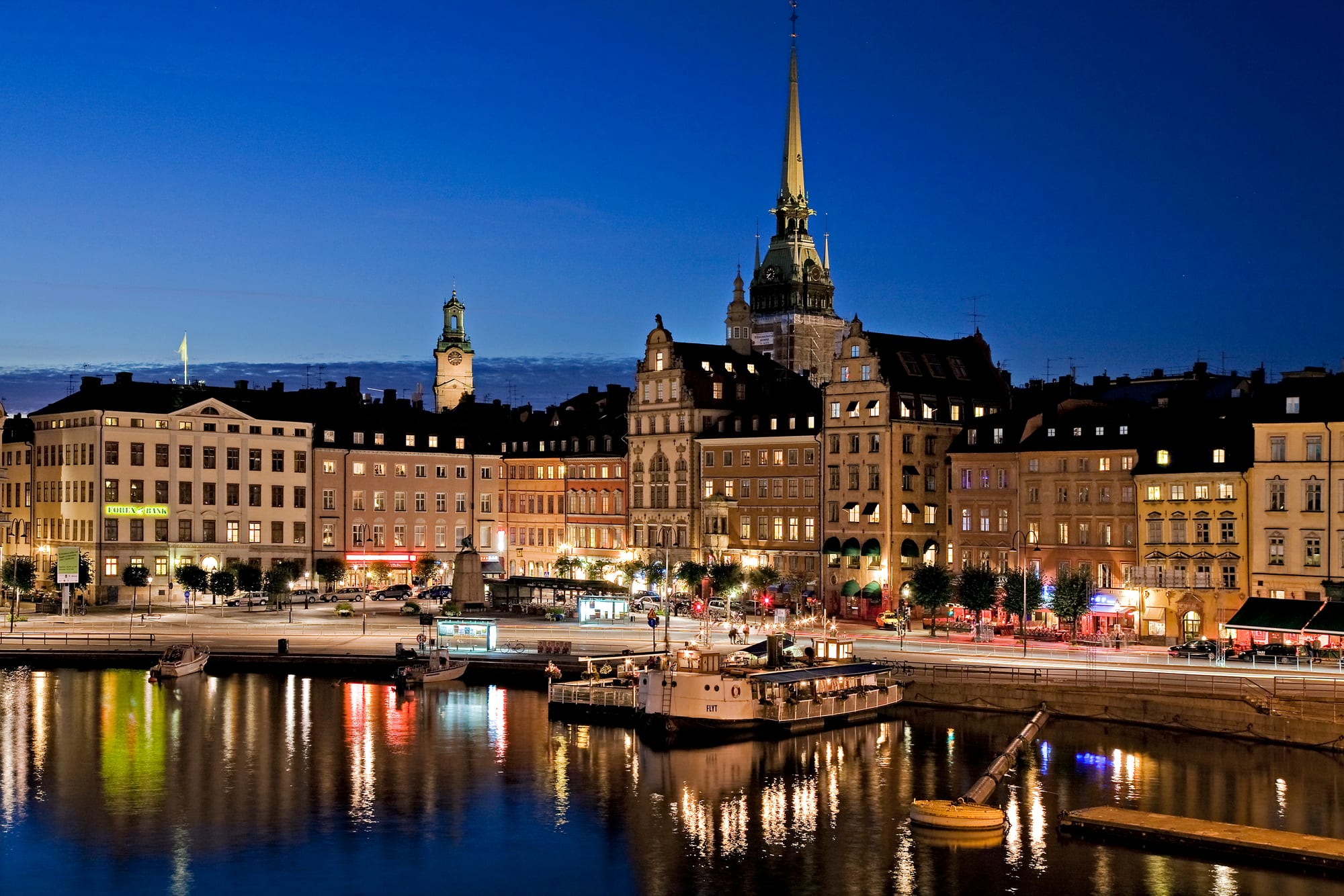
Row of tall ochre, red, and cream townhouses along a dark waterfront at dusk, church spires rising behind

Sweden

The waterfront of Gamla Stan, Stockholm's medieval old town, on an island at the centre of the city. (Richardmaackphotography / Wikimedia Commons · CC BY 4.0)

The largest Nordic country — a long sweep of forest, lake, and archipelago from the Baltic to the Arctic — historically a European great power, later a byword for social democracy and neutrality, and a NATO member since 2024.

Explore Sweden

History

Farming communities, then Iron Age chiefdoms, gave way in the Viking Age (roughly 800–1050) to Swedish traders and raiders who ranged east down the Russian rivers to Constantinople and the Caspian. A unified Christian kingdom formed over the following centuries, joined Denmark and Norway in the Kalmar Union in 1397, and broke free under Gustav Vasa in 1523, who also made the church Lutheran.

In the seventeenth century Sweden was a great power. Under Gustavus Adolphus and his successors it dominated the Baltic, intervened decisively in the Thirty Years' War, and held territory around the sea's rim. That empire was dismantled by Russia and its allies in the Great Northern War (1700–21), and the loss of Finland to Russia in 1809 ended Swedish expansion. From 1814, after a last brief war with Norway, Sweden was at peace — a run of over two centuries and counting.

Nineteenth-century poverty drove more than a million Swedes to emigrate, mostly to North America, before industrialisation and reform transformed the country. In the twentieth century the Social Democrats governed for most of the period and built the folkhem, the "people's home" welfare state, while keeping Sweden neutral through both world wars and the Cold War. Sweden joined the EU in 1995, kept the krona in a 2003 referendum, and — abandoning two centuries of non-alignment after Russia's full-scale invasion of Ukraine — joined NATO in March 2024.

  • Sweden: The Reluctant Great Power A Viking homeland that briefly ruled the Baltic as a European great power, lost it all including Finland, then reinvented itself through two centuries of peace, neutrality and the welfare state — before joining NATO in 2024

Culture & Customs

Two ideas are often used to explain Swedish social life. Lagom — "just the right amount" — prizes moderation, balance, and not standing out. The Jante Law (Jantelagen), a satirical set of rules from a novel, names the flip side: a cultural discomfort with boasting or claiming to be better than others. Consensus, punctuality, personal space, and equality — including some of the world's most generous parental leave, shared between parents — run deep.

The right of public access (allemansrätten) lets anyone walk, camp, forage, and swim across private land within reason, and the outdoors is central to national life: the summer cottage (stuga), Midsummer with maypole and pickled herring, autumn mushroom and berry picking, and winter skiing and skating.

Fika — a coffee-and-cake break, ideally with company — is a daily ritual. Sweden also has an outsized cultural footprint in pop music, crime fiction, film (Bergman), and design, from IKEA flat-packs to fashion and furniture.

Daily Life

About 10.6 million people live in Sweden, most of them in the southern third, around Stockholm, Gothenburg, and Malmö; the vast forested north is very thinly populated. Roughly a fifth of residents were born abroad, the result of decades of labour migration and refugee intake, and integration is a live political issue alongside gang violence in some cities.

The welfare state remains extensive — tax-funded healthcare, near-free education through university, subsidised childcare — supported by high taxes and a competitive export economy (engineering, telecoms, pharmaceuticals, cars, music, and games). Society is highly digital and cashless, and trust in institutions is high.

Work-life balance is protected: long holidays, the right to reduce hours when children are small, and a general winding-down in July, when much of the country decamps to the countryside and the coast.

Food

Traditional Swedish food is husmanskost — homely cooking such as meatballs (köttbullar) with cream sauce, lingonberries, and pickle; pyttipanna (a fry-up hash); pea soup with pancakes on Thursdays; and raggmunk potato pancakes with pork and lingonberry. The smörgåsbord buffet and the julbord at Christmas pile up herring in many marinades, cured salmon (gravlax), cold cuts, and Janssons frestelse, a potato-and-anchovy gratin.

Bread is dense and often crisp (knäckebröd), cheese is eaten at breakfast, and the cinnamon bun (kanelbulle) is the national pastry, celebrated with its own day. Fermented Baltic herring (surströmming), opened outdoors for its notorious smell, is a northern summer ritual.

Alcohol over 3.5% is sold only through the state monopoly Systembolaget. Snaps (aquavit) accompanies festive meals with drinking songs, and Swedish craft beer, cider, and coffee — Swedes are among the world's heaviest coffee drinkers — round it out.

Attractions & Natural Wonders

Stockholm spreads across fourteen islands where Lake Mälaren meets the Baltic: the medieval Gamla Stan, the Vasa Museum with its salvaged seventeenth-century warship, the open-air Skansen, the Royal Palace, and, just offshore, an archipelago of some 30,000 islands reached by commuter ferry. Gothenburg on the west coast has canals, seafood, and the Liseberg amusement park, and Malmö is linked to Copenhagen by the Öresund Bridge.

The south (Skåne, Österlen) is gentle farmland, castles, and coast; the university towns of Uppsala and Lund have cathedrals and history; and Gotland, out in the Baltic, has the walled Hanseatic town of Visby and sea stacks. The Göta Canal crosses the country by locks and lakes.

In the north, Swedish Lapland offers the Kungsleden long-distance trail through the mountains, the Sarek and Abisko national parks, the ICEHOTEL rebuilt each winter at Jukkasjärvi, the Sami cultural centre at Jokkmokk, and — on clear winter nights — the aurora.

  • Sweden: Ten Attractions and Natural Wonders A 17th-century warship raised almost perfectly intact after 333 years underwater, a hotel rebuilt from scratch each winter entirely out of ice, and an Arctic sky lit by the aurora borealis for months at a time

Planning basics

Budget

Sweden is expensive, though less eye-watering than it once was for visitors with strong currency. Alcohol, restaurant meals, and taxis are the pain points; supermarkets, the excellent free outdoors, museums with free entry in Stockholm, and hostels and cabins keep costs manageable.

Daily Budget Midrange
SEK 1,700–3,200 / USD 160–300 (hotel, restaurant dinners, trains, paid museums)
Daily Budget Shoestring
SEK 700–1,100 / USD 65–105 (hostel or cabin, self-catering, lunch deals, transit passes)

Eat your main meal at lunch (dagens rätt), buy alcohol only at the state Systembolaget shops, and use the right to roam for free camping.

Visa Requirements

Sweden is in the EU and the Schengen Area. EU and EEA citizens have full free movement. UK, US, Canadian, Australian, and many other visitors enter visa-free for 90 days in any 180; the EU's ETIAS pre-authorisation is expected to apply to them once launched.

Typical Stay
90 days in any 180 (Schengen) for most Western passports

The Schengen 90-day allowance is shared across all member countries combined.

Safety

Sweden is a very safe country for visitors. Violent crime is concentrated in specific suburban areas and gang networks that do not affect tourists; the everyday risks are pickpocketing in central Stockholm and at Arlanda, icy pavements in winter, and the cold and remoteness of the northern wilderness.

Health
Tap water is excellent; winter cold and ice are the main hazards; ticks in the south in the warm months

Dress properly for winter conditions, carry the emergency number 112, and tell someone your route before hiking in the mountains.

Climate

Cool temperate in the south, subarctic and Arctic in the north. Summers are mild and long-lit (the midnight sun north of the Arctic Circle); winters are cold, dark, and snowy, more severe and longer inland and north. Autumn brings colour, spring comes late.

Summer
June–August, mild, very long daylight
Winter
November–March, cold and dark; polar night in the far north

Transportation

Stockholm Arlanda is the main hub, with Gothenburg and others regional. The SJ rail network is good along the populated south and east, including high-speed trains and the overnight service to the Arctic; long-distance buses (Flixbus) are cheaper and slower. Cities have strong public transport; a car helps for the countryside and the north.

Book SJ trains early for cheap fares; the night train to Abisko and Narvik is a destination in itself.

Best Time to Visit

June to August for the archipelago, the lakes, hiking, and long days, with Midsummer the high point. December to March for snow, skiing, dog-sledding, and the northern lights in Lapland. April–May and September are quiet shoulder seasons.

Events
Midsummer (late June); Walpurgis Night (30 April); Sami markets in Jokkmokk (February); Lucia (13 December); Nobel Prize ceremony, Stockholm (10 December)

Currency

Sweden keeps its own currency, the krona, and has not adopted the euro. It is one of the most cashless societies in the world — cards and the Swish phone app are used for almost everything, and many businesses no longer take cash at all.

Symbol
kr
Currency Code
SEK — Swedish krona

Language

Swedish is the national language. Five minority languages have official status, including Finnish and Sami. English is spoken fluently by the great majority of Swedes, and visitors rarely need Swedish.

English
Very widely and fluently spoken
National Language
Swedish