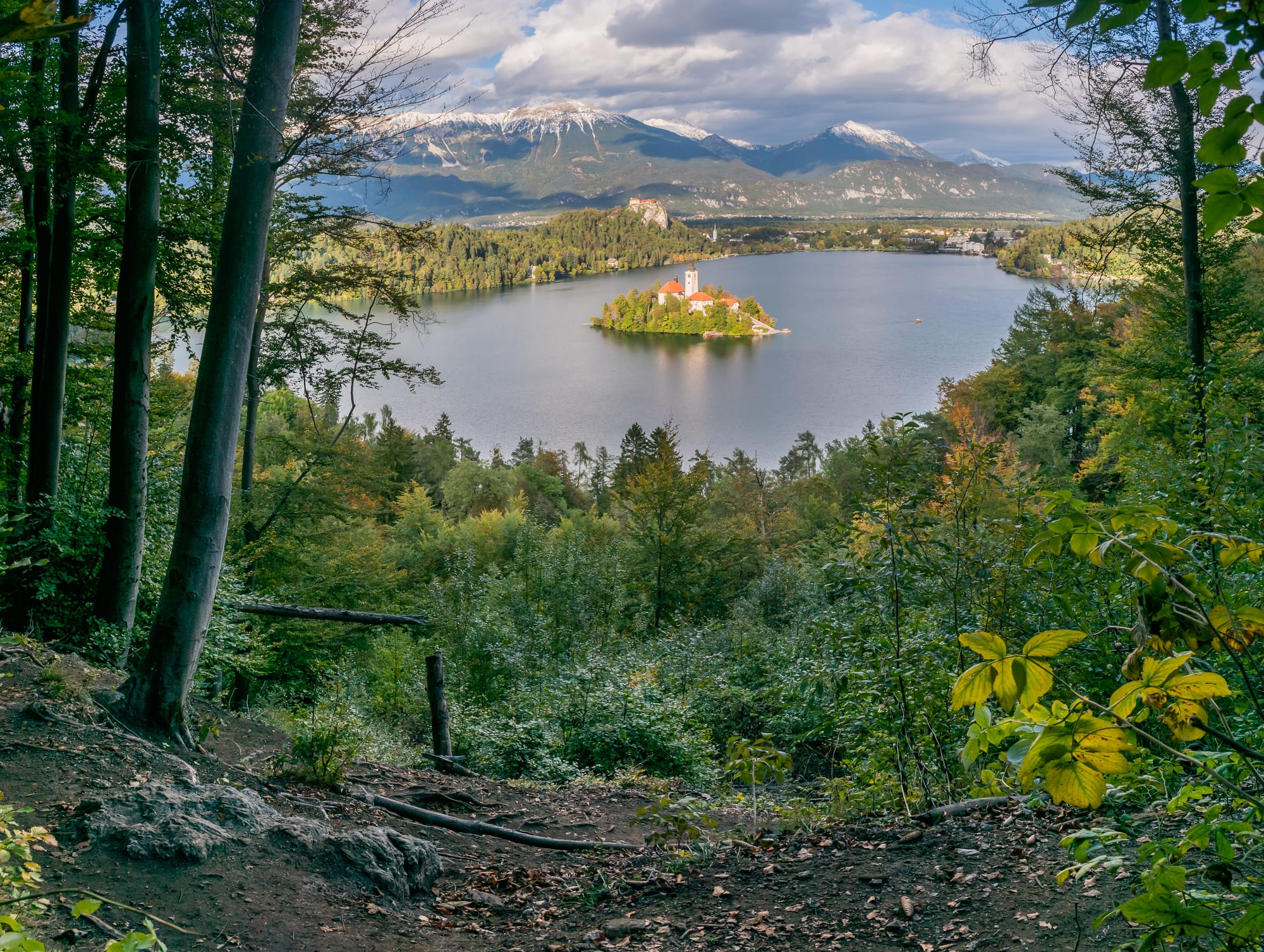
A small wooded island with a white church tower on a still green lake, wooded hills and a cliff-top castle behind

Slovenia

Lake Bled, with its island church and cliff-top castle, at the foot of the Julian Alps in northwestern Slovenia. (Krzysztof Golik / Wikimedia Commons · CC BY-SA 4.0)

A small, green country where the Alps, the Mediterranean, and the Balkans meet — Habsburg for centuries, then part of Yugoslavia, and independent since a ten-day war in 1991.

Explore Slovenia

History

Slavic ancestors of the Slovenes settled the eastern Alps and their forelands by the sixth century, briefly forming the early principality of Carantania. From the fourteenth century almost all Slovene-speaking lands — Carniola, and parts of Styria, Carinthia, and the coast — were under the Habsburgs, where they stayed, apart from Napoleon's short-lived Illyrian Provinces, until 1918. The Protestant reformer Primož Trubar printed the first Slovene books in the sixteenth century, and the Romantic poet France Prešeren became the national bard in the nineteenth.

After the First World War the Slovenes joined the Kingdom of Serbs, Croats and Slovenes, later Yugoslavia. The Second World War brought partition among Germany, Italy, and Hungary, a strong Partisan resistance, and civil conflict. In socialist Yugoslavia, Slovenia was the smallest and richest republic, closest to Western Europe.

Slovenia declared independence in June 1991. The Yugoslav army intervened but withdrew after the Ten-Day War, the briefest of the Yugoslav conflicts, and international recognition followed within months. The country joined NATO and the EU in 2004, adopted the euro in 2007, and entered the Schengen Area the same year. It has since been a stable parliamentary democracy, if with frequent changes of government.

  • Slovenia: The Sunny Side of the Alps A small Slavic nation held for a thousand years by Austria and Venice — the first republic to break from Yugoslavia, in a ten-day war, and the first ex-communist country to adopt the euro

Culture & Customs

Slovene culture places unusual weight on language and poetry: the national holiday, Prešeren Day, honours a poet, and a verse of his work is the anthem. Choral singing is widespread, with thousands of amateur choirs. The Roman Catholic Church shaped the calendar and the countryside's churches, though regular practice has declined.

Beekeeping is a point of national pride — the native Carniolan bee, the folk-painted fronts of traditional hives, and the proposal that made 20 May World Bee Day. The landscape carries other distinctive marks, above all the kozolec, the slatted wooden hayrack found on farms across the country.

Life is oriented outdoors. Hiking, cycling, skiing, and climbing are mainstream pursuits, Ljubljana has a strong café and festival culture, and many families keep a rural house or vineyard cottage for weekends. Environmental awareness is high, and Ljubljana was named a European Green Capital in 2016.

Daily Life

About 2.1 million people live in Slovenia, roughly a quarter of them in the Ljubljana urban area. Home ownership is high, incomes are the highest of the former Yugoslav states, and the economy runs on manufacturing, pharmaceuticals, car parts, and services, closely tied to Germany, Austria, and Italy.

The country is compact enough that people commute across it, ski in the morning and reach the coast by afternoon, and cross into Austria, Italy, or Croatia routinely. The population is ageing, and rural areas in the east and the mountains have thinned as people moved to the centre.

Weekends and holidays revolve around the outdoors and food — mountain huts, vineyards, mushroom foraging, and family lunches — and cross-border shopping and day trips are part of ordinary life.

Food

Slovene cooking draws on its neighbours: Alpine dumplings and cured meats, Italian-style pasta and risotto on the coast, Hungarian paprika stews in the east, and Balkan grilled meats. The rolled walnut cake potica is the festive centrepiece, and štruklji — rolled dough parcels, sweet or savoury — appear in many regional forms.

Signature dishes include the Carniolan sausage (kranjska klobasa), jota (a bean, sauerkraut, and potato soup), idrijski žlikrofi (small stuffed dumplings), and the layered prekmurska gibanica pastry. Buckwheat, in porridge (žganci) and bread, is a traditional staple.

Slovenia produces good wine in three regions — the orange and Rebula wines of Goriška Brda, Teran on the Karst, and the whites of Štajerska — and the Slovenian side of the Collio. The country punches above its weight in fine dining, with Ana Roš of Hiša Franko in the Soča valley internationally known.

Attractions & Natural Wonders

Lake Bled, with its island church, cliff-top castle, and the traditional pletna boats, is the iconic image, and quieter Lake Bohinj lies deeper in the mountains inside Triglav National Park. The park protects the Julian Alps and Mount Triglav, the national symbol, along with the Vintgar Gorge and the emerald Soča River, a centre for rafting, kayaking, and the via ferrata.

The Karst region gave its name to the landform and holds two great cave systems: Postojna, entered by an underground train, with the ruined Predjama Castle built into a cliff nearby, and the vast river canyon of the UNESCO-listed Škocjan Caves. The Lipica stud farm, origin of the Lipizzaner horses, is close by.

Ljubljana has a castle-topped old town, a riverside remodelled by the architect Jože Plečnik — whose works across the city are a UNESCO site — and a lively market and café scene. On the short Adriatic coast, Piran is a Venetian-Gothic town of tight lanes and a sea-girt square, and the Logar Valley and the Kamnik–Savinja Alps in the north offer some of the country's finest scenery with fewer visitors.

  • Slovenia: Six Attractions and Natural Wonders A church on an island reached only by traditional wooden gondola, a cave system explored partly by underground train, and a coastal town so Venetian in character it could pass for a corner of Italy

Planning basics

Budget

Slovenia sits mid-range for Europe. Ljubljana and Bled are the priciest spots, especially in summer; the countryside, farm stays, and the Soča valley outside peak season are better value. Tourist farms (turistična kmetija) offer good-value half board.

Daily Budget Midrange
EUR 120–230 (hotel or guesthouse, restaurant meals, car hire, cave and park tickets)
Daily Budget Shoestring
EUR 55–85 (hostel or farm stay, bakery and market food, buses)

Base outside Bled and Ljubljana for lower prices, and buy the Julian Alps or regional tourist card if you plan several sights.

Visa Requirements

Slovenia is in the EU and the Schengen Area. EU and EEA citizens have full free movement. UK, US, Canadian, Australian, and many other visitors enter visa-free for 90 days in any 180; the EU's ETIAS pre-authorisation is expected to apply to them once it launches.

Typical Stay
90 days in any 180 (Schengen) for most Western passports

The 90-day allowance covers the whole Schengen Area combined.

Safety

Slovenia is one of the safest countries in Europe, with low crime. Ordinary caution against pickpockets in Ljubljana's centre and at bus and train stations is enough. The main risks are in the mountains — fast weather changes, exposure on via ferrata routes, and the demanding ascent of Triglav.

Health
Tap water is safe; tick-borne encephalitis is present in forests in the warm months

Take a helmet and via ferrata kit for the Triglav routes, check mountain forecasts, and consider a tick vaccination for long forest stays.

Climate

Three climates in a small space: alpine in the mountains (cold, snowy winters, cool summers), sub-Mediterranean on the coast and in the Vipava and Goriška valleys (mild, dry summers), and continental in the east (hot summers, cold winters). Summer thunderstorms are common inland.

Alps
Snow roughly December–April; alpine hiking July–September
Coast
Warm and dry May–September

Transportation

Ljubljana's airport is small, so many visitors arrive via Venice, Trieste, Zagreb, Klagenfurt, or Vienna. Trains and buses connect the main towns cheaply but can be slow; a car is the practical way to see the Alps, the Karst, and the coast. A motorway vignette is required for driving.

Hire a car for the Julian Alps and the Karst; use the train for the Ljubljana–Bled–coast corridor if you would rather not drive.

Best Time to Visit

May–June and September for hiking, the lakes, and the coast with fewer crowds; July–August is warmest and busiest; December–March for skiing at Kranjska Gora, Vogel, and Krvavec. The Julian Alps high routes are usually snow-free only from late June.

Events
Ljubljana summer festival; Bled and Bohinj events; the Kurentovanje carnival in Ptuj (Feb/Mar); wine harvest festivals in autumn

Currency

Slovenia adopted the euro in 2007. Cards are accepted almost everywhere; keep small cash for parking, mountain huts, and rural stalls.

Symbol
Currency Code
EUR — euro

Language

Slovene is the official language. Italian and Hungarian are co-official in the bilingual border areas of Istria and Prekmurje. English is very widely spoken, especially by younger people, along with Croatian and German.

Co Official
Italian and Hungarian in designated border municipalities
Official Language
Slovene