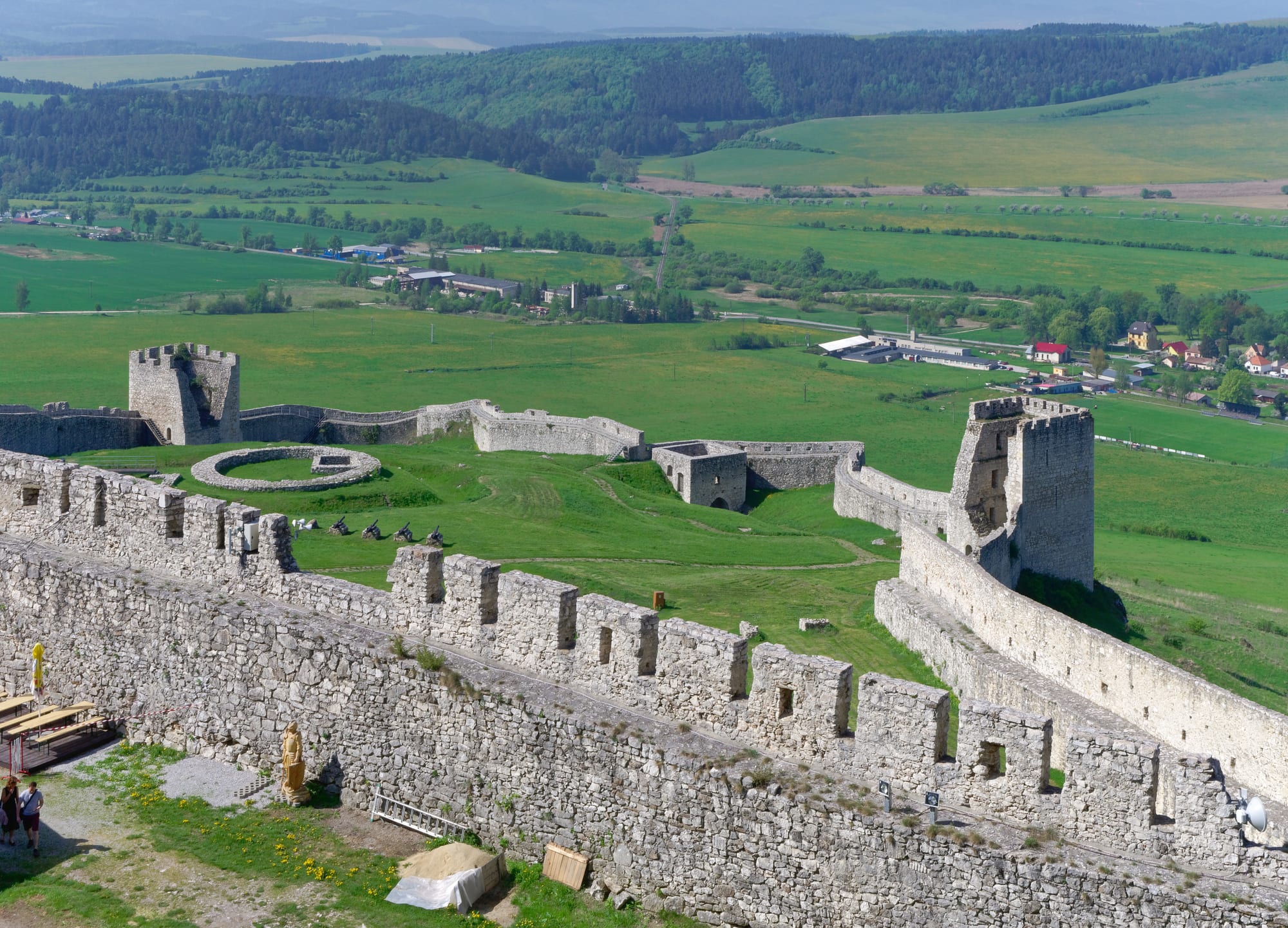
Extensive whitish castle ruins spread along a high ridge above green fields, with hills fading into the distance

Slovakia

Spiš Castle in eastern Slovakia, one of the largest castle complexes in Central Europe and a UNESCO World Heritage Site. (Jakub Hałun / Wikimedia Commons · CC BY-SA 4.0)

A landlocked Central European country of Carpathian mountains and castle-topped hills — part of the Kingdom of Hungary for a thousand years, then of Czechoslovakia, and independent since a peaceful 1993 split.

Explore Slovakia

History

Slavs settled the region by the sixth century, and in the ninth it was the core of Great Moravia, the first major Slavic state in Central Europe and the setting for the mission of Saints Cyril and Methodius. After Great Moravia collapsed, the territory was absorbed into the Kingdom of Hungary, where it remained — as "Upper Hungary" — for roughly a thousand years. For much of the sixteenth and seventeenth centuries, with the Ottomans holding central Hungary, Bratislava (Pressburg) served as the Hungarian coronation city.

A Slovak national revival gathered pace in the nineteenth century, and Ľudovít Štúr codified the modern literary language in the 1840s. After the First World War the Slovaks joined the Czechs in the new state of Czechoslovakia. During the Second World War a nominally independent Slovak State under Jozef Tiso was a client of Nazi Germany and deported most of its Jews; the Slovak National Uprising of 1944 was a major armed revolt against that regime.

Communist Czechoslovakia followed from 1948, including the crushed reform attempt of the 1968 Prague Spring. The Velvet Revolution ended one-party rule in 1989, and on 1 January 1993 the country separated peacefully from the Czechs — the "Velvet Divorce". Slovakia joined the EU and NATO in 2004 and the euro in 2009. Its politics have been turbulent: the 2018 murder of journalist Ján Kuciak brought down a government, and Prime Minister Robert Fico, back in office from 2023, was shot and wounded in 2024.

Culture & Customs

Slovak identity is bound up with folk tradition — painted wooden houses, the long fujara shepherd's flute (a UNESCO-listed instrument), embroidered costume, and the wooden churches of the Carpathians. Village life, family gatherings, and the weekend cottage (chata) remain central even for city-dwellers. The country is majority Roman Catholic, with a Lutheran minority strong in some regions.

Hospitality is warm and food-centred, and hiking is close to a national pastime, with a dense network of marked trails and mountain huts. Ice hockey is the sport that stirs the country most, followed by football. Easter Monday still brings the old custom in which men sprinkle women with water or lightly switch them with braided willow, in exchange for painted eggs.

Slovaks are sometimes wry about living in a small country long ruled from elsewhere, but pride in the language, the mountains, and independence runs deep.

Daily Life

About 5.4 million people live in Slovakia. Bratislava, in the far west against the Austrian and Hungarian borders, is prosperous and well connected; central and eastern regions are poorer, and many Slovaks commute or migrate for work to Czechia, Austria, and Germany. The Roma minority, concentrated in the east, faces segregation and poverty.

The economy leans heavily on car manufacturing — Slovakia produces more cars per head than any other country, in plants run by Volkswagen, Kia, Stellantis, and Jaguar Land Rover — along with electronics and engineering. This makes it sensitive to swings in the European car market.

Outside working hours, life centres on family, the outdoors, and the village of origin, with people returning at weekends to tend gardens, forage for mushrooms, and keep up rural houses.

Food

The national dish is bryndzové halušky: soft potato dumplings with sheep's cheese (bryndza) and fried bacon or pork fat. Cabbage soup (kapustnica), often with sausage and dried mushrooms, is the Christmas Eve staple. Other mainstays include segedínsky guláš (pork and sauerkraut goulash), potato pancakes, and pirohy dumplings.

Meat, potatoes, dumplings, and sauerkraut form the backbone of everyday cooking, with soups starting most main meals. Sweet dishes like steamed buchty filled with jam or poppy seed, and žinčica, the whey drink of the sheep-cheese regions, round it out.

Slovakia makes decent wine in the south — the Tokaj region straddles the Hungarian border — along with fruit brandies (slivovica, borovička) and the herbal spirit Demänovka. The cola-flavoured soft drink Kofola, a communist-era creation, remains hugely popular.

Attractions & Natural Wonders

The High Tatras, a compact alpine range on the Polish border, are the headline: sharp granite peaks, glacial lakes such as Štrbské Pleso and Popradské Pleso, and Gerlachovský štít, the highest point in the Carpathians. Nearby, the Slovak Paradise national park offers ladder-and-chain hikes up waterfall gorges, and the Low Tatras and Malá Fatra add more trails and ski slopes.

Castles are everywhere. Spiš Castle in the east is among the largest in Central Europe; Orava Castle rises on a river cliff; Bojnice Castle looks like a fairy tale; and Bratislava Castle overlooks the Danube above a compact, restored Old Town. Devín, at the Austrian border, marks the old Iron Curtain.

Banská Štiavnica, a UNESCO-listed former silver-mining town, is set in a volcanic caldera. The country also has extensive show caves, including the ice cave at Dobšiná and the aragonite cave at Ochtiná, and a string of the wooden Carpathian churches. Košice, the eastern capital, has Slovakia's grandest Gothic cathedral.

  • Slovakia: Six Attractions and Natural Wonders The ruins of one of Central Europe's largest castle complexes, a mountain range packed with more than a hundred glacial lakes, and a village whose houses are still hand-painted with the same white geometric folk patterns generation after generation

Planning basics

Budget

Slovakia is cheaper than Western Europe but no longer bargain-basement. Bratislava is the most expensive place; the High Tatras have resort pricing in season; the east and the villages are inexpensive. Hostels, pensions, and mountain chalets keep costs down.

Daily Budget Midrange
EUR 100–190 (mid-range hotel, restaurant meals, car hire, cable cars)
Daily Budget Shoestring
EUR 45–70 (hostel or pension, self-catering and pubs, buses)

Eat the lunch menu (denné menu) for a cheap two-course meal, and buy a motorway vignette online if driving.

Visa Requirements

Slovakia is in the EU and the Schengen Area. EU and EEA citizens may live and work freely. UK, US, Canadian, Australian, and many other nationals visit visa-free for 90 days in any 180; the EU's ETIAS pre-authorisation is expected to apply to them in due course.

Typical Stay
90 days in any 180 (Schengen) for most Western passports

Your 90 days are shared across the whole Schengen Area, not per country.

Safety

Slovakia is a very safe country with low violent crime. Watch for pickpockets in Bratislava's Old Town and at the main station, and take normal care in nightlife areas. Mountain weather changes fast — the High Tatras have alpine hazards and a mountain rescue service.

Health
Tap water is safe; tick-borne encephalitis is present in forests in the warm months

Check the weather and register your route before serious Tatra hikes; consider a tick vaccination for extended forest time.

Climate

Continental. Summers are warm, roughly 22–28°C in the lowlands, with thunderstorms; winters are cold and snowy, especially in the mountains, where the High Tatras hold snow well into spring. Spring and autumn are mild and changeable.

Summer
June–August, warm, occasional storms
Winter
December–March, cold, reliable mountain snow

Transportation

Slovakia has no large intercontinental airport; many visitors fly into Vienna, an hour from Bratislava by bus or train, or into Bratislava, Košice, or Kraków. Trains and intercity buses are cheap and reach most towns. A car is useful for the mountains and eastern villages; a motorway vignette is required.

For the High Tatras, base yourself in Poprad or a Tatra resort and use the electric mountain railway (TEŽ).

Best Time to Visit

June to September for hiking, lakes, and the castles; December to March for skiing in the Tatras and Low Tatras. Late spring and early autumn are quiet and pleasant. High summer and the Christmas–New Year ski weeks are the busiest.

Events
Bratislava and Košice cultural seasons; folk festivals (Východná, July); Christmas markets; Easter Monday water-and-whip custom in villages

Currency

Slovakia uses the euro, adopted in 2009. Cards are widely accepted; carry some cash for village shops, mountain huts, and small bakeries.

Symbol
Currency Code
EUR — euro

Language

Slovak is the official language, closely related to and largely mutually intelligible with Czech. Hungarian is widely spoken along the southern border. Younger people often speak English; older people may know German or Russian.

Minority Language
Hungarian (southern districts)
Official Language
Slovak