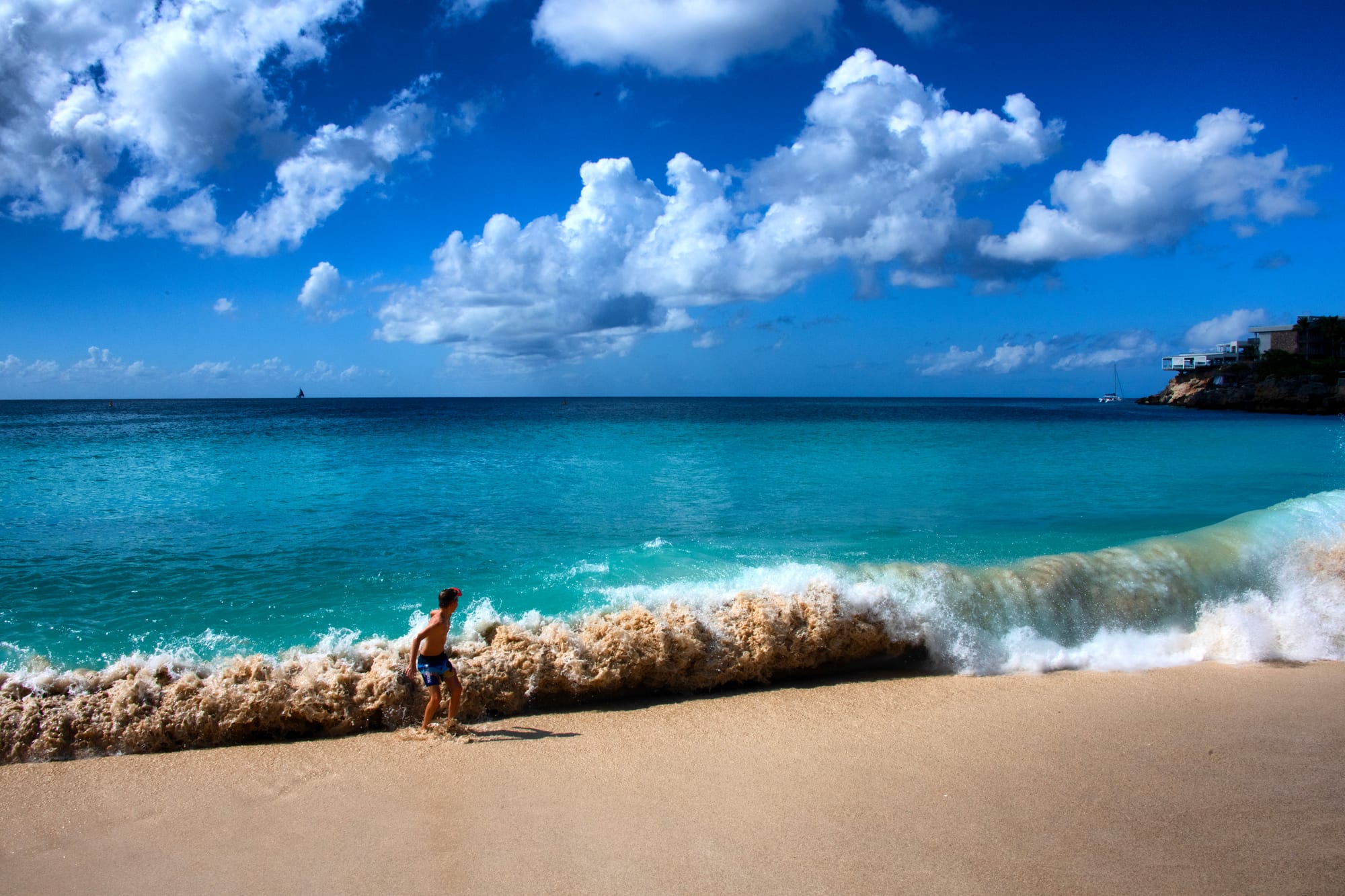
A foaming wave breaking onto golden sand beside a vivid turquoise sea, with a lone bather at the water's edge and white clouds in a deep blue sky

Sint Maarten

A big wave crashing onto the sand at Maho Beach, on the Dutch side of the island. (Andres Alvarado / Wikimedia Commons · CC BY-SA 2.0)

The Dutch southern part of a small Caribbean island shared with French Saint-Martin — a self-governing country within the Kingdom of the Netherlands, one of the world's most tourism-dependent economies, still rebuilding from Hurricane Irma in 2017.

Explore Sint Maarten

History

The island was home to Arawak and later Carib peoples; Columbus sighted it in 1493 and named it for Saint Martin. Spain held it loosely, and after Spanish withdrawal in 1648 the Dutch and French agreed to share it in the Treaty of Concordia — by legend settled by a walking contest, in practice by negotiation — making Saint Martin/Sint Maarten the smallest land mass in the world divided between two sovereign states, and the border has shifted only slightly since.

Both sides ran salt pans and small sugar and cotton plantations worked by enslaved Africans; slavery was abolished on the French side in 1848 and the Dutch side in 1863. The island stayed poor and thinly populated into the twentieth century.

Tourism changed everything from the 1950s and 60s: duty-free shopping, casinos, an international airport, and cruise ships turned Sint Maarten into one of the Caribbean's busiest destinations and drew a large migrant workforce from across the region. Within the Netherlands Antilles it pushed for autonomy, and when the Antilles were dissolved in 2010 Sint Maarten became a self-governing country within the Kingdom of the Netherlands. In September 2017 Hurricane Irma, a Category 5 storm, hit the island head-on, killing several people, wrecking the airport and much of the building stock, and triggering looting; a Dutch-funded reconstruction programme, with strings attached, has driven a slow recovery and recurring friction with The Hague.

  • Sint Maarten: The Dutch Half The southern part of an island shared with France since 1648 — a Dutch salt and sugar colony, long the neglected junior partner of Curaçao, transformed by an airport and mass tourism, and since 2010 a self-governing country within the Kingdom of the Netherlands

Culture & Customs

Sint Maarten's culture is a Caribbean melting pot with an unusual twist: because the tourism boom drew workers from across the region, the everyday language is English rather than Dutch or French, and the population is a mix of "SXM-born" families and communities from Dominica, Haiti, the Dominican Republic, Jamaica, Guyana, India, and elsewhere.

Carnival is the biggest cultural event on each side — the Dutch side after Easter, the French side before Lent — with calypso and soca competitions, costumed troupes, and street "jump-ups". Ponum dance, string bands, and the guavaberry liqueur that features in Christmas songs are older island traditions.

Religion is mostly Christian across many denominations, and family, church, the neighbourhood, and Carnival groups organise social life. The island's identity is strongly bound up with its unique dual status, marked each 11 November on Sint Maarten Day, celebrated on both sides.

Daily Life

Around 44,000 people live on the Dutch side and about 32,000 on the French side, almost all within a short drive of each other on a very small island. As Dutch or French nationals, many islanders hold EU citizenship and move to Europe for study and work.

The economy is overwhelmingly tourism — cruise calls at Point Blanche, one of the busiest cruise ports in the Caribbean, plus stopover visitors, yachting in the huge Simpson Bay Lagoon, and duty-free retail — supplemented by offshore finance. This leaves the island highly exposed to shocks, as the pandemic and Irma both showed, and the cost of living, imported almost entirely, is high.

Daily life is bilingual or multilingual, car-dependent, and closely tied to the cruise and flight schedules, the lagoon, and the beaches.

Food

Sint Maarten's food is pan-Caribbean with strong French, Dutch, Indian, and Indonesian influences, and the island bills itself as a culinary capital of the region. Callaloo soup, stewed conch, saltfish, curried goat, johnnycakes, and Creole-spiced snapper are the local base, with guavaberry — a tart wild fruit — made into a Christmas liqueur that is the island's own.

The roadside lolos of Grand Case, on the French side, grill ribs, chicken, snapper, and lobster over oil-drum barbecues and are an institution, while Grand Case's small strip of bistros gives the French half a reputation for fine dining. On the Dutch side, Philipsburg and Simpson Bay run from Dutch bar snacks (bitterballen, frikandel) to Indian roti shops and international resort restaurants.

Local rums, Carib and Presidente beers, and fresh tropical juices are the usual drinks, along with the guavaberry colada.

Attractions & Natural Wonders

Maho Beach, at the end of the airport runway, is the island's odd celebrity: a small beach where arriving jets pass just overhead and departing ones blast sand and spray across it. Philipsburg, the Dutch capital, has the long Great Bay boardwalk, Front Street's duty-free shops, and Fort Amsterdam on the headland, while quieter Dutch-side beaches include Mullet Bay, Cupecoy, and Little Bay.

The huge, sheltered Simpson Bay Lagoon, shared by both nations, is one of the largest inland lagoons in the Caribbean and a superyacht and watersports centre, crossed by opening bridges.

The French half of the island — Orient Bay and the other classic beaches, the harbour town of Marigot, hilltop Fort Louis, Pic Paradis, and the Grand Case restaurant strip — is covered on the Saint-Martin page; there is no border crossing between the two sides, so all of it is within easy reach of a Dutch-side base.

  • Sint Maarten: Five Attractions and Natural Wonders A beach where jet aircraft roar in low enough to feel the engine blast, a busy cruise-port capital street lined with duty-free shops, and a crumbling Dutch fort still watching over the harbour it once defended

Planning basics

Budget

Sint Maarten is geared to cruise passengers and resort tourism and is not cheap. Simpson Bay and the French side's Grand Case have the best-value guesthouses and apartments; self-catering and eating at the roadside lolos (barbecue shacks) on the French side cut costs sharply against the restaurants and casinos.

Daily Budget Midrange
USD 200–420 (hotel, restaurants, car hire, a boat or island tour)
Daily Budget Shoestring
USD 70–120 (guesthouse or apartment, lolo and supermarket food, bus or shared car)

Stay in Simpson Bay or on the French side, hire a car (the island is tiny and there is no border control), and eat at the Grand Case lolos.

Visa Requirements

Sint Maarten is a country within the Kingdom of the Netherlands, outside the EU and Schengen, with its own entry rules; the French half, Saint-Martin, is part of France but also outside Schengen. There is no border between them. Citizens of the EU, UK, US, Canada, and many others enter visa-free for up to 90 days; an online arrival card is required for the Dutch side.

Typical Stay
Up to 90 days visa-free for most Western passports

Complete the Dutch-side online arrival/ED card before you fly; you can move freely between the Dutch and French halves once on the island.

Safety

Sint Maarten has a higher crime rate than many Caribbean islands, with robberies, break-ins to cars and villas, and some violent crime, concentrated away from the main tourist strips and worse after dark. Petty theft on beaches is common. Post-Irma, some infrastructure is still patched, and the island is fully within the hurricane belt.

Health
Tap water on the Dutch side is desalinated and safe; dengue and other mosquito-borne illnesses occur; strong currents on some Atlantic-facing beaches; the sun is intense

Don't leave valuables in cars or on the sand, avoid walking in unlit areas at night, use repellent, and check the forecast carefully in hurricane season.

Climate

Tropical, hot and humid, around 28–31°C, cooled by the trade wind. The drier season runs December to April; the wetter, hotter months are June to November, which is also the Atlantic hurricane season — Hurricane Irma struck in September 2017.

Dry Season
December–April
Wet Season
June–November (hurricane season)

Transportation

Princess Juliana International Airport is a major Caribbean hub, famous for jets landing low over Maho Beach; the French side has the small Grand Case airport. A hire car is the easiest way around the 87-square-kilometre island, with buses on the main roads and water taxis in Simpson Bay.

Hire a car; there is no immigration check crossing between the Dutch and French sides, only a sign and a change of road markings.

Best Time to Visit

December to April is the peak — dry, sunny, and busy, with the highest prices around the winter holidays. May and November are quieter shoulder months. Hurricane risk is highest from August to October.

Events
Sint Maarten Carnival (April–May) with the Grand Parade; the French-side Carnival before Lent; the Heineken Regatta (March); Sint Maarten Day (11 November), marking the island's division; the Grand Case gastronomy evenings ('Les Mardis de Grand Case')

Currency

The Dutch side uses the Netherlands Antillean guilder but prices almost everything in US dollars, which are accepted everywhere. The French side officially uses the euro, though US dollars are also widely taken. Cards are standard; carry some cash for lolos and small shops.

Symbol
$ / €
Currency Code
ANG / EUR — guilder and euro (US dollars accepted island-wide)

Language

On the Dutch side, Dutch and English are official, but English is the everyday language of nearly everyone, in a local creole-inflected form. The French side's official language is French, with English also widely spoken. Spanish, Papiamento, and French Creole are common among the large migrant workforce.

Dutch Side
English (everyday); Dutch (official)
French Side
French (official); English widely spoken