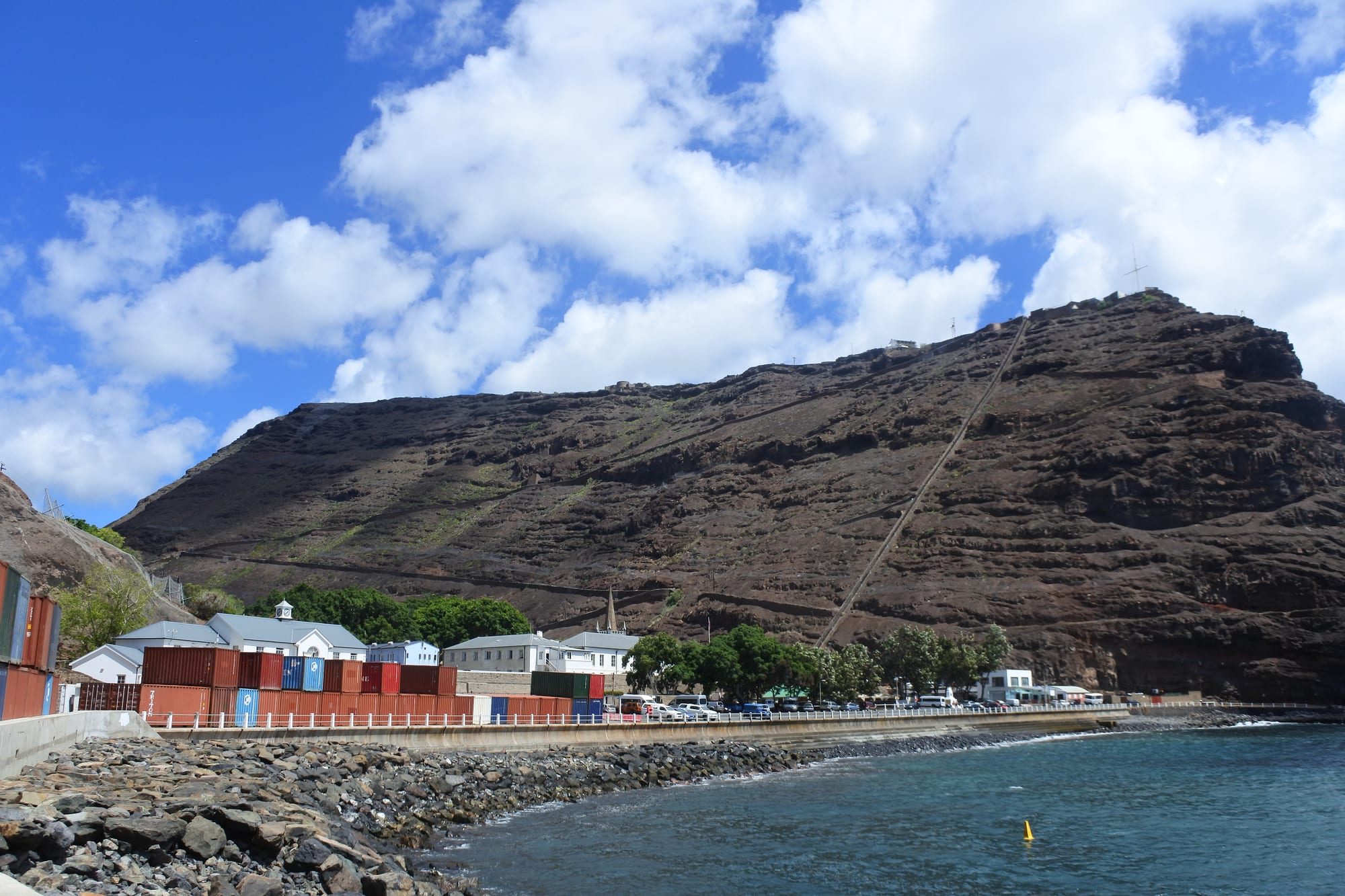
A small town of pale buildings packed into the floor of a steep, bare-sided valley that opens onto the sea, with old fortifications on the ridges

Saint Helena

Jamestown, the capital, wedged into a narrow valley between fortified cliffs on Saint Helena's leeward coast. (Luke McKernan / Wikimedia Commons · CC BY-SA 2.0)

A remote volcanic island in the tropical South Atlantic, the main part of the British Overseas Territory of Saint Helena, Ascension and Tristan da Cunha — famous as Napoleon's final place of exile, reachable only by ship until 2017 and now by a weekly flight to one of the most isolated communities on Earth.

Explore Saint Helena

History

Saint Helena was uninhabited when the Portuguese navigator João da Nova reached it in 1502 and used it as a resupply stop on the route from India. The English East India Company settled and fortified the island from 1659, founding Jamestown, and it became a vital watering and provisioning station for ships on the long haul between Europe and Asia. Enslaved people were brought to work it; the island abolished slavery in 1827, ahead of the wider British Empire. After 1840 the Royal Navy landed tens of thousands of "Liberated Africans" — people freed from intercepted slave ships — at Rupert's Bay, where many died and were buried.

Napoleon Bonaparte was exiled here in 1815 and died at Longwood House in 1821; the island was also used to hold the Zulu king Dinuzulu, Boer prisoners of war, and, later, Bahraini political detainees. It became a Crown colony in 1834.

The opening of the Suez Canal and the shift to steamships took away the passing trade, and Saint Helena declined into poverty and aid dependence. Islanders — the "Saints" — emigrated for work to Ascension, the Falklands, and Britain, and full British citizenship was only restored to them in 2002. A long-debated airport finally opened in 2016, after a well-publicised wind-shear problem delayed commercial flights until 2017, replacing the mail ship RMS St Helena.

  • Saint Helena: The Loneliest Island A volcanic rock in the middle of the South Atlantic — an East India Company waystation, Napoleon's prison, a refuge for liberated Africans and Boer captives, and one of the most isolated inhabited places on Earth until an airport opened in 2017

Culture & Customs

The roughly 4,400 "Saints" are of mixed English, African (both enslaved and Liberated African), Chinese, Malagasy, and Indian descent, and speak English with an accent and dialect found nowhere else. The Anglican Church is the largest denomination, and life is small-scale, church- and family-centred, and famously friendly — drivers wave to everyone, and visitors are quickly known.

Flax growing and rope-making were the twentieth-century industry until the market collapsed in the 1960s; fishing and, more recently, the island's rare coffee are the traditional products. Community events — the Festival of Running, cricket, Saint Helena Day, and a strong culture of volunteering — hold the small society together, and the pace is slow, with no traffic lights on the island.

Daily Life

About 4,400 people live on Saint Helena, most within reach of Jamestown, a narrow Georgian town squeezed into a steep valley. The economy is dominated by the public sector, much of it funded by the United Kingdom, with a young tourism industry since the airport, tuna fishing, and the coffee. There is one main road and only a few dozen kilometres of it.

Proper broadband arrived only with a subsea cable connection in the 2020s. Young people still leave for work overseas, and the island continues to rely on British budgetary support. Daily life runs on the weekly plane, the fortnightly cargo ship, and the weather over the highlands.

Food

Saint Helenian cooking is British home food with local touches. "Plo", a spiced pilau, is the island's signature dish; fishcakes, tuna in every form, curry, pumpkin fritters, "coconut fingers", and black pudding are staples, alongside the Sunday roast. A lot of the larder arrives frozen on the cargo ship. Saint Helena coffee — a green-tipped bourbon arabica grown since 1733 — is exported in tiny, expensive quantities, and Tungi, a spirit distilled from prickly pear, is the local drink.

Attractions & Natural Wonders

The Napoleonic sites are the headline: Longwood House, where the emperor died, restored and owned by France; the Briars Pavilion, his first lodging; and the empty original tomb in Sane Valley, his body having been returned to Paris in 1840. Jamestown itself has Jacob's Ladder, a straight 699-step stair up the valley wall, the Castle, St James' Church — the oldest Anglican church in the Southern Hemisphere — and the island museum.

Nature is the other draw. Jonathan, a Seychelles giant tortoise resident at Plantation House since 1882 and reckoned the world's oldest known living land animal, grazes the governor's lawn. The central peaks, including Diana's Peak at 823 metres, carry remnant cloud forest and the endemic wirebird, the national bird. Offshore, whale sharks and dolphins appear seasonally, and there is diving on wrecks and reefs. The "Post Box" walks lead to viewpoints and features such as Lot's Wife's Ponds, and the volcanic south coast around Sandy Bay is starkly scenic.

Planning basics

Budget

Reaching Saint Helena is expensive; on the ground it is modest. A handful of small hotels, self-catering cottages, and bed-and-breakfasts make up the accommodation, and eating out is limited. The airfare from Johannesburg is the dominant cost.

Daily Budget Note
Roughly GBP 100–200+ per day once accommodation and a hire car are counted, on top of the flight

Book the weekly flight and your accommodation together and well ahead — capacity is tiny — and hire a car, as public transport barely exists.

Visa Requirements

Most nationalities need no visa for visits of up to around 183 days; a visitor's pass is issued on arrival. You must show onward or return travel, pre-booked accommodation, adequate funds, and comprehensive medical and repatriation insurance — the last is effectively mandatory given the isolation.

Typical Stay
Up to about 183 days on a visitor's pass

Arrange full medical and evacuation insurance before you travel; it is checked, and there is no quick way off the island in an emergency.

Safety

Extremely safe, with almost no crime. The hazards are environmental — steep unfenced drops, sudden sea swells and rip currents (there are few beaches, and swimming is mostly off rocks and slipways), and the roads. Medical care is a single hospital in Jamestown with limited capacity; anything serious means an air evacuation to South Africa or the UK.

Health
No malaria or tropical disease risk; the main concern is access to advanced care

Take out comprehensive medical and evacuation insurance, take care near cliff edges and on the coast, and drive cautiously on the mountain roads.

Climate

Subtropical and mild, moderated by the ocean and the southeast trade winds. The coast around Jamestown is warm and dry at about 21–27°C; the central highlands are cooler, greener, and often wrapped in cloud. There is no hurricane risk. It is slightly warmer and wetter from January to April and cooler and windier from July to October.

Coast
Warm and dry, 21–27°C
Highlands
Cooler, wetter, often cloudy

Transportation

A weekly Airlink flight from Johannesburg (about six hours, sometimes with a fuel stop at Walvis Bay in Namibia) is the main link, with occasional charters and rare cruise calls. There is no longer a passenger ship, the RMS St Helena having retired in 2018. On the island, hire a car — driving is on the left — as the village bus service is minimal; roads are steep, narrow, and winding.

Reserve a hire car with your trip; the roads are demanding and there is essentially no other way to get around.

Best Time to Visit

Any time of year is feasible. October to March is warmest, and whale sharks are most likely from December to March. In practice the weekly flight schedule matters far more than the season.

Events
Saint Helena Day (21 May), marking the island's discovery; the Festival of Running (autumn); the Governor's Cup yacht race arrivals; Boxing Day and New Year sports

Currency

The Saint Helena pound is pegged one-to-one to sterling and used on Saint Helena and Ascension; UK notes and coins circulate alongside it. Card acceptance is very limited, the Bank of St Helena is the only bank, and there are no international ATMs — bring sterling cash and expect a cash economy.

Symbol
£
Currency Code
SHP — Saint Helena pound (at par with sterling)

Language

English is the sole official and everyday language, spoken with a distinctive Saint Helenian accent and turns of phrase.

Official Language
English