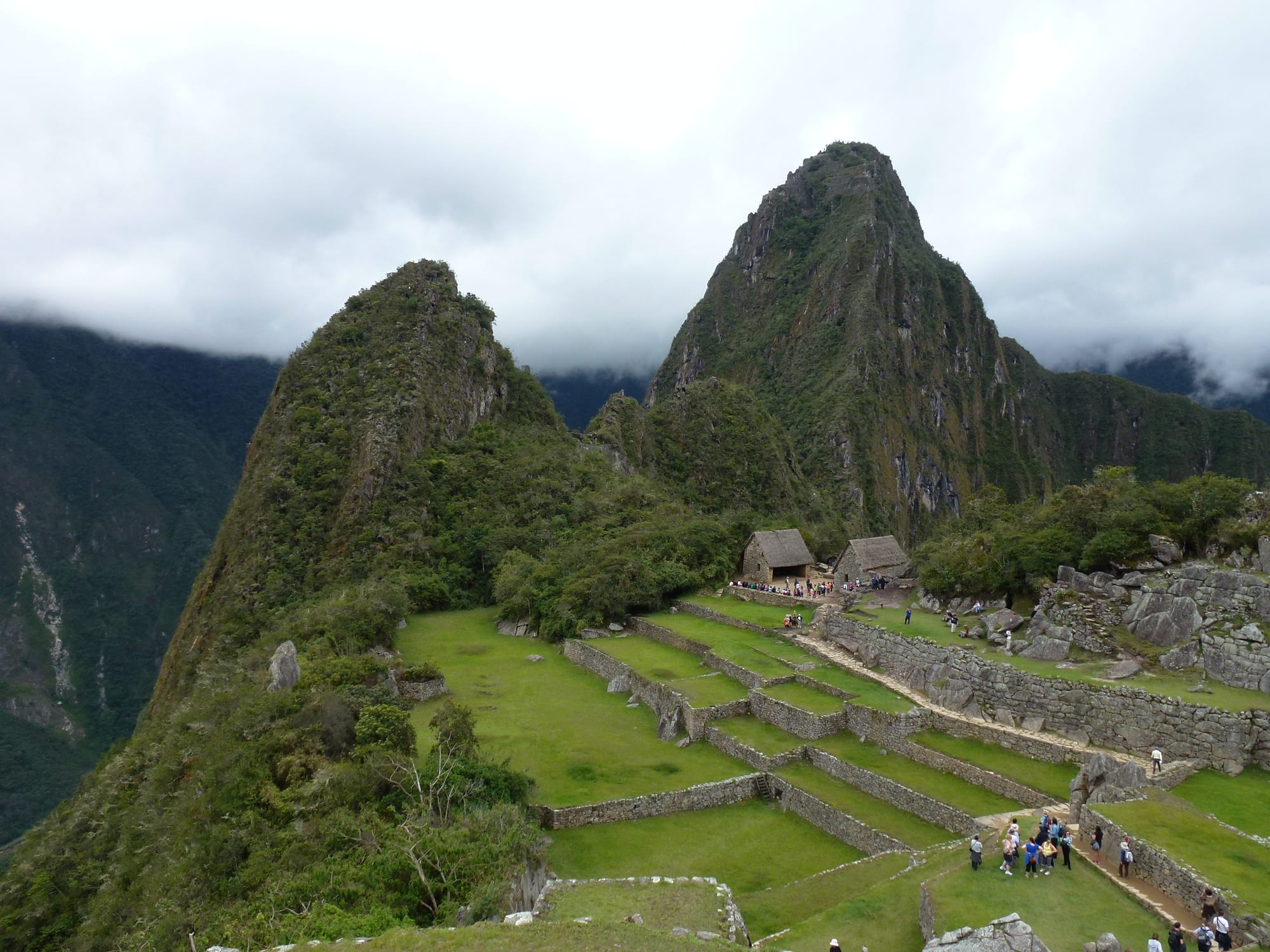
Stone Inca ruins and green agricultural terraces on a high mountain saddle, with the steep peak of Huayna Picchu rising behind under a clear sky

Peru

Machu Picchu, the 15th-century Inca citadel above the Urubamba river, with Huayna Picchu behind — Peru's most visited site. (Pierre André Leclercq / Wikimedia Commons · CC BY-SA 4.0)

A country on the Pacific coast of South America spanning desert, high Andes, and Amazon — the cradle of Andean civilisation and the heart of the Inca Empire, with a celebrated cuisine and a politics in near-permanent crisis.

Explore Peru

History

Peru is the cradle of Andean civilisation. Caral, on the coast, was a city 4,600 years ago, followed by the Chavín, the Nazca who scored their vast lines into the desert, the Moche and Chimú of the north coast, and the Wari, before the Inca built the largest empire in the pre-Columbian Americas from Cusco in barely a century, bound together by a road network that ran the length of the Andes. Francisco Pizarro's small Spanish force toppled it in 1532, helped by an Inca civil war, epidemic disease, and native allies.

Peru became the core of Spanish South America — the Viceroyalty of Peru, with Lima its capital and the silver of Potosí passing through it — and the setting for the largest Indigenous uprising of the colonial era, under Túpac Amaru II in 1780. Independence, declared in 1821, was only secured in 1824 at Junín and Ayacucho, Peru being among the last redoubts of Spanish power. The nineteenth century brought instability, a guano boom, and the loss of the War of the Pacific (1879–83) to Chile, which occupied Lima.

After democracy returned in 1980, an internal conflict against the Maoist Shining Path and the smaller MRTA killed some 69,000 people, most of them Quechua-speaking rural poor. Alberto Fujimori (1990–2000) beat hyperinflation and defeated the Shining Path but ruled through a "self-coup", death squads, and the forced sterilisation of hundreds of thousands of mostly Indigenous women before a corruption scandal ended his rule. In the quarter-century since, almost every elected president has been jailed or prosecuted for corruption; Pedro Castillo was arrested in 2022 after trying to dissolve Congress, and the deadly protests under his successor Dina Boluarte have left a human-rights crisis, with elections due in 2026.

  • Peru: The Andean Core The seat of the largest empire in the pre-Columbian Americas — conquered by a few hundred Spaniards, ruled for three centuries as the richest viceroyalty, a slow and contested independence, and a modern history swinging between oligarchy, military reform, insurgency and autocracy

Culture & Customs

Peruvian identity is a layering of Andean, Spanish, African, and Asian worlds. Quechua and Aymara are living languages, and highland communities keep the ayllu kin group, reciprocal labour, offerings to the mountain spirits and Pachamama, and festivals that fuse Catholic saints with pre-Hispanic rite — Inti Raymi in Cusco, the Virgen de la Candelaria in Puno, Qoyllur Rit'i on a glacier near Ausangate. Andean weaving is a high art, each region with its own patterns.

The coast has its own culture — criollo music of vals and marinera, and the guitar-and-cajón Afro-Peruvian tradition revived by singers such as Susana Baca — and Lima's identity as a cosmopolitan food capital. Chinese and Japanese immigration gave Peru chifa and nikkei cooking and, once, a Japanese-Peruvian president.

Football is the national passion, and the long gaps between World Cup appearances are a recurring national melodrama.

Daily Life

About a third of Peruvians live in Greater Lima, a vast desert city that grew through decades of migration from the Andes and now spreads for miles up the dry hills in informal districts. The coast holds most of the rest of the population and the modern economy — irrigated agro-export farms, fishing ports, and mining logistics. The Andean highlands are the Indigenous heartland, poorer and emptying as young people leave for the cities, though Cusco lives well off tourism. The Amazon, more than half the national territory, has only a twentieth of the people.

Peru has been a macroeconomic success by regional standards for two decades, on copper, gold, fishmeal, gas, and farm exports, yet most workers are informal, public services are thin, and conflict over mining — and, in the Amazon, illegal gold and logging — is constant.

Politics is in permanent crisis: a discredited Congress, a president few support, and a rotating cast of leaders under investigation.

Food

Peruvian cuisine has become one of the most celebrated in the world, drawing on an extraordinary range of ingredients — thousands of potato varieties, maize, quinoa, ají chillies, Pacific seafood, Amazonian fruits — and on Spanish, African, Chinese, Japanese, and Italian influence. Ceviche, raw fish "cooked" in lime with onion and chilli and served with sweet potato and corn, is the national dish.

Lomo saltado and arroz chaufa come from the chifa Chinese-Peruvian kitchen, and tiradito is the nikkei Japanese-Peruvian cousin of ceviche. The Andes give pachamanca baked in an earth oven, roasted cuy (guinea pig), rocoto relleno, and hearty soups; the Amazon gives juane and river fish such as paiche. Anticuchos — grilled beef-heart skewers — and causa are everyday favourites.

To drink there is pisco, the grape brandy at the centre of a rivalry with Chile, in the pisco sour; purple-corn chicha morada; Inca Kola, the fluorescent yellow soft drink that outsells Coca-Cola; and coca tea for the altitude.

  • Peru: Food and the National Dish Raw fish cured in citrus, from a country whose coast, mountains and Amazon have produced one of South America's most celebrated cuisines

Attractions & Natural Wonders

Machu Picchu, the Inca citadel on a saddle high above the Urubamba, is the icon — reached by train from Cusco and Ollantaytambo, or on foot via the four-day Inca Trail or the Salkantay route. Cusco, the Inca capital rebuilt in stone and baroque, is the base, with the Sacred Valley below — Pisac, Ollantaytambo, Maras and Moray — and the rainbow-striped Vinicunca mountain nearby.

Lake Titicaca from Puno has the reed islands of the Uros and the weaving communities of Amantaní and Taquile. Arequipa, a city of white volcanic stone below El Misti, is the gateway to the Colca Canyon, one of the world's deepest, where Andean condors ride the morning thermals. The southern desert holds the Nazca Lines, the Paracas peninsula and Ballestas islands, and the Huacachina oasis.

The north has the Cordillera Blanca and the trekking capital Huaraz, the adobe city of Chan Chan and the Moche pyramids near Trujillo, and the cloud-forest fortress of Kuélap. Lima itself has a rich museum scene, a preserved colonial centre, and the bluff-top districts of Miraflores and Barranco, and the Amazon opens from Puerto Maldonado into Tambopata and Manú, or from Iquitos into Pacaya-Samiria.

  • Peru: Ten Attractions and Natural Wonders A lost Inca citadel above the clouds, desert lines only fully legible from the air, floating islands built entirely of reeds, and a mountain painted in mineral stripes of rust, gold, and lavender

Planning basics

Budget

Peru offers a wide range. Hostels, menú set lunches, and long-distance buses are cheap; Cusco, the Sacred Valley, and the Machu Picchu trains and permits are where costs jump. Amazon lodges and the Inca Trail are the big planned expenses.

Daily Budget Midrange
USD 80–180 (mid-range hotel, restaurants, domestic flights, guided sites and treks)
Daily Budget Shoestring
USD 30–55 (hostel, set lunches and markets, buses)

The Machu Picchu train and entry, and Inca Trail permits (booked five to seven months ahead), are the costs to plan around; buses between regions are excellent value.

Visa Requirements

Citizens of the EU, the UK, the US, Canada, Australia, New Zealand, and most of Latin America enter visa-free, usually for up to 90 or 183 days, with the length set by the immigration officer. Keep the entry slip or digital record.

Typical Stay
90–183 days visa-free, at the officer's discretion

Safety

The standard tourist circuit — Lima's Miraflores and Barranco, Cusco, the Sacred Valley, Arequipa, Puno — is generally safe with urban precautions, but crime has risen. Pickpocketing and bag-snatching are widespread, and "express kidnapping" and robbery of street-hailed taxis are real risks. Extortion and gang violence have surged in Lima and Trujillo, prompting repeated states of emergency. Since December 2022, protests and road blockades in the southern Andes have repeatedly closed Machu Picchu and Cusco's airport for days.

Natural
Altitude sickness, a very seismic coast, and El Niño floods and landslides in the rains

Acclimatise before trekking, use licensed operators for serious treks, avoid the VRAEM valleys and the Colombian border in Loreto, and be ready to change plans around unrest.

Climate

Three climates. The coast is desert; Lima and the south coast are cool, grey, and damp from about May to November and sunny in summer, while the far north stays warm. The Andes have a dry season (May–September, sunny days, cold nights) and a wet season (November/December–March/April). The Amazon is hot, humid, and rainy year-round. Altitude, not season, is the main issue in the highlands.

Coast
Lima grey and cool May–November; sunny December–April
Highlands
Dry season May–October; Cusco sits at 3,400 m and Titicaca at 3,800 m

Transportation

Lima's Jorge Chávez airport is the hub, and flying is normal for the long distances (Lima–Cusco is 75 minutes versus around 21 hours by bus). Peru has some of South America's best long-distance buses. Trains are few but iconic — the tourist trains to Machu Picchu from Ollantaytambo, the Cusco–Puno–Arequipa sleeper, and the high Lima–Huancayo line. The Amazon is reached by air and then river boat.

Use app-based or hotel taxis, never hail one on the street or at the airport, and check the protest and roadblock situation before travelling in the southern Andes.

Best Time to Visit

May to September, the Andean dry season, is best for Cusco, Machu Picchu, the Inca Trail, Lake Titicaca, and the Colca Canyon — clear skies, though cold at night and busiest. The Inca Trail closes each February. Inti Raymi in Cusco (24 June) and the Virgen de la Candelaria in Puno (February) are the great festivals.

Events
Inti Raymi (24 June); Virgen de la Candelaria, Puno (February); Qoyllur Rit'i (May–June); Fiestas Patrias (28–29 July)

Currency

The currency is the sol (PEN). Cards are widely accepted in cities and tourist areas; carry cash for markets, small towns, buses, and the Andes. US dollars are easily exchanged. ATMs are common but charge fees.

Symbol
S/
Currency Code
PEN — sol

Language

Spanish is the official language nationwide and the first language of most Peruvians. Quechua, the language of the Inca Empire, is co-official where it predominates and is spoken by several million people in the southern and central Andes; Aymara is co-official around Lake Titicaca. About 48 Indigenous languages are recognised in all, many of them Amazonian.

Co Official
Quechua and Aymara where predominant
Official Language
Spanish