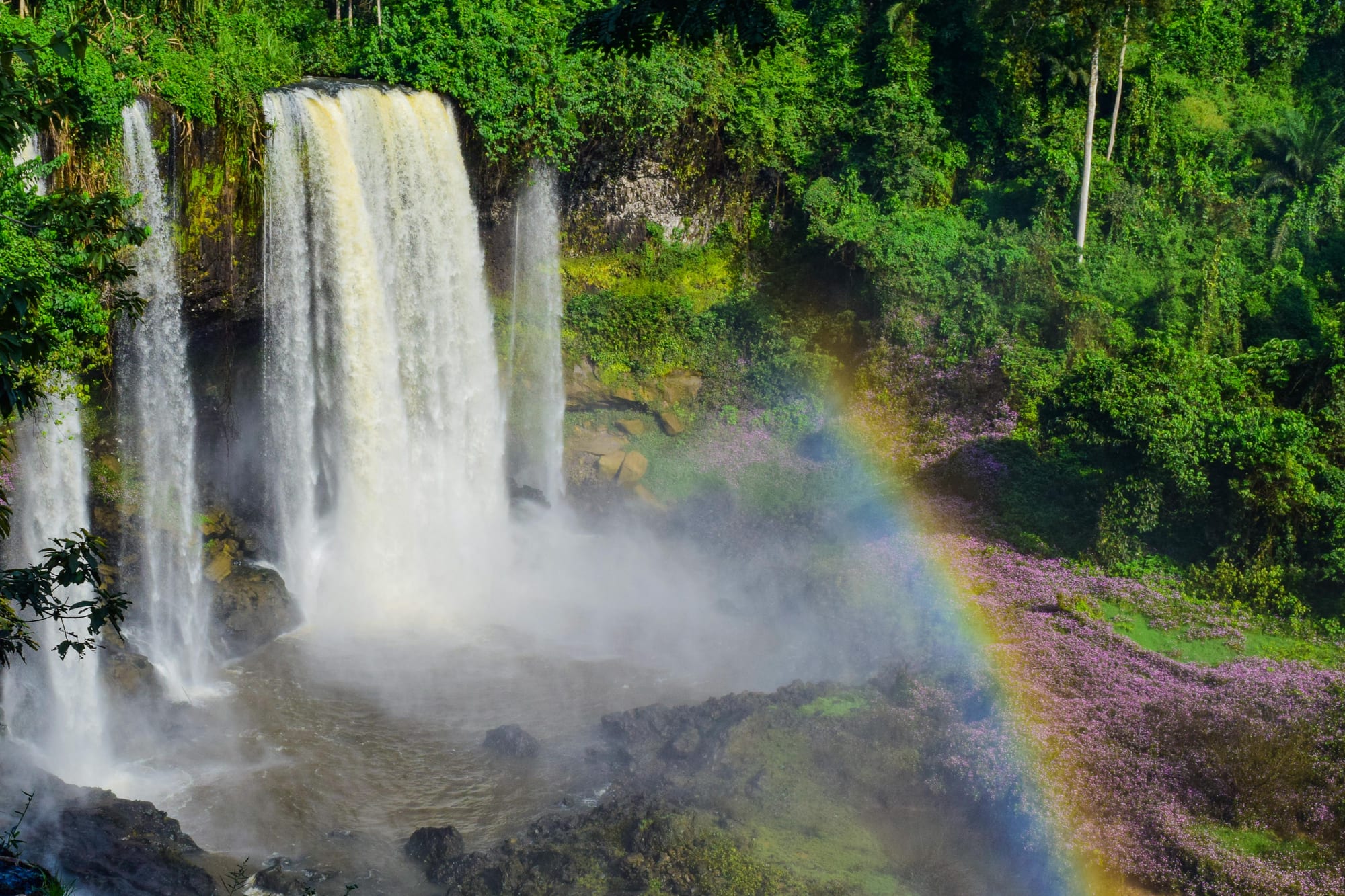
Several white streams of a waterfall plunging over a cliff wrapped in dense green rainforest, with a rainbow arching through the spray above a bank of purple flowers

Nigeria

The Agbokim Waterfalls in Cross River State, where a rainbow forms in the spray below the forest-covered cliff. (Ei'eke / Wikimedia Commons · CC BY-SA 4.0)

The most populous country in Africa — around 230 million people, split roughly between a Muslim north and a Christian south — an oil producer and cultural superpower whose government struggles to deliver security, power, and jobs.

Explore Nigeria

History

Nigeria's territory held some of Africa's most powerful pre-colonial states: the Kanem-Bornu Empire by Lake Chad, the walled Hausa trading cities, the Sokoto Caliphate founded by Usman dan Fodio's 1804 jihad, the Yoruba kingdoms centred on Ife and Oyo, the Kingdom of Benin with its celebrated bronzes — looted by a British expedition in 1897 — and the trading states of the Niger Delta. Britain took Lagos in 1861 and, in 1914, amalgamated its northern and southern protectorates into a single colony called Nigeria. Independence came on 1 October 1960.

The First Republic collapsed in 1966 in two coups and pogroms against the Igbo, after which the Eastern Region seceded as Biafra. The civil war that followed, from 1967 to 1970, cost between one and three million lives, most of them to starvation under blockade. Decades of mostly military rule followed, punctuated by short-lived civilian governments, the oil boom and bust of the 1970s, the annulment of the 1993 election, and the kleptocratic rule of Sani Abacha, until a return to democracy in 1999.

Under the Fourth Republic, power passed peacefully to an opposition party for the first time when Muhammadu Buhari won in 2015. Bola Tinubu took office after a disputed three-way election in 2023 and immediately removed the fuel subsidy and floated the naira, setting off a cost-of-living crisis, all against a backdrop of the Boko Haram insurgency in the northeast, mass kidnappings in the northwest, and farmer–herder violence in the Middle Belt.

  • Nigeria: The Giant of Africa The continent's most populous country — ancient art and Sahel caliphates, kingdoms of the forest, a colony assembled by a chartered company, a civil war over Biafra, decades of military rule, and an oil economy that never trickled down

Culture & Customs

Nigeria's cultural output is enormous. Nollywood is the world's most prolific film industry; Afrobeats — Fela Kuti's sound updated by Burna Boy, Wizkid, Davido, Tems, and Rema — is a global force; and writers from Chinua Achebe and the Nobel laureate Wole Soyinka to Chimamanda Ngozi Adichie have shaped world literature.

Religion is intense — a Pentecostal megachurch movement with vast auditoriums and celebrity pastors in the south, and a devout, sharia-influenced Muslim north — and traditional rulers such as the Sultan of Sokoto, the Ooni of Ife, and the Oba of Benin still command deep respect alongside the state. Festivals such as the Durbar horse parades of Kano, the Osun-Osogbo grove festival, and the Calabar Carnival draw huge crowds.

Across a very diverse country, common threads include the primacy of family and community, elaborate weddings and funerals, aso ebi matching outfits and owambe parties, jollof rice and the friendly "jollof wars" with neighbours, and a shared passion for football and the Super Eagles.

Daily Life

Nigeria is Africa's most populous country by a wide margin — young, urbanising fast, and defined by hustle. Lagos, a megacity built across lagoons and islands, is the commercial and creative capital, as famous for its traffic as for its energy; Abuja is the planned, orderly seat of government; and Kano, Ibadan, Port Harcourt, Benin City, and Onitsha are major cities in their own right.

The economy is one of Africa's largest and highly diversified — oil and gas from the Delta, but also agriculture (the biggest employer), Nollywood, music, a booming fintech sector, and a vast informal economy. Yet the state delivers little: the national power grid fails constantly, so homes and businesses run on generators; public services are thin; and corruption is a persistent drag.

Youth unemployment and, since 2023, steep inflation have driven "japa" — the mass emigration of skilled young Nigerians, especially doctors, nurses, and tech workers, to Britain, Canada, and the United States — while remittances from the diaspora run into the tens of billions of dollars a year.

Food

Jollof rice — rice simmered in a rich tomato, pepper, and onion base — is the centrepiece of every celebration and the subject of a proud rivalry with Ghana. Everyday eating is built on "swallows": pounded yam, eba from cassava, amala, and fufu, dipped into soups such as egusi (melon seed), ogbono, okra, and the fiery pepper soup.

Suya, thin spiced beef skewers dusted with peppery yaji, is the national street food, grilled at smoky roadside stalls in the evening. Beans appear as moin moin steamed pudding and akara fritters, plantain is fried as dodo or roasted as boli, and the north favours masa rice cakes, tuwo, and sweet tea.

To drink there are palm wine, Star and "33" lagers, hibiscus zobo, millet kunu, and chapman, a bittersweet mixed soft drink found in every bar.

  • Nigeria: Food and the National Dish A tomato-based rice dish claimed with real pride across West Africa's most populous country, alongside a spiced street-meat tradition just as loved

Attractions & Natural Wonders

Tourism is underdeveloped and shaped by the security map, but there is plenty to see. Lagos is the main draw — live music and nightlife, a strong art scene and galleries such as the Nike Art Gallery, the beaches of the Lekki peninsula and Tarkwa Bay, and the canopy walkway at the Lekki Conservation Centre. Abuja has the monolith of Zuma Rock on its approach and the National Mosque and Christian Centre facing each other across the city.

In the southwest, the Osun-Osogbo Sacred Grove is a World Heritage Site of shrines and sculpture along the river, Olumo Rock rises over Abeokuta, and the Erin-Ijesha waterfall and the hill town of Idanre are within reach. Benin City preserves the moat and royal court of the old Kingdom of Benin.

Further afield, the Calabar Carnival fills late December in the southeast, Obudu Mountain Resort sits on a plateau near the Cameroon border, and Cross River National Park protects rainforest. The cool Jos Plateau in the centre and Yankari National Park in Bauchi, with its elephants and warm Wikki Spring, round out a country whose northern walled cities remain culturally rich but currently hard to reach safely.

  • Nigeria: Seven Attractions and Natural Wonders Africa's largest city by some counts, a monolith of bare granite outside the capital, a sacred forest devoted to a river goddess, and a cool mountain ranch reached by Africa's longest cable car

Planning basics

Budget

Costs vary hugely. Local food, shared transport, and basic guesthouses are cheap in naira terms; Lagos and Abuja hotels, restaurants, and secure transport aimed at business travellers are expensive. The 2023 naira devaluation made the country cheaper for those bringing foreign currency but caused sharp inflation for residents.

Daily Budget Midrange
USD 90–220 (mid-range hotel, restaurants, a hired car with driver, domestic flights)
Daily Budget Shoestring
USD 30–55 (guesthouse, local eateries, shared taxis and buses) where travel is feasible

Bring US dollars in cash to change; card acceptance is patchy, ATMs often limit foreign-card withdrawals, and rates move fast.

Visa Requirements

Almost all visitors need a visa. Nigeria offers a visa on arrival for some nationalities with pre-approval through an accredited travel company, and e-visa and embassy options otherwise; the process is bureaucratic and often requires a letter of invitation. Yellow-fever vaccination is required for entry.

Typical Validity
30–90 days, single or multiple entry

Arrange the visa well ahead through an established agent, carry your yellow-fever certificate, and register with your embassy on arrival.

Safety

Safety is serious and region-specific. Governments advise against all travel to the northeast (Boko Haram and ISWAP), against travel to much of the northwest and parts of the north-central zone ("bandit" kidnapping and village raids), and to riverine parts of the Niger Delta. Kidnapping for ransom — from homes, schools, roads, and even trains — is the defining threat, concentrated in the north but possible widely. Armed robbery and carjacking are common in the cities after dark, and advance-fee and romance scams target foreigners.

Health
Malaria is a year-round risk countrywide; Lassa fever outbreaks occur in the dry season; road accidents are a leading cause of death

Stick to Lagos, Abuja, and other southern cities with local guidance and precautions; treat unsolicited business offers as scams; avoid road travel in the north and after dark anywhere.

Climate

Tropical, changing from south to north. The south and the Niger Delta are hot, humid, and very wet, with a long rainy season and serious flooding in Lagos and Port Harcourt. The Middle Belt has one rainy season from April to October. The far north is semi-arid, very hot before the rains, with a cool, dusty harmattan haze off the Sahara from December to February.

North
Semi-arid; 40°C+ before the June rains; harmattan December–February
South
Hot and humid, 25–33°C; heavy rain March/April–October

Transportation

Lagos and Abuja have the main international airports, and a busy domestic aviation market links the big cities — the practical way to cross the country. A standard-gauge railway connects Abuja with Kaduna and Lagos with Ibadan, and Lagos has opened urban rail lines. Road travel between regions carries a real risk of armed robbery and kidnapping on some highways.

Fly or take the train between regions rather than driving; in Lagos use app taxis, allow hours for traffic, and don't self-drive as a visitor.

Best Time to Visit

November to February, the dry season, is the most comfortable time, and December is "Detty December", when the diaspora returns to Lagos and Calabar for concerts, parties, and the Calabar Carnival. The harmattan haze can disrupt flights, and the June–September peak rains bring flooding in the south.

Events
Calabar Carnival (December); Durbar festivals in Kano and Katsina at Eid; Osun-Osogbo festival (August); Argungu fishing festival

Currency

The currency is the naira (NGN). It has lost much of its value since being floated in 2023, and there are cash shortages at times. Bring US dollars to exchange, use cards where accepted in Lagos and Abuja, and carry small naira notes for daily spending.

Symbol
Currency Code
NGN — naira

Language

English is the official language of government, law, and education, but a first language for relatively few. Nigerian Pidgin, an English-based creole, is the true everyday lingua franca, especially in the cities and the south. Hausa dominates the north, Yoruba the southwest, and Igbo the southeast; more than 500 languages are spoken in all.

Lingua Franca
Nigerian Pidgin; plus Hausa, Yoruba, and Igbo regionally
Official Language
English