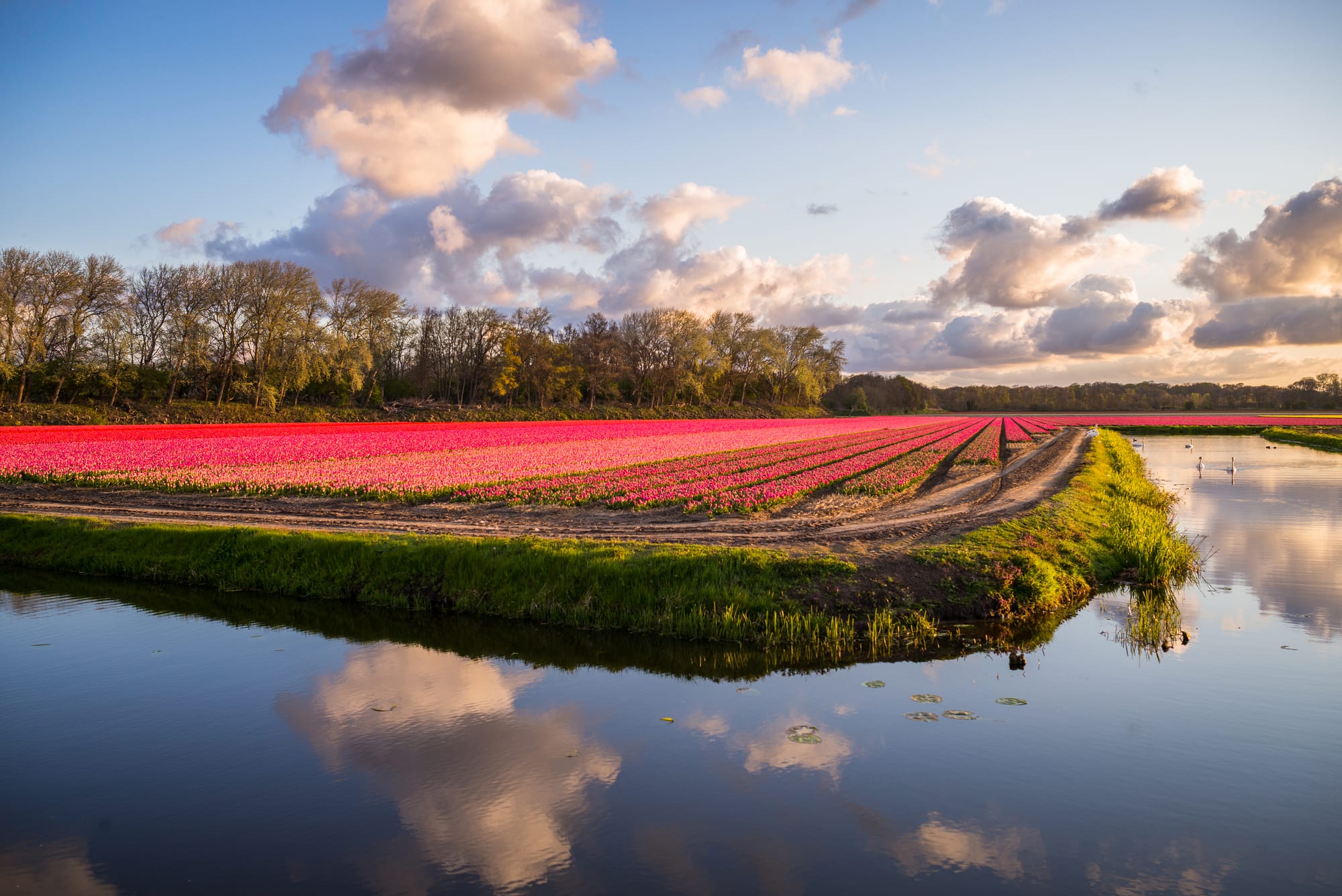
Long rows of bright pink tulips stretching towards a line of trees, beside a still channel of water that mirrors golden-lit clouds and a blue sky

Netherlands

A tulip field in full bloom in Holland, its rows of pink flowers running alongside a still waterway under low golden light. (rboed / Wikimedia Commons · CC BY 2.0)

A low-lying, densely populated country on the North Sea, much of it below sea level and defended by dykes and reclaimed from the water — a former global trading empire, and now a liberal, cycling, trade-based society at the heart of Europe.

Explore Netherlands

History

The Low Countries passed from Burgundy to Habsburg Spain, and in 1568 the northern provinces rose against Philip II in what became the Eighty Years' War, led by William of Orange. The result was the Dutch Republic, its independence recognised in 1648. The seventeenth century was the Golden Age: the Republic became the world's leading trading and financial power, its East and West India Companies built a colonial and commercial empire, and Rembrandt, Vermeer, and a generation of scientists and thinkers flourished in a tolerant, mercantile society — which was also deeply involved in the Atlantic slave trade, for which the state has recently apologised.

Decline followed in the eighteenth century, and French revolutionary armies overran the country before the Kingdom of the Netherlands was created in 1815 (with Belgium, which broke away in 1830). The Netherlands stayed neutral in the First World War but was invaded and occupied by Nazi Germany from 1940; three-quarters of Dutch Jews were murdered, and the winter of 1944–45 brought famine.

After the war came the loss of Indonesia, reconstruction, and membership of the new European and Atlantic institutions. The catastrophic North Sea flood of 1953 led to the Delta Works, the vast system of barriers and dams that, with the dykes and dunes, keeps a quarter of the country dry. From the 1960s a once compartmentalised society became one of the most secular and permissive in the world, and politics settled into fragmented, consensus-seeking coalitions — though a far-right party topped the 2023 election, and the coalition it joined collapsed in 2025.

  • The Netherlands: The Land Made by Water A low country drained and diked into existence — a republic of merchants that ran the 17th-century world economy, a colonial empire built on spices and slaves, occupation and flood, and a modern welfare state

Culture & Customs

The Dutch are known for directness — saying plainly what they think, and reading it as honesty rather than rudeness — and for a strong egalitarian streak captured in the saying "just act normal, that's crazy enough". Thrift, planning, and compromise run deep, a Calvinist inheritance that survives in secular form; the "polder model" of negotiating everything to consensus is a national habit.

The bicycle is central to life: there are more bikes than people, and adults ride in ordinary clothes, in all weather, for every kind of errand. The calendar's high points are Sinterklaas on 5 December, the main gift-giving occasion, and King's Day on 27 April, when the whole country dresses in orange for street parties and open-air flea markets.

Football — the "Total Football" of Cruyff and Ajax — speed skating, and field hockey are the sporting passions. Dutch art runs from the Golden Age masters through Van Gogh to Mondrian and modern design, and the cities are strongly multicultural, with Indonesian and Surinamese food long since part of the national diet.

Daily Life

The Netherlands is one of the most urbanised and densely populated countries in Europe, with around eight million people in the Randstad ring of Amsterdam, Rotterdam, The Hague, and Utrecht. A severe housing shortage — long social-housing waiting lists, unaffordable prices, students struggling to find rooms — is the dominant domestic worry, alongside immigration and a court-ordered squeeze on farm nitrogen emissions that set off large farmer protests.

Everyday life runs on the train and the bike, on agendas booked weeks ahead, and on a strong preference for work-life balance — the Netherlands has the highest rate of part-time work in the developed world. Rain and wind are constant companions in a flat, open landscape of polders, canals, dykes, and church spires.

The economy is highly developed and trade-based: the port of Rotterdam and Schiphol as European gateways, a farming and horticulture sector that makes this small country one of the world's biggest agricultural exporters, and high-tech industry led by the chip-equipment maker ASML.

Food

Dutch food is homely rather than celebrated. Lunch is typically bread — with cheese, or with chocolate sprinkles (hagelslag) — and the national cheeses, Gouda and Edam, are eaten young and aged. Raw herring, "Hollandse Nieuwe", is taken with chopped onion, held by the tail. Snack bars sell deep-fried bitterballen and kroketten, sometimes from a wall of coin-operated hatches.

Winter food is hearty: stamppot, mashed potato beaten with kale, sauerkraut, or endive and served with smoked sausage, and erwtensoep, a pea soup thick enough to stand a spoon in. Sweet options include poffertjes (little pancakes), thin stroopwafels filled with caramel syrup, and salty liquorice (drop), an acquired taste.

Indonesian and Surinamese cooking are fully naturalised — the rijsttafel, satay, roti — and the Netherlands invented jenever, the juniper spirit that became gin. Beer runs from the big brewers to a large craft scene, and coffee comes with a small biscuit on the saucer.

Attractions & Natural Wonders

Amsterdam's seventeenth-century canal ring, a World Heritage Site, is lined with gabled merchant houses and houseboats; the city holds the Rijksmuseum with Rembrandt's Night Watch, the Van Gogh Museum, the Anne Frank House, the Jordaan quarter, and Vondelpark. The Hague has the Binnenhof parliament, the Mauritshuis with Vermeer's Girl with a Pearl Earring, the Peace Palace, and the beach at Scheveningen, with Delft — Vermeer's town and the home of blue-and-white pottery — close by.

Rotterdam, rebuilt after wartime destruction, is a showcase of modern architecture — the Cube Houses, the Markthal, the Erasmus Bridge — while Utrecht has a compact medieval centre with canals at wharf level. Nearby are the 19 windmills of Kinderdijk, the working mills and green timber houses of the Zaanse Schans, and, in spring, the bulb fields and the Keukenhof garden.

Beyond the cities, Giethoorn is a village of canals instead of streets, the Hoge Veluwe National Park combines heath and forest with the Kröller-Müller Museum's Van Gogh collection, and the Wadden Sea — a World Heritage tidal wilderness — and the Frisian islands offer mudflat walks and seals. The Afsluitdijk and the Delta Works are monuments to the country's long argument with the sea.

Planning basics

Budget

The Netherlands is expensive, in line with northern Europe. Hostels and budget hotels are dear in Amsterdam; smaller cities such as Haarlem, Utrecht, or Rotterdam are cheaper bases with fast trains in. Supermarkets, bakeries, and snack bars keep food costs down.

Daily Budget Midrange
EUR 160–300 (three-star hotel, restaurants, museum entries, intercity trains)
Daily Budget Shoestring
EUR 70–110 (hostel, supermarket and snack-bar food, trains and a hire bike)

Stay outside Amsterdam and commute in by train, and book museum tickets — especially the Anne Frank House and Van Gogh Museum — well in advance.

Visa Requirements

The Netherlands is in the EU and the Schengen Area. Citizens of the EU, the UK, the US, Canada, Australia, New Zealand, Japan, and many other countries need no visa for stays of up to 90 days in any 180-day period.

Typical Stay
90 days in any 180-day period, visa-free, for most Western passports

Safety

The Netherlands is very safe, with low violent crime. Bicycle theft is rampant, and pickpocketing is common around Amsterdam Centraal, the Damrak, the red-light district, and on busy trams. Buying drugs from street dealers is dangerous — the product is often fake or adulterated. Organised-crime violence exists but does not target visitors.

Lock bikes with two good locks, keep bags zipped and in front in Amsterdam crowds, and only ever use licensed coffeeshops, not street sellers.

Climate

Temperate and maritime: mild, wet, windy, and changeable, with a lot of cloud. Summers are cool, occasionally reaching the low thirties in a heatwave; winters are mild with some frost and rare snow. Rain falls year-round rather than in a distinct season; spring is the driest and often the sunniest time.

Summer
June–August, 17–24°C
Winter
December–February, 1–7°C

Transportation

Schiphol is a major European hub. Trains (NS) are frequent and reach almost everywhere — Amsterdam to Rotterdam in about 40 minutes — and you tap in and out with a contactless bank card or an OV-chipkaart across trains, trams, buses, and metros. Cycling is a real transport mode, with segregated lanes and station bike hire everywhere.

Watch for cyclists at all times and never walk or stand in a red-asphalt bike lane; in cities, use the train and a bike rather than a car.

Best Time to Visit

April–May for the tulip fields and Keukenhof garden, King's Day, and mild, drier weather, and June–September for the warmest days, long light, and café terraces. Winter is dark and grey but the museums are quieter and the Amsterdam Light Festival runs from late November to January.

Events
King's Day (27 April); Keukenhof and the bulb season (mid-March–mid-May); Liberation Day (5 May); Carnival in the south (February)

Currency

The Netherlands uses the euro and is heavily cashless — many shops, supermarkets, and restaurants take cards only, and some refuse cash. Bring a Visa or Mastercard credit card, as machines geared to local debit cards sometimes reject foreign cards; Apple Pay and Google Pay are widely accepted.

Symbol
Currency Code
EUR — euro

Language

Dutch is the official language, with West Frisian co-official in the province of Friesland. English is spoken to a very high standard by most Dutch people — the country ranks near the top of global English-proficiency surveys — so visitors rarely need Dutch. German is also widely understood.

English
Near-universal and fluent
Official Language
Dutch