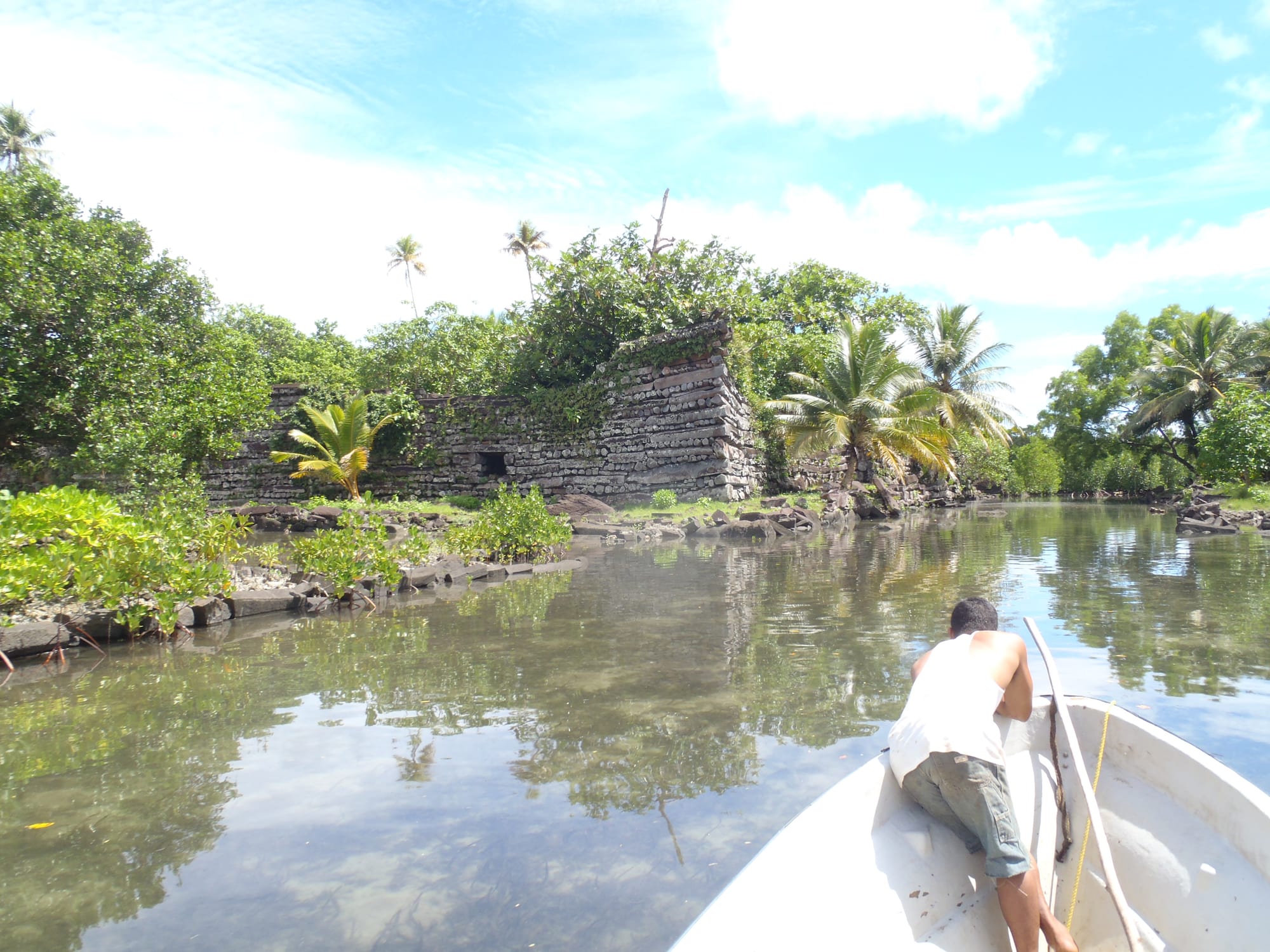
Walls of stacked black basalt logs rising from a still tidal channel among mangroves and palms

Federated States of Micronesia

Nan Madol off Pohnpei, a ceremonial city of some 90 artificial islets built from basalt columns between about 1200 and 1600. (Patrick Nunn / Wikimedia Commons · CC BY-SA 4.0)

A federation of four island states — Yap, Chuuk, Pohnpei, and Kosrae — spread across the western Pacific, holding the basalt city of Nan Madol, the wreck-filled Chuuk Lagoon, and Yap's living stone-money culture.

Explore Federated States of Micronesia

History

The Caroline Islands were settled more than three thousand years ago by seafaring peoples who spread across the western Pacific and became expert navigators. On Pohnpei, the Saudeleur dynasty built Nan Madol between roughly 1200 and 1600 — a complex of about ninety artificial islets of stacked basalt columns, laid out with canals, that served as a ceremonial and political capital. On Yap, a society developed around "stone money", great limestone discs quarried in Palau and carried home by canoe, still owned and exchanged today.

Spain claimed the Carolines, ruled them lightly, and sold them to Germany in 1899. Japan took the islands in the First World War and colonised them intensively under a League of Nations mandate. Chuuk Lagoon (then Truk) became Japan's main forward naval base in the central Pacific; a US air and sea attack in February 1944, sank around fifty ships and hundreds of aircraft there, leaving the wreck field that divers explore today.

After the war the islands were administered by the United States as part of the Trust Territory of the Pacific Islands. The Federated States of Micronesia adopted a constitution in 1979 and became a sovereign state in free association with the United States, effective in 1986, joining the United Nations in 1991. The Compact, renewed in 2023, provides US economic support and takes on the country's defence; FSM citizens can live and work in the United States without a visa.

  • Micronesia: The Federation of the Carolines Four island states — Yap of the stone money, Pohnpei of Nan Madol, Chuuk of the great lagoon, and Kosrae — ruled in turn by Spain, Germany, Japan and the US, and now a nation in free association with Washington

Culture & Customs

Each of the four states has its own language, chiefs, and traditions, and Yap is the most traditional of all: a place of men's houses, dance, and a historical caste system, where betel-nut chewing is near-universal and stone money still settles serious obligations. Pohnpei has its own strong chiefly system and title feasts, and the nightly drinking of sakau, a local kava, in community meeting houses.

Clan and lineage, often traced through the mother, govern land, reef rights, and status across the country. Respect behaviours matter: on Pohnpei people lower their heads and bodies when passing elders or chiefs, and across the islands women's thighs are kept covered, so swimming is done in shorts or a wraparound cloth.

Christianity, both Catholic and Protestant, is deeply established and sits over these customs rather than replacing them. The outer islands keep the old skills most fully, and the atoll of Satawal produced Mau Piailug, the master navigator who helped revive traditional wayfinding across the Pacific.

Daily Life

The population of about 100,000 is spread thinly across four widely separated states, each with its own centre — Kolonia on Pohnpei, Weno on Chuuk, Colonia on Yap, Tofol on Kosrae — and its own character. Getting between them means taking the one airline route, so most people rarely do.

Life on the high islands runs on subsistence gardening and fishing: taro, breadfruit, yams, bananas, and coconut from the land; reef and deep-water fish from the sea; pigs raised for feasts. Cash comes mainly from government jobs — the largest employer — from fishing-licence fees paid by foreign tuna fleets, and from relatives working in Guam, Hawaii, and the US mainland.

As across the Pacific, imported rice, ramen, and tinned meat have entered the everyday diet and brought rising rates of diabetes. The outer atolls remain very traditional and remote, reached only by infrequent supply ships, and are among the places most exposed to rising seas.

Food

The base of the diet is root crops and breadfruit — taro of several kinds, yam, cassava — with reef fish, tuna, octopus, and shellfish, and coconut used at every stage from drinking water to cream. Pigs, chickens, and, for the largest occasions, dogs are cooked in earth ovens for feasts, along with mounds of taro and whole fish.

Land crabs and mangrove crabs are delicacies, and Pohnpei is known for its black pepper, grown as a cash crop and used locally. Everyday eating in the towns now leans on white rice, instant noodles, tinned fish and corned beef, and fried chicken, with a few small restaurants serving American, Filipino, and Japanese dishes.

Betel nut, chewed with lime and pepper leaf, is the social habit of Yap, while on Pohnpei the evening centres on sakau, pounded from pepper-plant roots and drunk from a coconut shell.

Attractions & Natural Wonders

Nan Madol, off Pohnpei's southeast coast, is the country's cultural showpiece: a ruined city of basalt-log walls and platforms rising straight from the tidal flats, reached by boat or, at low tide, on foot with a guide. Pohnpei also has Sokehs Rock towering over its lagoon, jungle waterfalls such as Kepirohi, and the reef-pass surf break known to travelling surfers as P-Pass.

Chuuk Lagoon is one of the world's great wreck-diving sites — dozens of Japanese ships and aircraft sunk in 1944, now coral-covered, with holds still holding cargo. Yap offers reliable encounters with manta rays in its channels alongside the most intact traditional culture in the country, including village stone-money "banks" and dance.

Kosrae, the "Sleeping Lady", is the least developed of the four, with pristine hard-coral reefs, the mangrove channels of Utwe, rainforest hiking, and the Lelu ruins, a smaller stone city built around the same time as Nan Madol.

  • Micronesia: Five Attractions and Natural Wonders A ruined stone city built on artificial islets in a lagoon, an entire sunken WWII fleet you can dive, and giant stone discs that once served as money — four states scattered across the western Pacific

Planning basics

Budget

Micronesia is not a budget destination, because nearly everything is imported and moving between the states means flying. Each state capital has a few hotels and dive lodges; outer islands have only very basic homestay-style lodging. The US dollar is used throughout.

Daily Budget Midrange
USD 160–350 (dive lodge with meals, boat dives, inter-island flights)
Daily Budget Shoestring
USD 70–120 (guesthouse, local stores and small diners, shared taxis)

Diving packages, especially the Chuuk Lagoon wrecks and Yap manta trips, are the main cost and should be booked ahead.

Visa Requirements

Under the Compact of Free Association, US citizens may enter, live, and work without a visa. Most other nationalities are admitted visa-free for about 30 days on arrival with a passport valid for the stay and an onward ticket.

Typical Validity
30 days visa-free on entry for most non-US visitors, extendable locally

Each of the four states also has its own entry formalities for visitors arriving from elsewhere in the country; carry your passport when island-hopping.

Safety

Serious crime is uncommon and visitors are generally safe, though Weno in Chuuk has a rougher reputation and alcohol-related trouble occurs. The real concerns are practical: very limited medical care, with serious cases flown to Guam or Hawaii; poor roads; the remoteness of dive sites; and typhoons.

Health
No reliable recompression chamber on all islands — dive conservatively; bring your own medication

Much land and reef is owned by clans or families; ask permission before entering, swimming off, or photographing a site.

Climate

Tropical, hot, and humid all year, with rain in every month and some of the heaviest rainfall on Earth in the Pohnpei interior. Kosrae and Pohnpei are the wettest; Yap and Chuuk are a little drier and carry the main typhoon risk, mostly in the second half of the year.

Rainfall
Very high, especially on Pohnpei and Kosrae; no true dry season
Temperature
27–31°C year-round

Transportation

United Airlines' "Island Hopper" is the lifeline, calling at Chuuk, Pohnpei, and Kosrae a few times a week between Guam and Honolulu, with a separate service to Yap. There are no scheduled ferries for visitors; government field-trip ships serve the outer islands infrequently. On the main islands, shared taxis and rough roads are the norm.

Build wide buffers around Island Hopper connections and outer-island boats; weather and mechanical delays are common.

Best Time to Visit

December to April is generally the drier, calmer window. Chuuk's wreck diving is good most of the year; Yap's manta ray season runs roughly December to April; and Pohnpei's world-class surf breaks work best from November to March. Yap Day, the main cultural festival, falls in early March.

Events
Yap Day (early March); state constitution days; Christian holidays observed throughout

Currency

The Federated States of Micronesia uses the US dollar. It is a cash economy outside a handful of hotels; ATMs exist only in the state centres (Kolonia, Weno, and the like) and can run out of notes.

Cards
Accepted at some hotels and dive operators only
Symbol
$
Currency Code
USD — US dollar

Language

English is the official language and the common tongue between the states. Each state has its own language — Yapese, Chuukese, Pohnpeian, Kosraean — and there are several distinct outer-island languages, including two Polynesian ones on the atolls south of Pohnpei.

State Languages
Yapese, Chuukese, Pohnpeian, Kosraean, plus outer-island languages
Official Language
English