💰 Budget
Mauritania is inexpensive for food and local transport but costs add up fast once a 4x4, driver, and guide are involved, which is how most desert travel is done. Nouakchott and Atar have simple hotels and auberges; elsewhere accommodation is basic. It is largely a cash economy.
- Daily Budget Midrange
- USD 80–200 (hotel, a hired 4x4 with driver for the Adrar, guided desert nights)
- Daily Budget Shoestring
- USD 25–45 (auberge, local food, bush taxis)
Carry euros in cash to change; ATMs are unreliable outside Nouakchott and cards are rarely accepted.
✈️ Visa Requirements
Most nationalities need a visa. A visa on arrival is issued at Nouakchott's international airport and at some land borders for many travellers, paid in euros in cash; an e-visa system also operates. Rules and which borders issue visas change, so confirm shortly before travel.
- Typical Validity
- 30 days, single entry, extendable in Nouakchott
Bring passport photos and the exact fee in cash euros for a visa on arrival.
🛡️ Safety
Nouakchott, Nouadhibou, and the Adrar tourist circuit around Atar, Chinguetti, and Ouadane are generally calm, and Mauritania has not seen a jihadist attack on its soil since 2011. However, most governments advise against travel to the border regions with Mali and Algeria and much of the east and south-east, citing terrorism and kidnapping, and against unescorted desert travel.
- Landmines
- Uncleared mines remain near the Western Sahara border in the north
Travel the Adrar with a registered local operator, keep to established routes, and read your government's advisory in full before going.
🌦️ Climate
Saharan across most of the country — very hot by day, cold at night in winter, and extremely dry, with sandstorms (the irifi) in spring. The Atlantic coast is cooler and often foggy, cooled by the Canary Current. The far south, along the Senegal River, gets a short rainy season from July to September.
- Coast
- Milder, 20–30°C, humid and hazy
- Interior
- 40–45°C common April–September; cool winter nights
🚆 Transportation
Nouakchott has the main international airport, with seasonal charters to Atar. Paved highways link Nouakchott with Nouadhibou, Rosso on the Senegal border, Atar, and Néma in the east. Beyond them, travel is by bush taxi, Mercedes truck, or hired 4x4. A passenger car runs on the iron-ore railway between Nouadhibou and Zouérat.
- Iron Ore Train
- Travellers can ride free on top of the ore wagons Zouérat–Nouadhibou, a rough 12–20 hour trip, or in the single passenger carriage
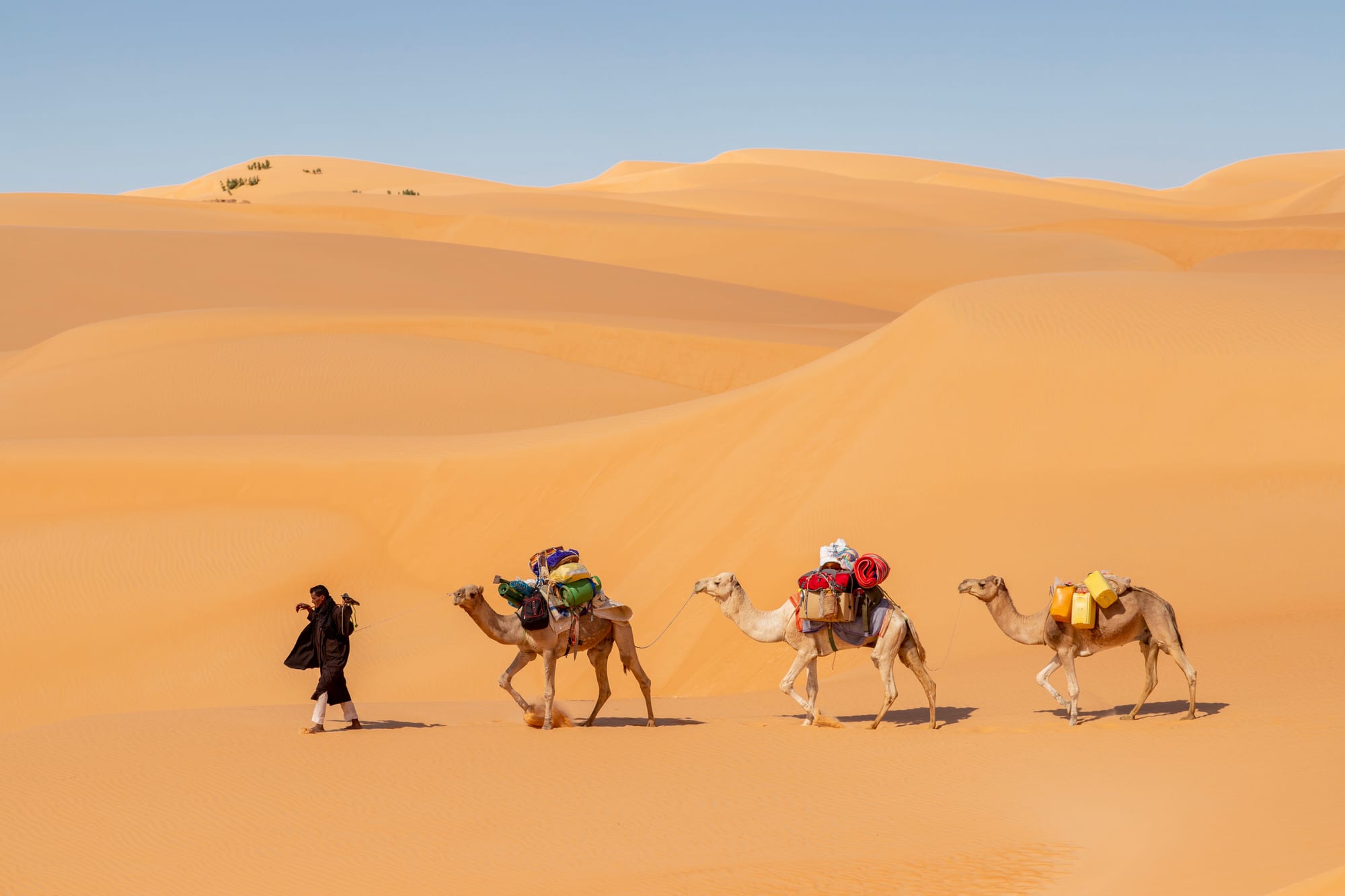
Desert routes need a 4x4, a local driver, and a satellite phone; sand can close tracks after wind.
📅 Best Time to Visit
November to February is the season for the Adrar and the desert — warm days, cold nights, and the winter charter flights to Atar. The date harvest festival, the Guétna, fills the oases in July and August despite the heat. Deep summer inland is punishing.
- Events
- Guétna date harvest (July–August) in the Adrar and Tagant oases
💱 Currency
The currency is the Mauritanian ouguiya (MRU), one of the world's few non-decimal currencies, notionally divided into five khoums. It was redenominated in 2018 (old notes were exchanged at ten to one). This is a cash economy; cards work only in a few Nouakchott hotels.
- Cards
- Very limited; carry cash
- Symbol
- UM
- Currency Code
- MRU — ouguiya
💬 Language
Arabic is the official language; the everyday Arabic of the Moors is Hassaniya. Pulaar, Soninke, and Wolof are recognised national languages, spoken by Afro-Mauritanian communities in the south. French remains widely used in business, administration, and education.
- French
- Common in cities and among educated Mauritanians
- Official Language
- Arabic (Hassaniya in daily speech)
- National Languages
- Pulaar, Soninke, Wolof